Category: Crochet Baskets

  • Warm Crochet Ideas for Rainy Days

    Warm Crochet Ideas for Rainy Days

    Woman relaxing by rainy window with fairy lights, cozy blanket, and blue pillows

    The sky is leaking. Your hook is waiting. This is not a coincidence.

    Here is the first lie we tell ourselves about rainy days: that they ruin plans.
    They don’t. They simply replace one kind of plan with another. The picnic becomes impossible, yes. The jog around the park? Postponed. But in exchange, the rain offers you something no sunny afternoon ever could: permission to stop moving.
    And here is the second lie: that crochet is just a hobby. It’s not. On a rainy day, crochet becomes a negotiation with time. The rain says: you are not going anywhere. The hook replies: fine. I will build a world where going somewhere was never the point.
    Below are four warm crochet projects perfect for stormy afternoons — each with a quick practical card so you can start immediately, even if you’ve never finished a granny square in your life.

    1. The Window Blanket That Eats the Gray

    Chunky knit blanket draped over armchair by rain-covered window with coffee cup
    We think we watch the rain. We don’t. The rain watches us.
    It presses its face against the glass — a billion tiny spectators — while you sit in the armchair with a crochet blanket growing across your lap. And here is where logic breaks: the blanket is not keeping you warm from the cold outside. It is keeping the outside from getting in. Each stitch is a tiny wall. A row of half-double crochet is a fortress. By the time you finish the third repeat of the pattern, the rain has stopped being weather and become ambience.
    The mega-logic of the rainy-day blanket is backwards. You aren’t making it to use on rainy days. You are making it because it’s raining. The drops on the window set the rhythm. The gray light removes the pressure of “productivity.” The blanket absorbs the rain’s grayness and converts it into texture.
    🧶 RAINY-DAY BLANKET — QUICK START
    Table

    Detail Recommendation
    Yarn weight Bulky #5 (or Super Bulky #6 for speed)
    Hook 8–10 mm
    Best stitch Half double crochet (HDC) — fast, warm, squishy
    Skill level Beginner
    Time 3–5 evenings
    Best colors Oatmeal, charcoal, mushroom, wet bark brown, fog gray
    Pro tip: Work in simple rows of HDC back and forth. No pattern needed. The yarn does the visual work.

    2. The Cup Cozy That Lies to Your Hands

    Handmade crochet cup cozy in blue with wooden button on white mug
    There is a strange loneliness in holding a ceramic mug. It is smooth, hard, and honest about what it is: a vessel. It does not pretend to care about your fingers.
    A crochet cup cozy is a conspiracy of comfort. It wraps the mug in wool and whispers to your palms: this is alive. This is warm because it loves you. It isn’t, of course. It’s just cotton and acrylic. But on a rainy day, we need the lie.
    The cozy turns your coffee into a pet. It gives the tea personality. And when the rain drums against the roof in that particular frequency that makes you remember childhood, the mug — now wearing its little wool sweater — becomes the only handhold you need.
    The surprise? You don’t even need a pattern. A rectangle. A button. Thirty minutes while the storm builds. That is all it takes to transform a disposable moment into something that feels crafted by intention.
    🧶 CROCHET CUP COZY — QUICK START
    Table

    Detail Recommendation
    Yarn Worsted cotton or acrylic, small amount
    Hook 4–5 mm
    Best stitch Single crochet with a ribbed effect (back loop only)
    Skill level Beginner
    Time 30–45 minutes
    Best colors Denim blue, cream, mustard, dusty rose
    Pro tip: Add a wooden button for closure. It elevates a 30-minute project into a gift-worthy object.

    3. Socks That Replace the Floor

    Cozy crochet slipper socks in neutral stripes on green ottoman
    Here is a question nobody asks: why do we accept that floors must be cold?
    We install heating, rugs, slippers — all apologies for the floor’s fundamental betrayal. But crochet slipper socks don’t apologize. They negotiate. They say: the floor is no longer your enemy. It is simply the bottom of your sock.
    The logic is almost offensive in its simplicity. You crochet a tube. You close the toe. You add a cuff thick enough to shame a winter boot. And suddenly, the boundary between you and the ground dissolves. You are not walking on the floor. You are walking through it, insulated by wool, buffered by stitches, untouchable.
    On rainy days, these socks become essential architecture. The kitchen tile? Conquered. The hardwood hallway? Irrelevant. You glide from window to kettle to couch with the arrogant warmth of someone who has literally redefined ground contact.
    🧶 SLIPPER SOCKS — QUICK START
    Table

    Detail Recommendation
    Yarn Bulky wool or wool-blend, 1–2 skeins
    Hook 5.5–6.5 mm
    Best stitch Single crochet in rounds for the foot, ribbed cuff
    Skill level Easy / Advanced Beginner
    Time 2–3 hours per pair
    Best colors Striped neutrals, oatmeal-to-charcoal ombré, forest green
    Pro tip: Work top-down starting at the cuff. No heel shaping needed — just a tube with a closed toe. Simplicity wins.

    4. The One-Skein Rebellion

    Crochet Slipper Socks Pattern: Cozy 1 Skein Project
    The cruelest thing about rainy days is that they end. The sun returns, the puddles evaporate, and the world demands you be productive again. This is why the best rainy-day crochet projects are small enough to finish before the storm passes.
    One skein. That is all you get. One ball of yarn, one afternoon of gray light, one complete transformation from “I should do something” to “I made something.”
    These projects don’t ask for commitment. They ask for presence. And when the last stitch is fastened off and the rain is still falling? That is the victory. You have outlasted the weather’s patience.
    🧶 ONE-SKEIN PROJECTS — QUICK START
    Table

    Project Yarn Hook Time Skill
    Headband / Ear warmer Worsted, 1 skein 5 mm 45 min Beginner
    Fingerless gloves DK or Worsted, 1 skein 4 mm 1–2 hrs Easy
    Mini basket T-shirt yarn, 1 skein 6 mm 1 hr Beginner
    Simple scarf Bulky, 1 skein 8 mm 2–3 hrs Beginner
    Pro tip: Choose a single variegated skein. The color changes do the design work — you just keep stitching.

    The Invisible Thread

    Here is the final surprise, the logic that ties the blanket, the cozy, the socks, and the single skein together:
    Rainy days don’t steal your time. They reveal it. The hours were always there, hidden behind errands and sunshine and the illusion that you must always be going somewhere. Crochet simply catches those hours and gives them a shape.
    So the next time the sky opens up, don’t reach for an umbrella. Reach for a hook. The rain is not an interruption. It is a collaboration.
  • Cottagecore Crochet Ideas Everyone Loves

    Cottagecore Crochet Ideas Everyone Loves


    Fall into Autumn Crochet Blanket Pattern - PDF Digital Download | Ophelia  Talks Crochet
    Where yarn meets nostalgia, and your living room becomes a hug.
    There is a peculiar magic in the click of a crochet hook. It sounds like rain on a tin roof. It sounds like your grandmother’s clock ticking in a hallway you haven’t visited since childhood. And somehow — somehow — that rhythmic click has become the unofficial anthem of an entire generation trying to slow down.
    Welcome to the paradox of cottagecore crochet: we live in an age of instant everything, yet millions of us are deliberately choosing the slowest possible way to make a blanket. Why? Because somewhere between the granny square and the pumpkin coaster, we discovered that coziness is not a trend. It’s a rebellion.
    Below are 12 cottagecore crochet ideas that transform your home into a handmade sanctuary — complete with practical how-to details and Pinterest-worthy styling tips you can save right now.

    1. The Blanket That Remembers the Trees

    Here is the first surprise: the most beloved cottagecore crochet pieces aren’t made for your home. They’re made from it. That autumn blanket draped across the sofa? It carries the color of the maple tree outside your window. The mustard yellow mirrors the last stubborn leaf. The burgundy echoes the cranberry sauce you burned last Thanksgiving.
    The logic is almost backwards. Instead of buying decor to match your life, you crochet your life into the decor. Every stitch holds a memory of the season you made it in. That is why a handmade throw feels warmer than a store-bought one — it literally contains more time.
    And here is the secret nobody tells you: you don’t need to be an expert. The most charming cottagecore blankets are slightly imperfect. One square a little tighter than the rest. A border that waves instead of lying flat. Those “flaws” are proof of humanity in a world of machine precision.
    📌 TRY THIS PROJECT
    Pair your finished blanket with linen cushions in oatmeal and rust tones. Add a sprig of dried eucalyptus on the armrest — instant Pinterest save.
    🧶 HOW TO MAKE IT
    • Yarn: Chunky wool or wool-blend acrylic, 6-8 skeins in autumn tones
    • Hook: 8 mm
    • Level: Intermediate
    • Time: 20-30 hours (spread across cozy evenings)
    • Difficulty: Medium — basic stitches, but size requires patience

    2. The Pumpkins That Never Rot

    Halloween, Crochet, Pumpkins, Fall Decor, Handmade, Pumpkin Decor, Unique  Gift, Witchy Cottage Core, Birthday, Amigurumi Plush Squish Plush
    Real pumpkins are beautiful for exactly eleven days. Then they sag. They weep. They become a science experiment on your porch that you avoid eye contact with.
    Crochet pumpkins, however, are eternal.
    But the real genius of the cottagecore crochet pumpkin isn’t durability — it’s permission. Permission to make something utterly useless in the most practical sense, and absolutely essential in every other. A crochet pumpkin doesn’t feed you. It doesn’t store your keys. It simply exists as a soft, smiling reminder that autumn is a feeling, not a date on the calendar.
    Scatter them on a mantel. Stack them in a ceramic bowl. Nestle one beside your coffee mug like a tiny, rotund guardian of your morning ritual. The smaller they are, the more powerful their charm.
    📌 SAVE THIS COMBO
    Stack three pumpkins (small, medium, large) on a wooden tray with fairy lights and cinnamon sticks. Photograph from above for maximum saves.
    🧶 HOW TO MAKE IT
    • Yarn: Worsted weight in orange, cream, and mustard
    • Hook: 4 mm
    • Level: Beginner
    • Time: 1-2 hours per pumpkin
    • Difficulty: Easy — single crochet in the round, stuff and seam

    3. Mushroom Pillows That Belong in a Fairy Tale

    Crochet mushroom basket, handmade in Europe
    If pumpkins are the ambassadors of autumn, mushroom pillows are the secret agents. They arrive quietly — a red-capped toadstool here, a creamy bolete there — and suddenly your couch looks like a forest floor from a storybook.
    The psychology is fascinating: humans are wired to notice mushroom shapes. They signal “safe place” to our ancient brains. A mushroom pillow doesn’t just decorate; it guards. It says: this spot is protected from adult responsibilities.
    Make them in varying sizes. Cluster them under a side table. Watch guests do a double-take, then smile.
    📌 QUICK IDEA
    Place a mushroom pillow next to a stack of old books and a ceramic mug. Tag it #cottagecore — the algorithm loves whimsy.
    🧶 HOW TO MAKE IT
    • Yarn: Bulky weight in red, cream, and brown
    • Hook: 6 mm
    • Level: Beginner
    • Time: 3-4 hours per mushroom
    • Difficulty: Easy — simple shaping, no complex colorwork

    4. The Market Bag That Replaces Plastic

    Free crochet pattern - DIY farmers market bag
    Cottagecore isn’t just about staying home. It’s about how you move through the world. And nothing says “I live intentionally” like arriving at the farmer’s market with a bag you made yourself.
    The market bag is the ultimate flex disguised as practicality. It stretches to hold three loaves of sourdough, a bunch of sunflowers, and that overpriced organic honey you pretend you buy every week. The mesh pattern lets the produce breathe. The straps don’t dig into your shoulder. And when someone asks, “Where did you get that?” you get to say four magical words: “I made it myself.”
    📌 TRY THIS PROJECT
    Crochet your bag in natural cotton, then add a leather tag with your initials. Instant heirloom.
    🧶 HOW TO MAKE IT
    • Yarn: Cotton DK or light worsted, 3-4 skeins
    • Hook: 4 mm
    • Level: Beginner
    • Time: 5-6 hours
    • Difficulty: Easy — mesh stitch repeats, sturdy base

    5. The Tea Cozy That Slows Time

    Bobble Tea Cosy by Nicki Trench
    There is a forgotten ritual in the act of brewing tea. The kettle whistles. The pot warms. You wait. And in that waiting, the world slows down just enough for you to catch your breath.
    A crochet tea cozy is a time machine. It wraps your teapot in a woolly hug, keeping the second cup as hot as the first. But more than that, it announces to everyone in the room: we are not rushing today. The bobbles, the stripes, the little pom-pom on top — they all say the same thing. This moment matters.
    📌 SAVE THIS COMBO
    Style your tea cozy with mismatched vintage teacups and a plate of scones. Natural light from a window is mandatory.
    🧶 HOW TO MAKE IT
    • Yarn: Worsted weight wool or acrylic, 2-3 colors
    • Hook: 5 mm
    • Level: Beginner
    • Time: 2-3 hours
    • Difficulty: Easy — work in rounds, add bobbles for texture

    6. Plant Hangers From the Ceiling

    Crochet Plant Hanger - 3 Sizes - A Crocheted Simplicity
    Here is a geometry lesson nobody asked for: vertical space is the most underused real estate in any room. We fill our floors with furniture and our walls with shelves, but the ceiling? We leave it empty like a forgotten sky.
    Crochet plant hangers fix this. They drop down like green chandeliers, turning your pothos into a living mobile. The best part: you don’t need a single nail in the wall. A ceiling hook, a wooden ring, and some sturdy cotton cord are all it takes to float a garden above your coffee table.
    📌 QUICK IDEA
    Hang three plant hangers at different heights in a corner. Use white, sage, and terracotta yarn for a gradient effect.
    🧶 HOW TO MAKE IT
    • Yarn: Cotton macrame cord or bulky cotton
    • Hook: 5 mm
    • Level: Beginner
    • Time: 1-2 hours per hanger
    • Difficulty: Easy — chain and double crochet, wooden ring optional

    7. The Room That Breathes With You

    Cottagecore, But Make It Modern – Inside Dusk's Dreamy New Autumn/Winter  Homeware Collection
    Now, let’s talk about the alchemy of placement. Cottagecore isn’t about owning things. It’s about arranging things with intention.
    Notice how the striped armchair in the corner doesn’t fight the throw blanket draped across it — they negotiate. The blanket softens the chair’s geometry. The chair gives the blanket a purpose beyond “thing that lives in a basket.” Together, they create a third thing: a spot. A territory of comfort so potent that the cat has already claimed it.
    The candle on the floor isn’t careless placement. It’s a declaration that light belongs at ankle-level too. The mug on the book? That’s not clutter. That’s a pause button made visible.
    📌 SAVE THIS COMBO
    Layer a crochet throw over a striped armchair, add a wooden tray with a lit candle, and place sheepskin slippers nearby. The “I just stepped out” vibe is pure cottagecore gold.

    8. The Cup Cozy That Travels

    15 Must-Try Fall Crochet Cup Cozy Patterns for Warm Beverages - I Can  Crochet That
    We think of crochet as domestic — something that stays home. But cottagecore has a rebellious streak, and it shows up in the smallest pieces.
    The cup cozy is a revolution disguised as a sleeve. You carry it to the coffee shop. The barista notices. The person in line behind you leans in. “Did you make that?” Suddenly, you’re not just ordering a latte. You’re an ambassador for slowness in a paper-cup world. Your crochet cozy is a tiny, portable manifesto that says: I choose warmth. I choose texture. I choose to wrap even my disposable moments in something handmade.
    📌 TRY THIS PROJECT
    Crochet a cozy in autumn colors with a wooden button closure. Add a tiny felt leaf for extra cottagecore points.
    🧶 HOW TO MAKE IT
    • Yarn: Worsted weight, small amount
    • Hook: 4 mm
    • Level: Beginner
    • Time: 30 minutes
    • Difficulty: Very Easy — rectangle seamed, buttonhole added

    9. Crochet Baskets That Hold Everything

    Handmade Crochet Basket of Mushrooms Cottagecore Soft Plush Kids Room Decor
    The basket is the unsung hero of cottagecore. It doesn’t ask for attention. It simply sits there, holding your yarn stash, your remote controls, or that collection of dried flowers you keep meaning to arrange.
    But a crochet basket is different from a wicker one. It has give. It softens the edges of a room. And when you make it from t-shirt yarn or bulky cotton, it stands up on its own — a sturdy, beautiful contradiction of flexible strength.
    📌 QUICK IDEA
    Fill a crochet basket with rolled hand towels in the bathroom, or with pinecones and fairy lights on the mantel.
    🧶 HOW TO MAKE IT
    • Yarn: T-shirt yarn or bulky cotton
    • Hook: 8 mm
    • Level: Beginner
    • Time: 2-3 hours
    • Difficulty: Easy — spiral single crochet, no joining

    10. Wall Hangings & Lace Curtains

    Not every cottagecore statement needs to sit on a shelf. Some need to float.
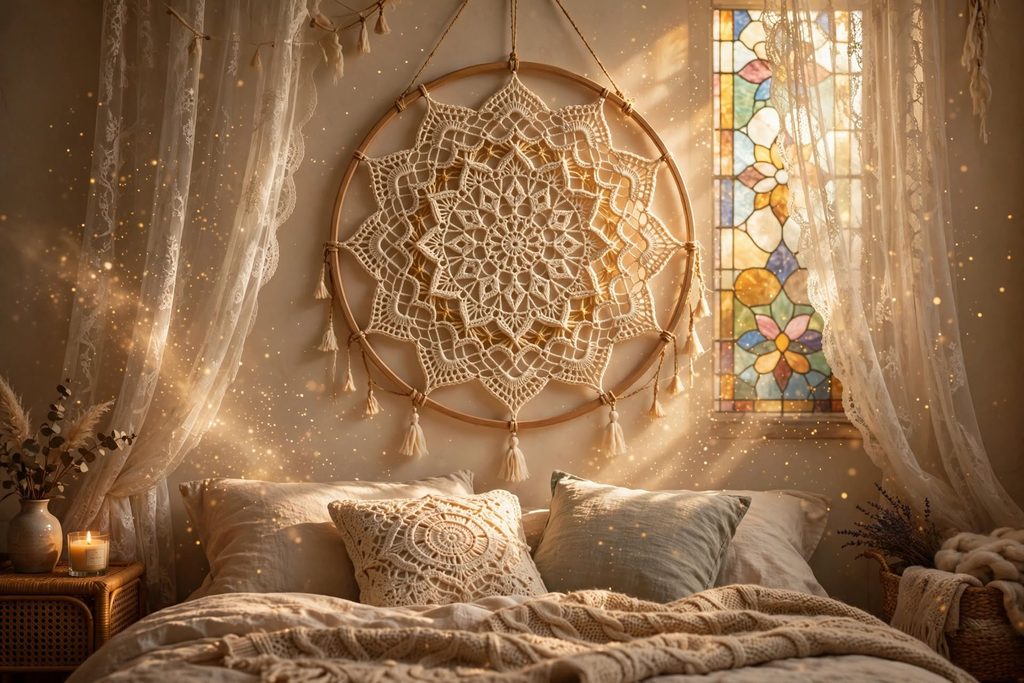
    A crochet wall hanging turns an empty wall into a window to another world. Worked in mandala patterns or simple geometric shapes, it catches the light like stained glass made of wool. And lace curtains? They are the original cottagecore filter — turning harsh afternoon sun into something golden and gentle, something that makes dust motes look like magic.
    📌 SAVE THIS COMBO
    Hang a circular crochet mandala in a wooden hoop above your bed. Pair with sheer lace curtains that touch the floor.
    🧶 HOW TO MAKE IT (Wall Hanging)
    • Yarn: Various weights in coordinating tones
    • Hook: Varies by pattern
    • Level: Intermediate
    • Time: 4-6 hours
    • Difficulty: Medium — pattern reading required

    11. Chair Cushions & Wildflower Table Runners

    The chair cushion is where cottagecore meets ergonomics. That wooden dining chair you found at a flea market? It looks beautiful, but after twenty minutes your spine files a complaint. A thick, squishy crochet cushion solves this without ruining the aesthetic.
    And the wildflower table runner? It’s a meadow that never wilts. Worked in soft greens and scattered with embroidered daisies, it turns every meal into a picnic — even if you’re just eating toast at 3 PM.
    📌 TRY THIS PROJECT
    Make chair cushions in natural cotton with tie strings. For the runner, use granny squares in green and cream, joined like a patchwork field.
    🧶 HOW TO MAKE IT (Chair Cushion)
    • Yarn: Bulky cotton, 3-4 skeins
    • Hook: 6 mm
    • Level: Intermediate
    • Time: 6-8 hours per cushion
    • Difficulty: Medium — shaping and stuffing required

    12. Lavender Sachets That Dream for You

    The smallest idea on this list might be the most powerful. A crochet lavender sachet fits in your palm. It lives in your drawer, under your pillow, or tucked into the pocket of a winter coat you won’t wear for months.
    But when you find it — months later, on the first cold day — the scent hits you like a memory you didn’t know you had. That’s the cottagecore time machine at its finest: an object so small it travels with you, so fragrant it bends time.
    📌 QUICK IDEA
    Crochet a tiny sachet in cream cotton, fill with dried lavender, and tie with raw silk ribbon. Stack three in a ceramic dish on your nightstand.
    🧶 HOW TO MAKE IT
    • Yarn: Cotton fingering or sport weight
    • Hook: 3 mm
    • Level: Beginner
    • Time: 45 minutes
    • Difficulty: Very Easy — small pouch, drawstring top

    The Invisible Thread

    Here is the final surprise, the one that ties every granny square and pumpkin and cup sleeve together:
    Cottagecore crochet isn’t about the objects. It’s about the spaces between them. The pause after a row is finished. The satisfaction of a color change. The way a finished piece holds the shape of the hands that made it long after those hands have moved on to the next project.
    We love these ideas not because they’re beautiful — though they are — but because they remind us that we are still capable of making things that outlast our attention spans. In a world designed for scrolling, crochet asks you to sit still and create something that cannot be swiped away.
    So pick up that hook. Choose a color that makes your heart feel like October. And remember: the blanket isn’t just for warmth. It’s for witnessing the season.
  • Crochet Wall Hanging Pattern: How to Make a Boho Mandala Tapestry That Transforms Any Room

    Crochet Wall Hanging Pattern: How to Make a Boho Mandala Tapestry That Transforms Any Room

     Free Easy Caron Boho Crochet Wall Hanging Pattern | YarnspirationsI once spent three weeks crocheting what I believed would be the centerpiece of my living room. A mandala. Dozens of rounds. Hundreds of color changes. When I finally blocked it and held it up, it was beautiful — and completely invisible against my white wall. It looked like a colorful pancake that had given up on gravity. I pinned it, framed it, even tried leaning it on a shelf. Nothing worked. It was not a wall hanging. It was a very patient doily with delusions of grandeur.

    That mandala taught me the difference between a crochet circle and a crochet wall hanging: the dowel, the fringe, and the intention.
    Before we begin, let me save you from the same mistake. Most crochet mandala patterns stop at the last round, as if the piece is finished simply because the yarn ran out. But a mandala without a hanging system is a coaster for a giant. Below is the complete method — from the center ring to the final fringe — for a boho wall tapestry that actually belongs on a wall.

    3 Mistakes That Make Crochet Wall Hangings Look Like Doilies

    The Center Is Too Heavy

    A mandala that grows outward evenly becomes denser and heavier at the edges. When you hang it, the center sags like a tired trampoline. The shape that was perfect on the table becomes an oval on the wall.
    The fix: Work the final three rounds in a lighter stitch — chain spaces, picots, or mesh — so the outer edge is airier than the center. This redistributes visual weight and keeps the piece flat against the wall.

    There Is No Hanging Mechanism

    I have seen people tape their crochet mandalas to the wall. I have seen them use thumbtacks through the yarn. I have seen them lean them against bookshelves and pretend it was a stylistic choice. A wall hanging needs a structure that holds it vertically.
    The fix: Mount the mandala on a wooden dowel or driftwood branch. Crochet a hanging loop at the top during the final round, or sew a fabric sleeve to the back. The dowel does the structural work so the yarn does not have to.

    The Fringe Is an Afterthought

    A mandala without fringe is a plate. A mandala with fringe is a tapestry. The fringe adds movement, length, and gravity. It turns a decorative circle into a statement piece.
    The fix: Cut fringe twice as long as you think you need. Short fringe looks apologetic. Long fringe looks intentional.

    Materials You Need

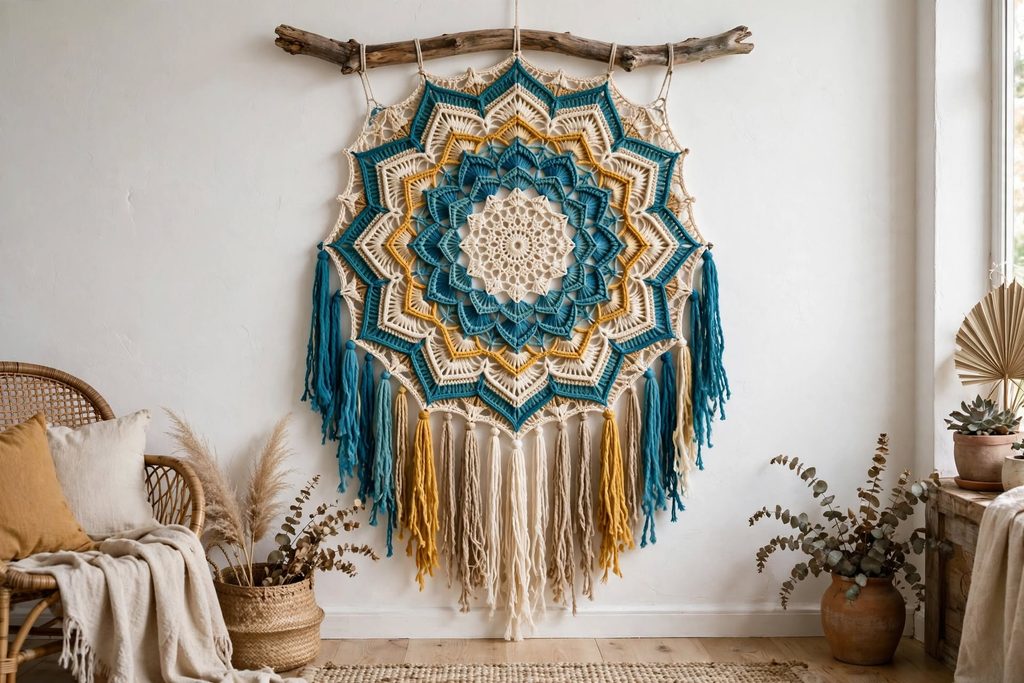
    • Yarn: Cotton or cotton-blend DK or worsted weight, approximately 200 to 300 meters total in 3 to 4 colors. For the ocean palette in the photograph, use teal, mustard, cream, and sand.
    • Hook: 4 mm (US G) or 4.5 mm (US 7).
    • Wooden dowel or driftwood: 30 to 40 cm long, 1.5 to 2 cm in diameter.
    • Stitch marker: Essential for tracking rounds.
    • Tapestry needle: For weaving in ends and attaching fringe.
    • Scissors: Sharp enough to cut clean fringe.
    Gauge: Not critical for wall hangings, but your stitches should be tight enough that the mandala holds its shape. If the fabric is too loose, the piece will droop.

    The Mandala: A Simplified Pattern

    This is a 12-round mandala designed specifically for wall hanging. The final rounds create an open, airy border that keeps the piece light.
    Round 1: Chain 4. Join with a slip stitch to form a ring. Chain 3 (counts as first double crochet), work 11 double crochet into the ring. Join with a slip stitch. You now have 12 stitches.
    Round 2: Chain 3. Work 2 double crochet in each stitch around. Join. You now have 24 stitches.
    Round 3: Chain 3. Work 1 double crochet in the next stitch, 2 double crochet in the next stitch. Repeat from * around. Join. You now have 36 stitches.
    Round 4: Chain 3. Work 1 double crochet in each of the next 2 stitches, 2 double crochet in the next stitch. Repeat from * around. Join. You now have 48 stitches.
    Round 5: Chain 3. Work 1 double crochet in each of the next 3 stitches, 2 double crochet in the next stitch. Repeat from * around. Join. You now have 60 stitches.
    Round 6: Switch to color 2. Chain 1. Work 1 single crochet in each stitch around. Join.
    Round 7: Chain 4 (counts as double crochet + chain-1). Skip 1 stitch, work 1 double crochet in the next stitch, chain 1. Repeat from * around. Join. This creates a mesh ring.
    Round 8: Switch to color 3. Chain 3. Work 2 double crochet in each chain-1 space around, with 1 chain between each cluster. Join.
    Round 9: Chain 3. Work 1 double crochet in each of the next 4 stitches, 2 double crochet in the next stitch. Repeat from * around. Join.
    Round 10: Switch to color 4. Chain 1. Work 1 single crochet in each stitch around. Join.
    Round 11: Chain 5 (counts as double crochet + chain-2). Skip 2 stitches, work 1 double crochet in the next stitch, chain 2. Repeat from * around. Join. This open round reduces weight at the edge.
    Round 12: Chain 1. Work 1 single crochet in each stitch and each chain space around. At every 6th stitch, work chain 8, slip stitch back into the same stitch to create a hanging loop. Make 3 to 4 loops evenly spaced. Join and fasten off.
    Blocking: Soak the mandala in lukewarm water for 15 minutes. Pin it to a foam board in a perfect circle. Let it dry completely. Blocking is not optional — it is the difference between a rug and a tapestry.

    The Dowel and the Fringe

    Attaching the dowel: Thread the hanging loops over the dowel. If using driftwood, wrap the loops twice for security. The dowel should sit horizontally, with the mandala hanging evenly.
    The fringe: Cut 40 to 50 strands of yarn, each 40 cm long (16 inches). Fold each strand in half. Use a lark’s head knot to attach them to the bottom edge of the mandala — work through the stitches of Round 10 or 11. Space the fringe evenly, approximately 1 cm apart.
    Trimming: Once all fringe is attached, comb it with your fingers and trim the ends to a gentle V-shape or leave them uneven for a more organic look.
    Summer Mandala - Free Crochet Pattern - Annie Design Crochet

    Hanging and Styling

    Height: Hang the center of the mandala at eye level — approximately 150 to 160 cm from the floor. Any higher and it floats. Any lower and it competes with the furniture.
    Wall color: A white or cream wall makes the colors pop. A dark navy or charcoal wall makes the piece glow. Avoid busy wallpaper — the mandala is already doing enough visual work.
    Context: Place a potted plant — a fiddle-leaf fig or a trailing pothos — to one side. The organic green softens the geometry and makes the wall feel like a curated corner, not a craft display.

    FAQ

    How long does it take to crochet a wall hanging mandala?
    This 12-round pattern takes 6 to 10 hours, including fringe and finishing.
    What yarn is best for wall hangings?
    Cotton or cotton-blend DK weight. It holds blocking well and drapes cleanly. Avoid fuzzy yarns — they obscure the stitch definition.
    Do I need to block a wall hanging?
    Yes. Blocking opens the stitches, evens the shape, and ensures the piece lies flat against the wall.
    Can I use a embroidery hoop instead of a dowel?
    Absolutely. A wooden embroidery hoop (20 to 30 cm) works beautifully for smaller mandalas. Stretch the mandala inside the hoop and tighten.
    How do I clean a crochet wall hanging?
    Dust it with a soft brush or hairdryer on cool setting. If necessary, spot clean with damp cloth. Do not machine wash — the fringe will tangle.

    The Final Loop

    Large Handmade Textured Yarn Wall Hanging Decor - Boho Style by Hippie &  Fringe
    A crochet wall hanging is not a decoration. It is a declaration. It says that you have the patience to work in rounds, the courage to cut fringe, and the confidence to hang your own art where everyone can see it.
    The mandala does not need a frame. It needs a wall. The fringe does not need symmetry. It needs movement. And you do not need permission to turn yarn into architecture.
    Make it in ocean colors. Make it in sunset colors. Make it in black and cream if that is what your wall demands.
  • Why Handmade Blankets Feel More Luxurious Than Expensive Throws

    Why Handmade Blankets Feel More Luxurious Than Expensive Throws


    Taupe Chunky Knit Merino Wool Blanket - Handmade Cozy Throw
    We’ve been trained to believe that luxury is a transaction. Swipe a card, acquire a feeling. The cashmere throw from the heritage brand. The merino blanket with the Italian label. The limited-edition collaborative piece that arrives in a box you feel guilty throwing away.
    And they are beautiful. Soft. Impressive.
    But here’s the plot twist that changes how you experience every evening on the sofa: a handmade blanket feels more luxurious than any of them. Not because it cost more. Not because it looks better in a photograph. Because of something no factory can weave into fiber — intention made tangible.

    The Weight of Warmth

    Let’s start with physics.
    Pick up a machine-made luxury throw. It’s light. Engineered to be invisible. Designed to add color without adding gravity. It drapes like a suggestion — there if you need it, forgettable if you don’t.
    Now pick up a handmade blanket. It’s heavy. Dense. The kind of weight that settles on your shoulders like a hand on your back after a long day. That weight isn’t accidental. It’s the accumulation of thousands of decisions: this stitch, this tension, this row, this hour.
    The bed above understands this perfectly. A chunky knit blanket in warm taupe, folded at the foot of a dark, quiet bed. The scale is enormous — each loop the size of a fist. The weight is palpable even in a photograph. This isn’t a blanket that decorates a room. It’s a blanket that grounds it.
    Expensive throws are optimized for shipping weight. Handmade blankets are optimized for emotional weight. And when you’re under one at midnight, reading by the light of a single lamp, your nervous system knows the difference.
    Your body doesn’t check the label. It checks whether the blanket will stay where you put it. Whether it will warm you gradually, like a slow exhale. Whether it feels like it was made for this moment.
    Machine-made blankets cover you. Handmade blankets hold you.

    The Invisible Architecture

    Here’s the counterintuitive truth: luxury isn’t felt by the eyes. It’s felt by the skin.
    A $600 throw from a designer house is chemically treated to be uniform. Every fiber is the same diameter. Every row is the same height. The texture is mathematically smoothed until it becomes a sealed surface — beautiful to look at, strangely dead to touch.
    A handmade blanket is the opposite. The stitch that’s slightly tighter where the maker paused to answer the door. The loop that loosened when the yarn ran low and tension changed. The edge that waves instead of cutting straight. These aren’t flaws. They’re events.
    CREVENT Crochet Throw Blanket for Couch Sofa Bed Light Weight Soft Warm  50x60 inches Turquoise
    The throw above carries this philosophy. Cream wool in a subtle rib, draped over a white armchair like it was tossed there by someone who lives here. The fringe isn’t factory-cut to identical lengths. The drape isn’t styled. It simply fell that way — because handmade textiles have a relationship with gravity that machine textiles don’t.
    Your fingers know the difference. They find the ridges. They follow the channels between stitches. They encounter variation, and that variation keeps them interested. A machine blanket is a wall. A handmade blanket is a conversation.

    7 Reasons Handmade Blankets Are Better Than Luxury Throws

    Ready to understand why your grandmother’s afghan outperforms the department store throw? Here’s the real playbook:
    1. Thermal Intelligence
    Machine blankets insulate. Handmade blankets breathe. The slight irregularity in hand-tension creates micro-channels of air. You warm up without overheating. You cool down without getting cold. It’s the difference between a sealed room and a room with the window cracked.
    2. The Drape Doctrine
    Expensive throws are stiffened with sizing to survive retail display. Handmade blankets are softened by use. The first time you drape one over a sofa, it doesn’t hold the shape. The tenth time, it remembers. It learns your furniture. It becomes custom-fit to your life.
    3. Acoustic Absorption
    Handmade textiles absorb sound differently. The open structure of crochet or the dense loops of knitting trap echo. A room with a handmade blanket is quieter. More intimate. The sound dies where the fibers begin.
    4. Biophilic Response
    Your brain is wired to respond to irregular, natural textures. Neuroscientists call it “tactile nourishment.” When your skin encounters the uneven surface of a handmade blanket, it triggers the same parasympathetic response as walking barefoot on grass or sand. Machine perfection can’t replicate this.
    5. The Patina of Use
    A cashmere throw pills and looks worn out. A handmade blanket pills and looks worn in. The spot where the cat kneads. The corner that fades where the sun hits. The edge that softens first. These aren’t damages. They’re the blanket’s autobiography.
    6. Emotional Weight
    Expensive throws impress guests. Handmade blankets comfort you. The weight of a chunky knit has been shown to reduce cortisol levels — the same science behind weighted blankets, but achieved through density and scale rather than artificial filling.
    7. Uniqueness
    No two handmade blankets are identical. Even the same maker, using the same pattern, will produce slightly different tension on different days. You own something that exists exactly once in the universe. No luxury brand can offer that.

    How to Choose the Perfect Handmade Blanket

    Google loves specificity. So do your cold feet at 2 a.m. Here’s how to pick the right handmade blanket for your space, your climate, and your life.
    Chunky Knit Blankets
    Best for: Modern bedrooms, Scandinavian interiors, statement pieces.
    Yarn: Super-bulky merino wool or vegan acrylic blends.
    Feel: Heavy, cloud-like, dramatic visual presence.
    Care: Spot-clean preferred; some merino felts if washed aggressively.
    Where to use: Draped at the foot of a bed, folded over a wide armchair.
    Crochet Throws
    Best for: Cottage style, farmhouse interiors, boho living rooms.
    Yarn: Cotton, cotton-linen blends, or light wool.
    Feel: Airy, breathable, structured patterns (granny squares, shells, ripples).
    Care: Machine-washable if cotton; gets softer with every wash.
    Where to use: Sofa back, reading nook, guest room layering.
    Wool Blankets
    Best for: Cold climates, rustic cabins, fall decorating.
    Yarn: Pure sheep’s wool, alpaca, or merino.
    Feel: Warm, slightly coarse, naturally water-resistant.
    Care: Air out regularly; dry-clean only.
    Where to use: Bed top layer, outdoor firepit seating, camping luxury.
    Cotton Blankets
    Best for: Warm climates, minimalist homes, all-season use.
    Yarn: Organic cotton, pima cotton, or recycled cotton blends.
    Feel: Light, crisp, breathable, gets better with age.
    Care: Machine washable; tumble low.
    Where to use: Summer bed cover, living room everyday throw, children’s rooms.
    Merino Wool Throws
    Best for: Quiet luxury homes, neutral color palettes, gift-worthy pieces.
    Yarn: Fine merino (21 micron or finer).
    Feel: Soft as cashmere, warm as wool, no itch.
    Care: Hand-wash cold; lay flat to dry.
    Where to use: Master bedroom, reading chair, anywhere skin touches fiber.
    Oversized Handmade Throws
    Best for: Large sectionals, king beds, cozy layering.
    Size: 60×80 inches or larger.
    Feel: Generous, enveloping, shareable.
    Where to use: Family movie nights, guest bedding, window seat cushions.
    Neutral Colors for Modern Homes
    Best palette: Oatmeal, sand, stone, cream, warm grey, undyed natural.
    Why it works: Neutrals don’t compete with furniture. They adapt to seasonal decor. They photograph beautifully for Pinterest. And they age gracefully — a cream blanket in year five looks vintage, not dirty.
    Table
    Table

    Blanket Type Best Room Best Season Care Level
    Chunky knit Bedroom Winter Low
    Crochet throw Living room All year Easy
    Wool blanket Cabin/rustic Fall/winter Medium
    Cotton blanket Any room Spring/summer Easy
    Merino throw Master bedroom All year High
    Oversized Family room All year Low

    Handmade Blanket Styling Ideas

    Pinterest loves a styled throw. But real life loves a throw that’s actually used. Here’s how to achieve both.
    Bedroom
    Drape a chunky knit blanket across the foot of a white linen bed. Let it fall asymmetrically — one side longer than the other. Add a single textured pillow in a tone-on-tone shade. The result reads boutique hotel, not craft fair.
    Living Room
    Fold a crochet throw in thirds and lay it over the back of a neutral sofa. Don’t tuck the ends. Let them hang. Place a wooden tray with a candle and a book on the coffee table. The blanket invites sitting. The tray invites staying.
    Reading Nook
    Layer two blankets: a solid wool base and a patterned crochet top. Add a floor lamp with a warm bulb (2700K). A small side table for tea. The nook isn’t decorated — it’s equipped for disappearance.
    Fall Decorating
    Switch to warmer tones: rust, mustard, olive, chocolate. Replace lightweight summer cotton with dense wool or chunky knits. Add dried grasses in a ceramic vase. The blanket becomes the color anchor of the entire room.
    Cottage Style
    Choose openwork crochet in cream or pale grey. Pair with floral prints, painted wood furniture, and vintage ceramics. The blanket should look like it was inherited — even if you made it last Tuesday.
    Farmhouse Interiors
    Use a thick, nubby wool throw in oatmeal or grey. Pair with raw wood, galvanized metal, and linen slipcovers. The blanket adds softness where architecture is hard. Drape it over a ladder-back chair or a wire basket.
    Scandinavian Homes
    Go monochrome. A white-on-white bedroom with a single cream chunky knit. Or a grey sofa with a slightly lighter grey handmade throw. The key is restraint: one texture, one color family, maximum calm. Hygge isn’t clutter. It’s intention.

    The Science of Cozy

    Why do these details work so powerfully? Because your body is older than capitalism.
    Table
    Table

    Element Machine-Made Luxury Handmade Blanket
    Weight Light, optimized for shipping Heavy, grounding, pressure-calming
    Texture Sealed, uniform surface Open, variable, engages touch receptors
    Temperature Synthetic fibers trap heat Natural fibers breathe, regulate
    Sound Flat acoustic signature Absorbs echo, softens room
    Aging Pills, looks worn out Develops patina, looks lived-in
    Emotional effect Impressive Comforting
    This table isn’t just theory. It’s a diagnostic tool. Next time you’re under a blanket, check: does it impress you, or does it comfort you? If the answer is only the first, you own a decoration. If it’s the second, you own a companion.

    The Bedroom as Sanctuary

    Now look at the image below and notice what happens to your breathing.
    Cozy Chunky Knit Blanket Texture Warm Home Interior Detail
    A neutral bedroom. White linens. A chunky knit throw in oatmeal, draped across the foot of the bed with the kind of casualness that takes years to perfect. Botanical prints on the wall. A single plant. Nothing shouts. Everything whispers.
    This is the opposite of a styled photograph. This is a lived photograph. And the blanket is the reason it works. Remove it, and the room is a hotel. Add it, and the room is a sanctuary.
    The blanket doesn’t match the room. It agrees with it. The slight unevenness of the hand-knit texture echoes the imperfection of the linen sheets. The weight of it anchors the visual lightness of the white bedding. The color — neither cream nor grey, but something in between — bridges every other tone in the room.
    This is what handmade textiles do that expensive throws don’t: they mediate. They negotiate between the hard and the soft, the cold and the warm, the perfect and the human.

    The Living Room Lie

    We’ve been sold a lie about living rooms.
    The lie is that they should look like magazine spreads. That the throw on the sofa should be color-coordinated to the pillows. That the blanket should be folded at a perfect 45-degree angle, waiting for a photographer.
    50 Cozy Living Room Ideas That Make Your Home Look Expensive in 2026
    The room above tells a different story. A cream crochet blanket draped over the arm of a white sofa, not because it was styled that way, but because someone was reading there an hour ago and left it. A candle burning. Coffee cooling. Books stacked unevenly. The blanket isn’t performing. It’s resting.
    And that rest is contagious. When you enter a room where textiles are allowed to be tired, you feel permission to be tired too. You don’t have to perform perfection. You can simply sit. Simply be. Simply pull the blanket over your knees and let the afternoon dissolve.
    Expensive throws demand attention. Handmade blankets give permission.

    Your Blanket Manifesto

    So here’s your homework. Not a shopping list. A shift in attention.
    Remove one machine-made throw. The one that came in a gift box. The one with the label you still haven’t cut off. The one that looks beautiful in daylight but feels like plastic at midnight.
    Add one handmade blanket. Not expensive. Just made. A crochet afghan from a market. A knit throw from a friend. Something with uneven edges and the faint smell of wool.
    Protect the imperfection. The loop that’s looser than the others. The spot where the color changes slightly. The fringe that tangled in the wash. These aren’t flaws. They’re evidence.
    May your evenings be heavy. May your blankets be uneven. May your home feel like the most luxurious place in the world — not because you bought it, but because someone, somewhere, made it with hands that knew the weight of time.

    You Might Also Love

  • Crochet Decor That Looks Like Restoration Hardware

    Crochet Decor That Looks Like Restoration Hardware


    Buy CTRAFTED RUGS Round Pet Wool Crochet Area Rug 4x4 Feet, Natural Beige  Hand Woven Carpet with Fringe, Boho Style Floor Rug for Living Room, Bedroom,  Entryway, Pet Wool Online at Low

    Walk into any Restoration Hardware. The air smells like sandalwood and money. Everything is oversized, underlit, and draped in Belgian linen that costs more per yard than your monthly grocery bill. The sofas are deep enough to lose a small dog in. The tables look like they were carved from trees that witnessed the signing of the Magna Carta.

    It’s beautiful. It’s also a performance.
    And here’s the plot twist that changes everything: crochet decor can create the exact same emotional effect — the same hush, the same weight, the same sense that someone with impeccable taste lives here — for roughly the price of a single RH throw pillow.
    Not cheaper. Not a substitute. The same feeling, achieved through a different door.

    The $4,000 Sofa Rule

    Let’s start with the lie we’ve all accepted.
    We’ve been trained to believe that luxury lives in price tags. That a living room only feels expensive when the sofa required financing. But the truth is far more interesting: luxury lives in contrast. In the tension between rough and smooth. Between heavy and light. Between the cold geometry of architecture and the warm irregularity of something made by hand.
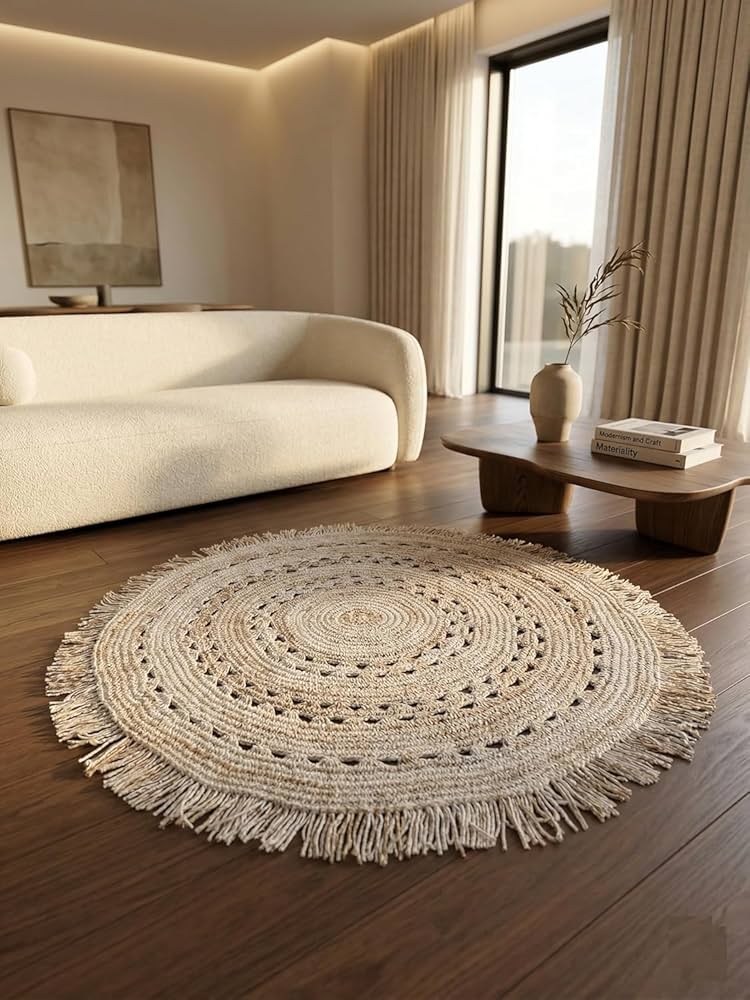
    Look at the room below. A curved white sofa that looks like a cloud. Dark wood floors with the kind of grain that suggests old growth. Natural light filtering through linen curtains. And on the floor — a round crochet rug in undyed wool, its spiral pattern radiating from the center like a fingerprint.
    The rug didn’t cost $4,000. It cost evenings. It cost the decision to use undyed yarn instead of something brighter. It cost the patience to work in a spiral without losing tension. And when your bare feet hit those fibers on a Sunday morning, the sensation is identical to what you’d feel stepping onto a $400-per-square-yard hand-knotted carpet.
    Because your nervous system doesn’t check receipts. It checks texture.
    Restoration Hardware knows this. They sell “vintage” rugs that are artificially distressed to look like they survived a century. But a crochet rug actually carries the memory of its making. The spot where the hook paused. The row that tightened because the phone rang. These aren’t imperfections. They’re authenticity that money can’t manufacture.

    Texture as Currency

    Here’s the counterintuitive truth: in a world of mass production, irregularity has become the ultimate luxury.
    Machine-made decor is perfect. Uniform pile. Mathematical symmetry. Colors mixed by algorithms to offend no one and inspire no one. This perfection is impressive for exactly three seconds. Then your brain files it under “background” and moves on.
    Crochet does the opposite. It demands attention through its very humanity. The stitch that’s slightly tighter than its neighbor. The edge that waves instead of cutting straight. The thickness that varies because human hands tire, pause, adjust.
    The blanket above understands this perfectly. Cream wool in a honeycomb stitch, draped over a neutral sofa like it landed there by accident — but landed exactly right. The fringe isn’t factory-cut. It’s worn. The texture catches afternoon light and turns it into something sculptural. Next to it: a stack of books and a single plant. Nothing else.
    This is the Restoration Hardware formula, decoded: one dominant texture + neutral palette + negative space = expensive. They charge $300 for a linen throw that achieves this. You can achieve it with yarn, a hook, and the understanding that luxury isn’t bought — it’s built, stitch by stitch.
    The difference? Their blanket was distressed by a machine in a factory. Yours was distressed by your cat kneading it while you watched Netflix. One comes with a certificate of authenticity. The other is authentic.

    5 Ways to Fake a $50K Living Room (Without Faking Anything)

    Ready to transform your space without transforming your bank account? Here’s the real playbook:
    1. Go Monochrome, Not Boring
    Choose one neutral and stay in it. Cream, oatmeal, sand, stone. The RH palette isn’t about color — it’s about the absence of color. A cream crochet blanket on a cream sofa doesn’t disappear. It glows. The texture becomes the only language the room needs.
    2. Scale Up Without Fear
    Small crochet reads “craft fair.” Large crochet reads “gallery.” A chunky throw in super-bulky yarn. A rug that covers the entire conversation area. Oversized is the secret handshake of expensive spaces.
    3. Pair With Cold Materials
    Crochet is warm, soft, organic. Place it next to something that isn’t: marble, metal, raw wood, glass. The contrast is what makes both elements feel intentional. A crochet basket on a concrete floor. A wool pillow on a leather chair. Tension creates interest.
    4. Leave It Imperfect
    Don’t block your pieces into submission. Let the blanket drape unevenly. Let the pillow sit slightly askew. Restoration Hardware spends millions distressing furniture to look lived-in. Your crochet is already there. Don’t iron out the soul.
    5. Light It Low
    Overhead lighting kills texture. Crochet comes alive in warm, sidelong light — floor lamps, candles, late-afternoon sun. The shadows between stitches become part of the pattern. RH stores are dim for a reason. Mimic the light, mimic the feeling.

    The Pillow Test

    Now look at the image below and notice what your eye does first.
    Ivory Crochet Cushion Cover, Bolster Pillow Case Square, Sofa and Bed
    It doesn’t go to the sofa. It goes to the pillows. Two cream crochet cushions, side by side, each with a different openwork pattern. One is dense and geometric. The other is lacy and floral. They don’t match — they rhyme. And that rhyme is the sound of intention.
    A machine would have made them identical. A machine would have optimized for efficiency. But these were made by someone who decided: this pillow will be solid, and this one will breathe. This one will anchor, and this one will whisper.
    That decision-making process — visible in the final object — is what separates decor from design. Restoration Hardware hires designers to make these decisions for you. Crochet lets you make them yourself. The result is the same: a room that feels curated rather than purchased.

    The Organization Illusion

    Here’s the final secret, and it’s the one that contradicts everything Instagram wants you to believe:
    Expensive-looking homes aren’t empty. They’re contained.
    The clutter doesn’t disappear. It gets organized into vessels that make it look like art. Open shelves with identical glass jars. Woven baskets that hold the chaos of daily life. Trays that corral the small objects into compositions.
    Easy Crochet Basket Pattern Set, Beginner Home Decor PDF, Organize Storage  Tutorial, Modern Square Round Trinket Tray
    The baskets above carry this philosophy. Chunky crochet in soft neutrals — cream, stone, warm grey. Some hold yarn, some hold towels, one holds a single succulent like a sculpture. They don’t hide the mess. They elevate it. The texture of the crochet turns storage into display.
    Restoration Hardware sells seagrass baskets for $80 each. These cost the price of cotton yarn and an afternoon of mindless stitching. But the effect is identical: the room looks like someone with restraint lives here. Someone who chooses what to show and what to tuck away. Someone who understands that organization is the highest form of decoration.

    The Science of Neutral

    Let’s get technical for a moment. Because the physics of why this works are fascinating.
    A brightly colored room is a shouting match. Red fights with blue. Pattern fights with pattern. The eye has nowhere to rest, so it rests nowhere. The result is visual exhaustion — the same feeling you get from a day in a casino.
    A neutral room with handmade texture is a conversation. The eye moves slowly. It lingers. It notices the way light changes a cream blanket from ivory at noon to amber at dusk. It registers the shadow of a crochet basket against a white wall. It finds the slight variation in tone between two undyed yarns.
    Table
    Table

    Element Machine-Made Effect Handmade Crochet Effect
    Visual calm Uniform, predictable Slight irregularity engages without overwhelming
    Light interaction Consistent reflection Shadows between stitches create depth
    Temperature Synthetic fibers trap heat Natural wool breathes, regulates
    Sound Silent, flat Textile absorbs echo, softens acoustics
    Touch Smooth, sealed Micro-massage, biophilic response
    This table isn’t theory. It’s a diagnostic tool. Walk through your home and check: does each room have at least three of these handmade elements? If not, you know where to start.

    Your RH Manifesto

    So here’s the reframe. Not a shopping list. A philosophy.
    Restoration Hardware sells the feeling of a life well-lived. But they sell it as a product. You can buy the feeling — or you can make it. And making it doesn’t just save money. It changes the frequency of the room.
    A crochet rug underfoot reminds you that patience exists. A handwoven blanket on the sofa reminds you that warmth can be built. A basket on the shelf reminds you that chaos, properly contained, becomes beautiful.
    Remove one machine-made thing. The synthetic throw that pills. The plastic storage bin. The decorative object that came with a barcode.
    Add one handmade thing. Not expensive. Just made. A crochet pillow. A wool basket. A single coaster worked in cotton while you listened to rain.
    Protect the imperfection. The slight unevenness of the rim. The spot where the dye didn’t take perfectly. The edge that curls no matter how many times you block it. These aren’t flaws. They’re the evidence that a human was here.
    May your home feel like a Restoration Hardware catalog. May your hands be the ones who made it that way.
  • Why Everyone Is Falling in Love with Crochet Rugs Again

    Why Everyone Is Falling in Love with Crochet Rugs Again

    Buy Handmade Crochet Rug | Boho Floor Mat | Chunky Yarn Carpet | Living Room  Decor | Round Crochet Rug Online
    Disclosure: This post contains affiliate links to Creative Fabrica. I only recommend products I genuinely love
    Why Everyone Is Falling in Love with Crochet Rugs Again
    What if the most important piece of furniture in your home isn’t furniture at all — but something you walk on?
    The Forgotten Canvas
    Let’s start with a confession.
    For years, I treated my floor like a stage. A neutral backdrop. A place for sofas and coffee tables to perform while the floor itself stayed silent. I bought rugs the way I bought insurance — functional, necessary, and completely forgettable. Beige rectangles that disappeared under furniture. Synthetic fibers that felt like office carpet. Designs so safe they could put a caffeinated squirrel to sleep.
    Then I visited a cottage in Cornwall. The kind with low ceilings and a cat that owns the armchair. And the rug? The rug stopped me mid-step.
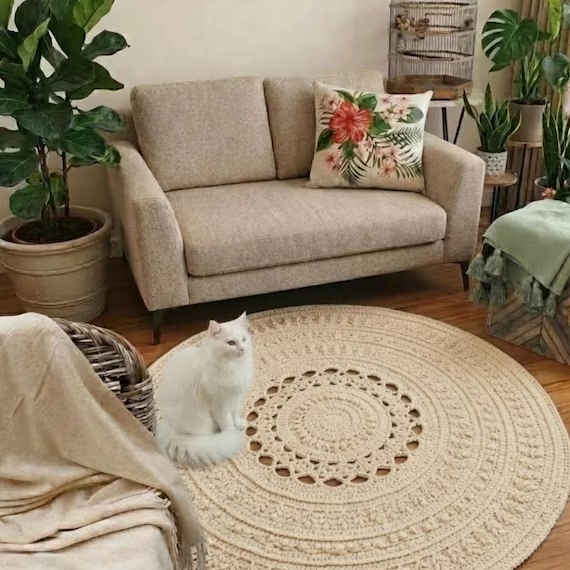
    It wasn’t large. It wasn’t expensive. But it was alive. A round crochet rug in undyed cotton, its spiral pattern radiating from the center like a fingerprint. A white cat sat on it like a queen on a throne. The fibers had compressed in some places, fluffed in others, creating a topography of touch that no machine could replicate. I kicked off my shoes without thinking. And I realized: we’ve been decorating every surface in our homes except the one that carries our entire weight.
    The living room above understands this perfectly. The creamy round crochet rug doesn’t just occupy floor space — it claims it. The openwork pattern creates negative space that lets the wood breathe. The natural cotton catches afternoon light like parchment. And that cat? She knows what every interior designer forgets: the best rug in the room is the one that makes you want to lie down on it.
    This is the power of crochet rugs. Not decoration. Invitation. A tactile whisper that says: stay awhile. Take off your shoes. Be here, fully.
    Why Crochet Rugs Feel Like Hugs
    Here’s the counterintuitive truth that changes everything: the most luxurious thing a rug can do isn’t look expensive. It’s feel human.
    Machine-made rugs are perfect. Uniform pile. Mathematical symmetry. Colors that match exactly because they were chosen by algorithms. This perfection is impressive — for about three seconds. Then your brain files it under “background noise” and moves on.
    Crochet rugs do the opposite. They demand attention through their very irregularity. The stitch that’s slightly tighter than its neighbor. The edge that waves instead of cutting straight. The thickness that varies because human hands tire, pause, adjust. These aren’t flaws. They’re fingerprints.
    Round Boho Crochet Rug, Handmade Style Circular Area Rug, Fringe Floor  Carpet, Rustic Scandinavian Home Decor
    The boho crochet rug above takes this to its logical extreme. Concentric circles of terracotta, sage, cream, and navy — colors that argue and harmonize like a family at dinner. The fringe that trembles when someone walks past. The texture that changes underfoot depending on whether you step on a solid row or an open chain.
    Your feet know the difference. They always know. A machine rug says: walk on me. A crochet rug says: feel me. And in a world where most of our sensory input comes through screens, the chance to feel something handmade under your bare feet is no longer decoration. It’s therapy.
    The Shape That Changes Everything
    Now let’s talk about geometry. Because not all crochet rugs are created equal — and the shape you choose sends a message you might not realize.
    Rectangular rugs divide. They create zones. They say: this is the living area, that is the dining area, and never the twain shall meet. They’re the urban planners of floor decor — efficient, organized, and slightly authoritarian.
    Round rugs unify. They create gathering points. They say: sit here. Talk here. Put your coffee table here and let conversation orbit it like planets around a sun. A round crochet rug turns a corner of a room into a destination.
    But oval rugs? Oval rugs are the secret weapon. They combine the unity of a circle with the direction of a rectangle. They guide the eye along a path. They fit under tables better than circles and soften hallways better than rectangles. An oval rug doesn’t just occupy space — it flows through it.
    Oval Rug
    The sage green crochet rug above, with its delicate openwork and generous scale, demonstrates this perfectly. Placed in a light-filled living room, it doesn’t compete with the furniture — it cradles it. The oval shape echoes the curves of the coffee table, the roundness of the mirror, the organic lines of the plants. Everything in the room agrees with everything else because the rug established the visual language first.
    This is why oval crochet rugs are having a moment. They solve problems rectangles create. They add softness where architecture is hard. They make small rooms feel bigger and big rooms feel intimate.
    The Return of Slow Decor
    Here’s where logic gets flipped. We’re told that good design is fast. Order today, deliver tomorrow, trend next week. But the most beautiful homes I’ve ever visited — the ones that felt like exhales — all had one thing in common: they were slow.
    Slow decor is the opposite of fast fashion for your home. It’s choosing pieces that took time to make, that will take time to age, that ask you to slow down in return. A crochet rug is the ultimate slow decor object. Someone — maybe across the world, maybe down the street — sat with yarn and hook and made a series of decisions that resulted in this exact object under your feet.
    The vintage oval rag rug below carries this philosophy in every loop. Pastel stripes of pink, blue, cream, and grey — colors that look like they were chosen from leftover fabric with love rather than from a Pantone chart with strategy. The scalloped edge that required extra rows, extra time, extra patience. This rug wasn’t produced. It was composed.
    Vintage Oval Rag Rug Crochet Pattern | Retro Home Decor
    And here’s the plot twist: slow decor is fast becoming the ultimate luxury. Not because it’s expensive, but because it’s rare. In a world of same-day delivery and algorithmic recommendations, owning something that took forty hours to create is a radical act. It’s a declaration that your home isn’t a backdrop for your life — it’s a participant in it.
    5 Ways to Style a Crochet Rug (Without Making It Look Like Grandma’s House)
    Ready to bring this philosophy home? Here’s your roadmap:
    1. Let It Breathe
      Don’t hide your crochet rug under furniture. Give it at least 18 inches of visible border. The pattern is the point — let it be seen.
    2. Contrast the Texture
      Pair a chunky crochet rug with smooth leather furniture. Or place a delicate openwork rug on rough-hewn wood floors. The tension between textures creates interest.
    3. Go Monochrome
      A cream or natural cotton crochet rug in a white room doesn’t disappear — it glows. It adds warmth without adding color. It’s the design equivalent of a whisper.
    4. Layer It
      Place a smaller crochet rug on top of a larger jute or sisal rug. The natural fibers talk to each other. The layers add depth. And your feet get to choose their texture.
    5. Light It Low
      Crochet rugs come alive in warm, low light. A floor lamp casting sideways shadows across the stitches turns texture into art. Overhead lighting kills the magic — always light from the side.
    The Science of Softness: Why Your Nervous System Craves Crochet
    Let’s get technical for a moment. Because the physics of crochet create something no woven rug can replicate.
    A machine-woven rug is a barrier. It covers. It protects the floor from you. A crochet rug is a conversation. The negative space between stitches allows air to move. The natural fibers regulate temperature — cool in summer, warm in winter. The slight unevenness creates micro-massage points for your feet that stimulate circulation without you noticing.
    Neuroscientists call this “tactile nourishment.” When your feet encounter irregular, natural textures, your brain releases dopamine. It’s the same response you get from walking on a beach or grass. Crochet rugs bring that biophilic response indoors.
    Table

    Element Effect
    Natural cotton Temperature regulation — cool when hot, warm when cold
    Openwork stitches Air circulation — prevents that “stuffy rug” feeling
    Hand-tension variation Micro-massage — stimulates foot receptors
    Organic shapes Visual calm — curves reduce cognitive load
    Natural dyes Color harmony — earth tones soothe the nervous system
    This table isn’t just theory. It’s a diagnostic tool. Walk through your home barefoot. Does your floor nourish you or merely support you? If the answer is the latter, you know where to start.
    Your Rug Manifesto
    So here’s the reframe. Not a shopping list. A philosophy.
    Start with your feet. Before you choose a rug for how it looks, choose it for how it feels. Stand on it barefoot. Close your eyes. Does your body relax? Good. That’s the only review that matters.
    Choose natural over perfect. A cotton rug that sheds slightly is better than a synthetic rug that sheds microplastics. Imperfection is the price of authenticity.
    Let it age. The spot where you stand to drink coffee. The corner where your dog curls up. The edge that fades where the sun hits. These aren’t damages. They’re the rug’s autobiography.
    Go oval. Not because it’s trendy. Because it flows. Because it fits life better than right angles. Because it reminds you that beauty doesn’t have to be sharp to be powerful.
    May your floors be soft. May your stitches be even. May your home feel like the hug you’ve been needing.
  • The Table Runner That Ate My Weekend

    The Table Runner That Ate My Weekend

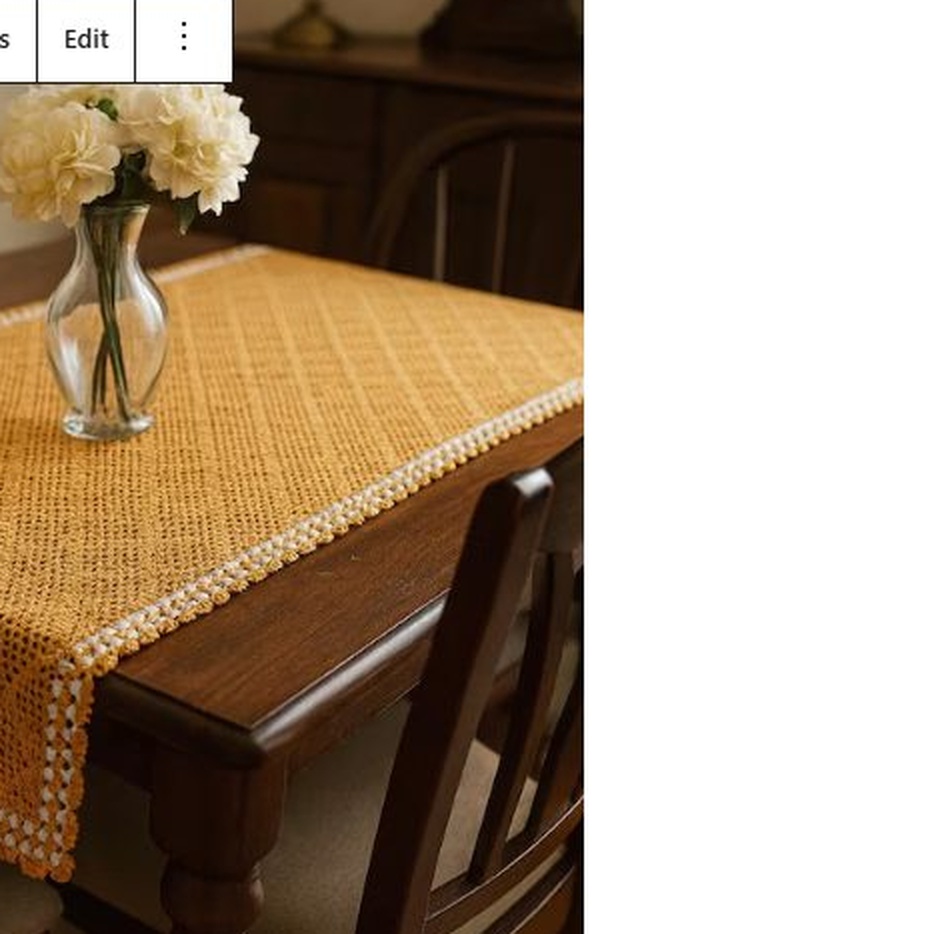
    Mustard Yellow Crochet Table Runner - Daisy Trim Lace Decor. Or: How a Yellow Oval Changed My Relationship With Furniture

    Disclosure: This post contains affiliate links to Creative Fabrica. I only recommend products I genuinely love this Crochet Oval Plush Table Runner Pattern in PDF format

    The runner that started it all. One oval. Zero regrets. Infinite brunch invitations.

    Chapter 1: The Table That Broke Me

    My dining table was sad.
    Not “needs a therapist” sad. More like “wears the same outfit every day and has given up on life” sad. It was a perfectly good wooden table — sturdy, rectangular, the kind of table that says “I am functional and I have accepted my fate.”
    I tried placemats. I tried a vase. I even tried one of those Pinterest-centerpiece situations with floating candles and eucalyptus that smelled like a spa but looked like a funeral.
    Nothing worked.
    The table remained sad. And then, one Tuesday at 11 PM — because all great ideas happen at 11 PM — I had a thought:
    What if I crocheted it a sweater?
    Not a literal sweater. That would be weird. (Though now that I say it out loud, a table sweater has potential.) No. I meant a table runner. A long, plush, yellow oval of happiness that would transform my sad table into a table that dares to dream.
    I grabbed my hook. I grabbed some yarn. And I made a terrible mistake:
    I chose yellow.

    Chapter 2: The Yellow That Wouldn’t Quit

    The color of sunshine, optimism, and mild existential dread.

    Yellow is not a color. Yellow is a personality.
    I picked a bright, buttery, unapologetic yellow. The kind of yellow that doesn’t whisper — it sings. The kind of yellow that makes your morning coffee feel like a celebration. The kind of yellow that says: “I am here. I am oval. Deal with it.”
    I bought four skeins. (Okay, six. Two were “for backup.” Three were “just in case.” One was because the store was closing and they were on sale.)
    The first row was magical. The second row was satisfying. The third row was when I realized: this is an oval. And ovals are not rectangles. Ovals have curves. Ovals have increases and decreases. Ovals have math.
    I hate math.
    But I kept going. Because something strange happens when you crochet a table runner. You start talking to it. You start patting it. You start referring to it as “my oval” in conversations with your partner, who looks at you with increasing concern.
    “How’s my oval doing?” I’d ask, walking past the work-in-progress.
    “It’s… it’s a table runner, babe.”
    “No. It’s MY OVAL.”

    Chapter 3: The Physics of Plush

    Free Easy Bernat Springtime Kitchen Accessories Crochet Pattern |  Yarnspirations
    Where the magic happens — one plush stitch at a time.
    Here’s what nobody tells you about a “plush” table runner: it’s thick. Like, really thick. Like, “this could double as a yoga mat” thick.
    A regular table runner? Flat. Boring. Functional. It lays there and does its job and goes home at 5 PM.
    A plush table runner? It has presence. It has volume. It has the kind of texture that makes people reach out and touch it without asking permission. (Rude, by the way. But also understandable.)
    The plush stitch is basically a double crochet that ate a sandwich. It’s puffy. It’s squishy. It’s the crochet equivalent of a hug. And when you work it in a continuous oval — increasing at the ends, decreasing at the sides, praying to the geometry gods — it creates this beautiful, rounded, cloud-like shape that makes you want to set the table even when you’re eating cereal out of the box.
    I worked on it for three days. My fingers went numb. My couch developed a permanent yarn dent. My cat claimed the work-in-progress as his personal throne and had to be bribed with treats to move.
    But when I finished? When I laid that yellow oval on my sad wooden table?
    The table smiled.
    I swear. It smiled.

    Chapter 4: The Brunch That Changed Everything

    Crochet Table Runner & Placemat Pattern: Modern Boho or Farmhouse Dining  Set (PDF Pattern) - Etsy
    The moment of truth — when handmade meets hospitality.
    I invited my friends over for brunch. Not because I wanted to show off. (Okay, maybe a little.) But mostly because I needed witnesses. I needed people to see what my sad table had become.
    They walked in. They saw the table. They stopped.
    “Oh my god, did you MAKE that?!”
    “It’s so… YELLOW.”
    “Can I touch it?”
    (Yes, Karen, you can touch it. Everyone can touch it. That’s literally the point.)
    We sat down. We ate avocado toast. We drank too much coffee. And the entire time, no one could stop looking at the table runner. It was like a celebrity had joined us for brunch. A flat, oval, yellow celebrity that smelled faintly of yarn store.
    My friend Sarah — who has a master’s degree in interior design and judges everyone’s home silently — actually said: “This looks like something from Anthropologie.”
    I didn’t tell her it cost me $12 in yarn and 72 hours of my life. I just smiled and said: “Thanks. I made it.”
    And then I watched her face do the thing.
    You know the thing. The “wait, you MADE this?!” thing. The thing that makes all the finger cramps worth it.

    Chapter 5: The Secret I Need to Share

    Cozy Cottage Dining Room - The Beauty Revival
    The cozy home — where handmade meets heart.
    Here’s what I learned from this whole oval adventure: your home is a story, and you get to write it.
    That sad table? It wasn’t sad because it was plain. It was sad because I hadn’t given it a story yet. I hadn’t invested in it. I hadn’t spent 72 hours making something specifically for it, with love and yarn and a mild obsession with geometry.
    When you make something for your home — a table runner, a pillow, a blanket — you’re not just decorating. You’re narrating. You’re saying: “This space matters to me. This moment matters. This meal, this coffee, this conversation — they all deserve a beautiful setting.”
    And here’s the wild part: other people feel it.
    My friends didn’t just see a yellow table runner. They saw intention. They saw care. They saw someone who chose to spend three days making something beautiful instead of buying something disposable.
    That energy is contagious. That energy is real.
    If you’re looking at your own sad table — or sad couch, or sad shelf, or sad corner that you’ve been ignoring — and thinking “I wish it felt more like me,” here’s your permission slip: make something for it.
    Start with a table runner. A long, plush, oval hug for your furniture. Something that says “I am here. I am handmade. I am yours.”
    If you need a place to start — a pattern that holds your hand through the increases, the decreases, and the inevitable “why is this lopsided?!” moments — here’s the exact one I used: this Crochet Oval Plush Table Runner Pattern in PDF format. It’s beginner-friendly, includes detailed instructions for that tricky oval shape, and produces a runner so plush you’ll want to nap on it.

    Chapter 6: The Unexpected Side Effects

    The workspace of a maker — where dreams are built one stitch at a time.
    Making this table runner had consequences I didn’t anticipate.
    Consequence 1: I now set the table for everything. Breakfast. Snacks. Midnight cereal. My sad table has become a stage, and the yellow oval is the star.
    Consequence 2: My partner has started calling me “the oval lady.” I am not sure how I feel about this. I am also not sure I can stop it.
    Consequence 3: I have developed a deep, emotional attachment to a piece of fabric. I fluff it before guests arrive. I smooth it after meals. I once yelled at the cat for sitting on it. (He did not care. He sat on it anyway.)
    Consequence 4: I now notice table runners everywhere. Restaurants. Magazines. TV shows. I judge them all. “Too thin.” “Not plush enough.” “Where are the increases?!” I have become a table runner snob. This is my life now.

    Chapter 7: The Philosophy of the Oval

    Page 26 | Crochet texture Images
    The finished object — where geometry and coziness become one.
    Let me get philosophical for a second.
    Why does a handmade table runner matter? In a world where you can buy a perfectly decent one for $15 at IKEA, why spend three days crocheting one?
    Here’s my theory: handmade home decor is love made visible.
    That yellow oval isn’t just yarn. It’s the Netflix episodes I watched while making it. It’s the coffee that went cold. It’s the moment I almost gave up at hour 10 but kept going because I could already see how beautiful it would be.
    You can’t buy that. You can’t download it. You can’t subscribe to it.
    You can only make it.
    And every time someone sits at my table — every time they reach out and touch the plush stitches and say “this is so soft” — they’re feeling that love. They’re experiencing those hours. They’re connecting with something that was made slowly, deliberately, by hand.
    That’s the magic. That’s the whole point.

    Chapter 8: Your Turn to Make Magic

    Free Easy Bernat Springtime Kitchen Accessories Crochet Pattern |  Yarnspirations
    The tools of transformation — where a hook meets a dream.
    So here’s my challenge to you.
    Look at your home. Find the sad spot. The table that gave up. The shelf that’s just holding things. The corner that’s been ignored for too long.
    And make it something.
    Not buy. Make. Because the act of making is the act of claiming space. Of saying “this is mine, and I choose to fill it with beauty.”
    Start with a table runner. A long, plush, oval declaration of intent. Something that transforms a surface from “functional” to “fabulous.”
    If you need a pattern — a roadmap for your oval adventure — here’s the one that started my obsession: this complete PDF crochet pattern for an oval plush table runner. It comes with step-by-step instructions, tips for getting that perfect plush texture, and the kind of encouragement that makes you believe you can actually finish an oval without throwing it across the room.
    Because you can. I promise. If I can turn a sad table into a brunch destination, you can too.

    Epilogue: The Oval Lives On

    Mustard Yellow Crochet Table Runner - Daisy Trim Lace Decor
    The table that learned to dream — one yellow oval at a time.
    It’s been two months since I finished my oval.
    The yellow has softened slightly. The plush texture has settled into that perfect worn-in feel. The table — my formerly sad, formerly hopeless table — has become the heart of our home.
    We eat there. We laugh there. We spill coffee there and wipe it up and keep going.
    And every time I look at that yellow oval, I feel something I rarely feel in modern life: pride. Not the arrogant kind. The quiet, grounded kind that comes from knowing you built something beautiful with your own two hands.
    My partner still calls me “the oval lady.” The cat still sits on the runner. My friends still ask me to make them one.
    And I always smile and say: “Make your own. I’ll bring the coffee.”
    Because the best thing about handmade things isn’t owning them. It’s making them. It’s the journey from “I could never” to “I actually did.”
    The hook is in your hands now.
    What will you make for your home?
  • Crochet Hanging Planter Pocket: Turn Your Wall Into a Living Garden

    Crochet Hanging Planter Pocket: Turn Your Wall Into a Living Garden

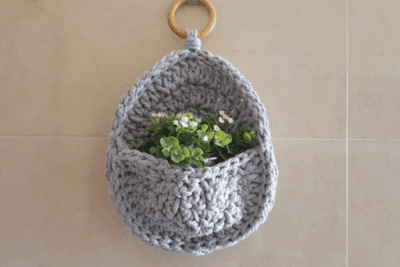
    Disclosure:Gray chunky crochet hanging planter pocket with small green plant on beige tiled wall This post contains affiliate links to Creative Fabrica. If you purchase through these links, I earn a small commission at no extra cost to you. I only recommend products I genuinely love. Thank you for supporting Wool & Hook! 🌿Hanging Planter Pocket Crochet Pattern

    🌿 Crochet Hnging Planter Pocket: Turn Your Wall Into a Living Garden

    I have a confession. I kill plants. Not on purpose — I forget to water them, or I overwater them, or I put them somewhere the cat can reach. But the idea of a home filled with greenery? That I can’t quit.
    So I found a workaround. I started making crochet hanging planter pockets — little yarn nests that hold small plants, herbs, or even faux greenery — and suddenly my walls came alive. No floor space needed. No windowsills to clutter. Just a beautiful teardrop pocket hanging there, making my bathroom look like a spa and my kitchen look like a cottage.
    Let me show you how to make one too.

    What Is a Hanging Planter Pocket?

    Think of it as a cross between a basket and a wall hanging. It’s a teardrop-shaped crochet pocket with a flat back that sits flush against the wall, and a generous front pouch that cradles a small pot or plant. A wooden ring at the top lets you hang it from a hook, a nail, or even a suction cup.
    The genius is in the shape. Unlike round hanging baskets that stick out into the room, a pocket planter hugs the wall. It takes up zero floor space and adds texture, warmth, and life to any vertical surface.

    Why This Project Is Perfect for 2026

    I keep an eye on home decor trends (okay, I scroll Pinterest at midnight), and three things are undeniable right now:
    1. Biophilic design. Bringing nature indoors is huge. Real plants, faux plants, plant art — if it’s green and growing, people want it.
    2. Small-space living. Apartments are getting smaller. People need decor that works vertically. Wall planters solve this beautifully.
    3. Handmade home goods. Mass-produced terracotta pots are fine. But a crochet planter pocket? That’s a conversation piece. That’s you in your home.
    The Hanging Planter Pocket Crochet Pattern taps into all three trends at once. It’s functional decor with a handmade soul.

    The Yarn: Why T-Shirt Yarn Changes Everything

    Here is the secret ingredient that makes this pocket special: t-shirt yarn (also called fabric yarn or trapillo). It is made from recycled cotton fabric strips, and it crochets up into a thick, sturdy, almost rope-like texture.
    Why it works for planters:
    • Structure. T-shirt yarn holds its shape. Your pocket will not sag or stretch under the weight of a pot.
    • Durability. Cotton can handle moisture. A little dribble from watering will not ruin it.
    • Texture. That chunky, woven look is exactly what gives the pocket its modern, Scandinavian-meets-boho vibe.
    • Eco-friendly. You are literally upcycling fabric waste. Feel-good crafting at its finest.
    White boho crochet hanging planter pod with trailing ivy in bright room
    💡 Pro tip: Can’t find t-shirt yarn? Cut up old cotton t-shirts into 1-inch strips and roll them into balls. Free yarn, zero waste, and the same chunky result.

    Breaking Down the Construction

    Don’t let the teardrop shape intimidate you. This pocket is built from simple shapes joined together:
    The back panel. A flat oval or teardrop shape, worked in rows or rounds. This is what sits against the wall.
    The front pocket. A deeper, basket-like piece with increases that create volume. This is where your plant lives.
    The joining. The front and back are crocheted together along the sides and bottom, leaving the top open. The back stays flat; the front poufs out.
    The hanging loop. A sturdy chain or cord at the top, threaded through a wooden ring. Simple, strong, and stylish.
    The Hanging Planter Pocket Crochet Pattern walks you through each step with photos — from the initial chain to the final assembly. It’s rated for confident beginners, which means if you know single crochet and how to increase, you’re ready.

    What Can You Put In It?

    The obvious answer is plants. But the fun answer is almost anything:
    🌿 Real plants. Small succulents, air plants, trailing pothos, or herbs like basil and mint. Just add a small plastic pot inside to protect the yarn from moisture.
    🌿 Faux plants. No green thumb? No problem. High-quality faux succulents look incredible and require zero maintenance.
    🌿 Dried flowers. Lavender, eucalyptus, pampas grass — a pocket of dried blooms is pure cottagecore magic.
    🌿 Bathroom storage. Roll up washcloths, stash makeup brushes, or hold a bar of soap. The bathroom application is honestly my favorite.
    🌿 Kitchen herbs. Hang one by a sunny window and fill it with fresh basil, parsley, or chives. Snip as you cook.
    🌿 Entryway catch-all. Keys, mail, sunglasses — corral the clutter in something beautiful.
    Two crochet wall plant pockets with air plants hanging on white wall

    Size and Placement Ideas

    One pocket is charming. Three in a row? That’s a statement.
    Table

    Placement Plant/Item Vibe
    Bathroom wall Faux succulents Spa retreat
    Kitchen backsplash Fresh herbs Farmhouse fresh
    Bedroom corner Trailing pothos Boho sanctuary
    Entryway Keys + dried lavender Organized welcome
    Nursery Soft faux plants Gentle, calming
    💡 Pro tip: Make two or three in different sizes and hang them in a staggered cluster. Instant gallery wall with zero frames needed.

    Materials You’ll Need

    Table

    Material Amount Notes
    T-shirt yarn 200–250g One standard ball is usually enough
    Crochet hook 8mm or 10mm Check your yarn label
    Wooden ring 1 piece, 3–4 inch diameter For hanging
    Stitch markers 2–4 To track rounds
    Tapestry needle 1 For weaving ends
    Small plastic pot 1, 4–5 inch diameter To insert inside the pocket
    Color ideas: The gray on the photo is classic and neutral. But imagine terracotta orange for a warm Mediterranean feel. Sage green for a botanical look. Cream for Scandinavian minimalism. Navy for dramatic contrast. The yarn color completely changes the mood.
    Crochet pocket planter on wooden hoop with eucalyptus stems against gray concrete wall

    Care and Maintenance

    Your planter pocket is sturdier than it looks, but a little care goes a long way:
    • Dust it. A quick swipe with a lint roller or soft brush keeps it fresh.
    • Spot clean. Damp cloth with mild soap for small marks. Don’t submerge.
    • Protect from direct water. Always use an inner plastic pot. Water the plant inside the pot, not the yarn.
    • Reshape if needed. If the pocket gets a bit saggy, stuff it with a towel overnight to restore the shape.

    Why This Project Is Worth Your Time

    In a world of flat-pack furniture and identical Instagram apartments, a handmade planter pocket is a small act of rebellion. It says: I made this space mine. I brought something living (or lifelike) into my home. I value slow craft over fast decor.
    It’s also ridiculously satisfying. You start with a ball of recycled fabric strips. A few hours later, you have a sculptural object that transforms a blank wall into something alive.
    And when someone visits and asks, “Where did you get that?” — you get to say, “I made it.”
    If you’re ready to add some living art to your walls, grab the Hanging Planter Pocket Crochet Pattern and start with your first pocket this weekend. One hook, one ball of yarn, one empty wall. That’s all it takes.
    If you make a hanging planter pocket, show us! Tag @woolandhook on Instagram or leave a comment below. We especially love seeing what creative things you plant in yours — real, faux, or completely unexpected.

    Related Articles from Wool & Hook:

  • Plush Granny Square Crochet Pattern: A Beginner’s Guide to Textured Floral Motifs

    Plush Granny Square Crochet Pattern: A Beginner’s Guide to Textured Floral Motifs

    Plush granny square

    Hey there, fellow crocheters! If you’ve been scrolling through Pinterest lately, you’ve probably noticed that chunky, textured granny squares are having a serious moment. And honestly? I’m here for it. Today I want to walk you through one of the coziest and most visually striking motifs I’ve come across lately — the plush granny square with a floral center. Whether you’re dreaming of a statement blanket, a boho pillow, or even a structured tote bag, this motif delivers that “handmade luxury” vibe we all crave.

    Affiliate Disclosure: This post contains affiliate links. If you make a purchase through one of these links, I may earn a small commission at no extra cost to you. I only recommend products I genuinely love and use myself. Thank you for supporting Wool & Hook! 💛

    What Exactly Is a Plush Granny Square?

    The classic granny square is basically crochet royalty — it’s been around forever and for good reason. But modern crocheters aren’t content with just “classic.” We’re taking that beloved technique and pumping up the volume with chunky plush yarn, dimensional flower centers, and unexpected color combinations. The result? A square that looks like a tiny textile masterpiece.
    Plush granny square | LoveCrafts
    Look at that beauty above — dense, velvety texture, a raised floral center, and that gorgeous turquoise-to-navy gradient framed by a crisp border. This isn’t your grandmother’s granny square (no offense to grandmas — they’re usually the ones who taught us!). The plush yarn gives it a 3D, almost cushion-like quality that makes it perfect for projects needing structure and softness.

    Why This Pattern Deserves a Spot in Your Queue

    1. It’s deceptively simple. Despite the fancy look, the techniques are beginner-friendly. If you can chain, single crochet, double crochet, and treble crochet, you’ve got this. Everything else is just practice and patience.
    2. Plush yarn does the heavy lifting. Using chenille or velvet-style yarn transforms an ordinary square into something that feels like a cloud. These motifs are perfect for baby blankets, sensory toys, or decorative pillows. Want a firmer result? Simply size down your yarn and hook.
    3. Color play is endless. Go ombre, high-contrast, or monochrome — the floral center should pop, and the border should frame it like a picture. I love how the designer used a cool turquoise palette here, but imagine this in warm rusts and creams for autumn, or soft pastels for a nursery.

    Materials You’ll Need

    To make one square approximately 6×6 inches (15×15 cm), gather:
    • Plush/chunky yarn in 4 colors: main color (turquoise/aqua) ~13g, contrast (navy) ~5g, white ~3g, beige ~5g
    • 4mm crochet hook — ideal for standard plush yarn weight
    • Scissors and tapestry needle for weaving in ends
    💡 Pro tip: To calculate total yarn for a full project, multiply the weight of one square by your total square count. A throw blanket (about 47×60 inches) typically needs 80–100 squares.
    For a complete downloadable PDF with step-by-step photos, crochet charts, and a 37-minute video tutorial, check out this pattern:
    This pattern by Anna Kuznietsova includes written instructions for every round, a full crochet chart, and video support — perfect if you’re a visual learner or just want the confidence of a tested pattern.

    Step-by-Step Technique Breakdown

    Round 1 — The Magic Ring Center

    Start with a magic ring and work 12 double crochets (dc) into the ring using white yarn. Pull the ring tight and join with a slip stitch. You’ll have a solid little circle — the heart of your flower.

    Round 2 — Petal Formation

    Attach beige yarn. Work treble crochet clusters separated by chain spaces to create puffy petals around the center. This is where the dimension starts happening. Don’t skip the corner increases — they’re what transform the circle into a square shape.

    Round 3 — The Contrast Transition

    Switch to navy yarn. Work double crochets into the spaces between petals, creating a smooth bridge from flower to frame. Corners are worked as: 3 dc, ch 2, 3 dc — the classic granny square corner that keeps everything square and flat.

    Round 4 — The Border Frame

    Finish with your main turquoise color. One more round of double crochet clusters, increasing stitches along each side to maintain the square shape. The finished motif should lie perfectly flat with no curling or twisting.
    These variations show how the same motif shines in different color stories — from icy blues to warm earth tones. The floral center technique stays the same; only your palette changes the mood.

    The #1 Beginner Mistake (And How to Fix It)

    The twist. If your square starts spiraling like a cinnamon roll, you’re not alone. The fix is ridiculously simple: turn your work after every round. Finish a round on the right side? Flip it over, attach your new color, and work the next round from the wrong side. This alternating direction keeps your square perfectly flat and symmetrical.

    Project Ideas That Go Beyond the Blanket

    Sure, a plush granny square blanket is gorgeous, but why stop there?
    • Statement throw pillow — Two squares + a zipper-backed cushion cover = instant boho decor.
    • Structured tote bag — Line with fusible interfacing, add a fabric lining and leather handles. The plush texture makes it look way more expensive than it is.
    • Baby lovey or sensory blanket — Use baby-safe plush yarn and a smaller hook for a tighter weave.
    • Coasters or trivets — Swap plush yarn for cotton and you’ve got functional kitchenware.
    These classic granny square charts illustrate the logic of corner increases and side growth. Even if you’ve never worked motifs before, mastering the basic square first makes the plush floral version feel like a natural next step.

    Joining Your Squares: The Make-or-Break Moment

    Let’s be real — joining is the least fun part of any granny square project. But you’ve come too far to quit now! Here are your options:
    • Slip stitch join — Fast and creates a visible ridge between squares. Great if your final rounds are all the same color.
    • Whip stitch (invisible join) — Slower but seamless. Ideal for multicolored squares where you don’t want the joining yarn to show.
    • Join-as-you-go — Crochet squares together while working the final round. Efficient and satisfying once you get the rhythm.
    For chunky plush squares, I personally prefer the slip stitch method because the slight ridge adds to that cozy, quilted texture.

    Where to Find More Inspiration

    If you’re ready to dive deeper into plush and chunky granny square techniques, search YouTube for “chunky granny square blanket tutorial” — there are fantastic free video guides that walk you through working with chenille yarn, which behaves a bit differently than standard acrylic. The stitches hide easily, so you’ll develop a “feel” for where to insert your hook rather than relying on sight.
    And if you want a complete, printer-friendly pattern with photos, charts, and video access, I highly recommend grabbing the full PDF:
    It’s designed for beginners, includes both US and UK terminology, and the video tutorial alone is worth the price if you’re nervous about tackling your first plush project.

    Final Thoughts: Slow Down and Enjoy the Process

    Here’s the thing about crochet — it’s not a race. Each square is a tiny meditation session. The repetitive motion, the texture of the yarn, the gradual emergence of a flower from a simple circle — it’s therapeutic. Don’t stress about perfect tension or identical squares. Handmade means made by hands, and hands aren’t machines. The slight variations are what make your piece uniquely yours.
    So grab your hook, queue up a good podcast, and start stitching. I’d absolutely love to see what color combos you come up with — drop a photo in the comments or tag me on social media. There’s nothing better than seeing how one pattern transforms into completely different works of art in different hands.
    Before you go — if you’re serious about making this project and want a pattern you can trust, here’s that link one more time:
    Happy hooking! 🧶