Category: Crochet Towels

  • The Crochet Hand Towel That Makes Drying Your Hands Feel Like a Spa Ritual

    The Crochet Hand Towel That Makes Drying Your Hands Feel Like a Spa Ritual

    Colorful crochet dishcloths and hand towels in wicker basket on kitchen counter — handmade cotton kitchen linens in green, yellow, blue and striped patterns. 


    You do not dry your hands with this towel.
    You thank them. You thank them for holding the coffee mug, for carrying the groceries, for typing the emails. And in return, they meet cotton — soft, thirsty, striped in colors that have no business being this cheerful in a room where drains live.
    This is not a towel. It is a mood regulator disguised as household linen.
    In this article, you will learn:
    • Why three bright stripes are the secret to a kitchen that feels alive
    • The exact stitch combo (SC + DC) that creates texture without complexity
    • How one cone of white cotton becomes an entire gift set
    • The border trick that elevates “homemade” to “artisan”
    • The 5 mistakes that turn a hand towel into a dish rag
    Now, pick up your hook. The sink is waiting.

    Part I: The Stripe Is a Conversation

    Look at it. White, interrupted. A band of guava pink. A band of pastel blue. A band of sunflower yellow. Each stripe is only two rows tall — barely a whisper — but together they form a sentence. White says “I am clean.” Guava says “I am fun.” Blue says “I am calm.” Yellow says “I am awake.”
    Here is the color theory that breaks interior design rules: you do not need to match your towels to your tiles. You need them to apologize for your tiles. Beige countertop? Boring. Beige countertop with a hand-crocheted towel in tropical stripes? Curated. The towel becomes the accessory that makes everything else look intentional.
    And the practical magic of the stripe placement in this pattern? It is symmetrical. Guava at the top, Guava at the bottom. Blue and Sunflower mirror each other around the center. The eye reads this as balance, even if the viewer has never crocheted a stitch. It feels designed. Because it is.
    Yarn math that will make you feel smart: One 700-yard cone of white cotton + three 131-yard rolls of color = one hand towel + three matching dishcloths. That is four handmade gifts from four skeins. The economics of generosity have never looked better.

    Part II: The Stitch Is a Lie Your Hands Love

    Pastel crochet dishcloths stacked on wooden counter next to bowl of lemons — soft cotton washcloths in pink, blue, yellow and purple
    Single crochet. Double crochet. That is the entire vocabulary of this towel.
    But here is the twist: alternating them creates a texture illusion. The single crochet sinks. The double crochet rises. Row by row, they negotiate with each other until the fabric becomes a ridged landscape — absorbent, scrubby, yet soft enough for your face. It looks like waffle weave. It behaves like a sponge. It is actually just SC, DC, SC, DC repeated until your row counter tells you to stop.
    The megalogic that defeats complicated patterns: repetition is meditation. You do not need to count to twelve. You do not need to front-post, back-post, or twist yourself into a cable. You need one row of singles and doubles, then one row of doubles and singles. The pattern reverses itself every other line, which means your brain can wander while your hands do the work.
    The foundation chain: 45 chains. That is it. Not 145. Not 445. Forty-five. Small enough to finish in an evening, large enough to actually dry a human hand without feeling like a coaster.

    Part III: The Cotton Is a Promise

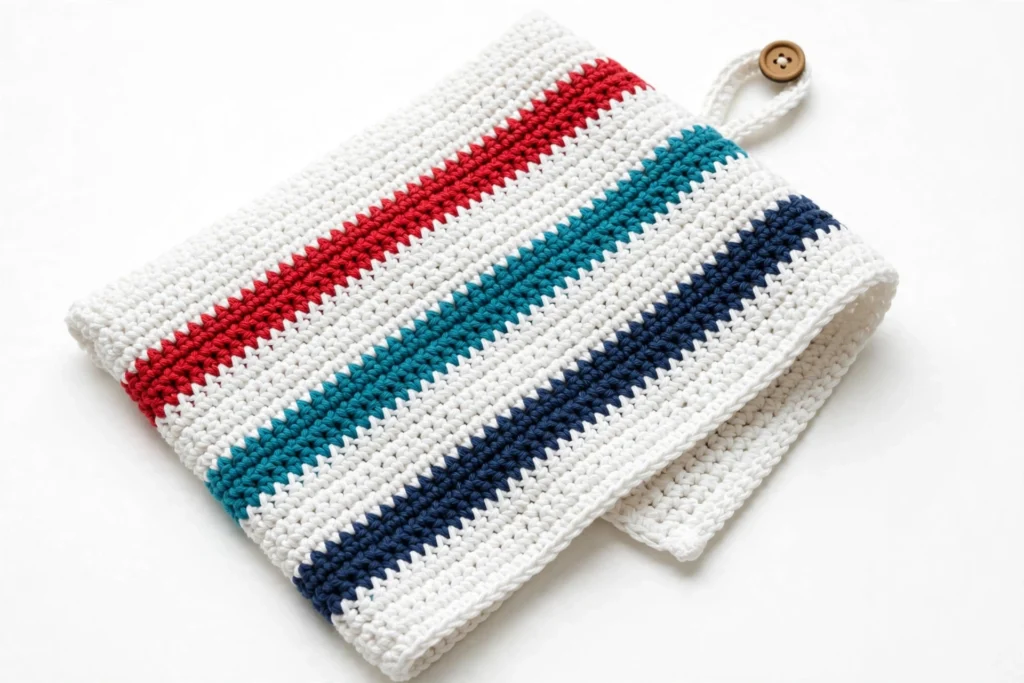
    White crochet hand towel with diagonal red, teal and navy blue stripes — colorful cotton kitchen towel with button loop on white background
    Premier Home Cotton. Not acrylic. Not wool. Not that fuzzy yarn that sheds like a golden retriever in July.
    Cotton makes promises that synthetic fibers cannot keep. It absorbs. It launders. It softens with every wash instead of pilling into sadness. A cotton hand towel used daily for six months will feel better than it did on day one — the fibers relax, the texture blooms, the stripes settle into their identity.
    And the color? Cotton takes dye honestly. Guava is guava. Sunflower is sunflower. There is no metallic sheen, no plastic shine — just pigment doing its job. When you hang this towel on a brass hook by the sink, it does not compete with the hardware. It complements it.
    Care instructions that will save your sanity: Machine wash warm, tumble dry low. No special treatment. No hand-washing guilt. Cotton forgives. Cotton forgets. Cotton shows up tomorrow ready to dry another set of hands.

    Part IV: The Pattern Is a Journey

    Folded blue crochet hand towel with two white stripes on marble surface — textured cotton kitchen linen next to white mug
    Now, the practical magic. Here is how you turn one cone of white and three pops of color into a towel that makes guests ask, “Where did you buy this?”
    The Setup:
    • Hook: Size H (5.00 mm) — the Goldilocks of crochet hooks, not too tight, not too loose
    • Foundation: Chain 45
    • Base row: Single crochet in the second chain from hook, then alternate DC, SC across. End with a DC in the final stitch. Chain 1, turn.
    The Rhythm:
    Rows 2–5: Continue the SC, DC dance in white. At the end of Row 5, switch to Guava (Color A).
    Rows 6–7: Two rows of Guava. Switch back to white.
    Rows 8–9: Two rows of white. Switch to Pastel Blue (Color B).
    Rows 10–11: Two rows of Blue. Back to white.
    Rows 12–13: Two rows of white. Switch to Sunflower (Color C).
    Rows 14–15: Two rows of Sunflower. Back to white.
    The Mirror:
    Rows 16–42: White continues the rhythm. Then you mirror the color sequence in reverse — Sunflower, white, Blue, white, Guava, white — until Row 57. The towel becomes a palindrome. The top half and bottom half are reflections of each other, separated by a wide white center that says “I have room to breathe.”
    The Color Change Trick: Do not cut the yarn at every stripe. Carry the inactive color loosely up the side edge, trapping it in the turning chain. When you finish the towel, the carried strands become invisible inside the border. Less weaving. More living.

    Part V: The Border Is Optional (But You Will Want It)

    Terracotta crochet hand towel hanging on brass hook by white farmhouse sink — handmade cotton towel in sunny kitchen with herbs
    At Row 57, you have a choice. You can fasten off, weave in the ends, and call it finished. The towel works. It dries. It hangs. It is enough.
    Or — and this is where “homemade” becomes “heirloom” — you can add a slip-stitch border around all four edges. Chain 1, do not turn, slip stitch down the side, across the bottom, up the other side, across the top. One round. Five minutes. The result? A smooth, corded frame that makes the towel look like it came from a boutique in Provence, not your couch at 10 PM.
    Here is the practical truth: crochet edges are wobbly. The tension varies. The sides pucker. A slip-stitch border is not decoration. It is arbitration. It negotiates peace between the top edge and the side edge. It gives the towel a spine.

    The 5 Mistakes That Ruin a Crochet Towel

    1. Using acrylic yarn
    Acrylic repels water. It is literally plastic. A wet acrylic towel is a wet dog that never dries. Use 100% cotton or prepare for mildew and regret.
    2. A hook that is too small
    A 4.00 mm hook creates a fabric so dense it could be used as armor. The H (5.00 mm) hook gives you drape and absorbency. Do not fight the fabric.
    3. Skipping the gauge swatch
    If your 44 stitches measure 8 inches instead of 10, your towel will be a washcloth. Swatch. Block. Measure. Then proceed.
    4. Cutting yarn at every color change
    You will have 47 ends to weave in. Carry the yarn up the side. Your future self — the one who has to finish this before the birthday party — will thank you.
    5. Forgetting the hanging loop
    Add a chain-8 loop at one corner before the final border round. Every hand towel needs a way to live on a hook. Otherwise it lives on the counter, and a counter towel is a towel that has given up.

    Epilogue: Hang the Happiness

    White crochet dish towel with turquoise border and corner accent on rustic wood — textured cotton kitchen towel with decorative edge
    So here is the truth, delivered with the gentleness of cotton against wet skin:
    Your kitchen does not need another factory towel with a corporate logo. It needs a towel that remembers your hands. A towel that took three evenings, two podcasts, and one moment of “Did I switch to Guava at the right row?” A towel that makes drying your hands feel like a ritual instead of a chore.
    Make the set. Three dishcloths with single stripes. One hand towel with the full rainbow. Wrap them in twine. Give them to the friend who just bought a house, or to the friend who needs to remember that handmade things still exist.
    Or keep them. Hang them where you will see them every morning. Let the Guava wake you up. Let the Sunflower stay with you through dinner. Let the Pastel Blue calm you down before bed.
    Because the crochet hand towel that makes drying your hands feel like a spa ritual is not about drying. It is about noticing. Noticing that your hands work hard. That cotton is kind. That a stripe is a small rebellion against a beige world.
    Now go chain 45. The water is running.

    Happy crocheting.
  • How to Wash and Care for Handmade Crochet Items: A Love Story in Four Acts

    How to Wash and Care for Handmade Crochet Items: A Love Story in Four Acts

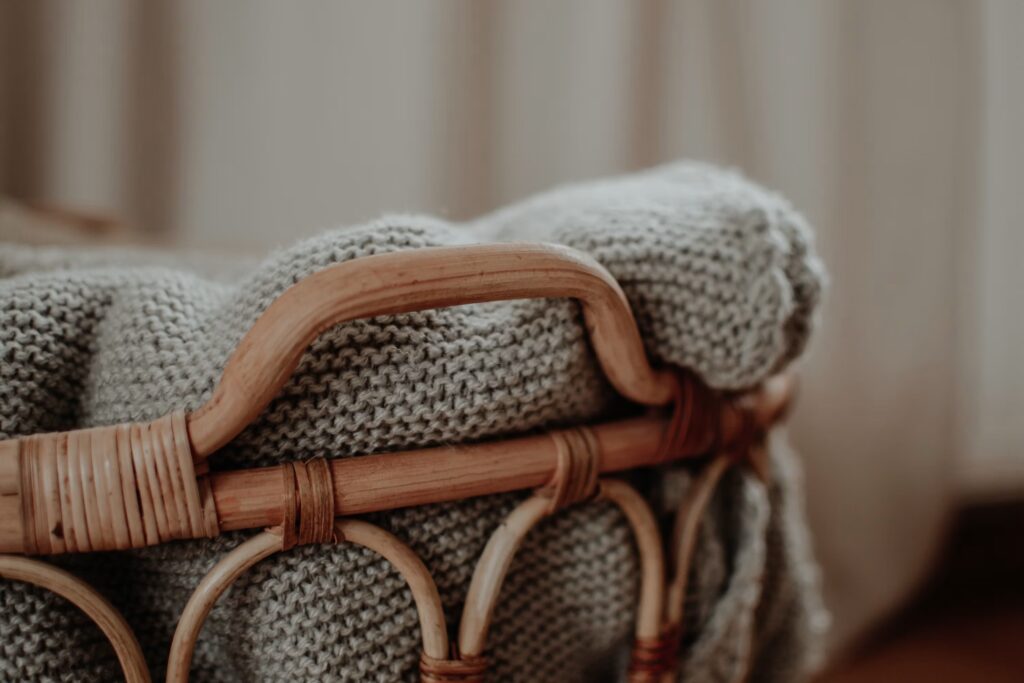
    A wicker basket sitting on top of a blanket photo

    Or: Why Your Grandma’s Afghan Deserves a Spa Day
    Let me tell you a secret that yarn stores don’t want you to know: your crochet blanket is not an inanimate object. It is a textile diary. Every loop holds a story. That slightly uneven edge? That’s the row where your aunt was watching a thriller and jumped at the plot twist. The impossibly tight stitch in the corner? That was made by someone thinking hard about a breakup. These items are memory keepers wrapped in wool, and yet—we toss them into the washing machine like they’re gym socks.
    Shame on us. All of us.

    Act I: The Confession

    First, admit your crimes. Have you ever thrown a handmade cardigan into a hot wash because you were “in a rush”? Have you watched in horror as a beloved crochet hat emerged from the dryer looking like it had been designed for a teacup chihuahua? Welcome to the club. The membership fee is one shrunken sweater and a heavy conscience.
    Here’s the plot twist nobody expects: crochet items are more like houseplants than laundry. They don’t want aggression. They want attention. They want you to look them in the eye (or the loop) and say, “I see you, you beautiful tangle of patience and time.”
    Before we even talk about water, let’s talk about reading. Not poetry—labels. If your item came with care instructions, treat that scrap of paper like a treasure map. If it didn’t, assume the yarn is a drama queen until proven otherwise. Cotton plays it cool. Wool is the sensitive artist. Acrylic is the easygoing friend who forgives everything. But even acrylic has limits. Don’t test them.

    Act II: The Baptism

    Now, the water. And here’s where logic takes a vacation.
    You might think: Hot water kills germs, so hot water is good. Wrong. Hot water is the villain of this story. Hot water is what turns a lovingly crafted shawl into a felted coaster. The golden rule—scratch that, the platinum rule—is: cold or lukewarm water only. Think of the temperature you’d use to bathe a newborn kitten. That level of tenderness.
    Fill a basin. Not the sink where you washed dishes yesterday. A clean basin. Add a splash of mild detergent—baby shampoo works beautifully in a pinch, and here’s why: if it’s gentle enough for a baby’s scalp, it’s gentle enough for forty hours of someone’s crochet labor. Swirl the water with your hand until it looks like a tiny, fragrant ocean.
    Then lower the item in. Slowly. Dramatically. Imagine you’re lowering a treasure chest into the sea.
    Hands Washing Clothes in Water Basin Outside
    Do not wring. I repeat: do not wring. Wringing is how you turn art into anxiety. Instead, press. Gently. Squeeze the water out like you’re coaxing secrets from a shy friend. If the water turns slightly colored, don’t panic. Some yarns are simply dramatic and like to release a little dye as a form of self-expression. It’s their version of a moody sigh.
    Rinse the same way—gentle, patient, repetitive. Think of it as a meditation. If you’re stressed, your crochet item can feel it. (Okay, scientifically maybe not, but why risk it?)

    Act III: The Secret Life of Stitches

    Here’s where things get weird—in a good way.
    Did you know that wool has memory? It’s true. Wool fibers remember the shape they were in when they dried. This is both magical and terrifying. It means if you dry your crochet sweater flat in the right shape, it will return to that shape like a loyal dog. But if you hang it dripping wet like a criminal in a dungeon, it will stretch, sag, and never forgive you.
    The drying process is where most crochet care goes to die. People think: I’ll just drape it over a chair. No. That chair will leave a crease that haunts you for years. People think: The dryer on low won’t hurt. Oh, but it will. It will hurt everything.

    Lay your item on a clean, dry towel. Roll the towel up with the item inside, like a sleeping bag for a very tired textile. Press gently to remove excess water. Then unroll, reshape the item with your hands—this is called “blocking,” and it sounds technical but it’s really just you being a sculptor with damp yarn—and lay it flat on a fresh dry towel or a blocking mat if you’re fancy.
    Walk away. Let it dry naturally. This takes time. Crochet does not believe in microwave culture. Crochet believes in slow living. In a world of instant everything, your handmade item is a rebellion. Treat it like one.
    And here’s the unexpected truth: the time you spend caring for your crochet item is time it spends caring for you. There’s a reason people wrap themselves in handmade blankets when they’re sad. These objects hold intention. They hold hours of someone’s life. When you wash them with care, you’re not just cleaning fabric. You’re maintaining a relationship.

    Act IV: The Legacy

    Storage. The final frontier.
    Do not—under any cosmic circumstances—store crochet items in plastic bags. Plastic traps moisture, and trapped moisture breeds mildew, and mildew turns your treasured heirloom into a science experiment. Use cotton storage bags, or old pillowcases if you’re feeling resourceful. Add a sachet of lavender or cedar blocks to keep moths away. Moths, by the way, are the true enemies of crochet. They have no respect for art.
    Every few months, take your stored items out. Air them. Let them breathe. Fold them differently so they don’t develop permanent creases. Talk to them if you want. I’m not here to judge.
    If you’re a maker, consider attaching a care label to your creations. Not because you’re obsessive, but because you’re generous. You’re giving the next owner a cheat code to keep the magic alive. “Hand wash cold, lay flat to dry”—eight words that can save a hundred hours of work.

    You Might Also Love

  • Why Handmade Blankets Feel More Luxurious Than Expensive Throws

    Why Handmade Blankets Feel More Luxurious Than Expensive Throws


    Taupe Chunky Knit Merino Wool Blanket - Handmade Cozy Throw
    We’ve been trained to believe that luxury is a transaction. Swipe a card, acquire a feeling. The cashmere throw from the heritage brand. The merino blanket with the Italian label. The limited-edition collaborative piece that arrives in a box you feel guilty throwing away.
    And they are beautiful. Soft. Impressive.
    But here’s the plot twist that changes how you experience every evening on the sofa: a handmade blanket feels more luxurious than any of them. Not because it cost more. Not because it looks better in a photograph. Because of something no factory can weave into fiber — intention made tangible.

    The Weight of Warmth

    Let’s start with physics.
    Pick up a machine-made luxury throw. It’s light. Engineered to be invisible. Designed to add color without adding gravity. It drapes like a suggestion — there if you need it, forgettable if you don’t.
    Now pick up a handmade blanket. It’s heavy. Dense. The kind of weight that settles on your shoulders like a hand on your back after a long day. That weight isn’t accidental. It’s the accumulation of thousands of decisions: this stitch, this tension, this row, this hour.
    The bed above understands this perfectly. A chunky knit blanket in warm taupe, folded at the foot of a dark, quiet bed. The scale is enormous — each loop the size of a fist. The weight is palpable even in a photograph. This isn’t a blanket that decorates a room. It’s a blanket that grounds it.
    Expensive throws are optimized for shipping weight. Handmade blankets are optimized for emotional weight. And when you’re under one at midnight, reading by the light of a single lamp, your nervous system knows the difference.
    Your body doesn’t check the label. It checks whether the blanket will stay where you put it. Whether it will warm you gradually, like a slow exhale. Whether it feels like it was made for this moment.
    Machine-made blankets cover you. Handmade blankets hold you.

    The Invisible Architecture

    Here’s the counterintuitive truth: luxury isn’t felt by the eyes. It’s felt by the skin.
    A $600 throw from a designer house is chemically treated to be uniform. Every fiber is the same diameter. Every row is the same height. The texture is mathematically smoothed until it becomes a sealed surface — beautiful to look at, strangely dead to touch.
    A handmade blanket is the opposite. The stitch that’s slightly tighter where the maker paused to answer the door. The loop that loosened when the yarn ran low and tension changed. The edge that waves instead of cutting straight. These aren’t flaws. They’re events.
    CREVENT Crochet Throw Blanket for Couch Sofa Bed Light Weight Soft Warm  50x60 inches Turquoise
    The throw above carries this philosophy. Cream wool in a subtle rib, draped over a white armchair like it was tossed there by someone who lives here. The fringe isn’t factory-cut to identical lengths. The drape isn’t styled. It simply fell that way — because handmade textiles have a relationship with gravity that machine textiles don’t.
    Your fingers know the difference. They find the ridges. They follow the channels between stitches. They encounter variation, and that variation keeps them interested. A machine blanket is a wall. A handmade blanket is a conversation.

    7 Reasons Handmade Blankets Are Better Than Luxury Throws

    Ready to understand why your grandmother’s afghan outperforms the department store throw? Here’s the real playbook:
    1. Thermal Intelligence
    Machine blankets insulate. Handmade blankets breathe. The slight irregularity in hand-tension creates micro-channels of air. You warm up without overheating. You cool down without getting cold. It’s the difference between a sealed room and a room with the window cracked.
    2. The Drape Doctrine
    Expensive throws are stiffened with sizing to survive retail display. Handmade blankets are softened by use. The first time you drape one over a sofa, it doesn’t hold the shape. The tenth time, it remembers. It learns your furniture. It becomes custom-fit to your life.
    3. Acoustic Absorption
    Handmade textiles absorb sound differently. The open structure of crochet or the dense loops of knitting trap echo. A room with a handmade blanket is quieter. More intimate. The sound dies where the fibers begin.
    4. Biophilic Response
    Your brain is wired to respond to irregular, natural textures. Neuroscientists call it “tactile nourishment.” When your skin encounters the uneven surface of a handmade blanket, it triggers the same parasympathetic response as walking barefoot on grass or sand. Machine perfection can’t replicate this.
    5. The Patina of Use
    A cashmere throw pills and looks worn out. A handmade blanket pills and looks worn in. The spot where the cat kneads. The corner that fades where the sun hits. The edge that softens first. These aren’t damages. They’re the blanket’s autobiography.
    6. Emotional Weight
    Expensive throws impress guests. Handmade blankets comfort you. The weight of a chunky knit has been shown to reduce cortisol levels — the same science behind weighted blankets, but achieved through density and scale rather than artificial filling.
    7. Uniqueness
    No two handmade blankets are identical. Even the same maker, using the same pattern, will produce slightly different tension on different days. You own something that exists exactly once in the universe. No luxury brand can offer that.

    How to Choose the Perfect Handmade Blanket

    Google loves specificity. So do your cold feet at 2 a.m. Here’s how to pick the right handmade blanket for your space, your climate, and your life.
    Chunky Knit Blankets
    Best for: Modern bedrooms, Scandinavian interiors, statement pieces.
    Yarn: Super-bulky merino wool or vegan acrylic blends.
    Feel: Heavy, cloud-like, dramatic visual presence.
    Care: Spot-clean preferred; some merino felts if washed aggressively.
    Where to use: Draped at the foot of a bed, folded over a wide armchair.
    Crochet Throws
    Best for: Cottage style, farmhouse interiors, boho living rooms.
    Yarn: Cotton, cotton-linen blends, or light wool.
    Feel: Airy, breathable, structured patterns (granny squares, shells, ripples).
    Care: Machine-washable if cotton; gets softer with every wash.
    Where to use: Sofa back, reading nook, guest room layering.
    Wool Blankets
    Best for: Cold climates, rustic cabins, fall decorating.
    Yarn: Pure sheep’s wool, alpaca, or merino.
    Feel: Warm, slightly coarse, naturally water-resistant.
    Care: Air out regularly; dry-clean only.
    Where to use: Bed top layer, outdoor firepit seating, camping luxury.
    Cotton Blankets
    Best for: Warm climates, minimalist homes, all-season use.
    Yarn: Organic cotton, pima cotton, or recycled cotton blends.
    Feel: Light, crisp, breathable, gets better with age.
    Care: Machine washable; tumble low.
    Where to use: Summer bed cover, living room everyday throw, children’s rooms.
    Merino Wool Throws
    Best for: Quiet luxury homes, neutral color palettes, gift-worthy pieces.
    Yarn: Fine merino (21 micron or finer).
    Feel: Soft as cashmere, warm as wool, no itch.
    Care: Hand-wash cold; lay flat to dry.
    Where to use: Master bedroom, reading chair, anywhere skin touches fiber.
    Oversized Handmade Throws
    Best for: Large sectionals, king beds, cozy layering.
    Size: 60×80 inches or larger.
    Feel: Generous, enveloping, shareable.
    Where to use: Family movie nights, guest bedding, window seat cushions.
    Neutral Colors for Modern Homes
    Best palette: Oatmeal, sand, stone, cream, warm grey, undyed natural.
    Why it works: Neutrals don’t compete with furniture. They adapt to seasonal decor. They photograph beautifully for Pinterest. And they age gracefully — a cream blanket in year five looks vintage, not dirty.
    Table
    Table

    Blanket Type Best Room Best Season Care Level
    Chunky knit Bedroom Winter Low
    Crochet throw Living room All year Easy
    Wool blanket Cabin/rustic Fall/winter Medium
    Cotton blanket Any room Spring/summer Easy
    Merino throw Master bedroom All year High
    Oversized Family room All year Low

    Handmade Blanket Styling Ideas

    Pinterest loves a styled throw. But real life loves a throw that’s actually used. Here’s how to achieve both.
    Bedroom
    Drape a chunky knit blanket across the foot of a white linen bed. Let it fall asymmetrically — one side longer than the other. Add a single textured pillow in a tone-on-tone shade. The result reads boutique hotel, not craft fair.
    Living Room
    Fold a crochet throw in thirds and lay it over the back of a neutral sofa. Don’t tuck the ends. Let them hang. Place a wooden tray with a candle and a book on the coffee table. The blanket invites sitting. The tray invites staying.
    Reading Nook
    Layer two blankets: a solid wool base and a patterned crochet top. Add a floor lamp with a warm bulb (2700K). A small side table for tea. The nook isn’t decorated — it’s equipped for disappearance.
    Fall Decorating
    Switch to warmer tones: rust, mustard, olive, chocolate. Replace lightweight summer cotton with dense wool or chunky knits. Add dried grasses in a ceramic vase. The blanket becomes the color anchor of the entire room.
    Cottage Style
    Choose openwork crochet in cream or pale grey. Pair with floral prints, painted wood furniture, and vintage ceramics. The blanket should look like it was inherited — even if you made it last Tuesday.
    Farmhouse Interiors
    Use a thick, nubby wool throw in oatmeal or grey. Pair with raw wood, galvanized metal, and linen slipcovers. The blanket adds softness where architecture is hard. Drape it over a ladder-back chair or a wire basket.
    Scandinavian Homes
    Go monochrome. A white-on-white bedroom with a single cream chunky knit. Or a grey sofa with a slightly lighter grey handmade throw. The key is restraint: one texture, one color family, maximum calm. Hygge isn’t clutter. It’s intention.

    The Science of Cozy

    Why do these details work so powerfully? Because your body is older than capitalism.
    Table
    Table

    Element Machine-Made Luxury Handmade Blanket
    Weight Light, optimized for shipping Heavy, grounding, pressure-calming
    Texture Sealed, uniform surface Open, variable, engages touch receptors
    Temperature Synthetic fibers trap heat Natural fibers breathe, regulate
    Sound Flat acoustic signature Absorbs echo, softens room
    Aging Pills, looks worn out Develops patina, looks lived-in
    Emotional effect Impressive Comforting
    This table isn’t just theory. It’s a diagnostic tool. Next time you’re under a blanket, check: does it impress you, or does it comfort you? If the answer is only the first, you own a decoration. If it’s the second, you own a companion.

    The Bedroom as Sanctuary

    Now look at the image below and notice what happens to your breathing.
    Cozy Chunky Knit Blanket Texture Warm Home Interior Detail
    A neutral bedroom. White linens. A chunky knit throw in oatmeal, draped across the foot of the bed with the kind of casualness that takes years to perfect. Botanical prints on the wall. A single plant. Nothing shouts. Everything whispers.
    This is the opposite of a styled photograph. This is a lived photograph. And the blanket is the reason it works. Remove it, and the room is a hotel. Add it, and the room is a sanctuary.
    The blanket doesn’t match the room. It agrees with it. The slight unevenness of the hand-knit texture echoes the imperfection of the linen sheets. The weight of it anchors the visual lightness of the white bedding. The color — neither cream nor grey, but something in between — bridges every other tone in the room.
    This is what handmade textiles do that expensive throws don’t: they mediate. They negotiate between the hard and the soft, the cold and the warm, the perfect and the human.

    The Living Room Lie

    We’ve been sold a lie about living rooms.
    The lie is that they should look like magazine spreads. That the throw on the sofa should be color-coordinated to the pillows. That the blanket should be folded at a perfect 45-degree angle, waiting for a photographer.
    50 Cozy Living Room Ideas That Make Your Home Look Expensive in 2026
    The room above tells a different story. A cream crochet blanket draped over the arm of a white sofa, not because it was styled that way, but because someone was reading there an hour ago and left it. A candle burning. Coffee cooling. Books stacked unevenly. The blanket isn’t performing. It’s resting.
    And that rest is contagious. When you enter a room where textiles are allowed to be tired, you feel permission to be tired too. You don’t have to perform perfection. You can simply sit. Simply be. Simply pull the blanket over your knees and let the afternoon dissolve.
    Expensive throws demand attention. Handmade blankets give permission.

    Your Blanket Manifesto

    So here’s your homework. Not a shopping list. A shift in attention.
    Remove one machine-made throw. The one that came in a gift box. The one with the label you still haven’t cut off. The one that looks beautiful in daylight but feels like plastic at midnight.
    Add one handmade blanket. Not expensive. Just made. A crochet afghan from a market. A knit throw from a friend. Something with uneven edges and the faint smell of wool.
    Protect the imperfection. The loop that’s looser than the others. The spot where the color changes slightly. The fringe that tangled in the wash. These aren’t flaws. They’re evidence.
    May your evenings be heavy. May your blankets be uneven. May your home feel like the most luxurious place in the world — not because you bought it, but because someone, somewhere, made it with hands that knew the weight of time.

    You Might Also Love

  • The Lace That Time Forgot

    The Lace That Time Forgot

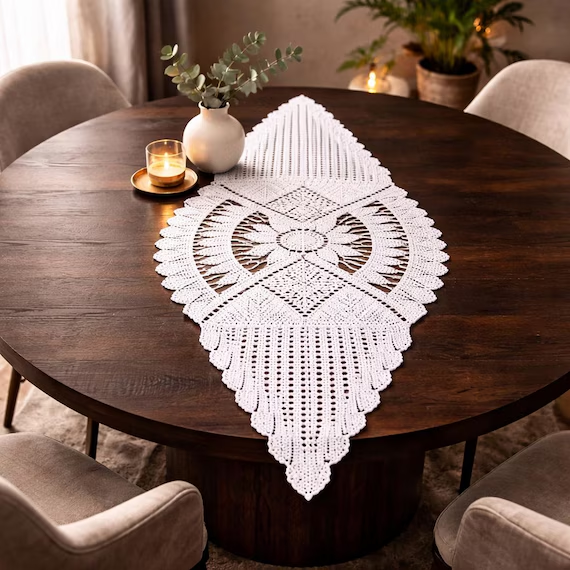
    Crochet Table Runner Crochet Table Doily Doily Runner Center Piece Lace  Runner Home Décor Crochet Table Runner Pattern Written Instructions - Etsy
    The runner that whispered: “Slow down. I’m worth it.
    “Disclosure: This post contains affiliate links to Creative Fabrica. I only recommend products I genuinely love this Crochet Oval Plush Table Runner Pattern in PDF format

     Or: How a Single Thread Resurrected My Dining Room and My Soul

    Chapter 1: The Pinterest Trap

    I fell down a rabbit hole.
    It started innocently. “Quick dining room refresh,” I typed. Thirty-seven tabs later, I was staring at $4,200 Restoration Hardware tables, $800 pendant lights, and a ceramic vase that cost more than my first car.
    My dining room didn’t need a refresh. It needed a mortgage.
    And then — buried between a sponsored post for marble coasters and an influencer’s “affordable” living room reveal — I saw it. A photo so quiet, so unassuming, it almost didn’t register.
    A wooden table. Natural light streaming through sheer curtains. A white ceramic vase holding dried flowers. And beneath it all, like a secret only the patient could hear: a lace table runner.
    Not just any lace. This was filet crochet. Openwork. Geometric. The kind of lace that looks like someone took a spiderweb, taught it manners, and invited it to dinner.
    I stared at it for eleven minutes. I know because my phone told me.
    And then I did something radical. I closed all thirty-seven tabs. I opened my yarn stash. And I decided to make the thing that had stopped my scroll.

    Chapter 2: The Thread That Time-Traveled

    Handmade Crochet Lace Doily – Vintage Style Cotton Table Decor (14 Inch),  White Dresser Doily, Coffee Table Doily - Etsy
    The language of grandmothers, decoded one square at a time.
    Filet crochet is old. Like, centuries old. It started in the fishing villages of Italy — yes, actual fishermen’s nets — and somehow, through some miracle of human creativity, became the language of Victorian parlors and French châteaux.
    Here’s how it works: you crochet a grid. Some squares are filled (solid blocks of double crochet). Some are empty (chain spaces that let the light through). Together, they form pictures. Patterns. Stories told in negative space.
    It’s basically pixel art. But with cotton. And patience. And the occasional urge to throw your hook across the room.
    I chose white cotton. Not cream. Not ivory. The kind of white that makes you think of fresh sheets, of blank pages, of possibilities. The kind of white that says: “I am a canvas. Make me mean something.”
    The first row took forty minutes. Forty minutes for twelve inches of thread. My husband walked past, saw me counting stitches out loud, and quietly backed away.
    By row three, I understood why filet crochet survived centuries. It’s not fast. It’s not efficient. It’s not “content.” It’s the opposite of everything modern life demands.
    And that’s exactly why it matters.

    Chapter 3: The Geometry of Obsession

    Luxury Hand Crocheted Lace Table Runner, Vintage Beige/white Crochet Decor,  Country Farmhouse Style - Etsy
    Where mathematics meets poetry — one block at a time.
    Filet crochet is secretly math. Don’t tell anyone.
    Each pattern is a grid. Each grid is a decision: fill or empty? Solid or space? And those decisions, repeated hundreds of times, create something your brain recognizes before your eyes can name it.
    I was making a simple geometric pattern — diamonds within diamonds, the kind of design that feels both ancient and utterly modern. But here’s what nobody warns you about: filet crochet is a meditation you can’t escape.
    There’s no autopilot. No “muscle memory” to save you. Every stitch requires you to look at the chart, count your chains, decide: block or space? Over and over. For hours.
    My mind wandered. It came back. It wandered again. And slowly, something strange happened.
    I started noticing things I’d been missing. The way afternoon light hits my kitchen counter at 4 PM. The sound of my neighbor’s wind chime. The fact that my cat’s purr has three distinct frequencies.
    Filet crochet doesn’t just make lace. It makes you present.

    Chapter 4: The Reveal Nobody Expected

    Cozy Modern Cottage Dining Room Designs - Edward George
    The moment handmade meets home — and everything changes.
    Three weeks. That’s how long it took. Not because I’m slow (okay, I’m slow), but because filet crochet refuses to be rushed. It’s like a sourdough starter or a good friendship — it takes the time it takes.
    The day I finished, I washed it. Blocked it. Laid it on my dining table with the kind of ceremony usually reserved for wedding cakes.
    And then I stepped back.
    My dining room — the same room I’d been trying to “refresh” with $4,200 tables and $800 lights — suddenly looked… complete. The wooden table I’d owned for years, the one I’d been planning to replace, suddenly looked intentional. The ceramic vase I’d bought on sale at Target looked curated. The whole room felt like someone had whispered a secret into it.
    My husband walked in. Stopped. Actually looked.
    “Did you make that?”
    “I did.”
    “It looks like it belongs in a magazine.”
    I didn’t tell him it cost $8 in cotton thread and 63 hours of my life. I just smiled and said: “Thanks.”

    Chapter 5: The Philosophy of Negative Space

    White French Crochet Table Runner - Striped, Fringed – SilvesterFabric
    What isn’t there matters as much as what is.
    Let me get slightly philosophical. (I promise it’ll be quick.)
    Filet crochet taught me something about life. About my home. About the spaces we create and why we create them.
    The “empty” squares — the chain spaces, the holes, the negative space — aren’t failures. They’re not “missing” stitches. They’re intentional. They’re what lets the light through. They’re what makes the pattern breathe.
    And I realized: my home was full of “empty squares” I’d been trying to fill. Blank walls I thought needed art. Corners I thought needed furniture. Surfaces I thought needed stuff.
    But maybe the beauty isn’t in the filling. Maybe it’s in the choosing. The curation. The courage to leave space for light, for air, for possibility.
    That lace runner, with its deliberate holes and careful solids, is a metaphor I didn’t ask for but desperately needed.

    Chapter 6: Where to Begin Your Own Time Travel

    Boho Crochet Table Runner With Fringe, Macrame Style Beige Runner, Rustic  Farmhouse Decor for Dining or Weddings, Housewarming Gift Idea
    The invitation — your table is waiting.
    Okay. Real talk. You don’t need to be a crochet wizard to make this. I’m not. I’m just persistent. And I had help.
    A good filet crochet pattern is like a treasure map. It shows you where the blocks go, where the spaces live, and how the whole thing comes together into something that looks impossibly complex but is actually just… repetition. Beautiful, meditative, soul-filling repetition.
    The pattern I used was perfect for this. It had a chart (because filet crochet without a chart is like driving without a map). It had clear instructions. And it produced a runner so elegant, so quietly stunning, that my dining room went from “needs a refresh” to “exactly right” with one piece of cotton thread.
    If you’re looking at your own dining table — or coffee table, or dresser, or that sad console table by the door — and thinking “this space needs something, but I don’t know what,” here’s my suggestion:
    Don’t buy something. Make something. Something slow. Something intentional. Something that carries your hours and your attention and your love in every stitch.
    If you want to start with a pattern that holds your hand through the grid, the blocks, and the beautiful emptiness between them, here’s the one I used: this Crochet Oval Plush Table Runner Pattern in PDF format. It’s beginner-friendly, includes detailed charts, and produces a runner that makes any surface feel like it was styled by someone who actually cares.

    Chapter 7: The Side Effects of Slowness

    Rustic Cottage Crochet Placemat Pattern | Beginner-friendly DIY Tutorial |  Crochet Pattern for Home Decor | English PDF | Brushnhook
    One handmade piece invites another — and another.
    Making this runner had consequences I didn’t see coming.
    Consequence 1: I now notice lace everywhere. In museums. In old movies. In my grandmother’s photo albums. I have become a lace-detector. It’s a beautiful curse.
    Consequence 2: My home has slowed down. Not literally — the chaos of daily life continues — but visually. The runner creates a quiet center. A place for the eye to rest. An anchor in the storm of toys, mail, and half-empty coffee cups.
    Consequence 3: I have developed a reputation. I’m “the friend who makes things.” This means I get invited to craft nights and fewer “let’s go shopping” afternoons. I am not complaining.
    Consequence 4: I have become emotionally attached to a piece of cotton thread. I smooth it after meals. I rotate it seasonally. I once panicked when I thought the cat had snagged it. (He hadn’t. He was just sitting on it. Rude.)

    Chapter 8: Your Invitation to the Grid

    Crochet Table Runner Crochet Table Doily Doily Runner Center Piece Lace  Runner Home Décor Crochet Table Runner Pattern Written Instructions
    The finished object — where patience becomes presence.
    So here’s my challenge to you.
    Not “go buy lace.” Not “become a crochet master overnight.”
    Just this: make one slow thing. One thing that takes longer than you think it should. One thing that requires you to look at a chart, count your stitches, and breathe through the frustration when you mess up row seven.
    Start with a table runner. A long, lace, filet declaration of intention. Something that transforms a surface from “functional” to “meaningful.”
    If you need a place to start — a pattern that guides you through the grid and celebrates you when you finish — here’s the one that started my obsession: this complete PDF crochet pattern for an elegant table runner. It comes with charts, step-by-step instructions, and the kind of encouragement that makes you believe you can actually finish something this beautiful.
    Because you can. I promise. If I can turn a Pinterest scroll into a dining room centerpiece, you can too.

    Epilogue: The Lace Lives On

    Cozy Modern Cottage Dining Room Designs - Edward George
    Some stories don’t end — they just keep getting more beautiful.
    It’s been four months since I finished my runner.
    The white has softened slightly. The cotton has relaxed into that perfect lived-in drape. The pattern — those diamonds within diamonds — catches the light differently at every hour of the day.
    And my dining room? It’s no longer a room I want to “refresh.” It’s a room I want to live in. To eat in. To laugh in. To leave empty sometimes, just so I can look at the lace and remember that beauty doesn’t require a credit card.
    My husband still notices it. Every time we have guests, someone asks where I bought it. And I always smile and say: “I didn’t.”
    Then I watch their face do the thing.
    The “wait, you MADE this?!” thing. The thing that makes all the counted stitches worth it.
    The hook is in your hands now.
    What will you make for the spaces you love?
  • The Table Runner That Ate My Weekend

    The Table Runner That Ate My Weekend

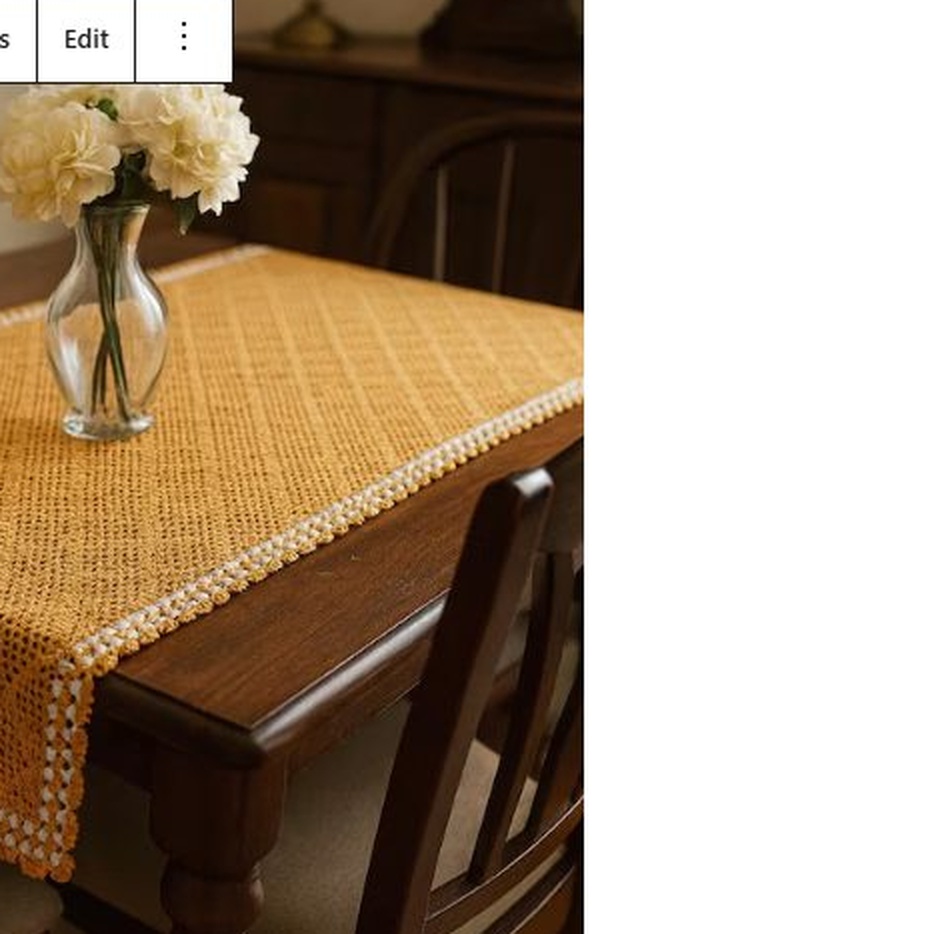
    Mustard Yellow Crochet Table Runner - Daisy Trim Lace Decor. Or: How a Yellow Oval Changed My Relationship With Furniture

    Disclosure: This post contains affiliate links to Creative Fabrica. I only recommend products I genuinely love this Crochet Oval Plush Table Runner Pattern in PDF format

    The runner that started it all. One oval. Zero regrets. Infinite brunch invitations.

    Chapter 1: The Table That Broke Me

    My dining table was sad.
    Not “needs a therapist” sad. More like “wears the same outfit every day and has given up on life” sad. It was a perfectly good wooden table — sturdy, rectangular, the kind of table that says “I am functional and I have accepted my fate.”
    I tried placemats. I tried a vase. I even tried one of those Pinterest-centerpiece situations with floating candles and eucalyptus that smelled like a spa but looked like a funeral.
    Nothing worked.
    The table remained sad. And then, one Tuesday at 11 PM — because all great ideas happen at 11 PM — I had a thought:
    What if I crocheted it a sweater?
    Not a literal sweater. That would be weird. (Though now that I say it out loud, a table sweater has potential.) No. I meant a table runner. A long, plush, yellow oval of happiness that would transform my sad table into a table that dares to dream.
    I grabbed my hook. I grabbed some yarn. And I made a terrible mistake:
    I chose yellow.

    Chapter 2: The Yellow That Wouldn’t Quit

    The color of sunshine, optimism, and mild existential dread.

    Yellow is not a color. Yellow is a personality.
    I picked a bright, buttery, unapologetic yellow. The kind of yellow that doesn’t whisper — it sings. The kind of yellow that makes your morning coffee feel like a celebration. The kind of yellow that says: “I am here. I am oval. Deal with it.”
    I bought four skeins. (Okay, six. Two were “for backup.” Three were “just in case.” One was because the store was closing and they were on sale.)
    The first row was magical. The second row was satisfying. The third row was when I realized: this is an oval. And ovals are not rectangles. Ovals have curves. Ovals have increases and decreases. Ovals have math.
    I hate math.
    But I kept going. Because something strange happens when you crochet a table runner. You start talking to it. You start patting it. You start referring to it as “my oval” in conversations with your partner, who looks at you with increasing concern.
    “How’s my oval doing?” I’d ask, walking past the work-in-progress.
    “It’s… it’s a table runner, babe.”
    “No. It’s MY OVAL.”

    Chapter 3: The Physics of Plush

    Free Easy Bernat Springtime Kitchen Accessories Crochet Pattern |  Yarnspirations
    Where the magic happens — one plush stitch at a time.
    Here’s what nobody tells you about a “plush” table runner: it’s thick. Like, really thick. Like, “this could double as a yoga mat” thick.
    A regular table runner? Flat. Boring. Functional. It lays there and does its job and goes home at 5 PM.
    A plush table runner? It has presence. It has volume. It has the kind of texture that makes people reach out and touch it without asking permission. (Rude, by the way. But also understandable.)
    The plush stitch is basically a double crochet that ate a sandwich. It’s puffy. It’s squishy. It’s the crochet equivalent of a hug. And when you work it in a continuous oval — increasing at the ends, decreasing at the sides, praying to the geometry gods — it creates this beautiful, rounded, cloud-like shape that makes you want to set the table even when you’re eating cereal out of the box.
    I worked on it for three days. My fingers went numb. My couch developed a permanent yarn dent. My cat claimed the work-in-progress as his personal throne and had to be bribed with treats to move.
    But when I finished? When I laid that yellow oval on my sad wooden table?
    The table smiled.
    I swear. It smiled.

    Chapter 4: The Brunch That Changed Everything

    Crochet Table Runner & Placemat Pattern: Modern Boho or Farmhouse Dining  Set (PDF Pattern) - Etsy
    The moment of truth — when handmade meets hospitality.
    I invited my friends over for brunch. Not because I wanted to show off. (Okay, maybe a little.) But mostly because I needed witnesses. I needed people to see what my sad table had become.
    They walked in. They saw the table. They stopped.
    “Oh my god, did you MAKE that?!”
    “It’s so… YELLOW.”
    “Can I touch it?”
    (Yes, Karen, you can touch it. Everyone can touch it. That’s literally the point.)
    We sat down. We ate avocado toast. We drank too much coffee. And the entire time, no one could stop looking at the table runner. It was like a celebrity had joined us for brunch. A flat, oval, yellow celebrity that smelled faintly of yarn store.
    My friend Sarah — who has a master’s degree in interior design and judges everyone’s home silently — actually said: “This looks like something from Anthropologie.”
    I didn’t tell her it cost me $12 in yarn and 72 hours of my life. I just smiled and said: “Thanks. I made it.”
    And then I watched her face do the thing.
    You know the thing. The “wait, you MADE this?!” thing. The thing that makes all the finger cramps worth it.

    Chapter 5: The Secret I Need to Share

    Cozy Cottage Dining Room - The Beauty Revival
    The cozy home — where handmade meets heart.
    Here’s what I learned from this whole oval adventure: your home is a story, and you get to write it.
    That sad table? It wasn’t sad because it was plain. It was sad because I hadn’t given it a story yet. I hadn’t invested in it. I hadn’t spent 72 hours making something specifically for it, with love and yarn and a mild obsession with geometry.
    When you make something for your home — a table runner, a pillow, a blanket — you’re not just decorating. You’re narrating. You’re saying: “This space matters to me. This moment matters. This meal, this coffee, this conversation — they all deserve a beautiful setting.”
    And here’s the wild part: other people feel it.
    My friends didn’t just see a yellow table runner. They saw intention. They saw care. They saw someone who chose to spend three days making something beautiful instead of buying something disposable.
    That energy is contagious. That energy is real.
    If you’re looking at your own sad table — or sad couch, or sad shelf, or sad corner that you’ve been ignoring — and thinking “I wish it felt more like me,” here’s your permission slip: make something for it.
    Start with a table runner. A long, plush, oval hug for your furniture. Something that says “I am here. I am handmade. I am yours.”
    If you need a place to start — a pattern that holds your hand through the increases, the decreases, and the inevitable “why is this lopsided?!” moments — here’s the exact one I used: this Crochet Oval Plush Table Runner Pattern in PDF format. It’s beginner-friendly, includes detailed instructions for that tricky oval shape, and produces a runner so plush you’ll want to nap on it.

    Chapter 6: The Unexpected Side Effects

    The workspace of a maker — where dreams are built one stitch at a time.
    Making this table runner had consequences I didn’t anticipate.
    Consequence 1: I now set the table for everything. Breakfast. Snacks. Midnight cereal. My sad table has become a stage, and the yellow oval is the star.
    Consequence 2: My partner has started calling me “the oval lady.” I am not sure how I feel about this. I am also not sure I can stop it.
    Consequence 3: I have developed a deep, emotional attachment to a piece of fabric. I fluff it before guests arrive. I smooth it after meals. I once yelled at the cat for sitting on it. (He did not care. He sat on it anyway.)
    Consequence 4: I now notice table runners everywhere. Restaurants. Magazines. TV shows. I judge them all. “Too thin.” “Not plush enough.” “Where are the increases?!” I have become a table runner snob. This is my life now.

    Chapter 7: The Philosophy of the Oval

    Page 26 | Crochet texture Images
    The finished object — where geometry and coziness become one.
    Let me get philosophical for a second.
    Why does a handmade table runner matter? In a world where you can buy a perfectly decent one for $15 at IKEA, why spend three days crocheting one?
    Here’s my theory: handmade home decor is love made visible.
    That yellow oval isn’t just yarn. It’s the Netflix episodes I watched while making it. It’s the coffee that went cold. It’s the moment I almost gave up at hour 10 but kept going because I could already see how beautiful it would be.
    You can’t buy that. You can’t download it. You can’t subscribe to it.
    You can only make it.
    And every time someone sits at my table — every time they reach out and touch the plush stitches and say “this is so soft” — they’re feeling that love. They’re experiencing those hours. They’re connecting with something that was made slowly, deliberately, by hand.
    That’s the magic. That’s the whole point.

    Chapter 8: Your Turn to Make Magic

    Free Easy Bernat Springtime Kitchen Accessories Crochet Pattern |  Yarnspirations
    The tools of transformation — where a hook meets a dream.
    So here’s my challenge to you.
    Look at your home. Find the sad spot. The table that gave up. The shelf that’s just holding things. The corner that’s been ignored for too long.
    And make it something.
    Not buy. Make. Because the act of making is the act of claiming space. Of saying “this is mine, and I choose to fill it with beauty.”
    Start with a table runner. A long, plush, oval declaration of intent. Something that transforms a surface from “functional” to “fabulous.”
    If you need a pattern — a roadmap for your oval adventure — here’s the one that started my obsession: this complete PDF crochet pattern for an oval plush table runner. It comes with step-by-step instructions, tips for getting that perfect plush texture, and the kind of encouragement that makes you believe you can actually finish an oval without throwing it across the room.
    Because you can. I promise. If I can turn a sad table into a brunch destination, you can too.

    Epilogue: The Oval Lives On

    Mustard Yellow Crochet Table Runner - Daisy Trim Lace Decor
    The table that learned to dream — one yellow oval at a time.
    It’s been two months since I finished my oval.
    The yellow has softened slightly. The plush texture has settled into that perfect worn-in feel. The table — my formerly sad, formerly hopeless table — has become the heart of our home.
    We eat there. We laugh there. We spill coffee there and wipe it up and keep going.
    And every time I look at that yellow oval, I feel something I rarely feel in modern life: pride. Not the arrogant kind. The quiet, grounded kind that comes from knowing you built something beautiful with your own two hands.
    My partner still calls me “the oval lady.” The cat still sits on the runner. My friends still ask me to make them one.
    And I always smile and say: “Make your own. I’ll bring the coffee.”
    Because the best thing about handmade things isn’t owning them. It’s making them. It’s the journey from “I could never” to “I actually did.”
    The hook is in your hands now.
    What will you make for your home?