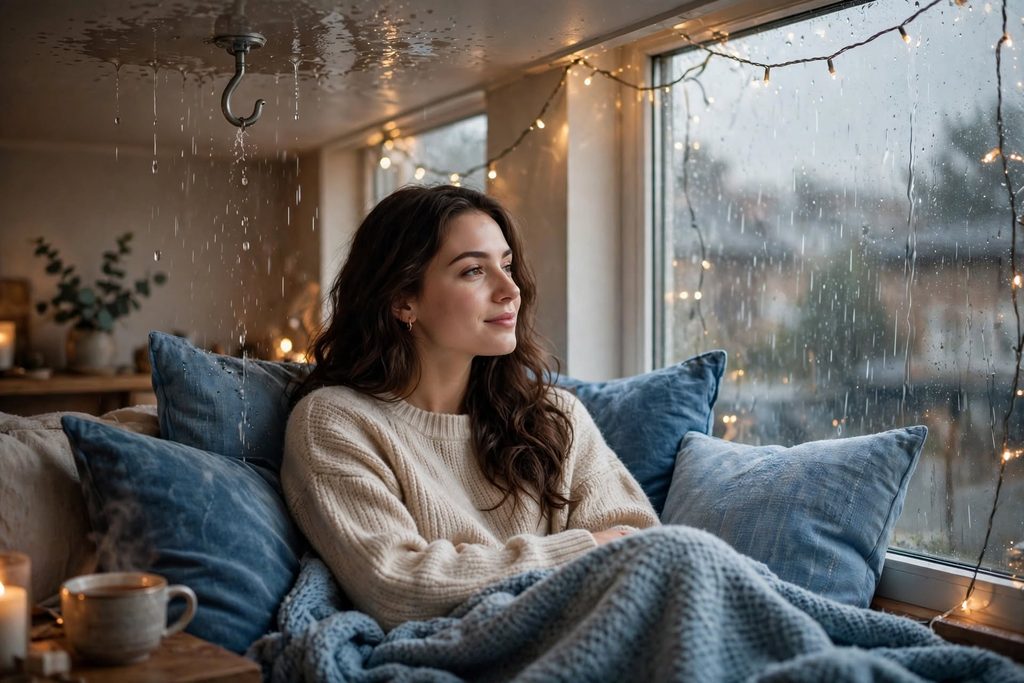
Woman relaxing by a rainy window with fairy lights, a cozy blanket, and blue pillows.
The sky is leaking. Your hook is waiНазваниting. This is not a coincidence.
Here is the first lie we tell ourselves about rainy days: that they ruin plans.
They don’t. They simply replace one kind of plan with another. The picnic becomes impossible, yes. The jog around the park? Postponed. But in exchange, the rain offers you something no sunny afternoon ever could: permission to stop moving.
And here is the second lie: that crochet is just a hobby. It’s not. On a rainy day, crochet becomes a negotiation with time. The rain says: you are not going anywhere. The hook replies: fine. I will build a world where going somewhere was never the point.
Below are four cozy crochet projects for stormy afternoons. Each comes with a quick-start guide, so you can choose something that fits your mood, your yarn stash, and the time you have available.
You don’t need to finish a giant blanket before the clouds clear. Sometimes, a small project and a warm drink are enough.
1. The Window Blanket That Eats the Gray

Chunky crochet blanket draped over an armchair by a rain-covered window, with a coffee cup nearby.
We think we watch the rain. We don’t. The rain watches us.
It presses its face against the glass — a billion tiny spectators — while you sit in the armchair with a crochet blanket growing across your lap. And here is where logic breaks: the blanket is not keeping you warm from the cold outside. It is keeping the outside from getting in.
Each stitch is a tiny wall. A row of half-double crochet is a fortress. By the time you finish a few rows, the rain has stopped being weather and become ambience.
The logic of a rainy-day blanket is backwards. You aren’t making it only to use on rainy days. You are making it because it’s raining. The drops on the window set the rhythm. The gray light removes the pressure of productivity. The blanket absorbs the rain’s grayness and converts it into texture.
🧶 Rainy-Day Blanket — Quick Start
| Detail | Recommendation |
|---|---|
| Yarn weight | Bulky (#5) or super bulky (#6) |
| Hook | Start with the size recommended on your yarn label; approximately 8–10 mm may suit many bulky yarns |
| Best stitch | Half double crochet (HDC) for a simple, textured fabric |
| Skill level | Beginner |
| Time | Several evenings to several weeks, depending on the finished size and your pace |
| Best colors | Oatmeal, charcoal, mushroom, wet-bark brown, fog gray |
Pro tip: Work in simple rows of HDC back and forth. You don’t need a complicated stitch pattern to make a beautiful blanket. Let the yarn do some of the visual work.
Before you begin: Decide on the finished dimensions and check your yarn’s yardage. A small lap blanket and a full-size throw require very different amounts of yarn. Make a small swatch if you want a better estimate of the finished fabric and drape.
2. The Cup Cozy That Lies to Your Hands

Handmade blue crochet cup cozy with a wooden button on a white mug.
There is a strange loneliness in holding a ceramic mug. It is smooth, hard, and honest about what it is: a vessel. It does not pretend to care about your fingers.
A crochet cup cozy is a conspiracy of comfort. It wraps the mug in yarn and whispers to your palms: this is alive. This is warm because it loves you.
It isn’t, of course. It’s just cotton or acrylic. But on a rainy day, we need the lie.
The cozy gives your coffee personality. It turns an ordinary mug into something that looks as though somebody thought about it. And when the rain drums against the roof in that particular rhythm that makes you remember childhood, your mug — now wearing its little yarn sweater — becomes the only handhold you need.
The surprise? You don’t even need an elaborate pattern. A rectangle, a button, and a little time while the storm builds can be enough to transform a disposable moment into something that feels crafted with intention.
🧶 Crochet Cup Cozy — Quick Start
| Detail | Recommendation |
|---|---|
| Yarn | A small amount of worsted-weight cotton or acrylic |
| Hook | Approximately 4–5 mm; adjust to your yarn and tension |
| Best stitch | Single crochet, worked through the back loop for a ribbed effect |
| Skill level | Beginner |
| Time | Approximately 30–45 minutes for a simple rectangle, once you’re comfortable with the stitches |
| Best colors | Denim blue, cream, mustard, dusty rose |
Pro tip: Add a wooden button for closure. It elevates a simple project into a gift-worthy object.
Fit tip: Measure the mug before making the foundation chain. The rectangle should wrap around the mug without being stretched tightly. Leave enough room for the handle, and make sure the cozy stays clear of the drinking rim.
A cozy is decorative and can make a mug more comfortable to hold, but it does not guarantee protection from hot surfaces. Use care when handling hot drinks, and remove the cozy before washing the mug.
3. Slipper Socks That Make Rainy Floors More Bearable

Cozy crochet slipper socks in neutral stripes resting on a green ottoman.
Here is a question nobody asks: why do we accept that floors must be cold?
We install heating, rugs, slippers — all apologies for the floor’s fundamental betrayal. But crochet slipper socks don’t apologize. They negotiate. They say: the floor is no longer your enemy. It is simply the bottom of your sock.
The logic is almost offensive in its simplicity. You crochet a foot-shaped piece, work the upper section, and finish the opening with a snug cuff. Suddenly, the journey from window to kettle to couch feels a little more civilized.
There is one practical detail worth remembering, though: feet are not tubes. A sock that is easy to crochet is not automatically a sock that fits well. The heel, instep, and toe all influence comfort, especially if you want to wear the socks for more than a few minutes around the house.
🧶 Crochet Slipper Socks — Quick Start
| Detail | Recommendation |
|---|---|
| Yarn | Bulky wool or a wool blend; quantity depends on foot size, yarn yardage, and construction |
| Hook | Approximately 5.5–6.5 mm, adjusted to the yarn and desired fabric |
| Best stitch | Single crochet for a sturdy fabric; ribbing for the cuff |
| Skill level | Advanced Beginner if the pattern includes shaping; Beginner for a simple tube-style design |
| Time | Allow a few hours or more per pair, depending on construction and experience |
| Best colors | Striped neutrals, oatmeal-to-charcoal ombré, forest green |
Pro tip: Choose a pattern that matches the fit you want. A simple tube-style slipper sock can be a good first project, but it may bunch around the heel or slip down because it lacks shaping. For a closer fit, choose a pattern with a defined heel and toe.
Safety note: Crochet fabric can be slippery on polished wood, laminate, or tile. If you plan to walk around in your slipper socks, consider suitable non-slip sole grips or a compatible slipper sole. Do not assume that wool or a textured stitch will provide reliable traction.
The goal isn’t to conquer the floor. It’s to make the walk to the kettle feel a little kinder.
4. The One-Skein Rebellion

Small crochet projects arranged together: a headband, fingerless gloves, a mini basket, and a simple scarf.
The cruelest thing about rainy days is that they end. The sun returns, the puddles evaporate, and the world demands you be productive again.
This is why small crochet projects have their own kind of magic. You can finish one before the storm passes — or at least make satisfying progress while the rain keeps tapping at the window.
One skein. One afternoon of gray light. One transformation from “I should do something” to “I made something.”
There is a practical catch: one skein can mean very different things. A ball of fine yarn and a bulky skein may contain very different amounts of yarn, even if they look similar in size. Check the yardage on the label and choose a project that fits what you have.
🧶 One-Skein Projects — Quick Start
| Project | Yarn | Hook | Approximate Time | Skill |
|---|---|---|---|---|
| Headband / ear warmer | Worsted-weight yarn; amount depends on width and circumference | Around 5 mm | About 45 minutes to a few hours | Beginner |
| Fingerless gloves | DK or worsted-weight yarn; check yardage before starting | Around 4–5 mm | A few hours or more | Beginner to Advanced Beginner |
| Mini basket | T-shirt yarn; check the label for recommended hook size | Often larger than 6 mm, depending on the yarn | About 1–2 hours for a small basket | Beginner |
| Simple scarf | Bulky yarn; one skein may make a short scarf rather than a full-length one | Around 8 mm, depending on the yarn | A few hours to several sessions | Beginner |
These are planning estimates, not guaranteed finished times or yarn quantities. Actual results depend on skein yardage, project dimensions, stitch pattern, and individual tension.
Pro tip: A single variegated skein can do much of the design work for you. The colors change; you keep stitching. Just check that you have enough yardage for the size you want.
If you’re choosing a project for a gift, make the decision backwards: start with the amount of yarn you own, then pick a pattern that fits it. It is much more satisfying than reaching the final row and discovering that your one-skein rebellion needs a second skein.
The Invisible Thread
Here is the final surprise, the logic that ties the blanket, the cozy, the slipper socks, and the single-skein projects together:
Rainy days don’t steal your time. They reveal it.
The hours were always there, hidden behind errands and sunshine and the illusion that you must always be going somewhere. Crochet simply catches those hours and gives them a shape.
You don’t need to finish a blanket, master sock shaping, or turn one skein into an entire wardrobe. You only need a project that fits the day you have.
So the next time the sky opens up, don’t reach for an umbrella just yet. Reach for a hook. Make a few stitches. Put the kettle on. Watch the rain for a while.
The rain is not an interruption. It is a collaboration.
Happy crocheting.