Category: Crochet Accessories
-

Embrace the Cozy Season: Cozy Fall Crochet Ideas for September Evenings
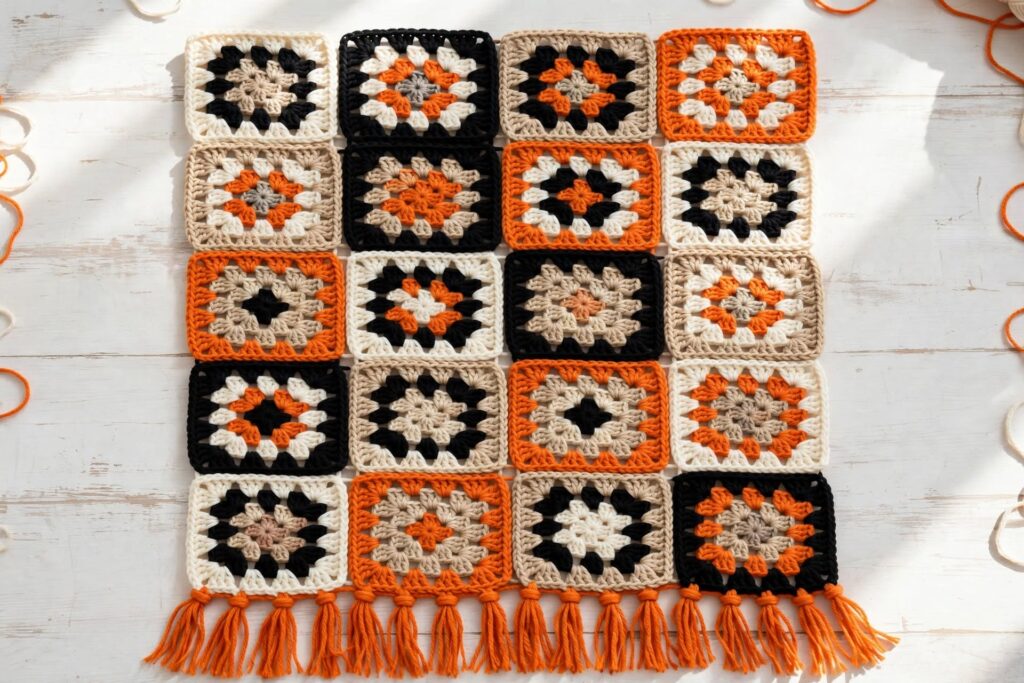
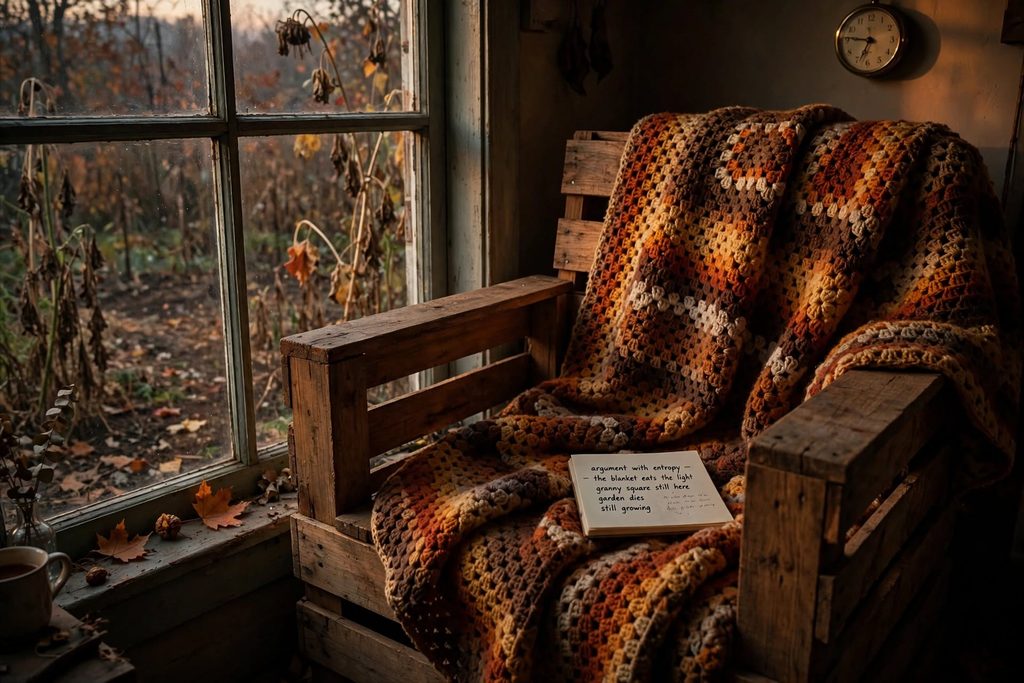
September doesn’t arrive. It knocks, then lets itself in with a draft.Here is the first lie we tell about autumn: that it begins in October.It doesn’t. Autumn begins in the first week of September, at exactly 6:47 PM, when you realize you need a sweater to take out the trash. The light changes from yellow to amber. The air develops a texture — not quite cold, but inquisitive. And suddenly, your living room looks too bright, too smooth, too much like July.That is the moment cottagecore crochet becomes necessary. Not decorative. Necessary.Because September evenings are not about decorating. They are about negotiating with the dying summer. And crochet is the only medium slow enough to keep up.We think we choose autumn colors. We don’t. They choose us.That rust-orange, that moss green, that particular mustard that looks like a leaf photographed at 5 PM — these aren’t aesthetic preferences. They are memories of photosynthesis. Your brain sees those stripes and remembers a time when warmth came from the ground up, not the radiator.The mega-logic of the September blanket is this: it doesn’t keep you warm from the outside. It keeps the summer from leaving. Each stitch is a tiny argument with entropy. A granny square says: I am still here. I am still growing, even as the garden dies.Drape it over the armchair nearest the window. Not the sofa — the armchair. The one you sit in when you’re avoiding something. The one that faces the glass so you can watch the sky turn the color of cooked apricots. The blanket doesn’t complete the chair. It apologizes to it for the coming winter.And when the first rain hits in mid-September — not the dramatic thunderstorm of July, but the soft, persistent drizzle that sounds like someone knitting in the next room — that blanket becomes a door. You wrap yourself in it, and you are no longer in a house. You are in a cottage that happens to be attached to a city.Real pumpkins are a commitment. They demand counter space. They attract fruit flies. They sag after two weeks like a forgotten resolution.Crochet pumpkins, however, are eternal. And more importantly: they are honest.A real pumpkin pretends it might become pie. A crochet pumpkin admits it is pure atmosphere. It exists to sit on a windowsill and catch the last horizontal light of September evenings — that specific angle of sun that only happens between 5:30 and 6:15, when everything looks like a painting by someone who really understood ochre.The psychology is almost backwards. We make these pumpkins in August, when the yarn is still sticky with humidity. We stuff them while the AC hums. And then, when September arrives, they are already waiting — a small army of woolly spheres in burnt orange, sage, and cream, stationed on the mantel like negotiators between summer and fall.Stack three of different sizes. Add a dried hydrangea. Step back. You have created a still life that will outlast Halloween, Thanksgiving, and possibly your lease.There is a specific loneliness to September coffee. It is no longer the iced fuel of productivity. It is not yet the spiced ritual of deep autumn. It is something in between — warm, slightly melancholic, drunk while looking at a tree that hasn’t decided whether to turn yet.A ceramic mug in September is too honest. It tells your hands exactly how warm the coffee is, and for exactly how long. It offers no comfort beyond containment.But a mug wearing a crochet cozy? That is a conspiracy of comfort. The wool whispers to your palms: this drink loves you. This drink will stay warm because I am here, wrapped around it like a promise. The leaf appliqué — perhaps a maple, perhaps an oak — turns your morning routine into a ceremony of transition.The surprise is how little yarn it takes. Thirty grams. Forty minutes. One episode of something you weren’t really watching. And suddenly, every cup of tea for the next three months arrives wearing a sweater.September evenings are not about grand gestures. They are about small, woolly rebellions against the coming dark.Here is the final surprise, the logic that ties the blanket, the pumpkins, and the cozy together:Cottagecore crochet in September is not about creating a look. It is about creating a speed. The world outside accelerates toward winter — school starts, deadlines return, the light disappears by 7 PM. But crochet forces a different tempo. One stitch cannot be rushed. One row takes exactly as long as it takes.So when you crochet in September, you are not making decor. You are making time. Time that moves at the speed of wool, not the speed of notifications. Time that says: the evening is still here. The light is still here. I am still here, one loop at a time.Pick up that hook. Choose a color that makes your heart feel like a leaf mid-fall — not quite green, not quite gold, but perfectly in between.September is waiting. And it is much cozier than you remember. -

How to Crochet a Beanie That Looks Like It Cost $120 (And the 3 Mistakes That Ruin Most Handmade Ones)
I once made the mistake of choosing bright neon yarn for a winter beanie. It looked fun in the skein — all electric pink and highlighter yellow — but finished up looking more like a ski marker than something I’d actually wear. I gave it to my niece. She wore it ironically for one afternoon, then it disappeared into the bottom of a toy chest where neon things go to die.That beanie taught me something expensive. The difference between a crochet beanie that looks boutique-bought and one that looks, well, made in a hurry has almost nothing to do with skill level. It has everything to do with a handful of choices most people make before they even pick up the hook.Below is not a catalog of twenty patterns you will never finish. It is one complete, step-by-step guide to a beanie that gets stopped-in-the-street compliments — plus the three mistakes that separate the $120 look from the craft-fair look.3 Mistakes That Instantly Make a Handmade Beanie Look Homemade
Before we talk about what to do, let us talk about what to avoid. Because these three errors are so common, so invisible to the maker, and so obvious to everyone else.Mistake 1: The Wrong Yarn Weight
I see this constantly in crochet groups. Someone buys the prettiest variegated worsted-weight yarn, works it up in double crochet with a 6 mm hook, and ends up with a fabric full of holes. You can see their scalp through it. The wind goes straight through. It looks like a fishing net that gave up.The fix: Use worsted-weight yarn with a 4.5 mm or 5 mm hook, and work in half-double crochet or a textured stitch. The fabric should be dense enough that you cannot see daylight through it when you hold it up. If you can see through your beanie, so can everyone else.Mistake 2: The Crown That Points
You know the shape. The beanie fits fine around the forehead, but the top comes to a gentle nipple. A soft cone. A wizard hat that lost its ambition. This happens when you decrease too slowly — too many rounds of gradual reductions — or when you stop increasing too early and the crown is not deep enough.The fix: The crown should be a smooth dome, not a cone. We will get to the exact math in a moment, but the visual test is simple: when you lay the finished beanie flat, the crown should form a gentle curve, not a peak.Mistake 3: No Blocking
This is the invisible killer. You finish the beanie, weave in the ends, slap on a pom-pom, and take a photo. But the stitches are uneven. The brim rolls. The crown has a dent from where your tension changed after a coffee break. Unblocked crochet is like unironed linen — technically functional, visually exhausted.The fix: Every beanie must be blocked. Every single one. We will cover exactly how in the finishing section.The One Thing Luxury Brands Almost Never Do
Here is a secret from the $120 beanies hanging in boutique windows: they rarely use complicated stitches. Walk into any high-end store and pick up a knit beanie. It is usually ribbed. Maybe a simple cable. Nothing fussy. The luxury comes from the material, the density, and the fit — not from a stitch dictionary that requires a PhD.Crochet can achieve the same effect, but we have to be honest about our limitations. Crochet is naturally thicker and more textured than knitting. A simple half-double crochet beanie in good yarn will always look more expensive than an overcomplicated beanie in cheap acrylic.So here is the rule: Choose one simple stitch. Execute it perfectly. Let the yarn do the talking.Step-by-Step: The Only Beanie Pattern You Need
This is a fitted adult beanie with a folded brim and a smooth dome crown. It works for men and women. It takes 3 to 4 hours. It uses one skein of worsted-weight yarn — approximately 150 to 180 meters.What You Need
-
Yarn: Worsted-weight merino or merino-acrylic blend, 150–180 m. Color suggestion: oatmeal, charcoal, dusty rose, or forest green. Avoid neon. Avoid heavy variegation.
-
Hook: 4.5 mm (US 7) or 5 mm (US 8). Use the smaller hook if you tend to crochet loosely.
-
Stitch marker: Essential. You will work in continuous rounds.
-
Tapestry needle: For weaving in ends.
-
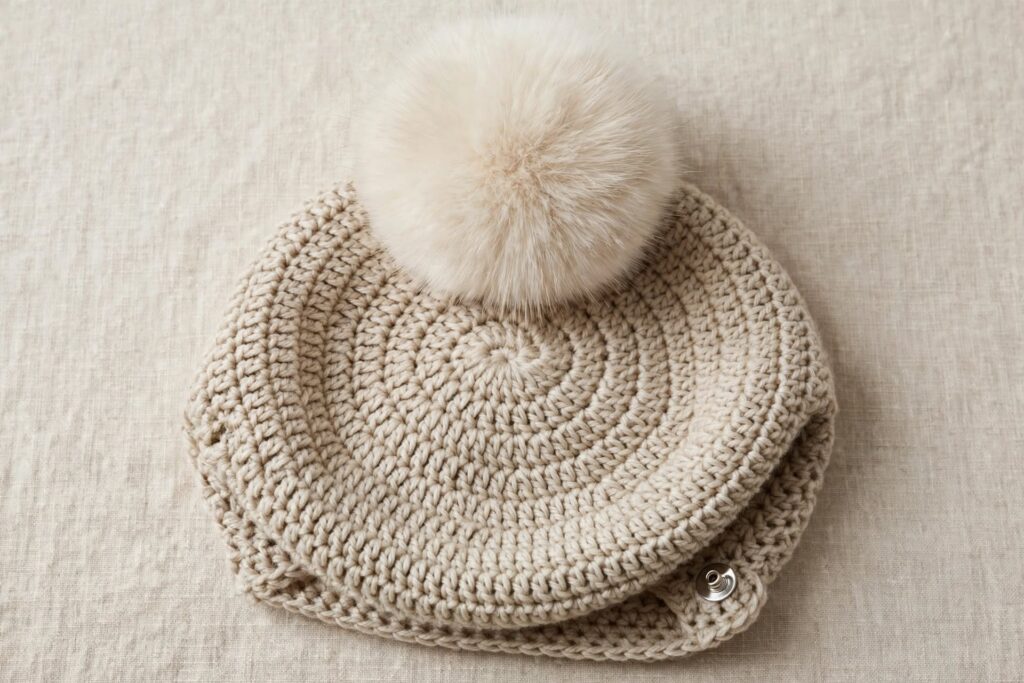
Optional: Faux fur pom-pom with a snap button.
Gauge
Work a swatch: 10 half-double crochet stitches × 8 rows should measure approximately 5 cm × 5 cm (2 in × 2 in). If your swatch is larger, go down a hook size. If it is smaller, go up. Do not skip this. A beanie that is 2 cm too wide will slide down over your eyes.The Brim (Ribbed Fold)
The brim is worked in front-post and back-post double crochet to create a stretchy, knit-like rib.Round 1: Chain 9. Starting in the second chain from the hook, work 1 half-double crochet in each chain across. You now have 8 stitches. Chain 1, turn.Round 2: Working in the back loop only, half-double crochet in each stitch across. Chain 1, turn.Repeat Round 2 until the brim strip measures approximately 48 to 52 cm (19 to 20.5 in) unstretched. This is slightly smaller than the average adult head circumference (54 to 57 cm) because the rib will stretch.Join: Fold the strip in half lengthwise and slip-stitch the ends together to form a ring. Do not twist. You now have a ribbed cuff.The Body
Round 1: Work 72 half-double crochet stitches evenly around the top edge of the brim. Place a stitch marker in the first stitch. Work in continuous rounds — do not join with a slip stitch, do not chain between rounds. Just keep spiraling upward.Rounds 2 through 18: Half-double crochet in each stitch around. Move the stitch marker up every round. Work until the piece measures approximately 17 cm (6.75 in) from the base of the brim to your current round. For a slouchier fit, work 20 to 22 rounds instead of 18.Visual check: Try it on. The body should cover your ears and reach the crown of your head. If it stops short, work two more rounds.The Crown Decreases
This is where most beanies go wrong. We are going to decrease 8 stitches per round for the last 5 rounds. This creates a smooth dome, not a cone.Round 19: Half-double crochet in 7 stitches, half-double crochet 2 together. Repeat around. You now have 64 stitches.Round 20: Half-double crochet in 6 stitches, half-double crochet 2 together. Repeat around. You now have 56 stitches.Round 21: Half-double crochet in 5 stitches, half-double crochet 2 together. Repeat around. You now have 48 stitches.Round 22: Half-double crochet in 4 stitches, half-double crochet 2 together. Repeat around. You now have 40 stitches.Round 23: Half-double crochet in 3 stitches, half-double crochet 2 together. Repeat around. You now have 32 stitches.Final round: Half-double crochet 2 together around until you have 8 stitches remaining. Cut the yarn, leaving a 20 cm tail. Thread the tail through the remaining stitches with a tapestry needle, pull tight, and weave the end into the inside of the crown.Why Expensive Beanies Always Look Softer
Have you ever noticed that boutique beanies have a drape and evenness that handmade ones often lack? It is not the machine. It is the blocking.Blocking is the difference between “I made this” and “Where did you buy this?” Here is how to do it properly for a beanie.Method: Fill a bowl with lukewarm water and add a drop of wool wash or mild shampoo. Submerge the beanie completely. Let it soak for 15 minutes. Do not agitate. Lift it out, press gently between two towels to remove excess water — do not wring. Now stretch the beanie over a balloon, a bowl, or a foam head form that matches your head size. Smooth the fabric with your hands. Let it air dry completely. This can take 24 to 48 hours.What blocking does: It evens out tension variations. It sets the stitches. It gives the brim a professional, store-bought roll. It transforms lumpy handmade into intentional artisanal.The steam shortcut: If you are impatient, pin the damp beanie to a form and hold a steam iron 5 cm above the surface. Do not touch the iron to the yarn. The steam relaxes the fibers instantly.The Pom-Pom Secret
A pom-pom is not childish. It is architecture. It adds vertical height, draws the eye upward, and turns a simple hat into a personality. But there is a right way and a wrong way.The snap-button trick: Sew a small metal snap to the crown of your beanie and another to the underside of a faux fur pom-pom. This allows you to remove the pom-pom before washing — and lets you swap colors to match your coat.Placement: The pom-pom should sit dead center on the crown, not slightly off like a satellite dish. Sew through the center hole of the crown decreases, not just the surface loops. A pom-pom that falls off after three wears is a tragedy easily avoided.Size: For an adult beanie, use a pom-pom between 10 and 15 cm (4 to 6 in) in diameter. Smaller looks apologetic. Larger looks like you are wearing a pet.Sizing for Everyone (Without Another Table)
If you are making this for someone else, here is how to adjust without drowning in charts.For a smaller head (teen or small adult): Start with a brim that measures 46 cm unstretched, and work 64 stitches around the top edge instead of 72. Decrease by 8 stitches per round as written, but start the decreases one round earlier.For a larger head: Start with a brim that measures 54 cm unstretched, and work 80 stitches around the top edge. Begin decreases at Round 20 instead of Round 19.For a child (4 to 10 years): Work the brim to 40 cm, then work 56 stitches around the top. Begin decreases at Round 14.For a toddler: Work the brim to 36 cm, then work 48 stitches around the top. Begin decreases at Round 12.The formula is always the same: the brim circumference should be 5 to 8 cm smaller than the actual head. The body height should reach the crown of the head before you start decreasing. The decreases should remove 8 stitches per round for the last 5 rounds.The Final Fold
I have made maybe thirty beanies. The ones I still wear — the ones that get compliments from strangers in coffee shops — are never the complicated ones. They are the simple half-double crochet beanies in oatmeal merino, blocked properly, with a faux fur pom-pom that snaps on and off.The complicated ones live in a drawer. The simple ones live on my head.You do not need twenty patterns. You need one pattern, executed well, in yarn that feels like it belongs near your skin. You need to block it. You need to weave in the ends like you are hiding evidence. And you need the confidence to say, when someone asks where you bought it: I made it.That is always the better answer. -
-

Crochet Scarves You’ll Wear All Season Long
There is a peculiar geometry to the way a scarf frames a face. Not the factory-made kind that hangs like a uniform strip of fabric, obedient and forgettable. But a crochet scarf — one that holds the memory of your hands in every loop, that settles against your collarbone with the slight irregularity of something alive. It does not merely warm your neck. It announces that you have decided to move through the world with intention.
What if the most versatile piece in your wardrobe is not a designer bag or a tailored coat, but a rectangle of yarn you made yourself?The mistake most people make is thinking of a scarf as winter equipment. A survival tool for January. But the right crochet scarf — in the right fiber, with the right stitch, at the right dimensions — becomes a year-round companion. It is a shawl on a breezy spring morning. It is a statement piece over a white tee in September. It is the only thing standing between you and an over-air-conditioned café in July.Below are five crochet scarf styles that transcend seasons, with the exact yarns, yardage, stitches, and time estimates that make them wearable from January to December.1. The Lightweight Lace Scarf: Air You Can Wear
The first rule of all-season crochet is counterintuitive: the scarf must breathe. Not gaps that let the wind punish you, but deliberate negative space — lace, mesh, openwork — that allows air to move through the fabric so you do not overheat.What makes it work:-
The stitch: Use V-stitch (double crochet + chain-1 + double crochet in one space), filet crochet, or shell stitch with chains between. These create a light, airy fabric that reads as substantial but weighs almost nothing.
-
The yarn: Choose cotton-bamboo blend (DK weight) or linen-cotton (sport weight). These fibers are cool against the skin, drape like water, and actually improve with washing.
-
The dimensions: 25 cm wide × 180 cm long (10 in × 70 in). Any narrower and it looks like a shoelace. Any shorter and it does not wrap with authority.
-
The edge: Add a single-row picot border or a crab stitch edge. The slight ruffle catches light and movement, transforming a simple rectangle into something that looks imported from a Mediterranean boutique.
Color strategy: For maximum versatility, work in a muted sage, dusty rose, or warm sand. These shades complement both winter coats and summer dresses.Yardage: Approximately 250–300 meters (275–330 yards) of DK-weight yarn.Time to make: 6–8 hours, depending on your pace and the complexity of the lace pattern.Budget: Typically 1–2 skeins, depending on the final length. One ball of Scheepjes Linen Soft or Debbie Bliss Eco Baby will often suffice for the standard size.2. The Chunky Cowl: Winter Armor That Knows When to Stop
A cowl is not a scarf that gave up. It is a scarf that got smart. No trailing ends to catch in car doors. No re-tying every twenty minutes. Just a tube of warmth that you pull over your head and forget.What makes it work:-
The stitch: Use front-post and back-post double crochet to create a vertical rib. This stitch has natural elasticity — the cowl hugs your neck without strangling it. Alternatively, the moss stitch (single crochet + chain-1) creates a dense, woven texture that looks like expensive knitwear.
-
The yarn: Super-bulky merino or alpaca blend. The fiber must be soft enough to touch your bare neck. Test it: hold the yarn against the inside of your wrist for thirty seconds. If it itches, your neck will hate it.
-
The dimensions: Circumference 60 cm × height 30 cm (24 in × 12 in) for a single-loop cowl. For a double-loop (wrap it twice), make it 140 cm × 25 cm (55 in × 10 in). The double-loop is more versatile — it functions as both a neck warmer and a loose cowl.
-
The seam: Crochet the cowl in the round to eliminate the seam entirely. If you must seam, use the whip stitch on the inside and weave in ends with surgical precision. A visible seam is the fastest way to make handmade look homemade.
Transition trick: In spring, wear the double-loop cowl loose and low, almost like a necklace over a button-down shirt. In winter, pull it high and tuck the bottom edge into your coat collar.Yardage: Approximately 150–200 meters (165–220 yards) of super-bulky yarn.Time to make: 3–4 hours. This is the perfect weekend project.Budget: $20–$35 in yarn. Wool and the Gang Crazy Sexy Wool or Lion Brand Hue + Me are excellent.3. The Oversized Wrap Scarf: A Blanket You Can Leave the House In
There is a special kind of person who needs an oversized wrap scarf. Usually, this person is always cold. Or always reading in drafty corners. Or both.What makes it work:-
The stitch: Use granite stitch or linen stitch for a flat, non-curling fabric. These stitches create a woven appearance that looks like a textile, not a craft project. For texture, add a cable panel running down the center — crochet cables are easier than they look and add instant sophistication.
-
The yarn: Worsted-weight wool-acrylic blend (60/40) for structure without excessive weight. Pure wool in this size becomes a burden. Pure acrylic often lacks the drape and texture associated with premium garments. The blend gives you warmth, washability, and drape.
-
The dimensions: 50 cm × 200 cm (20 in × 80 in) minimum. This is not a scarf. This is a personal landscape. It should wrap around your shoulders twice and still have length to drape.
-
The fringe: Add 15 cm (6 in) fringe at both ends using the same yarn, cut evenly with a rotary cutter. Fringe transforms a rectangle into a statement. No fringe, and it looks like a table runner.
All-season hack: In summer, use this as a plane blanket, a beach cover-up, or a picnic mat. In winter, it is your primary defense against existential chill.Yardage: Approximately 700–900 meters (765–985 yards) of worsted-weight yarn.Time to make: 12–15 hours. This is a commitment, but one that pays for itself every time you wear it.Budget: $30–$50 in yarn. You will need 3–4 skeins.4. The Infinity Scarf: The Circle of Sanity
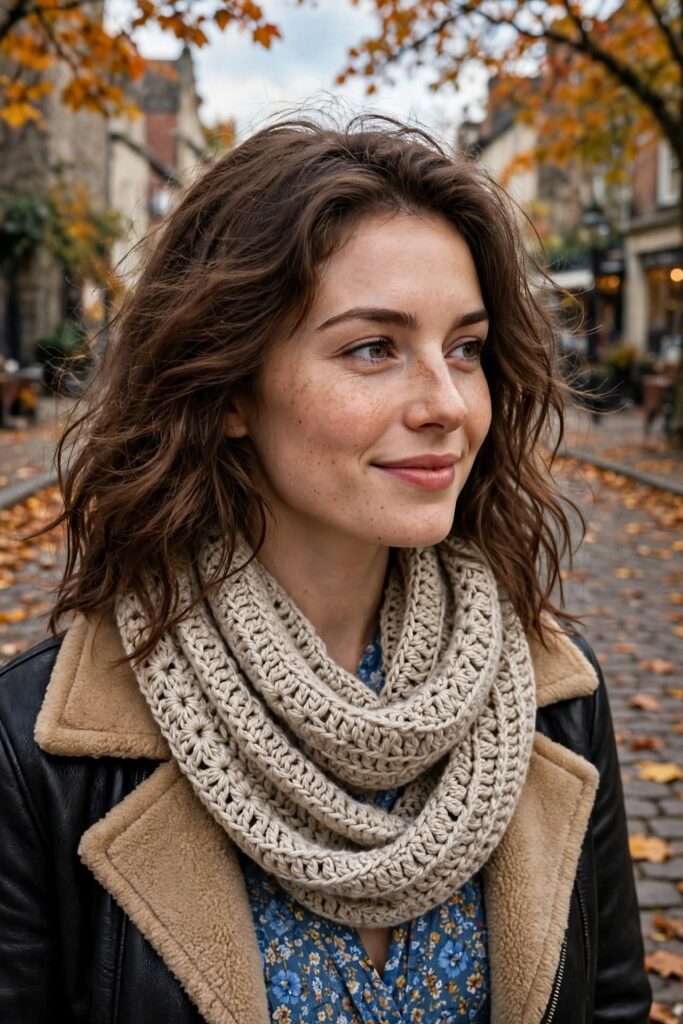
The infinity scarf is the only scarf that understands modern life. It does not require tying. It does not require folding. It simply loops, and in looping, it solves every styling problem you have.What makes it work:-
The stitch: Use half-double crochet in the back loop only for a ribbed effect that mimics knitwear. Or try star stitch for a dense, puffy texture that traps air and warmth. The star stitch looks complicated but repeats predictably once you learn the rhythm.
-
The yarn: DK-weight merino or merino-silk blend for a lighter infinity scarf that works indoors and out. For a winter-only version, use bulky alpaca.
-
The dimensions: 150 cm circumference × 25 cm width (60 in × 10 in) for a standard loop. For a long infinity that you can wrap twice, go to 180 cm × 20 cm (70 in × 8 in). The long version is more versatile — one loop for style, two loops for warmth.
-
The twist: Before joining the ends, give the strip one half-twist (like a Möbius strip). This creates a figure-eight drape that sits flatter against the chest and never bunches.
Styling: Wear it long and loose with a leather jacket in autumn. Double it up under a wool coat in February. Let one loop hang low like a necklace over a summer dress in May.Yardage: Approximately 350–450 meters (385–495 yards) of DK-weight yarn.Time to make: 5–6 hours.Budget: $18–$30 in yarn. Typically 2–3 skeins.5. The Hooded Scarf: When a Scarf Becomes Architecture
A hooded scarf is not an accessory. It is a shelter. It is the intersection of scarf, hood, and cowl — a three-in-one garment that makes people stop you on the street.What makes it work:-
The construction: Crochet a standard scarf (30 cm × 150 cm), then fold one end upward to create a hood pocket. Seam the sides for 30 cm (12 in), leaving the top open. The result: a scarf with a built-in hood that does not require drawstrings, buttons, or prayers.
-
The stitch: Use thermal stitch or waistcoat stitch for the hood section — these are dense and wind-resistant. Use a lacier stitch for the scarf ends to keep the overall weight manageable.
-
The yarn: Worsted-weight wool or wool-blend for structure. The hood needs body to stand up, so avoid droopy fibers like cotton or bamboo for this section.
-
The depth: The hood should be 30 cm deep (12 in) from base to crown. Any shallower and it slides off. Any deeper and you look like you are wearing a yarn sleeping bag.
When to wear it: Rainy October mornings. Snowy February dog walks. Airplane cabins where the vent is aimed directly at your skull.Yardage: Approximately 400–500 meters (440–550 yards) of worsted-weight yarn.Time to make: 8–10 hours.Budget: $25–$40 in yarn.Quick Reference: Choose Your Scarf by Season
TableSeason Scarf Style Best Yarn Yardage Time Dimensions Spring Lightweight lace Cotton-bamboo, DK ~250–300 m 6–8 hrs 25 × 180 cm Summer Lightweight lace / Infinity Linen-cotton, sport ~250–300 m / ~350–450 m 6–8 hrs / 5–6 hrs 25 × 180 cm or 150 × 20 cm loop Autumn Chunky cowl / Infinity Merino, super-bulky / DK ~150–200 m / ~350–450 m 3–4 hrs / 5–6 hrs 60 × 30 cm or 150 × 25 cm loop Winter Oversized wrap / Hooded Wool-acrylic, worsted ~700–900 m / ~400–500 m 12–15 hrs / 8–10 hrs 50 × 200 cm or 30 × 150 cm hooded All year Infinity (DK weight) Merino-silk, DK ~350–450 m The Finishing Details That Elevate Everything
-
Block your scarf. Every time. Soak in lukewarm water with a drop of wool wash, squeeze (do not wring), pin to dimensions, and let dry. Blocking transforms lumpy handmade into intentional artisanal.
-
Weave in ends with a tapestry needle, not a crochet hook. Thread the yarn diagonally through three rows of stitches. Cut flush. Invisible ends are the mark of a professional.
-
Add a leather tag or a small fabric label with your initials. It costs next to nothing and can significantly increase the perceived value.
-
Photograph it worn. A scarf on a table is yarn. A scarf on a person is fashion.
The Final Loop
A crochet scarf is not an object. It is a decision. A decision to spend six, eight, or fifteen hours making something that a machine could produce in seconds — because the machine cannot replicate the particular warmth of your hands, the particular color you chose at dusk in a yarn shop, the particular patience you discovered you had.The best crochet scarves are not the ones with the most complicated stitches. They are the ones you actually wear. The ones that live in your bag, your car, the hook by your door. The ones that have absorbed your perfume, your coffee spills, your rain.Make one for every season. Make one for every mood. And then wear them like the armor they are — not against the cold, but against the rush of a world that forgot how to make things slowly. -
-

Best Crochet Kits for Adults — And Why the Right One Changes Everything
There is a peculiar kind of silence that descends when you finally learn to hold a crochet hook correctly. Not the silence of an empty room, but the silence of a mind that has, for the first time in hours, stopped rehearsing tomorrow’s anxieties. Your hands move. The yarn loops. And something impossible happens: you are exactly where you are.
If you are an adult standing at the threshold of crochet — or returning after decades — the sheer volume of kits available can feel paralyzing. Should you buy the giant box with 100 rainbow skeins and 47 hooks? The tiny amigurumi kit shaped like a cactus? The luxury merino wool set that costs as much as a dinner out?Here is the counterintuitive truth: the best crochet kit is not the one with the most stuff. It is the one that matches the state of your hands, the rhythm of your patience, and the particular loneliness you are trying to soothe.Below is a practical, no-nonsense guide to choosing a crochet kit that will actually get used — not just admired in its packaging.1. The Beginner Kit: Start With One Good Hook and One Good Yarn
Most beginner kits try to overwhelm you into feeling like you have gotten value. Eighty-seven hooks. Forty-two stitch markers. A bag the size of a pillowcase. But here is what actually happens: you open the box, panic at the chaos, and never touch it again.What to look for:-
One ergonomic hook in size 5.0 mm or 5.5 mm. This is the Goldilocks size — big enough to see your stitches, small enough to feel like real craft. Look for soft-grip handles (brands like Clover Amour or KnitPro Waves are excellent).
-
Two to three skeins of worsted-weight yarn in a light, solid color. Dark or variegated yarn hides your stitches and makes learning miserable. Choose cream, pale gray, or soft pink.
-
A printed pattern for a simple square or dishcloth. Not a scarf — scarves are boringly long and beginners abandon them. A square gives you satisfaction in two hours.
-
Stitch markers and a yarn needle. Metal split-ring markers are fine; plastic locking ones are better.
Avoid: Kits with thread-thin yarn, steel hooks (those are for lace), or patterns written in abbreviations without a glossary.Budget: $25–$402. The Amigurumi Kit: For Adults Who Miss Playing
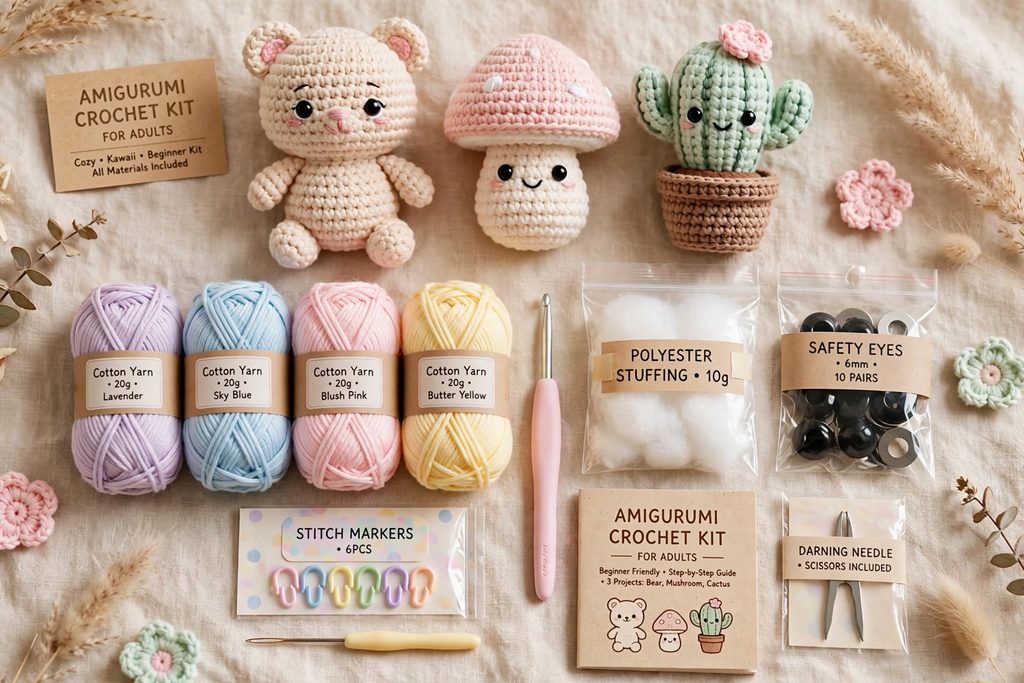
Amigurumi — the Japanese art of crocheting small stuffed creatures — is not childish. It is architectural. You are building a three-dimensional object from a single strand, and the precision required will humble anyone who thinks crochet is “just grandma’s hobby.”What to look for:-
Cotton or cotton-blend yarn in DK or worsted weight. Acrylic fuzzes and loses shape; cotton holds the sculptural integrity of tiny limbs.
-
A 3.0 mm or 3.5 mm hook. Amigurumi requires tight stitches so the stuffing does not peek through.
-
Safety eyes and stuffing included. Buying these separately is a hassle, and beginners never remember to order them.
-
A video tutorial link, not just a paper pattern. Amigurumi involves invisible decreases and magic rings that are nearly impossible to learn from text alone.
Top kit types for adults: Small animals (bears, bunnies), plants in pots, or celestial bodies (moons, stars). Avoid kits with more than six color changes for your first project.Budget: $20–$35 per kit3. The Blanket Kit: The Marathon, Not the Sprint
There is a special kind of adult who needs a blanket kit. Usually, this person has a specific sofa in mind. They can already see the drape of wool over the armrest. They are not looking for a weekend project; they are looking for a winter companion.What to look for:-
Chunky or super-bulky yarn. Blankets made with fingering-weight yarn are beautiful — and they take eleven months. Chunky yarn gives you visible progress after one evening.
-
A pattern using repetitive stitches. Granny squares. Moss stitch. Linen stitch. Your brain will enter a meditative loop, and the blanket will grow while you listen to podcasts or watch rain hit the window.
-
A kit with all yarn included and pre-measured. Nothing kills a blanket faster than running out of dye lot #47 and discovering the store only stocks #48, which is almost the same color but not quite.
Yarn quality note: For blankets, merino wool blends feel luxurious but require hand-washing. Acrylic or acrylic-wool blends are machine-washable and survive pets, children, and red wine.Budget: $60–$150 depending on size and fiber4. The Garment Kit: For the Brave
Crocheting a sweater or cardigan as an adult is an act of radical optimism. It says: I believe I will still like this color in three months. I believe my tension will be consistent. I believe I deserve to wear something I made with my own hands.What to look for:-
A kit with a size range, not just “one size fits most.” Adult bodies are diverse, and a good garment kit respects that.
-
Yarn with some elasticity. Cotton alone is unforgiving and heavy; look for cotton-acrylic or wool-nylon blends that drape and recover.
-
A top-down or seamless pattern. Sewing pieces together is where most garment projects go to die. Top-down constructions let you try it on as you go.
-
A gauge swatch requirement. If the kit does not mention gauge, the designer has not tested the pattern properly. Walk away.
Beginner-friendly garments: Oversized cardigans, boxy tees, or shawls. Fitted blouses with waist shaping are for your second or third garment, not your first.Budget: $50–$1205. The Luxury Kit: When You Are Crocheting for Your Nervous System
Sometimes you do not need a kit to learn. You need a kit to recover. The tactile equivalent of a weighted blanket. The kind of yarn that makes you close your eyes when you touch it.What to look for:-
Hand-dyed yarn in small batches. The color variations are subtle, alive, and impossible to replicate. Brands like Malabrigo, Madelinetosh, or indie dyers on Etsy.
-
A simple, repetitive pattern that showcases the yarn rather than competing with it. A garter-stitch scarf (yes, even in crochet — try the thermal stitch), a linen-stitch wrap, or a moss-stitch cowl.
-
A beautiful project bag. Not plastic. Canvas, linen, or hand-blocked cotton. Something that makes you feel like an artist when you carry it to the café.
Budget: $40–$100+Quick Comparison: Which Kit Fits Your Life?
TableIf you are… Choose this kit Key feature Budget Overwhelmed and new Beginner square kit One hook, light yarn, small pattern $25–$40 Needing play and focus Amigurumi kit Cotton yarn, video tutorial, small hook $20–$35 Seeking a winter ritual Chunky blanket kit All yarn included, repetitive stitches $60–$150 Ready to wear your work Garment kit Size range, top-down pattern, gauge info $50–$120 Crocheting to calm down Luxury hand-dyed kit Sensory yarn, simple pattern, beautiful bag $40–$100+ Where to Buy: The Short List
-
Amazon — Best for beginner kits with fast shipping. Read reviews for yarn quality; avoid kits where every review mentions “scratchy.”
-
Etsy — Best for amigurumi kits and hand-dyed luxury sets. You are supporting a human, not a warehouse.
-
LoveCrafts / WeCrochet — Best for garment and blanket kits with serious yarn. They often include free patterns with purchase.
-
Local yarn shops — Best for touching the yarn before you commit. Many offer beginner kits assembled by the owner.
The Final Stitch
The best crochet kit for adults is not defined by its price or its Instagram aesthetic. It is defined by whether you open it. Whether you make the first chain. Whether you keep going after the third row looks like a crumpled spiderweb.Crochet is not about perfection. It is about the radical act of creating something from nothing, one loop at a time, while the world outside moves too fast to notice.So buy the kit. Make the square. Drop a stitch and learn to fix it. Eventually, you will have something that did not exist before you decided to begin.And what if — just what if — that is exactly what your hands have been waiting for?You Might Also Love
-
-

Why Crochet Becomes a Lifelong Habit for So Many Women
Or: The Hook That Hooks You BackThere is a moment in every crocheter’s life that she rarely talks about. It happens quietly, usually around 9 p.m., when the house has settled into its nighttime breathing. She is holding a hook and a half-finished square of acrylic yarn that cost $2.99. The television is on but she is not watching. Her husband has asked her three times whether she wants tea, and she has answered “maybe” three times without looking up.She is not making anything important. A coaster, perhaps. A blanket for a baby who is not yet born. A granny square that will join forty-seven others into something she will give to someone who will say “thank you” and then store it in a closet.And yet—here is the strange part—she is happier in this moment than she was at her own birthday dinner.The Mathematics of Impossible Calm
Crochet should not work as therapy. Think about what it actually is: a sharpened metal stick, a length of twisted fiber, and the repeated instruction to pull one loop through another. For hours. Sometimes for years. By any rational measure, this is the definition of tedium.But the body disagrees with the mind. The body, it turns out, has been waiting for exactly this kind of tedium.When you crochet, your hands move in a pattern just complex enough to occupy the part of your brain that worries, but not so complex that it demands real concentration. The rhythm—yarn over, pull through, yarn over, pull through—creates a cadence that your nervous system recognizes before your conscious mind does. It is the same cadence as rocking a baby. As walking on sand. As the sound of rain on a roof when you do not have to go anywhere.Neuroscientists have a term for this: predictive processing. The brain is a prediction machine, constantly guessing what will happen next. When the world is unpredictable—emails, traffic, news, children—the brain burns glucose at a furious rate. Crochet gives the brain exactly what it craves: a future it can see coming. Loop three will follow loop two. The stitch will be the same as the last one. The hook will not surprise you.And in that small, artificial certainty, the shoulders drop.What the Long-Time Crocheters Actually Say
I started noticing something after speaking with women who have crocheted for thirty, forty, fifty years. They do not talk about the finished objects. They almost never mention the blankets or the baby booties. Instead, they describe the act in the same language, as if they all attended the same secret school of description.One woman in her seventies told me she still carries a hook in her handbag because “you never know when a panic attack will arrive, but you always know where row seventeen is.” Another said she taught her daughter not because she wanted an heir to the craft, but because she needed someone to understand why the sofa had to be positioned under the lamp. A third, who had made over four hundred afghans, could not remember where a single one of them lived now. “I don’t make them to keep,” she said. “I make them to stay sane.”It is not about the yarn. It is about the continuity. These women have found a tool that does not break, does not expire, and does not require a subscription. It only asks that you show up.Why Crochet Stays With You for Life
If you are wondering whether this craft is worth learning—or worth returning to after a long pause—here is what decades of practice actually deliver. Not the romantic version. The practical one.It creates routine without rigidity. You do not need to crochet at the same hour every day. You do not need a studio or special shoes. You need ten minutes and a chair. The habit forms not because you force it, but because the object itself calls you back. You want to see the next row. Then the next. Before you know it, the evening has shape.It reduces stress through motion, not medication. The repetitive hand movements lower cortisol. Studies on repetitive textile crafts show measurable decreases in heart rate and blood pressure after twenty minutes of work. You are not relaxing because you are thinking happy thoughts. You are relaxing because your body is too busy counting stitches to manufacture anxiety.It gives visible progress in a world of invisible work. You answer emails and they disappear into the void. You cook dinner and it is eaten. You crochet a row and it stays. The blanket grows at the edge of your vision, proof that time spent on yourself is not time wasted. For women who spend their days serving others, this visible, tactile progress is not trivial. It is evidence.It builds confidence through failure that is cheap. A dropped stitch costs nothing. Ripping back three rows takes minutes, not months. Crochet teaches your nervous system that mistakes are fixable, that perfection is unnecessary, and that starting over is not the same as failing. That lesson migrates. Women who crochet often report feeling calmer about professional setbacks—not because they are detached, but because they have practiced recovery on a small scale ten thousand times.It creates meaningful gifts without bankrupting your calendar. A store-bought present requires a trip, a decision, a wrapping. A crocheted dishcloth requires fifteen minutes and the willingness to say “I made this for you.” The recipient rarely understands the time invested, but the giver always does. And the act of giving something your hands touched changes the chemistry of the relationship. It is a small, domestic magic that cannot be replicated by a gift card.The Geometry of Control
Life offers very few guarantees. Children grow in directions you did not predict. Marriages shift. Bodies change without permission. Careers stall or accelerate or disappear entirely. The world is a river, and most of us are trying to build houses on its banks.Crochet offers the opposite: a world where every decision is reversible. Where a mistake is just a loop you can undo. Where the finished object is exactly the size you decided it would be, in exactly the color you chose, with exactly the border you planned.This is not trivial. For women who spend their days managing the chaos of other people’s needs—children, parents, colleagues, pets—the ability to create something that obeys them is not a hobby. It is a restoration of order.A crocheted blanket does not talk back. It does not need a snack. It does not reschedule the meeting. It simply grows, row by row, in direct proportion to the time and attention you give it. In a life full of variables, crochet is a constant. And constants, it turns out, are what keep people sane.The Legacy No One Asked For
There is a final secret, and it is the one that keeps women crocheting into their eighties.They know, even if they do not say it, that the blanket they are making will outlast them. The baby who receives it will grow into a teenager who spills soda on it. That teenager will become an adult who washes it carefully and folds it at the back of a closet. That adult will one day hold it and remember a grandmother they can no longer call.Crochet is slow because it is supposed to be slow. It is not about the finished object. It is about the time embedded in the object. Eighty hours of attention, compressed into wool. Eighty hours of someone thinking about you, even if you never knew it.The Hook That Hooks You Back
So why does it become a lifelong habit? Because crochet is not a hobby. It is a relationship. It is the friend who is always available at 10 p.m. It is the therapist who charges nothing and never interrupts. It is the proof that you were present in your own life, even when it felt like you were only surviving it.The women who crochet for decades are not women with extra time. They are women who have figured out that some things cannot be bought, optimized, or explained. They have found a way to hold time in their hands, loop by loop, and make it into something warm.And when the world feels too loud, too fast, too much—they reach for the hook. Not because they have nothing else to do. Because it is the one thing that has never let them down.You Might Also Love
-

Knitted Pieces That Look Expensive (Even From Simple Yarn)
Or: Why Your $4 Skein Can Pass for a $400 SweaterThere is a quiet conspiracy in the yarn aisle. The expensive skeins whisper that they alone hold the secret to luxury. The hand-dyed merino batts its eyelashes. The baby alpaca plays hard to get. And we fall for it—every time—believing that price tag equals prestige.It doesn’t.The difference between a sweater that looks like it came from a boutique in Copenhagen and one that looks like a craft-fair leftover rarely has anything to do with the fiber. It has to do with decisions. Specific, deliberate choices that anyone can make, even with the most basic yarn on the bottom shelf.Let me show you what they are.The 5 Stitches That Always Look Expensive
Google loves a list. Your wardrobe loves it even more. If you want your knitting to whisper money instead of screaming effort, these five stitches are your best friends:1. Ribbing (1×1 or 2×2)
Clean, vertical lines. Ribbing creates structure. It pulls fabric inward, giving garments a tailored edge that reads as intentional design rather than homemade bulk. Use it at cuffs, hems, and collars. It frames the piece like a good haircut frames a face.2. Stockinette
The plainest stitch in the book—and the most elegant when executed well. Stockinette demands tension discipline. Uneven rows show up immediately, which is exactly why perfect stockinette looks machine-made and high-end. It is the white T-shirt of knitting: simple, but only impressive when flawless.3. Moss Stitch
Also called seed stitch, though purists will argue the difference. Tiny, alternating bumps create a pebbled texture that catches light like expensive bouclé fabric. It is visually busy without being chaotic, and it hides minor tension sins better than stockinette. A moss-stitch scarf in oatmeal yarn looks like it cost three times what you paid.4. Fisherman Rib
Thick, plush, and deeply dimensional. Fisherman rib creates a fabric with natural weight and shadow. It eats yarn, yes, but the result is a sweater that looks like it was poured rather than knitted. It is the architectural equivalent of a cashmere overcoat—substantial, quiet, and undeniably expensive.5. Cable Stitch (Simple Variations)
Not the rainbow fair-isle yoke. Not the lace doily. A single, bold cable running up the front of a cream cardigan is all you need. Cables add verticality and heritage. They reference Aran sweaters and Scottish estates. One strong cable panel beats a dozen fussy embellishments every time.Master these five, and you have a toolkit that will outdress any novelty yarn on the market.The Color Trap
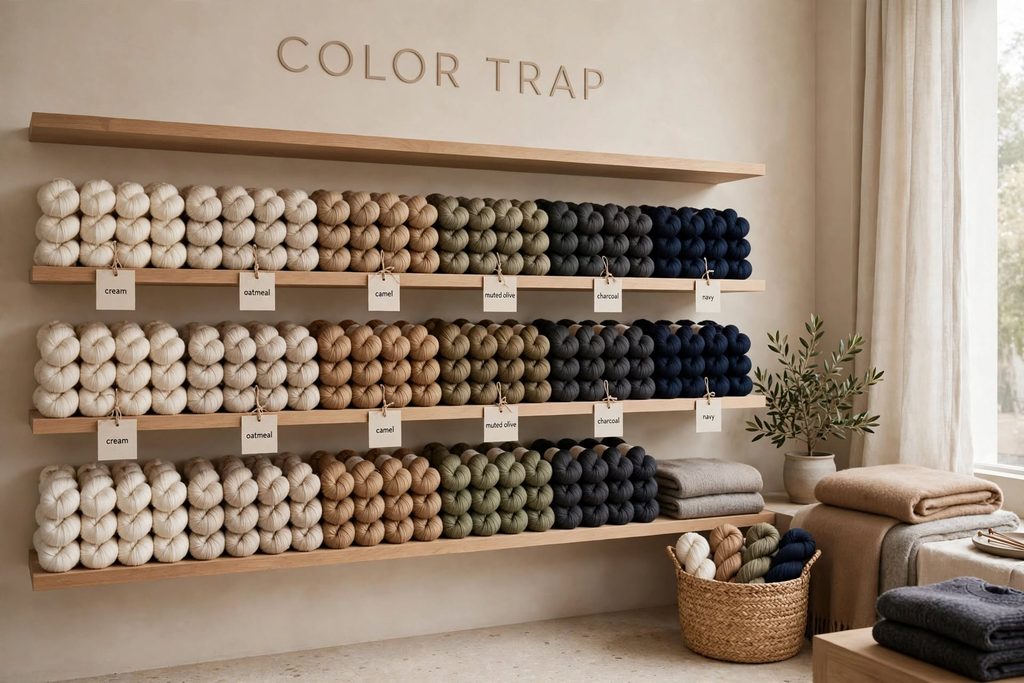
Walk into a luxury boutique. What do you see? Beige. Oatmeal. Charcoal. Bone. Navy. Camel. Maybe, if the designer is feeling wild, a dusty olive.Now walk into a yarn store. It is a carnival of fuchsia, teal, and variegated rainbow sparkle. Here is the thing: that hand-dyed rainbow skein is beautiful. It is art. But it will never look expensive. It will look handmade. There is a difference.Expensive-looking knitwear relies on neutrals because neutrals unify stitches. A complex cable in bright red looks busy. The same cable in oatmeal looks architectural. The stitches have not changed. Only the canvas has.Your palette is small: cream, taupe, heather gray, black, navy, camel, rust. These colors let the texture speak. And texture, when it is good, does not need to shout.Density Over Decoration
Loose knitting looks cheap. Tight knitting looks expensive. This is not a judgment on style—it is a visual fact. Dense fabric creates shadows between stitches. Shadows create depth. Depth reads as weight, quality, and intention.The simplest way to elevate basic yarn is to go down a needle size. If the pattern calls for a US 8, try a US 6. Your hands will work harder. The fabric will thank you. A dense stockinette in cheap cotton-blend can feel almost like a luxury knit when it has that compact, firm hand.Conversely, the lacy, airy shawl you spent forty hours on? It might look like a dishcloth that had an identity crisis if the tension is uneven. Airiness is not the enemy, but it is harder to control. If you want foolproof elegance, knit tight.The Blocking Secret
Here is the step most knitters skip, and it is the step that separates “nice” from bespoke.Blocking is not optional. It is not a finishing touch. It is a transformation. When you block a hand-knit piece, you are not just washing it. You are setting the stitches into their final formation. You are telling the fabric: This is your shape. Remember it.Wool has memory. Acrylic has stubbornness. Both benefit from blocking. Soak the finished piece in lukewarm water with a drop of wool wash. Press out moisture gently—never wring. Lay it flat on a towel or blocking mat. Pin the edges to the exact dimensions you want. Walk away. Let it dry completely.A misshapen sweater becomes a garment with shoulders. A curling scarf becomes a clean rectangle. A wobbly hat becomes a structured beanie. Blocking is the difference between I made this and I had this made.Fit & Silhouette
A poorly fitted hand-knit sweater looks like a well-meaning gift from a relative. A perfectly fitted one looks like it came from a tailor on Savile Row.But here is a secret: the easiest shapes often look the most expensive. Drop shoulders. Slightly oversized but structured bodies. Cropped lengths with long sleeves. These silhouettes require minimal shaping—beginner-friendly construction—but they read as modern and editorial.The boxy cardigan from 1998 is not coming back. But a boxy cardigan with clean ribbing, dense stockinette, and a neutral color? That is contemporary. That is intentional. That is what people pay $300 for in stores.The Final Touch: Presentation
Your knitting is finished. It is blocked. It fits. Now what?A hand-knit scarf stuffed in a plastic bag looks like a craft project. The same scarf folded neatly on a wooden hanger, photographed in morning light with a cup of coffee nearby, looks like an editorial spread. Context is the final ingredient.If you are selling your work, photograph it on a real body or a good mannequin. Shoot in natural light. Use neutral backgrounds. If you are keeping it for yourself, store it folded in a cotton bag with a cedar block. Treat it like an heirloom, and it will become one.The Bottom Line
Expensive-looking knitwear is not about money. It is about restraint.Dense stitches, not complicated ones.
Neutral colors, not loud ones.
Simple shapes, not fussy ones.
And the patience to block, fit, and present with care.The most radical thing you can do as a knitter is to pick up that “boring” affordable yarn in the most neutral color on the shelf. Knit it tightly. Block it aggressively. Wear it with confidence.The world will assume it is designer. And in a way, it is.You Might Also Love
-

Why Some Women Never Outgrow Croche
Your mother did it. Your grandmother did it. And now you do it at 3 a.m. while the world sleeps. What if crochet isn’t something you outgrow — but something you grow into?
We’ve been trained to believe that hobbies have an expiration date. That the things we love at twenty are meant to be abandoned by forty. That crochet, specifically, belongs to a phase — a youthful craft phase, a new-mother nesting phase, a retirement phase — and that mature women are supposed to move on to something more sophisticated. Wine tasting. Yoga. Minimalist watercolor painting that requires only three brushes and a sense of superiority.But here’s the plot twist that changes everything: the women who never outgrow crochet aren’t stuck. They’re rooted.And roots, unlike trends, don’t rotate.The Age Myth
Let’s start with the lie.Open any craft magazine and you’ll find crochet divided by decade. “Fun projects for teens!” “Stylish patterns for your twenties!” “Cozy makes for new moms!” And then — silence. A void where women between forty and seventy are supposed to disappear into gardening or book clubs or whatever society decides is age-appropriate for hands that used to hold hooks.But the truth is far more interesting. The women who keep crocheting into their forties, fifties, sixties, and beyond aren’t clinging to a youthful hobby. They’ve discovered something that the culture hasn’t caught up with yet: crochet gets better with age the same way wine does. The first twenty years teach you the mechanics. Every year after that teaches you the meaning.At twenty, you crochet for product. At forty, you crochet for process. At sixty, you crochet for peace. And peace, unlike a finished scarf, never goes out of style.Why the Hook Stays
Here’s the counterintuitive truth: the women who never outgrow crochet aren’t defined by the craft. The craft is defined by them.A hook doesn’t care how old you are. Yarn doesn’t check your ID. The loop is the same whether you’re fifteen or eighty-five. But what you bring to the loop — your patience, your rhythm, your understanding that some things cannot be rushed — that changes everything.The woman above understands this. She’s not crocheting because she has nothing better to do. She’s crocheting because, at this point in her life, she has finally learned that doing nothing is not the same as being still. The colorful yarn around her neck isn’t a fashion statement. It’s evidence. Proof that she is in the middle of making something that didn’t exist this morning. The cup beside her is cooling. The afternoon light is fading. And the hook moves — not quickly, not slowly, but at exactly the pace her hands have learned over decades.This is what outgrowing crochet would mean: giving up the one activity that has scaled with every version of yourself. The version that was anxious. The version that was grieving. The version that was waiting for test results, for phone calls, for children to come home. The hook was there for all of them. Why would you abandon the one friend who never asked why you needed to make a blanket in July?7 Signs Crochet Will Stay With You Forever
Not sure if you’re a lifelong crocheter or just passing through? Here’s the diagnostic checklist. If you recognize yourself in at least five of these, congratulations: the hook has already become part of your infrastructure.1. You Always Have a WIP
There is no such thing as “between projects.” One blanket is on the sofa, one scarf is in your bag, and one ambitious cardigan is hibernating in a basket with a note that says “fix neckline someday.” An empty hook feels wrong, like a hand without a purpose.2. Yarn Shopping Makes You Happy — Even When You Don’t Need Yarn
You have enough yarn to survive a nuclear winter. You know this. And yet, the sight of a new colorway, the feel of a merino blend, the smell of a yarn shop — it triggers the same dopamine as a first date. You don’t buy yarn because you need it. You buy it because possibility is a drug.3. You Relax With a Hook Instead of the TV
After a day of screens — emails, meetings, notifications — the last thing your nervous system wants is more light and noise. You reach for the hook because it asks nothing of your eyes and everything of your hands. The rhythm is the original Netflix, and it never buffers.4. Handmade Gifts Mean More to You Than Store-Bought Ones
When someone’s birthday approaches, you don’t think what should I buy? You think what should I make? And if time runs short and you have to buy something, you feel a faint, irrational guilt. As if love expressed in dollars is somehow thinner than love expressed in hours.5. You Notice Stitches Everywhere
You can’t look at a store-bought sweater without analyzing the construction. You touch hotel blankets and think this is machine-made, but it could be crocheted. You see a fence pattern and think that would make a beautiful filet mesh. The world has become a catalog of potential projects.6. You Collect Yarn “Just in Case”
That skein of hand-dyed alpaca? You have no pattern for it. But you bought it because someday the right project will appear, and you’ll be ready. Your stash isn’t hoarding. It’s research and development. It’s the raw material of future comfort.7. Crochet Feels Like Home
Not the finished objects. The act itself. The weight of the blanket on your lap. The sound of the hook against the stitch. The way the yarn smells like sheep and possibility. When you pick up the hook, you don’t feel like you’re starting a hobby. You feel like you’re returning to something that was always yours.If these signs feel like a mirror, you’re not alone. You’re part of a silent majority of women who discovered that crochet isn’t a phase — it’s a permanent address.Crochet at Every Age: What Changes, What Doesn’t
TableTableAge Why You Crochet What You Make What the Hook Teaches 20s To make things cheaply, to feel productive Scarves, simple blankets, gifts Patience exists 30s To calm the chaos of building a life Baby blankets, home decor, quick projects Imperfection is survivable 40s To reclaim time that others try to steal Complex patterns, heirlooms, gifts for yourself Your pace is the right pace 50s To process transition, empty nests, change Large projects, legacy pieces, teaching others Endings are just new starting chains 60s+ Because stopping would feel like leaving Whatever you want. Finally. Time is not running out — it’s looping This table isn’t just observation. It’s a map. And the women who never outgrow crochet are the ones who looked at this map and realized: there is no final destination. The road itself is the point.5 Reasons the Hook Becomes Permanent
Ready to understand why some women will die with a WIP* beside their bed? Here’s the real playbook.*Work In Progress. The crocheter’s term for the project that is never quite finished — which is to say, all of them.1. It Scales With GriefLife gets harder, not easier. Parents age. Children leave. Bodies change. Careers end. And through all of it, the hook offers a motion that is both productive and pointless. You’re making something, yes. But you’re also just moving your hands in a rhythm that predates language. The loop doesn’t care if you’re crying. The loop just asks you to keep going.2. It Refuses to Be OptimizedIn a world that demands efficiency — faster emails, faster meals, faster everything — crochet is the last remaining activity that cannot be rushed. You cannot “life-hack” a granny square. You cannot batch-process a cardigan. The time it takes is the time it takes. And women who have spent decades optimizing their lives for everyone else finally discover the radical pleasure of doing something that refuses to be optimized.3. It Creates EvidenceYou spend hours at a job that produces reports no one reads. You raise children who grow up and forget to call. You cook meals that disappear in twenty minutes. But a crocheted blanket? It stays. It covers a bed. It warms a grandchild. It becomes the thing people fight over when you’re gone. The hook doesn’t just make objects. It makes proof that you were here.4. It Is the Original Meditation AppHeadspace costs money. Calm requires a subscription. But a hook and a ball of yarn? That’s neuroscience you can hold. The repetitive motion of crochet has been shown to lower cortisol, reduce rumination, and activate the same brain waves as deep meditation. The women who never outgrow crochet aren’t avoiding modern wellness. They discovered it before it had a logo.5. It Connects Generations Without WordsYou don’t have to talk to your grandmother about her childhood if you’re sitting beside her, both working the same stitch. The hook becomes a translator between ages. The young woman learns tension from the old woman’s hands. The old woman learns new patterns from the young woman’s phone. Neither has to explain themselves. The yarn explains everything.The Heirloom Effect
Now look at the image below and notice what your hands already know.The blanket above is a cream afghan — vintage, soft, the color of old ivory and patience. It sits on a sofa that cost more than the blanket ever did, and yet the blanket is the reason the sofa feels like home. The fringe is slightly tangled. The stitches have relaxed into each other over years of use. This isn’t decor. It’s inheritance.And here’s the secret: the woman who made this blanket didn’t know she was making an heirloom. She was just making a blanket. She was cold, or someone she loved was cold, and she solved the problem with time and fiber. The fact that it outlasted her — that it now sits on her granddaughter’s sofa, still warming, still soft — was never the goal. It was the inevitable side effect of making something with your hands that is meant to last.This is why women don’t outgrow crochet. Because every project is a letter to the future. Every loop is a word in a language that only the hands can read.The Granny Square Time Machine
Some stitches are older than countries. The granny square was old when your grandmother learned it. It will be old when your granddaughter teaches it to hers. And in between — in the long stretch of your life — it will be exactly the same.The blanket above proves it. Granny squares in a dozen colors, joined into a grid that could have been made in 1974 or 2024. The black border contains the chaos. The white sofa sets it free. This is the opposite of a trend. This is a time machine — a piece of the past that the present hasn’t figured out how to improve.And that’s the point. Some things don’t need improving. The granny square doesn’t need innovation. It needs repetition. It needs hands that remember the pattern even when the mind is somewhere else. It needs women who understand that the most radical act in a world of constant upgrades is to keep making the same beautiful thing, over and over, until it outlasts you.The Hook as Compass
Here’s the final secret, and it’s the one that contradicts everything the productivity industry wants you to believe:The women who never outgrow crochet aren’t hobbyists. They’re philosophers who use fiber instead of words.They’ve figured out that the hook isn’t a tool for making blankets. It’s a tool for making sense. Of time. Of loss. Of the particular loneliness that comes from being the only person in your house who remembers how the story started. The hook moves, and the story continues. The yarn runs out, and you join a new color. The pattern repeats, and so does the year. And somehow, in the repetition, meaning accumulates.The copper hook above understands this. It rests on grey wool like a punctuation mark in a sentence that has no end. The stitches around it are tight where the maker was focused, loose where she drifted into thought. This isn’t a work in progress. It’s a thought in progress. The blanket will be finished eventually. But the thinking — the slow, looping, meditative thinking — that continues as long as the hands can hold the hook.And that is why some women never outgrow crochet. Not because they’re stuck in the past. But because they’ve finally arrived at a place where the past, the present, and the future are all held in the same loop.Your Hook Manifesto
So here’s your homework. Not a pattern. A philosophy.Pick up the hook you put down. Not because you have time. Because you have finally learned that time isn’t something you find. It’s something you make, loop by loop, row by row.Start the project that scares you. The complex pattern. The large blanket. The thing that will take six months in a world that wants everything in six days. The slowness is the gift.Teach someone. Not because crochet needs saving. Because the transfer of knowledge — hand to hand, loop to loop — is the only immortality that actually works.Protect the WIP. The half-finished blanket on the chair. The scarf with the dropped stitch you haven’t fixed. The project that waits patiently while you live your life. These aren’t failures of completion. They’re proof of continuation.May your hooks stay warm. May your yarn never tangle beyond saving. And may you be one of the women who never outgrows crochet — not because you refuse to grow, but because you finally grew into exactly the person the hook was waiting for. -

Why Handmade Crochet Never Goes Out of Style
They told us macramé was back. Then quilting. Then embroidery. But crochet never needed a revival — because it never needed saving.We’ve been trained to believe that newness is the engine of style. That fashion moves forward by abandoning what came before. That the moment something becomes familiar, it becomes embarrassing — the shag carpet, the macramé owl, the doily under every lamp in your grandmother’s house. We look at crochet and see nostalgia. We see the past. We see something that belongs in a museum of domesticity, not in a modern living room.But here’s the plot twist that changes everything: crochet isn’t vintage. It’s eternal. And eternity, by definition, never goes out of style.The same loops that warmed a Victorian parlor are warming a Brooklyn loft right now. The same stitches that covered a prairie bed are covering a meditation cushion in Copenhagen. The technique hasn’t changed because the technique doesn’t need to change. What changes is us — our need, our anxiety, our endless search for the thing that will finally make us feel at home. And crochet, with its quiet, maddening, meditative repetition, is always there at the end of the search, saying: I was here before you were born. I’ll be here after you’re gone. Sit down.The Anti-Trend
Let’s start with the reversal.Every other craft has had its boom and bust. Macramé had the seventies and died. Quilting had the nineties revival and faded. Embroidery had its Instagram moment and became background noise again. They all follow the same arc: discovery, explosion, overexposure, exhaustion, irony, obscurity.Crochet doesn’t follow this arc. It doesn’t spike. It doesn’t crash. It simply persists — like a heartbeat, like breathing, like the making of bread. It was never trendy enough to become untrendy. It was never loud enough to become quiet. It existed in the margins for so long that the margins became the center.The blanket above carries this persistence in every row. A chunky sampler of textures — bobbles, ribs, shells, clusters — worked in wool that will outlast the hands that made it. This isn’t a throwback. This is a throw-forward. The colors are vintage only because vintage is what we call things that have already proven they last.And that’s the secret: crochet doesn’t borrow from the past. It lends to the future. Every piece you make today is a loan against a time when someone will need exactly this warmth, exactly this weight, exactly this evidence that a human being cared enough to loop one strand through another ten thousand times.Why Machines Can’t Kill It
Here’s the counterintuitive truth: the more advanced technology becomes, the more valuable crochet becomes.We can 3D-print a chair. We can algorithmically generate a sweater pattern. We can mass-produce a blanket in a factory that never sleeps, never blinks, never pauses to wonder if the tension is right. And we do. We do all of these things, brilliantly, efficiently, cheaply.But we cannot mass-produce time.A machine blanket is the product of minutes — fiber in, blanket out, next. A crochet blanket is the product of hours — evenings, commutes, waiting rooms, the pause between one life event and the next. The time is woven into the object. You can feel it. You can weigh it. You can spread it on your bed and know that someone, somewhere, chose to spend forty hours of their finite life making sure your feet would be warm.The doilies above understand this. Three small circles of cotton, each one a different shade of patience. The hook beside them is worn smooth by use. The stitches are tight where the maker was focused, looser where they relaxed into the rhythm. These aren’t factory-perfect. They’re human-perfect — which is to say, imperfect, specific, and completely unreplicable.And in a world where everything is replicable, unreplicability becomes the ultimate luxury. Not the luxury of price. The luxury of proof. Proof that a person was here. Proof that time was spent. Proof that the object in your hands is the only one of its kind in the universe.The 5 Reasons Crochet Outlives Every Trend
Ready to understand why this craft persists while others fade? Here’s the real playbook:1. It Scales InfinitelyA doily. A blanket. A dress. A rug. A sculpture. A lampshade. A bag. A hat. The same tool, the same motion, the same loop — applied to any scale. Crochet isn’t a technique for one thing. It’s a technique for everything. And techniques that do everything don’t die. They evolve.2. It Travels LightOne hook. One ball of yarn. That’s a craft that fits in a pocket, a purse, a drawer. It doesn’t require a studio. It doesn’t require a machine. It doesn’t require electricity, Wi-Fi, or a subscription. It requires hands, and hands are the one tool every human already owns.3. It Ages in ReverseMachine-made textiles fade, pill, and look tired. Crochet blooms. The fibers soften. The texture opens. The drape improves. A crochet blanket in year one is good. In year ten, it’s better. In year thirty, it’s an heirloom. Very few things in your home improve with age. Crochet is one of them.4. It Cannot Be FakedYou can photograph crochet. You can describe it. You can watch a tutorial. But you cannot understand it without doing it. The tension lives in the fingers, not the eyes. This creates a barrier to entry that protects the craft from overexposure. Not everyone will crochet. And because not everyone will, those who do possess something rare.5. It Is the Original Slow FashionBefore “slow fashion” was a hashtag, crochet was slow fashion. You bought yarn. You made a garment. You wore it for decades. When it tore, you repaired it. When you outgrew it, you unraveled it and made something else. Zero waste. Zero carbon footprint from shipping. Zero exploitation of garment workers. Just fiber, hook, and time.The Granny Square Is a Time Machine
Now look at the image below and notice what your grandmother and your niece have in common.The blanket above is a granny square sampler — daisies in sage and cream, joined into a grid that could cover a bed or a lap. The pattern is older than the internet. Older than television. Probably older than your grandmother’s grandmother. And yet a twenty-year-old in Portland is making this exact blanket right now, posting it on TikTok, and receiving thousands of comments asking for the pattern.This is the time machine effect. Crochet moves through generations not by being preserved in museums, but by being recreated in living rooms. The granny square doesn’t survive because someone saved it. It survives because someone made it again. And again. And again. Each repetition is a vote for its continued existence.The pattern is free. The technique is known. The only thing required is the decision to start. And that decision — made by millions of hands across centuries — is what keeps crochet alive. Not a corporation. Not a trend forecaster. Just the quiet, stubborn, human refusal to stop making things with our hands.The Science of the Loop
Why does this specific craft persist when others don’t? Because the loop is perfect.Not aesthetically perfect. Mechanically perfect. A crochet stitch is a knot that can be tightened or loosened, joined or separated, worked in a line or in the round. It’s the DNA of textiles — simple, repetitive, capable of infinite variation.TableTableElement Machine Knit Hand Crochet Structure Interlocking loops, uniform Interlocking loops, variable Stretch Predictable, mechanical Organic, responsive Repair Difficult, often impossible Easy, part of the design Weight Light, efficient Heavy, grounding Texture Flat, sealed Dimensional, open Emotional effect Functional Therapeutic Lifespan 5–10 years 30–100+ years This table isn’t just comparison. It’s a diagnosis. If your home is full of things that are efficient but dead, crochet is the antidote. It brings in weight, texture, time, and the irregularity that tells your nervous system: a human made this. You are safe here.The Modern Proof
Crochet isn’t surviving in spite of modernity. It’s thriving because of it.In an age of screens, crochet is tactile. In an age of speed, crochet is slow. In an age of sameness, crochet is unique. In an age of disposal, crochet is permanent. Every anxiety of modern life has a crochet-shaped answer.The rug above proves it. A round crochet rug in muted sage, placed in a living room that could be in any city in the world. The furniture is modern. The plant is trendy. The light is Instagrammable. But the rug is ancient technology — looped, joined, shaped by hand — and it anchors the entire room. Without it, the space is a catalog. With it, the space is a home.This is why interior designers are specifying handmade crochet for luxury projects. Not as an accent. As a foundation. The client doesn’t know why the room feels warmer. They just know that it does. And the designer knows that the warmth comes from time, from irregularity, from the evidence of human patience.Your Crochet Manifesto
So here’s your homework. Not a shopping list. A philosophy.Buy one hook and one ball of yarn. Not because you need another hobby. Because you need proof that your hands can still make something permanent. In a world where everything you create on a screen can be deleted with a keystroke, crochet is undeletable.Make one ugly thing. The first piece will be uneven. The edges will wave. The tension will be a confession of your distraction. Keep it. In five years, it will remind you that expertise is just the accumulation of ugly things.Give away the first good thing. The scarf. The washcloth. The granny square that finally lies flat. When someone wraps your work around their shoulders, you understand why this craft never died. Because warmth, once given, creates an obligation to continue.Protect the handmade. The blanket with the loose thread. The doily with the stain. The rug with the spot where the dog sleeps. These aren’t damages. They’re biographies. And biographies are always more interesting than perfection.May your loops be even. May your tension be true. May your home be full of things that outlast you — starting with the ones you make yourself. -

Best Crochet Books for Beginners
What if the best crochet teacher isn’t a person — but a page?
We’ve been trained to believe that learning happens on screens. A YouTube tutorial at 2x speed. A TikTok clip that shows a stitch in fifteen seconds. An Instagram carousel that promises to teach you granny squares between subway stops. The screen is immediate, infinite, and always ready to answer the question how do I do this?But here’s the plot twist that changes everything: the question you actually need answered isn’t how. It’s why.And screens are terrible at why.A video shows you the mechanics. A book gives you the context. A video rushes to the finish. A book lets you stay in the confusion until it becomes clarity. A video is a transaction — you watch, you copy, you move on. A book is a relationship — you return, you annotate, you spill tea on page forty-seven and that stain becomes part of the story.The best crochet books don’t just teach stitches. They teach patience. And patience, unlike a double crochet, is the one skill no algorithm can accelerate.The Page vs. The Screen
Let’s start with the reversal.Open any streaming platform and search “crochet for beginners.” You’ll find ten thousand videos. Each one starts with an energetic greeting, a promise of simplicity, and a hook moving so fast your eyes can’t track it. You pause. You rewind. You pause again. You try to mimic the motion while holding your phone with your chin. You drop the hook. You drop the phone. You feel old.The video isn’t the problem. The format is.A screen demands your eyes. Your hands must stop to watch. Then start to copy. Then stop again. The rhythm is broken before it begins. Crochet — which is fundamentally about rhythm, about the meditative repetition of loop through loop — becomes a staccato performance of start-and-stop frustration.A book demands nothing but your attention. It lies open on the table while both hands work. You glance down, read the next sentence, look back at your hook. The rhythm continues. The page is patient. It doesn’t autoplay the next chapter while you’re still figuring out the first. It waits.The stack above understands this. Real books with real pages. A ball of pink yarn resting on top like a bookmark. These aren’t references you pull up when stuck. They’re companions you keep nearby. The spine cracks. The pages soften. The margins fill with your own abbreviations, your own discoveries, your own evidence that you were here.A crochet book ages with you. A video disappears into the algorithm.What Makes a Crochet Book Worth Buying
Not every book with “crochet” on the cover deserves shelf space. Here’s how to separate the teachers from the tourists.Clear Photography
Not styled Instagram flat-lays. Close-ups of actual hands holding actual yarn. Photos where you can see the hook entering the loop from the same angle your own eyes see it. If the book shows you a finished blanket but not the stitch that built it, it’s a coffee table book, not a manual.Logical Progression
The best beginner books don’t start with a scarf. They start with a chain. Then a row. Then a square. Then a project. Each chapter builds the nervous system of your hands before asking them to perform.Written Instructions + Charts
Some brains read words. Some brains read symbols. The best books speak both languages. If a pattern only offers written abbreviations, it abandons half its audience.Troubleshooting Sections
A book that acknowledges mistakes is a book written by a human. “If your edges are wavy, you added stitches.” “If your work curls, your tension is too tight.” These sentences save hours of unraveling.Projects That Scale
One simple pattern repeated with variations. A coaster becomes a placemat becomes a blanket. This teaches you that crochet isn’t infinite complexity — it’s infinite application of the same few ideas.5 Types of Books Every Beginner Needs
You don’t need a library. You need a curriculum. Here are the five books that, together, form a complete education.1. The Visual DictionaryThis is your foundation. A book that shows every stitch — chain, single crochet, half double, double, treble — in large, clear photographs. No projects yet. Just anatomy. Think of it as the dictionary you consult before writing poetry.What to look for: Step-by-step photos of hand positions. Explanations of turning chains. A glossary of symbols. This book lives on your table, not your shelf.2. The First Project BookOne book. Three to five projects. Nothing that requires shaping or decreasing. Dishcloths. Scarves. Simple squares. The goal isn’t the finished object — it’s the completion. The neurological reward of I made this is more important than the object’s beauty.What to look for: Projects that use only one or two stitches. Clear yarn weight recommendations. Photos of the finished item that look achievable, not aspirational.3. The Stitch BibleOnce you can chain and double crochet without looking, you need a reference that expands your vocabulary. A stitch bible contains hundreds of patterns — shells, bobbles, ripples, cables — each with a small swatch photo and written instructions.What to look for: Swatches worked in light-colored yarn so texture is visible. Symbols alongside text. Organization by stitch family, not alphabetical chaos.4. The Granny Square BibleGranny squares are the graduate school of beginner crochet. They require joining, color changes, and reading patterns in the round. A book dedicated to this one shape teaches you more than twenty random projects.What to look for: Classic patterns plus modern variations. Joining techniques. Layout ideas for turning squares into garments, bags, and blankets.5. The Amigurumi StarterAmigurumi — small stuffed creatures worked in spirals — teaches tension, counting, and shaping. It’s a different nervous system than flat work. A good starter book makes the spiral logical rather than mystifying.What to look for: Projects that start with simple spheres before adding limbs. Clear instructions for magic ring or chain-start alternatives. Photos of the inside of the piece, not just the cute exterior.The covers above carry this philosophy. Handmade book sleeves in cream, blush, and sage — each one a crochet project that protects the knowledge inside. This is what happens when the craft becomes the container. The book teaches you. You crochet a cover for it. The loop closes.The Secret Life of Crochet Books
Here’s something nobody tells you: the best crochet book isn’t the one you read cover to cover. It’s the one you live with.The page you fold down because it contains the only explanation of front post double crochet that ever made sense. The margin where you wrote “looser here” in pencil. The coffee ring on the granny square chapter. The yarn sample you taped to page thirty-two so you’d remember what “aran weight” feels like.A crochet book becomes a journal. A record of your learning that no app can replicate.The wall hanging above understands this. A tapestry of stacked books, each spine a different color, each title a different lesson. This isn’t just decor. It’s a map. Every book on that wall represents an hour of confusion that became clarity. A stitch that felt impossible until it didn’t. A project that was abandoned and returned to six months later with new hands.This is why physical books matter for crochet in a way they don’t for other crafts. Knitting can be taught verbally — “knit two, purl two” is a rhythm you can chant. But crochet is visual-spatial. The hook enters from the front, catches the yarn, pulls through two loops while holding three others in suspension. It’s a three-dimensional puzzle that flat video compresses into two dimensions.A book, with its large still photos, preserves the depth. You can stare at a single image for ten minutes without a play button judging you. You can place your own work next to the photo and compare. You can fail in private, at your own pace, with a teacher who never sighs.Book vs. Screen vs. Class: The Honest Comparison
TableTableFactor Video Tutorial In-Person Class Crochet Book Pace Fixed, requires pausing Group speed, may rush or drag Entirely yours Angle One camera angle, often overhead Instructor’s hands, hard to see Multiple photos, study forever Repetition Must rewind, loses place Ask once, maybe twice Open to page, always there Cost over time Free or subscription $30–$100 per session $15–$30 one time, lasts years Portability Needs device and signal Fixed location Anywhere, no battery Annotation Comments section chaos Notes on scrap paper Margins, highlights, bookmarks Depth Surface, quick wins Moderate, social pressure Deep, builds understanding Community Anonymous, often toxic Immediate, supportive Solitary, introspective This table isn’t just comparison. It’s confession. I’ve learned from all three. Videos got me started. Classes gave me courage. But books made me fluent. They were the teachers who stayed.How to Actually Use a Crochet Book
Buying the book isn’t the lesson. Using it is. Here’s how to build a relationship with your reference that lasts.Read the introduction. Not the patterns. The intro. The author explains their philosophy, their assumptions, their definition of “beginner.” This context prevents the frustration of discovering, twenty pages in, that their “easy” is your “impossible.”Make the first swatch exactly as written. Same yarn weight. Same hook size. Same tension. Don’t substitute. The first swatch is a calibration, not a project. It tells you whether your hands match the author’s hands.Keep a “learning swatch” notebook. A three-ring binder with plastic sleeves. Every time you learn a new stitch, make a 4×4 inch swatch, label it with the book title and page number, and slide it in. In six months, you’ll have a tactile dictionary you made yourself.Write in the margins. Circle the stitch count that confused you. Draw an arrow where the pattern turns. Note the date you finished your first project. The book becomes yours when you mark it.Return to the same book. Don’t chase new patterns every week. Finish three projects from one book before buying another. Depth beats breadth. Familiarity breeds confidence.Your Book Manifesto
So here’s your homework. Not a shopping list. A philosophy.Buy one book before you buy yarn. Not instead of — before. Let the book tell you what yarn to buy. Let the author curate your first experience. Trust their sequence.Read the first chapter without a hook in your hand. Just read. Understand the language before you speak it. Crochet has a grammar. Learn it.Make the ugliest swatch in the book. The one that looks like a mistake. The one the author includes to show what not to do. Make it on purpose. See what happens. Understanding failure is faster than avoiding it.The stitches above carry this philosophy. Close enough to see the tension, the fiber, the exact moment where one loop becomes two. This is the distance a book gives you — intimate, still, patient. The hook waits. The yarn waits. The page waits. And in that waiting, you learn.Protect the margins. The coffee stains. The pencil notes. The dog-eared page with the stitch that finally clicked. These aren’t damages. They’re the book’s autobiography — and yours.May your shelves be few and your pages be soft. May your first book become your most worn. And may you discover that the best teacher isn’t the one with the most followers — but the one who stays open on your table while you figure it out, loop by loop, hour by hour, in the quiet that only paper allows. -

How to Start Crochet as a Complete Beginner
This post contains an affiliate link. If you click, you can check out and purchase the👉 Crochet Pattern Plush Granny Square PDF on Creative Fabrica. New users get 10 free downloads.”
What if the most complicated thing about crochet isn’t the stitches — but the decision to begin?We’ve been trained to believe that making things requires permission. A certificate. A course. A grandmother who passed down the secret knowledge on a rainy Sunday while the smell of soup filled the kitchen. We look at a crocheted blanket and see skill, patience, a lifetime of practice. We see the finished object and assume the journey must have been equally complex — months of frustration, tangled yarn, thrown hooks, abandoned projects hidden in shame at the back of a closet.But here’s the plot twist that changes everything: crochet has only one stitch more than tying your shoes.Everything else — the blankets, the sweaters, the intricate lace that looks like it was made by fairies with engineering degrees — is just that one stitch, repeated, varied, and combined. The magic isn’t in the complexity. It’s in the accumulation.And the only thing standing between you and your first finished piece is the belief that you need to be good at this before you start.The Permission Problem
Let’s start with the reversal.Open any craft store and the crochet aisle looks like a foreign country. Hooks in sizes from 2mm to 20mm, labeled with letters and numbers that don’t correspond to anything logical. Yarn weights with names like “worsted,” “aran,” “fingering” — words that sound like weather reports from 1850. Patterns written in a code of abbreviations: sc, hdc, dc, tr, sl st. It looks like a language. It looks like a club with a password.And that appearance is the first trap.Because crochet isn’t a language you need to learn before speaking. It’s a language you learn by speaking. You don’t study grammar. You make a chain. You don’t memorize vocabulary. You make a row. And by the time you’ve made ten rows, you realize you’ve been fluent all along — you just didn’t know the words for what your hands already knewThe hands above understand this. They’re not expert hands. They’re just hands — holding a hook, wrapping yarn, making a circle that will become a coaster, then a square, then a blanket. The grip isn’t perfect. The tension wobbles. But the loop is there. And the loop is everything.Because crochet, at its core, is just pulling one loop through another. That’s it. The entire history of textile art — from Victorian doilies to modern chunky throws — rests on that single mechanical action. Your hands already know how to do this. They do it every time they button a coat or tie a knot in a grocery bag.The hook is just a finger that never gets tired.What You Actually Need (It’s Less Than You Think)
Here’s the counterintuitive truth that changes everything: you can start crochet tonight with two objects and zero preparation.Not ten hooks. Not a pattern book. Not a YouTube tutorial that lasts forty-five minutes and tells you to “relax your shoulders” seventeen times.Two things:-
One hook (size 5mm, also called H/8 — the middle child of hooks, forgiving and versatile)
-
One ball of yarn (medium weight, also called “worsted” or “aran” — pick a color that makes you want to touch it)
That’s it. The rest is optional. The stitch markers, the row counters, the fancy ergonomic hooks with rubber grips shaped like flowers — they’re lovely. But they’re not necessary. They’re the equivalent of buying a chef’s knife set before you’ve boiled your first egg.The shelves above show what happens when the bug bites. Hooks in every size. Yarn sorted by color like a painter’s palette. But this isn’t the starting line. This is the finish line, five years later. The starting line is one hook, one ball, and the courage to make something ugly on purpose.Because your first piece will be ugly. And that’s not a prediction — it’s a requirement.The First Ugly Thing
Let’s talk about the first thing you’ll make. Not because it’s important in itself, but because your relationship with it determines everything that comes after.It will be a rectangle that isn’t rectangular. The edges will curve like a smile or frown depending on whether you accidentally added or dropped stitches. The tension will be uneven — tight where you were concentrating, loose where you got comfortable and started watching Netflix. It will look, to your critical eye, like a mistake.But to the eye of experience, it looks like a beginning.That uneven edge is evidence that your hands were learning. The tight sections show where you cared too much. The loose sections show where you relaxed into the rhythm. The whole misshapen object is a map of your first hour with a hook — and maps of first hours are always more interesting than maps of perfect journeys.Keep it. Don’t unravel it. In five years, when you’re making sweaters that fit and blankets that lie flat, that first wobbly rectangle will remind you that expertise isn’t a destination. It’s just the accumulation of wobbly rectangles.5 Stitches That Build Everything
Ready to learn the actual mechanics? Here are the five stitches that contain the entire universe of crochet. Master these, and you can make anything.1. The Chain (ch)The foundation of everything. Yarn over, pull through. Repeat. It looks like a braid. It feels like knitting’s simpler cousin. Every project starts here.2. The Single Crochet (sc)Insert hook into chain, yarn over, pull through, yarn over, pull through both loops. Two motions. That’s it. This stitch is dense, warm, and slow — the meditation stitch.3. The Half Double Crochet (hdc)Yarn over, insert hook, yarn over, pull through, yarn over, pull through all three loops. Taller than single, shorter than double. The Goldilocks stitch — just right for blankets and scarves.4. The Double Crochet (dc)Yarn over, insert hook, yarn over, pull through, yarn over, pull through two, yarn over, pull through two. Tall, airy, fast. This is the stitch that makes projects grow while you watch.5. The Slip Stitch (sl st)Insert hook, yarn over, pull through everything. No height. Just movement. Used for joining, edging, and sneaking across the row when you need to get somewhere else without being noticed.TableTableStitch Height Speed Best For Chain None Fast Foundation, lace Single Crochet Short Slow Amigurumi, dense fabric Half Double Medium Medium Blankets, scarves, everything Double Crochet Tall Fast Shawls, openwork, quick gifts Slip Stitch None Fastest Joining, edging, texture This table isn’t just reference. It’s a roadmap. Start with single crochet. Get comfortable. Then add half double. Then double. Within a week, you’ll be combining them without thinking — and that’s when crochet stops being craft and starts being conversation.Your First Real Project
Now look at the image below. This is where you’re headed.The granny square above is the beginner’s graduation ceremony. It’s not one stitch — it’s all of them, dancing together. Chains form the corners. Double crochets cluster in groups of three. Slip stitches sneak between them, holding everything in place. And the color changes — oh, the color changes — turn a simple square into a stained-glass window.The granny square is crochet’s greatest gift to beginners because it teaches rhythm. You don’t count every stitch. You count clusters. You count corners. The pattern repeats like a heartbeat: cluster, chain, cluster, chain, corner. After three rounds, your hands know the dance. Your eyes stop reading the pattern. Your fingers take over.And then — this is the moment — you realize you’ve been crocheting for an hour without looking up. Without checking your phone. Without thinking about tomorrow’s meeting or yesterday’s argument. You’ve been in a state that neuroscientists call “flow” and grandmothers call “Tuesday.”That’s not a hobby. That’s therapy with a hook.The Meditation Nobody Talks About
Here’s the secret that crochet pattern books never mention: the finished object is the least important part.Yes, the blanket is warm. Yes, the scarf keeps your neck cozy. Yes, the baby booties make people cry at baby showers. But the real product — the thing you carry with you when the project is done — is the state of mind that crochet creates.The repetitive motion of the hook. The slight resistance of yarn against fiber. The predictable rhythm: insert, yarn over, pull through, yarn over, pull through. It’s a mantra made physical. And like any mantra, it quiets the part of your brain that generates anxiety.Studies have shown that repetitive handcrafts lower cortisol levels, reduce rumination, and activate the parasympathetic nervous system — the “rest and digest” mode that modern life has almost eliminated. Crochet doesn’t just make things. It makes calm.The woman above isn’t making a blanket. She’s making peace. The sofa is soft. The light is low. The yarn is bright and alive in her hands. She isn’t performing productivity. She isn’t optimizing her time. She’s simply present — loop by loop, breath by breath, minute by minute.This is why crochet is having a renaissance among people who have never held a hook before. Not because they need another blanket. Because they need another way to be still.The 30-Day Beginner Roadmap
Ready to start? Here’s a realistic path from “I’ve never held a hook” to “I made this.”Week 1: The Chain and the Rectangle
Make chains. Lots of them. Then practice single crochet back and forth until you have a rectangle that resembles a very small, very ugly dishcloth. Celebrate it.Week 2: The Granny Square
Learn double crochet. Make a granny square. It will curl at the corners. It will have holes where there shouldn’t be holes. Make another. The third one will lie flat. That’s your magic number.Week 3: The Scarf
Chain 25. Half double crochet back and forth until it’s long enough to wrap around your neck twice. Use a color you love. Wear it even if the edges wave like a flag.Week 4: The Blanket Decision
Either make twelve more granny squares and join them, or start a simple blanket in half double crochet. The key decision: do you want a quick win (granny squares) or a long journey (one big piece)? There’s no wrong answer.Month 2: The First Gift
Make something for someone else. A coaster. A washcloth. A simple beanie. The moment you give away something your hands made, crochet stops being a hobby and becomes a language — a way of saying I thought of you without words.Your Crochet Manifesto
So here’s your homework. Not a shopping list. A shift in attention.Buy one hook and one ball of yarn. Not tomorrow. Not when you “have time.” Tonight. On the way home. The yarn should be a color that makes you feel something. The hook should feel comfortable in your hand — not too light, not too heavy.Make the first ugly thing. Expect it to be uneven. Expect to lose stitches. Expect to Google “why is my crochet getting wider” at 11 p.m. This is the tuition. Everyone pays it.Protect the rhythm. The evening hour when the house is quiet. The Sunday morning when the coffee is hot. The waiting room where you’d otherwise scroll through news that makes you anxious. These are your crochet hours. Defend them like appointments with a therapist — because functionally, they are.Give away the first good thing. The scarf. The coaster. The granny square that finally lies flat. Give it to someone who will use it. Watch them hold something your hands made. That feeling — that specific, irreplaceable feeling — is why people crochet for fifty years.May your chains be loose. May your tension be even. May your first ugly rectangle become your most treasured artifact. And may you discover that the hook doesn’t just make blankets — it makes peace, one loop at a time. -