Author: Admin-0Hmjt

  • Why Handmade Crochet Feels More Luxurious Than Designer Fashion

    Why Handmade Crochet Feels More Luxurious Than Designer Fashion

    Ivory Crochet Lace Bardot Midi DressDisclosure: This post contains affiliate links to Creative Fabrica. Red Shawl Crochet Pattern If you purchase through these links, I earn a small commission at no extra cost to you. I only recommend patterns I’ve actually looked at and would use myself. Thank you for supporting Wool & Hook! 

     What if the most expensive thing you could wear… is something that cost almost nothing to make?

    The Paradox of the Price Tag

    Let’s start with a thought experiment.
    Walk into any luxury boutique. The kind with marble floors and staff who remember your name. Pick up a silk blouse. Feel the weight of the fabric, the precision of the seams, the quiet authority of the label stitched inside. Now check the price. Four digits. Maybe five.
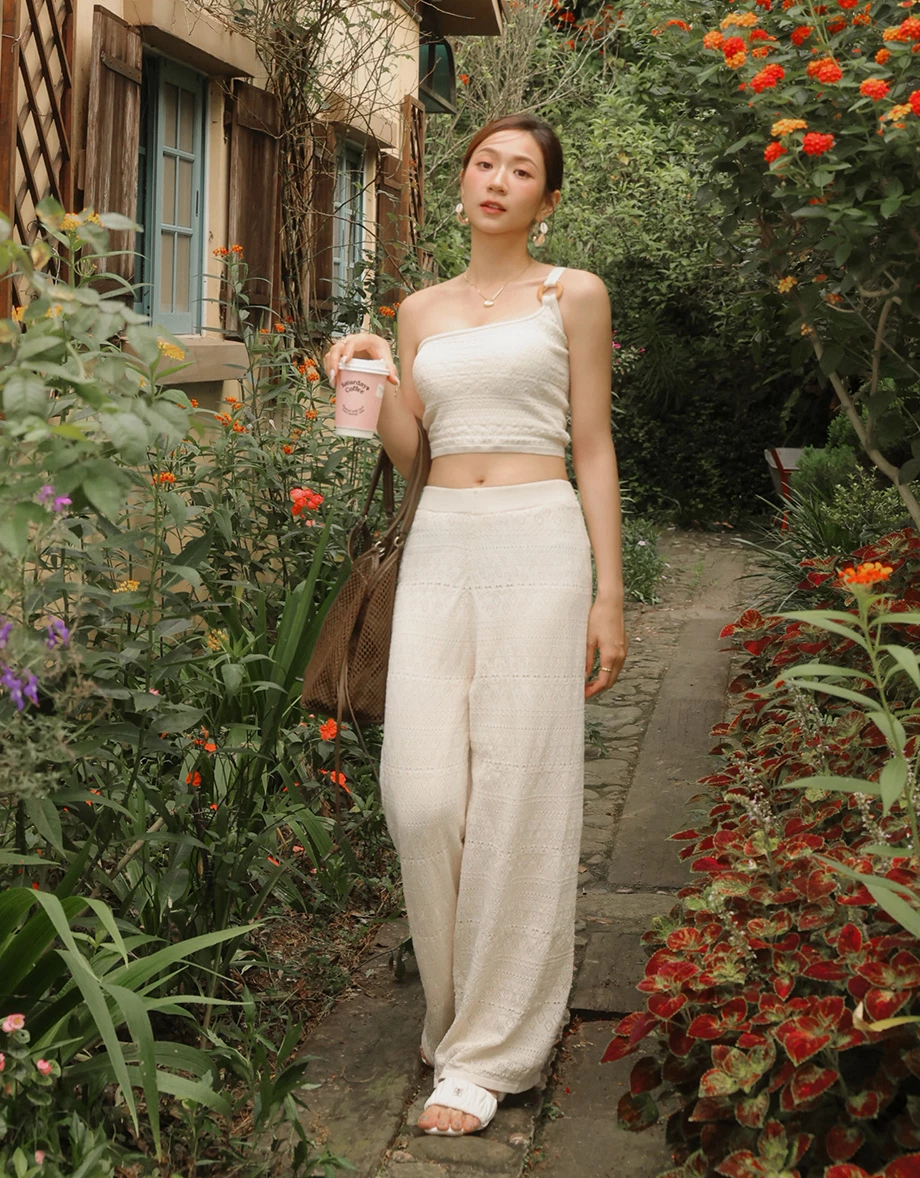
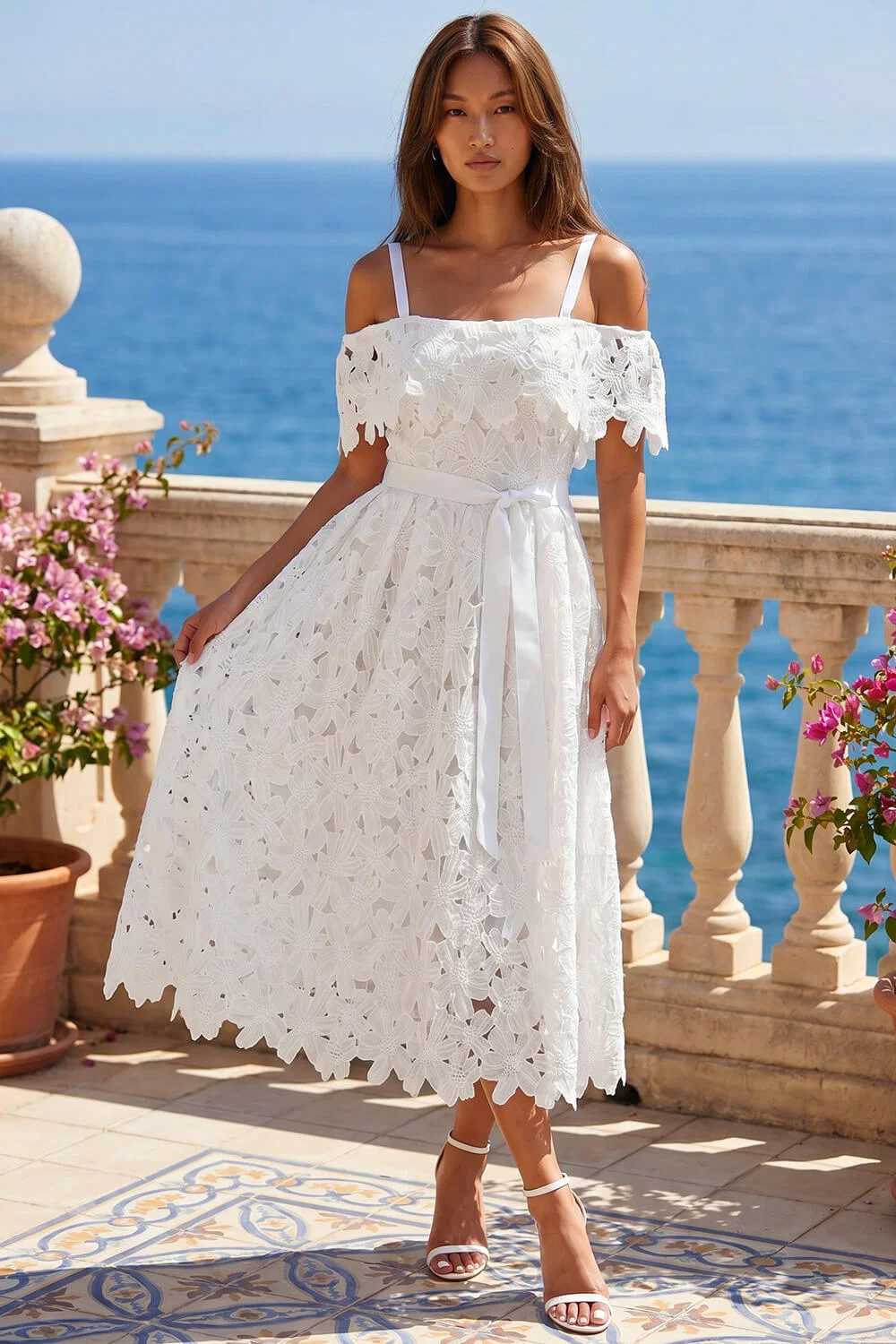
    Now imagine a woman on a Mediterranean terrace — the one in the photo above — wearing a white crochet lace dress that catches the sea breeze through every open stitch. No label visible. No logo screaming status. Just thread, transformed by human hands into something that makes the ocean behind her look like a backdrop.
    Here’s the question: which feels more luxurious?
    The boutique blouse is expensive. But the crochet dress is rare. And in a world where algorithms can replicate almost anything, rarity has become the ultimate currency of luxury.
    We’ve been trained to believe that luxury lives in price tags. In heritage brands. In the weight of packaging and the whisper of tissue paper. But the truth is more subversive: true luxury is the feeling that no one else has exactly what you have. And a handmade crochet piece — with its slight variations, its human imperfections, its story of time and patience — delivers that feeling in a way no factory ever could.

    Why Imperfection Reads as Expensive

    Let’s talk about what happens when you wear handmade.
    A machine-made garment is perfect. Uniform. Predictable. Every stitch identical, every seam mathematically precise. This perfection is comforting — until you realize it’s also anonymous. That same blouse was made in thousands, shipped to hundreds of stores, worn by countless women you’ll never meet. It belongs to everyone. Therefore, in a strange way, it belongs to no one.
    Handmade crochet is the opposite. The tension varies slightly from row to row — not because the maker was careless, but because human hands tire, pause, adjust. The pattern shifts subtly where the crafter stopped for tea, or started again in different light. These aren’t flaws. They’re fingerprints. Proof that a person, not a machine, decided this piece should exist.
    The metallic blue crochet dress below understands this on a cellular level. Every open stitch is a decision. Every ruffled edge is a risk. The asymmetrical hem doesn’t follow a pattern — it follows an instinct. And when the wearer moves, the dress moves with her, not because of engineering, but because of the living quality of the thread.
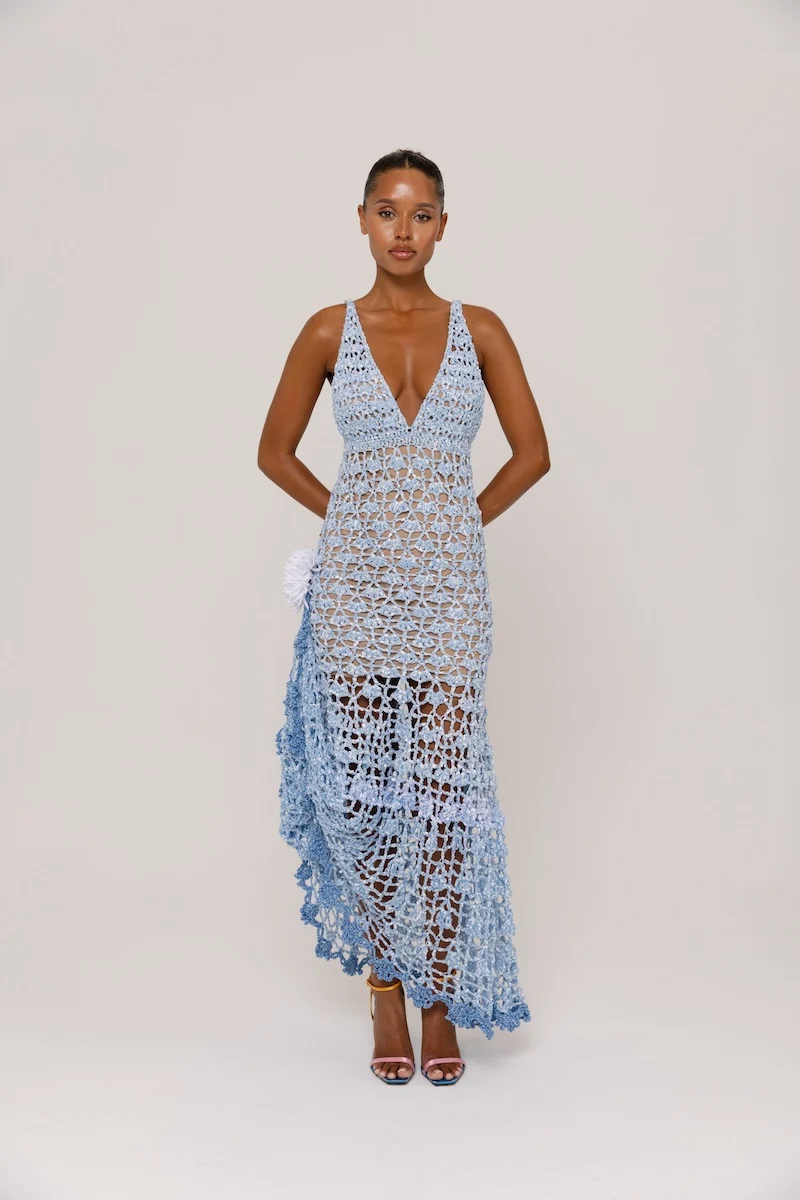
    METALLIC IRIS HANDMADE CROCHET DRESS - Metallic Blue / XS
    This is why handmade reads as expensive even when it isn’t. The eye — trained by decades of mass production — recognizes the irregularity as value. The slight unevenness signals: someone spent time on this. Someone cared. And care, in any currency, is priceless.

    The Invisible Labor That Creates Visible Value

    Here’s something the fashion industry doesn’t want you to think about too deeply: most designer clothes are made by people you’ll never see, in conditions you’ll never know, for wages that would shock you.
    The “luxury” you’re buying? It’s often marketing. Storytelling. The myth of heritage crafted in boardrooms rather than workshops.
    Handmade crochet tells a different story — and it’s written in the work itself. You can see the hours. Count the stitches. Estimate the patience. A single crochet dress might contain ten thousand loops, each one formed by a hand that chose to keep going. That’s not manufacturing. That’s meditation. That’s art that happens to be wearable.
    The woman in the brown crochet top below — walking through a sunlit courtyard with a woven bag and the confidence of someone who knows exactly what she’s wearing — carries that story with her. The top wasn’t produced. It was created. And that creation leaves an energy that others can feel, even if they can’t name it.
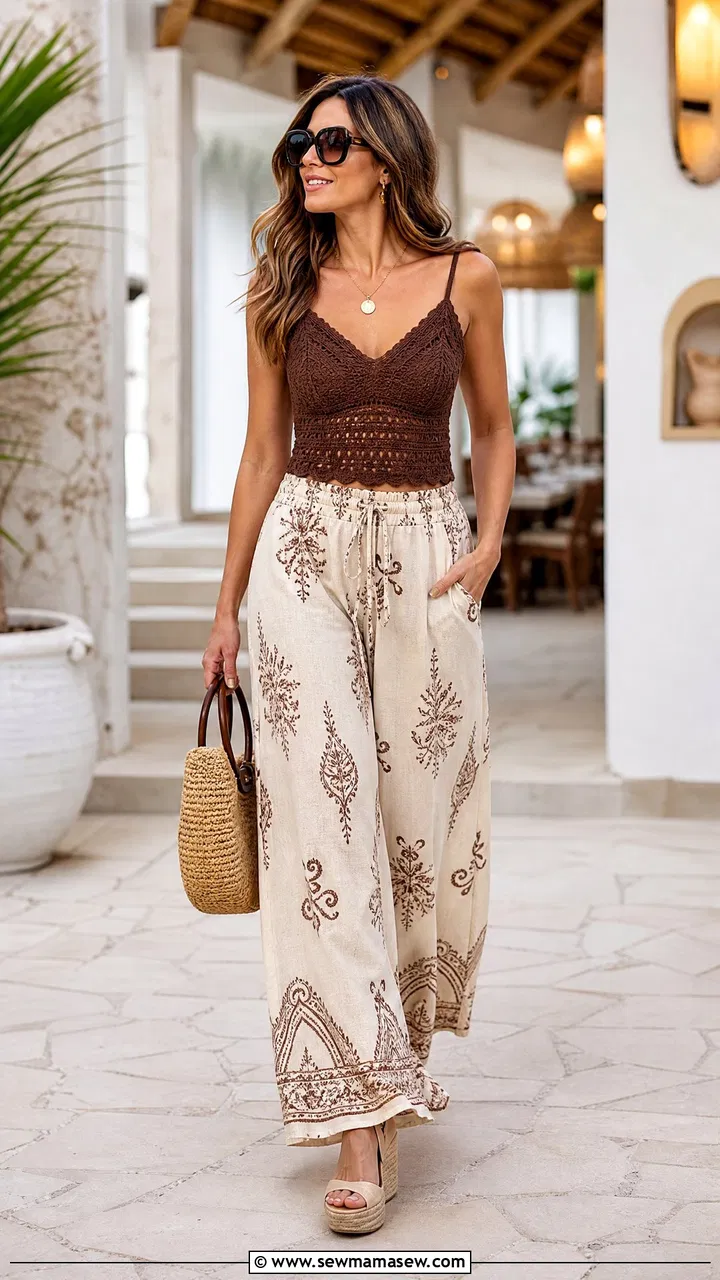
    20 Crochet Top Outfit Ideas for Effortless Vacation Style
    Designer fashion asks: Can you afford this?
    Handmade crochet asks: Do you understand this?
    The second question is harder to answer. And harder things always feel more valuable.

    The Texture of Authenticity

    Let’s get technical for a moment. Because the physics of crochet create something no woven fabric can replicate.
    A solid fabric — silk, cotton, wool — creates a barrier. It covers. It conceals. It performs the basic function of clothing: hiding the body from the world. Crochet does something else entirely. It creates structured transparency. The negative space between stitches isn’t emptiness — it’s invitation. It says: look, but not too closely. Reveal, but not everything.
    This interplay of hide and show is the essence of true luxury. Not the obvious display of wealth, but the subtle suggestion of it. The knowledge that what you’re seeing is only part of the story.
    The yellow crochet set below takes this to its logical conclusion. Matching crop top and wide-leg pants in a sunny, hand-dyed yellow. The pattern is open enough to suggest skin without exposing it. The fit is relaxed without being sloppy. And the overall effect isn’t “I bought this” — it’s “I am this.”
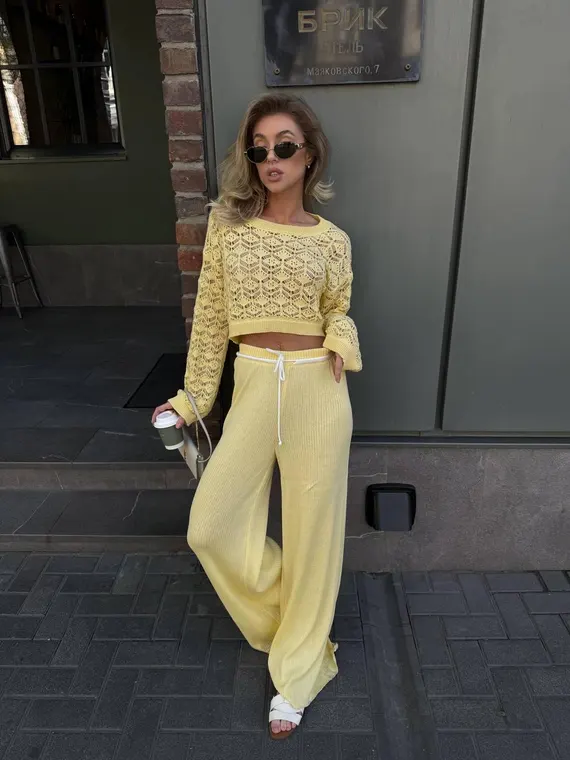
    Yellow Knit Lounge Set – Crochet Crop Top and Wide Leg Pants – 2 Piece  Summer Outfit for Women – Beachwear, Vacation, Casual Loungewear
    This is the luxury of alignment. When what you wear matches who you are. When your clothes don’t perform status — they perform selfhood. And that alignment, that authenticity, is something no amount of money can buy off a rack.

    The Slow Fashion Rebellion

    Here’s the plot twist that changes everything: handmade crochet is a political act.
    Not in the obvious way. Not with slogans or protests. But with the quiet radicalism of slowness in a world obsessed with speed.
    Fast fashion delivers trends in weeks. Handmade crochet delivers pieces in days, sometimes weeks, sometimes months. Fast fashion is designed to fall apart. Handmade crochet is designed to last decades, softening with every wash, growing more beloved with every wear. Fast fashion is anonymous. Handmade crochet is signed — if not with a name, then with the unmistakable mark of human hands.
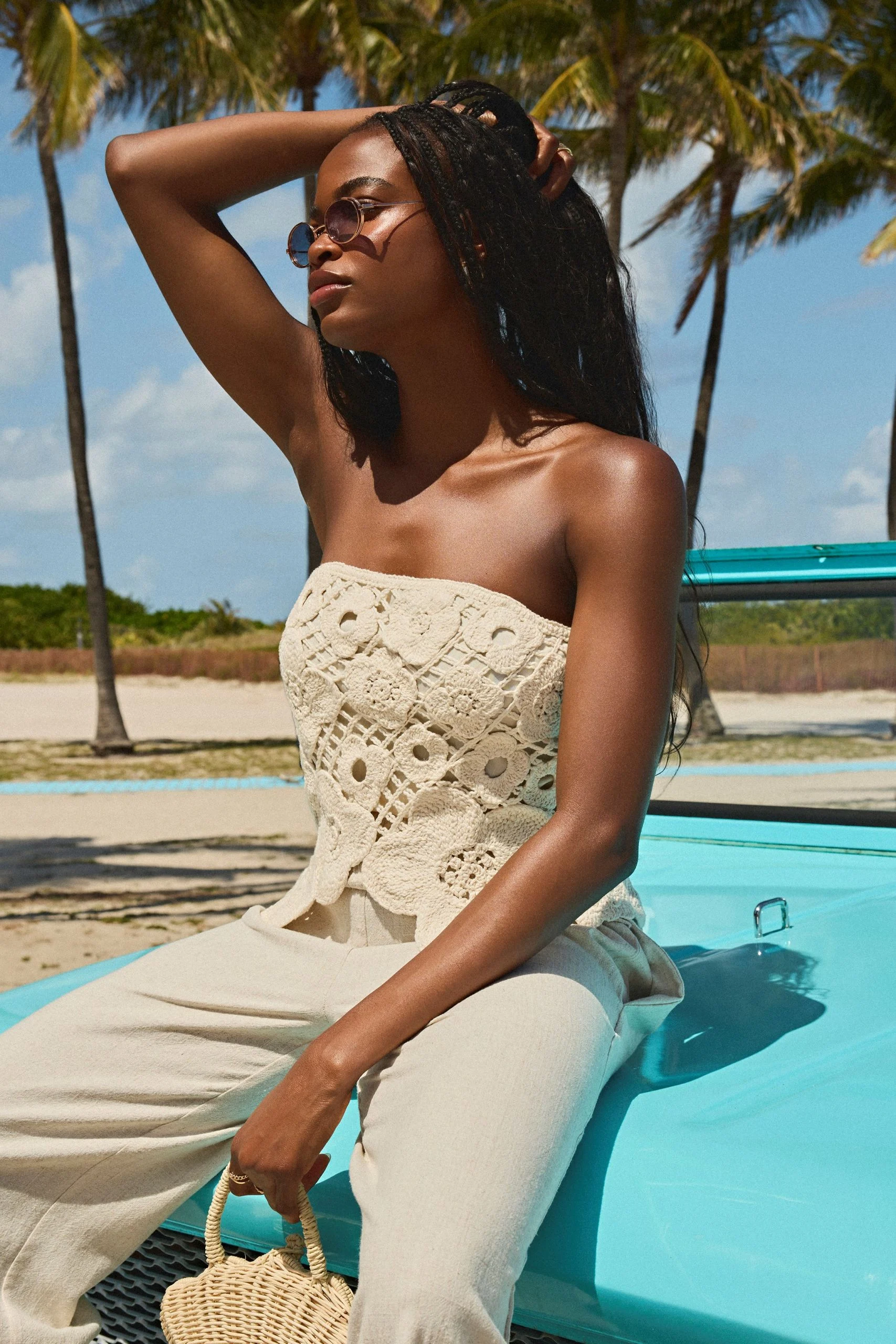
    The white crochet dress below, with its off-shoulder silhouette and ocean backdrop, isn’t just beautiful. It’s resistant. It resists the algorithm that predicts what you’ll want next season. It resists the factory that would churn out a thousand copies. It resists the very idea that clothing should be disposable.
    Ivory Crochet Lace Bardot Midi Dress | Roman UK
    And in that resistance, it finds something more valuable than trendiness: timelessness. A handmade crochet piece doesn’t go out of style because it was never in style to begin with. It exists outside fashion’s calendar. It’s not seasonal. It’s eternal.

    The Luxury of Story

    Let’s end with the most important thing.
    A designer handbag comes with a story — but it’s someone else’s. The founder’s vision. The brand’s heritage. The marketing team’s narrative. You’re borrowing it, wearing it, performing it.
    A handmade crochet piece comes with a story that’s yours to write. Who made it? A grandmother in a village you’ve never visited. An artist on Etsy who included a handwritten thank-you note. Yourself, learning to crochet on winter evenings, frogging rows, celebrating when the pattern finally clicked.
    The cream crochet and linen set below — photographed against driftwood at sunset — carries this potential. It could be from a boutique in Tulum. It could be from a craft fair in Maine. It could be from your own hands, still holding the warmth of the afternoon when you finished the last stitch.
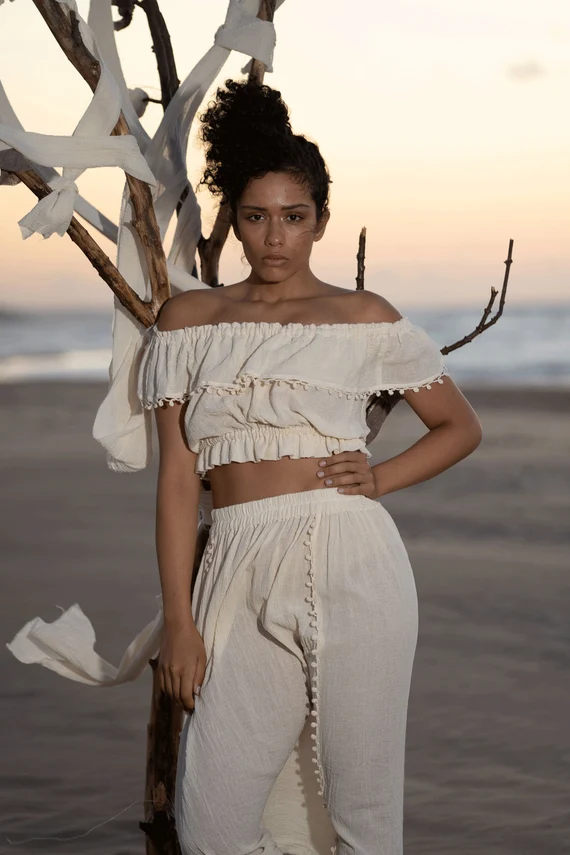
    Handmade Crochet Organic Cotton Linen Set | Boho Two Piece Fashion
    That uncertainty is the point. The story isn’t pre-written. It’s waiting for you. And a garment that invites your story — rather than imposing its own — is the ultimate luxury.

    Your Handmade Manifesto

    So here’s the reframe. Not a shopping list. A philosophy.
    1. Value the irregular. The stitch that’s slightly tighter than its neighbor. The edge that curves where it should be straight. These are signatures, not mistakes.
    2. Invest in time, not price. A handmade piece that took forty hours to create is worth more than a machine-made piece that took forty minutes, regardless of what the tag says.
    3. Wear the maker. When you put on handmade, you carry someone’s afternoon, someone’s patience, someone’s skill. That’s not clothing. That’s connection.
    4. Reject the disposable. Choose pieces that age, that soften, that tell your story over years. True luxury is longevity.
    May your wardrobe be slow. May your stitches be even. May your style be unmistakably, irreplaceably yours. 🧶✨
  • Quiet Luxury Crochet: The Tote Bag That Goes With Everything

    Quiet Luxury Crochet: The Tote Bag That Goes With Everything

    Summer Round Crochet Tote Bag Handmade Woven Beach Shoulder Bag for  Vacation | eBay What if the most versatile thing in your wardrobe isn’t something you wear — but something you carry?

    The Bag That Broke the Rules
    Let’s start with a confession. I used to be a leather-bag person. The structured kind. The kind that costs more than a weekend getaway and requires its own maintenance routine. I believed, like most of us, that luxury meant weight. That elegance required hardware. That a bag needed to announce itself to be worth carrying.
    Then I met the crochet tote.
    Not the chunky, colorful kind from childhood summers. Not the beach bag that screams “vacation mode.” A quiet, intentional, meticulously crafted crochet tote in a neutral tone — cream, sand, soft grey — with leather straps that have aged like a favorite pair of boots.
    And everything changed.
    Here’s the paradox: this bag is technically “just” cotton and thread. No logo. No lining with a designer’s name repeated like a prayer. And yet it elevates every outfit it touches. Jeans and a white shirt? Suddenly editorial. Linen dress? Suddenly Positano. Swimsuit cover-up? Suddenly St. Tropez.
    The crochet tote doesn’t match your outfit. It harmonizes with your intention.
    Calla Crochet Bag

    Why Crochet Is the New Cashmere

    Let’s talk about texture. In a world of smooth leather, shiny nylon, and structured canvas, crochet is a rebellion. It’s tactile. It catches light differently through every opening. It moves when you move, breathes when you breathe, and somehow manages to look both artisanal and expensive at the same time.
    The luxury industry has spent decades convincing us that value lives in opacity — in hiding the making, in sealing the seams, in presenting a finished product that feels untouchable. Crochet does the opposite. It shows the work. Every loop is visible. Every stitch is a decision. The pattern isn’t printed on; it’s built in, row by row, by human hands.
    This transparency is what makes it feel luxurious. Not despite its handmade quality, but because of it.
    Think about it: the most expensive restaurants don’t hide their kitchens. The most coveted watches have exhibition casebacks so you can watch the mechanism work. Luxury has shifted from “look what I have” to “look what was made for me.” And a crochet tote, with its visible craftsmanship, its slight irregularities that prove it wasn’t machine-made, fits this new definition perfectly.
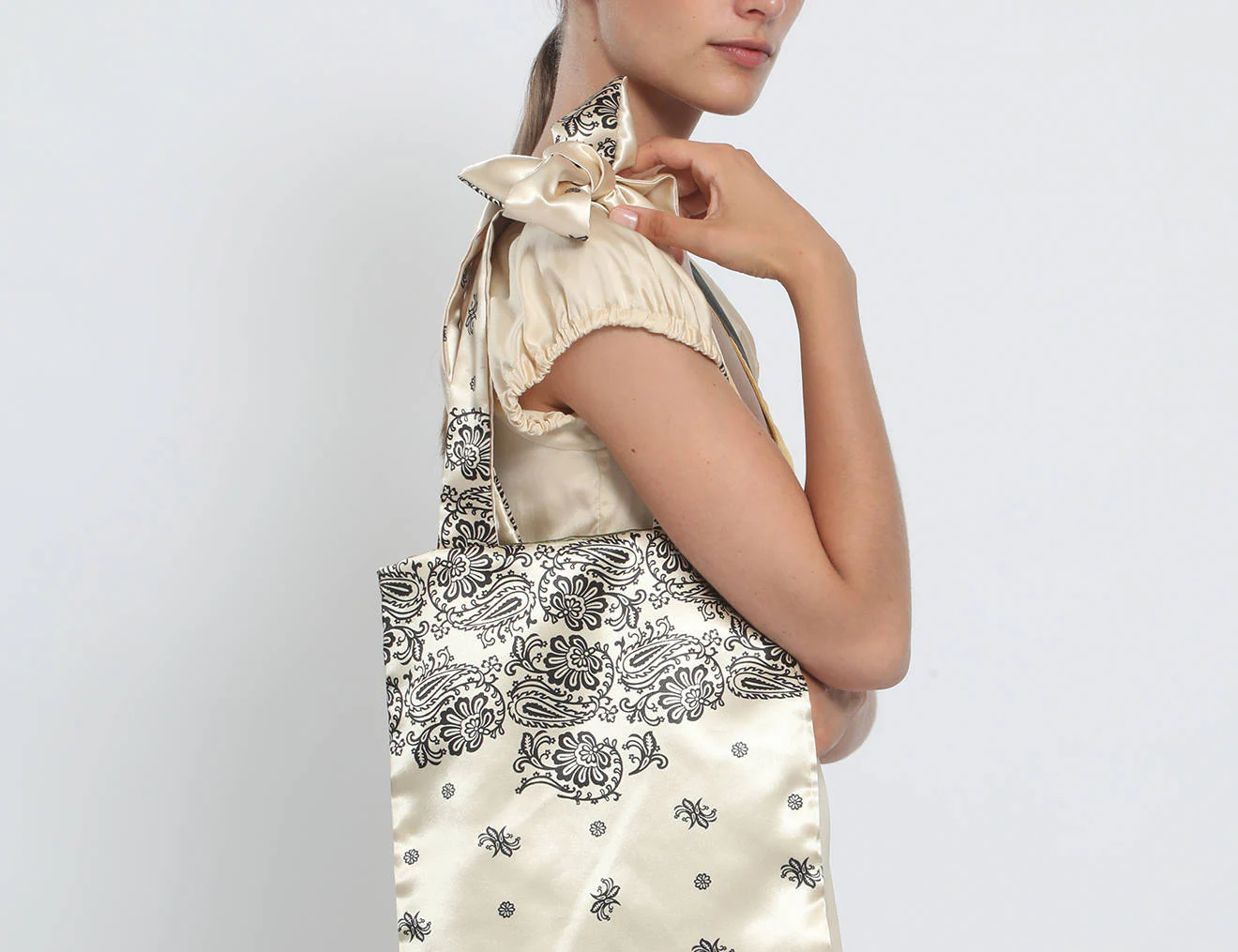
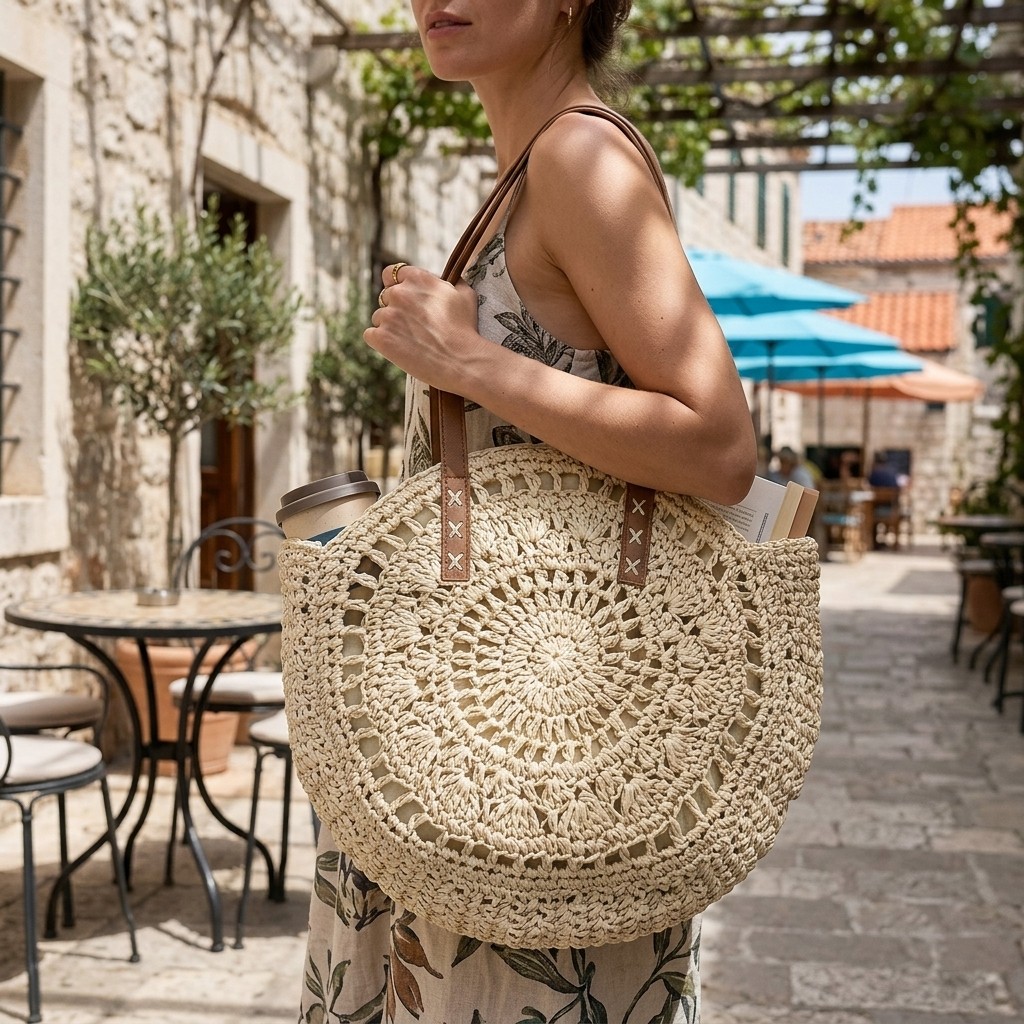
    The woman in the photo above understands this. Standing against a clean backdrop with a structured crochet bag on her shoulder, she doesn’t need a logo to signal taste. The bag speaks in a whisper that carries across a room.

    The Mathematics of Versatility

    Here’s where logic gets flipped. Most bags in your closet have a range. The evening clutch works for dinners. The leather tote works for work. The canvas bag works for groceries. Each has its territory, its designated function, its invisible fence.
    The crochet tote has no fence.
    I’ve carried mine to:
    • A black-tie gala (with a silk gown — the contrast was chef’s kiss)
    • A farmer’s market at 8 AM (with linen pants and a messy bun)
    • A job interview (with a blazer — yes, really)
    • A beach wedding (with a flowing dress and bare feet)
    The secret isn’t magic. It’s neutral intentionality. A crochet tote in cream or sand doesn’t compete with what you’re wearing. It completes it. Like the perfect note in a chord, or the pinch of salt that makes a dessert taste like itself, only better.
    And the texture adds something no leather bag can: dimension. A flat leather tote against a flat outfit reads as one note. A crochet tote against the same outfit creates visual rhythm. The eye travels. The outfit breathes.
    How to Style Crochet Handbags | Outfit Ideas & Everyday Looks

    The Handmade Advantage: Why Imperfection Is the Point

    Let’s get technical for a moment. Machine-made crochet exists, and it’s fine. Uniform. Predictable. Boring. But hand-crocheted bags have something else entirely: soul.
    The slight variation in tension between rows. The way the pattern shifts subtly where the maker paused for coffee. The leather straps that were cut and attached by hand, not stamped out by a machine. These aren’t flaws — they’re fingerprints. Proof that a person, not an algorithm, decided this bag should exist.
    In an era where everything can be replicated, where your neighbor’s bag is identical to yours because they bought it from the same algorithm, handmade is the ultimate luxury. It’s the difference between a print and an original painting. Between a recording and a live performance. Between “I have this” and “this was made for me.”
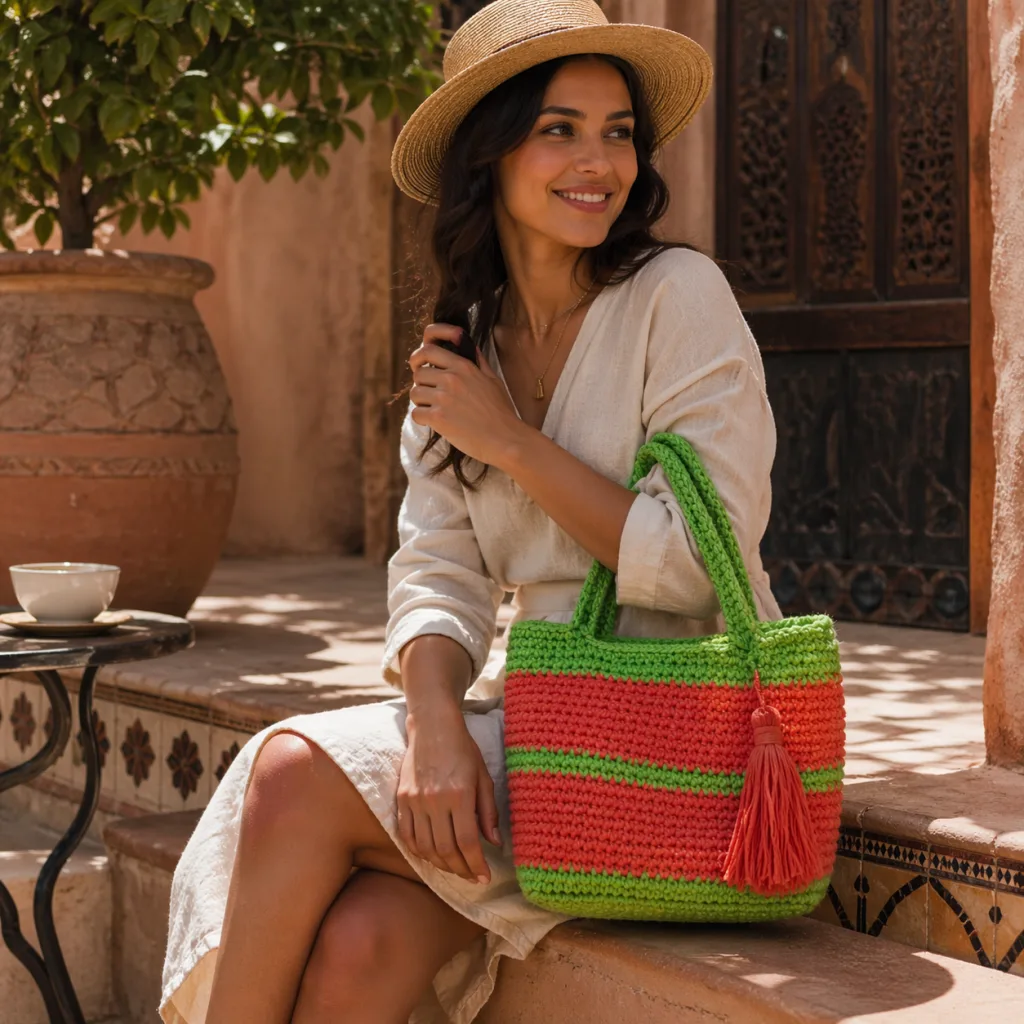
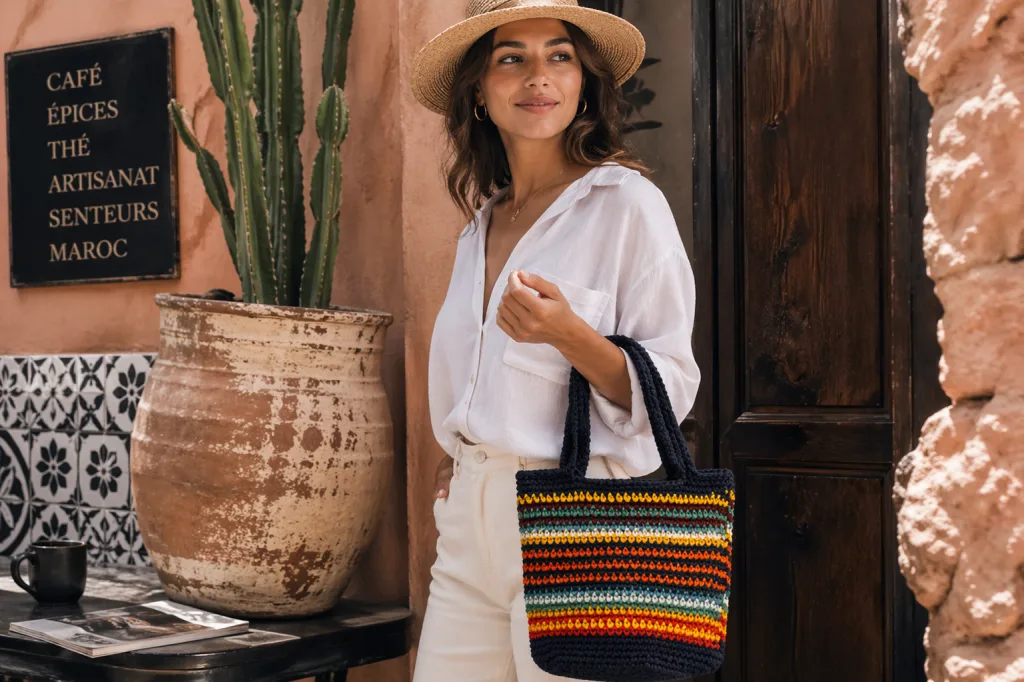
    The woman in the Moroccan courtyard below gets it. Her striped crochet tote isn’t trying to be a designer bag. It’s something better: a piece of functional art that carries her story through sunlit streets and shaded cafés.
    How to Style Crochet Handbags | Outfit Ideas & Everyday Looks

    How to Style Your Crochet Tote (Without Looking Like You’re Going to the Beach)

    The biggest misconception about crochet bags? That they’re only for beach days. Let’s destroy that myth.
    The Office Upgrade: Pair a structured crochet tote in charcoal or navy with a tailored blazer and wide-leg trousers. The contrast between corporate structure and artisanal texture creates tension — the good kind. The kind that makes people ask where you got it.
    The Date Night: A small crochet clutch (or a mini tote tucked under your arm) with a slip dress and heels. The softness of the crochet against the silk creates a tactile dialogue that reads as effortlessly seductive.
    The Weekend Wander: Oversized crochet tote, vintage denim, a white t-shirt that’s seen better days, and leather sandals. This isn’t an outfit; it’s a philosophy. The “I have nowhere to be and everywhere to go” aesthetic.
    The Travel Uniform: Crochet tote as your personal item on a flight. It holds your book, your scarf, your snacks, and somehow looks more polished than any roller bag ever could. Plus, it squishes under the seat without complaint.
    The rule? There is no rule. The crochet tote doesn’t demand a specific aesthetic. It adapts to yours.

    The Sustainability Plot Twist

    Here’s something the luxury industry doesn’t want you to think about: most designer bags are terrible for the planet. The tanning process for leather is one of the most polluting industries on earth. Synthetic “vegan leather” is just plastic with a marketing team. And fast-fashion bags? Designed to fall apart so you’ll buy another.
    Crochet totes are the quiet rebels.
    Cotton. Linen. Sometimes hemp or jute. Natural fibers that biodegrade when their life is done. Dyes that don’t poison rivers. A construction method — crochet — that uses minimal energy and creates zero waste (every scrap of yarn finds its way into something).
    And the durability? Surprising. A well-made crochet tote, properly cared for, lasts years. The fibers soften without weakening. The leather straps develop a patina that tells your story. This isn’t disposable fashion. This is keepable fashion.
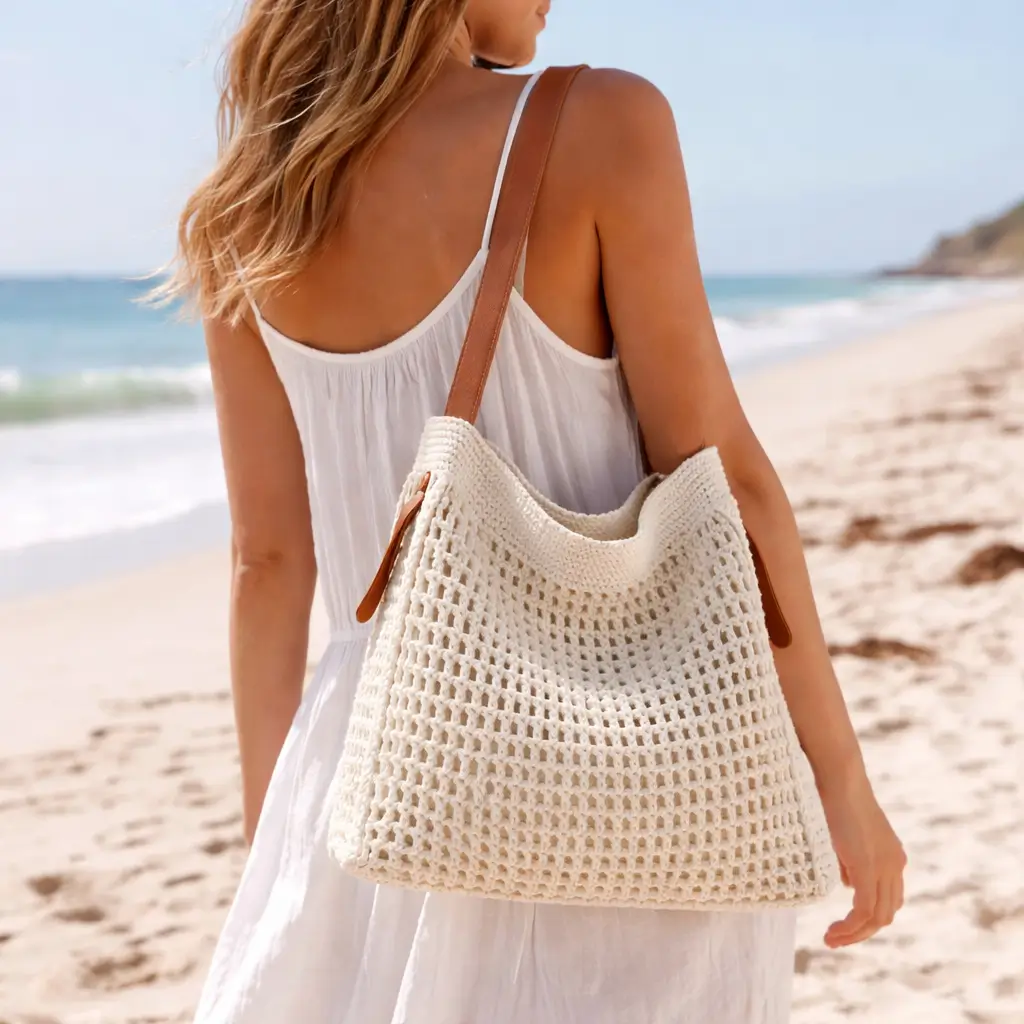
    The bag in the photo below — cream crochet with leather straps, carried by a woman in a white sundress on a sun-bleached beach — isn’t just beautiful. It’s a choice. A vote for slowness in a world of speed.
    Handmade Crochet Tote Bag for Women – Boho Summer Beach Tote | Dreamer  Studio

    The Investment That Isn’t One

    Let’s talk numbers. A designer leather tote starts around $2,000 and climbs fast. A handmade crochet tote? A fraction of that. Sometimes a small fraction.
    But here’s the twist: the crochet tote often gets more compliments. More questions. More “where did you get that?” moments. Not because it’s cheaper, but because it’s rarer. In a sea of identical luxury bags, the crochet tote is the one that stands out by not trying to.
    It’s the fashion equivalent of a handwritten letter in an inbox full of emails. Of a home-cooked meal in a city of restaurants. Of a conversation without phones. It signals something deeper than wealth: it signals intention.
    You didn’t buy this bag because an influencer told you to. You chose it because it spoke to you. Because the craftsmanship moved you. Because you understand that true luxury isn’t about price — it’s about rarity, story, and soul.

    Your Crochet Tote Manifesto

    So here’s your homework. Not a shopping list. A mindset shift.
    1. Look for hand, not brand. The best crochet totes come from makers, not megacorporations. Etsy. Local markets. That friend who crochets and hasn’t realized she could sell her work. The story matters more than the label.
    2. Choose neutral, live colorful. A cream or sand tote goes with everything. Let your outfit be the color. Let your bag be the canvas.
    3. Embrace the patina. The slight stretching of the base. The softening of the straps. The way the crochet molds to your shoulder over time. This is the bag becoming yours.
    4. Carry it everywhere. To the grocery store. To the gala. To the coffee shop where you write your novel. The crochet tote doesn’t judge your destination. It just makes getting there more beautiful.
    Happy carrying, beautiful wanderer. 🌿✨
    May your tote be handmade, your outfits be effortless, and your summer be unforgettable.
  • The Summer Crochet Top That Makes Linen Pants Look Expensive

    The Summer Crochet Top That Makes Linen Pants Look Expensive

    Bohemian Crochet Texture Wide Leg Pants
    Disclosure: This post contains affiliate links to Creative Fabrica. I only recommend products I genuinely love
    What if the secret to looking like you spent a fortune… is wearing almost nothing at all?

    The $40 Pants, $400 Vibe Trick

    Let’s start with a confession. Those wide-leg linen pants in your drawer? The ones you bought on sale, slightly wrinkled, that make you look like you just rolled out of bed? They’re not the problem. The problem is what you’ve been pairing them with.
    A basic tank top turns linen pants into pajamas. A structured blazer makes them look like you’re trying too hard. But a crochet lace top? Magic. Suddenly those same pants look like they came from a boutique in Positano. Suddenly you’re the woman who “just threw something on” and stopped traffic.
    Here’s the physics of it: linen is humble. It’s earthy, wrinkled, honest. Crochet is the opposite — it’s intricate, decorative, almost aristocratic in its detail. Put them together and you get tension. The kind of visual tension that makes people look twice. The kind that reads as expensive without a single logo in sight.
    The woman in our hero photo knows this secret. Standing among pink roses in a white crochet lace top and pale blue linen pants, she doesn’t look dressed up. She looks elevated. Like she understood an equation everyone else missed.

    Why Crochet + Linen = Summer’s Most Underrated Power Couple

    Let’s talk about what happens when these two fabrics meet.
    Linen pants breathe. They keep you cool when the sidewalk is melting. They have that effortless drape that says “I summer in places you’ve only seen in movies.” But left alone, they can veer into “I just finished gardening” territory.
    Crochet tops fix this instantly. The openwork creates texture against linen’s smooth planes. The handmade quality adds soul to linen’s simplicity. And the negative space — those deliberate holes where skin (or a camisole) shows through — creates visual interest that a solid top never could.
    It’s the fashion equivalent of pairing a rough stone wall with a delicate chandelier. Each makes the other more beautiful.
    If you’re loving this combination and want to explore more pieces that bring this same handcrafted elegance to your summer wardrobe, check out this stunning creation: Safiya Lacy Poncho. It carries that same airy, artisanal spirit that makes every outfit feel intentional.

    The Three Outfit Formulas That Will Change Your Summer

    Formula 1: The Garden Party
    Crochet lace top (white or cream) + high-waisted linen pants in sand or stone + leather sandals + a single gold chain. Add a straw bag if you’re feeling fancy. This isn’t an outfit — it’s a mood. The kind of look that makes people ask where you’re brunching, even if you’re just walking to the farmer’s market.
    Formula 2: The Beach-to-Bistro
    Wear your crochet top over a swimsuit. Linen pants pulled on over your suit bottoms. Espadrilles. Sunglasses. A book tucked under your arm. When the sun sets and the restaurant lights come on, you don’t need to change. You just need a table with a view.
    Formula 3: The Unexpected Evening
    Crochet top + wide-leg linen pants in charcoal or navy + block heels + bold earrings. The lace reads delicate, the linen reads grounded, and together they create something that works for rooftop drinks, gallery openings, or anywhere you want to look like you tried without actually trying.
    2023 — Mary's Little Way

    The Handmade Advantage: Why Machine-Made Will Never Compare

    Here’s something the fast fashion brands don’t want you to know: you can see the difference between handmade and machine-made crochet from across a room.
    Machine crochet is uniform. Perfect. Boring. It lies flat and stays flat. Handmade crochet has life. Slight variations in tension. Imperfections that become character. The way the fabric moves when you walk, catching light differently through each opening.
    When you wear a handmade crochet top, you’re not just wearing a garment. You’re wearing someone’s time. Their skill. Their patience. And that intangible quality — the human touch — is what reads as expensive. Not the price tag. The story.
    This is why a $30 handmade crochet top can make $40 linen pants look like a $400 outfit. The value isn’t in the materials. It’s in the intention.
    If the idea of wearing something with this much soul speaks to you, you’ll want to see this next piece — it’s handcrafted beauty at its finest: Safiya Lacy Poncho.

    How to Choose the Perfect Crochet Top for Your Linen Pants

    Not all crochet is created equal. Here’s your cheat sheet:
    The Neckline: A boat neck or slight scoop flatters almost everyone. V-necks elongate but can read casual. High necks feel more editorial. Choose based on where you’re going — and what necklace you want to wear.
    The Sleeve: Cap sleeves (like our hero photo) are the sweet spot. They cover enough to feel polished, expose enough to feel summery. Sleeveless works for beach days. Long sleeves in crochet? Save that for autumn.
    The Length: Cropped tops work with high-waisted linen pants. Hip-length tops tuck in beautifully. Anything longer starts to compete with the pants’ silhouette. Keep it simple.
    The Color: White and cream are classics for a reason. They reflect heat, photograph beautifully, and pair with every shade of linen. But don’t sleep on soft sage, dusty rose, or pale blue — especially if your linen pants are neutral.

    The Wrinkle Paradox: Why Linen’s “Flaws” Are Actually Features

    Let’s address the elephant in the room. Linen wrinkles. It wrinkles if you look at it wrong. And for years, we’ve treated this like a defect.
    Here’s the plot twist: the wrinkles are the point.
    A perfectly pressed linen pant looks stiff. Corporate. Like you’re trying to make linen be something it’s not. But linen with soft, lived-in wrinkles? That reads as authentic. As traveled. As someone who has better things to do than iron.
    The crochet top plays into this beautifully. Its intricate pattern draws the eye upward, while the linen’s relaxed texture grounds the look. Together they say: I’m put-together, but I’m not trying to be perfect. And in a world of over-curated Instagram perfection, that message is revolutionary.
    For more pieces that embrace this perfectly imperfect philosophy, take a look at this gorgeous handcrafted design: Safiya Lacy Poncho.

    Your Summer Style Reset

    This summer, try the unexpected. Reach past the basic tees and structured blouses. Pick up a crochet lace top — handmade, if you can find it. Pair it with those linen pants you almost gave away.
    Stand in front of the mirror. Notice how the light filters through the openwork. How the linen drapes differently against textured fabric. How you look like you stepped out of a different decade — one where people took time to dress, where clothes had stories, where summer meant something.
    You don’t need a bigger clothing budget. You need a better formula. Crochet + linen. Intricate + simple. Handmade + humble.
    That’s the equation. And it always equals expensive.
    36 Cute Summer Tops for Women That Instantly Make An Outfit

    Make It Yourself: The Free Pattern Promise

    Inspired? Here’s the best part. That crochet top in the photo? It’s not from a luxury brand. It’s from a pattern. A free PDF waiting for someone with a hook, some cotton yarn, and an afternoon to spare.
    The pattern works up in simple panels — front, back, sleeves joined at the shoulder. The lace motif repeats like a meditation. By the time you finish, you’ll have something no store can sell you: a piece of your own summer, stitched by your own hands.
    All you need:
    • 3-4 skeins of cotton or cotton-blend yarn
    • A 3.5mm crochet hook
    • Patience (the secret ingredient)
    • A sunny afternoon and good music
    Happy summer styling, beautiful dreamer. 🌿✨
    May your linen be wrinkled, your crochet be handmade, and your vibe be unmistakably expensive.
  • Easy Crochet Kerchief Pattern for a Timeless Boho Look

    Easy Crochet Kerchief Pattern for a Timeless Boho Look

    Free Crochet Head Scarf Pattern: Breezy Boho BandanaDisclosure: This post contains affiliate links to Creative Fabrica. I only recommend products I genuinely love

    There is a shape that refuses to die.
    Not the circle. Not the square. Something more dangerous. Something that has survived the French Revolution, the 1960s, and every music festival since Woodstock. It is a triangle. Specifically, a triangle made of yarn, tied under hair, worn with the kind of confidence that makes strangers ask where you bought it.
    They didn’t buy it. They made it. Or they will, after reading this.

    The Kerchief Paradox: How a Triangle Became a Crown

    Here is a riddle: What is simultaneously the most humble and the most regal piece of clothing ever invented?
    A crown is too obvious. A tiara is trying too hard. But a kerchief? A kerchief is a queen in disguise. It is the accessory that says, “I have gardens to tend and revolutions to lead, but first, coffee.”
    The crochet kerchief takes this even further. It is not fabric cut and sewn. It is fabric built, loop by loop, by human hands. Every hole in the lace pattern is a decision. Every edge is a border between “I made this” and “I am this.”
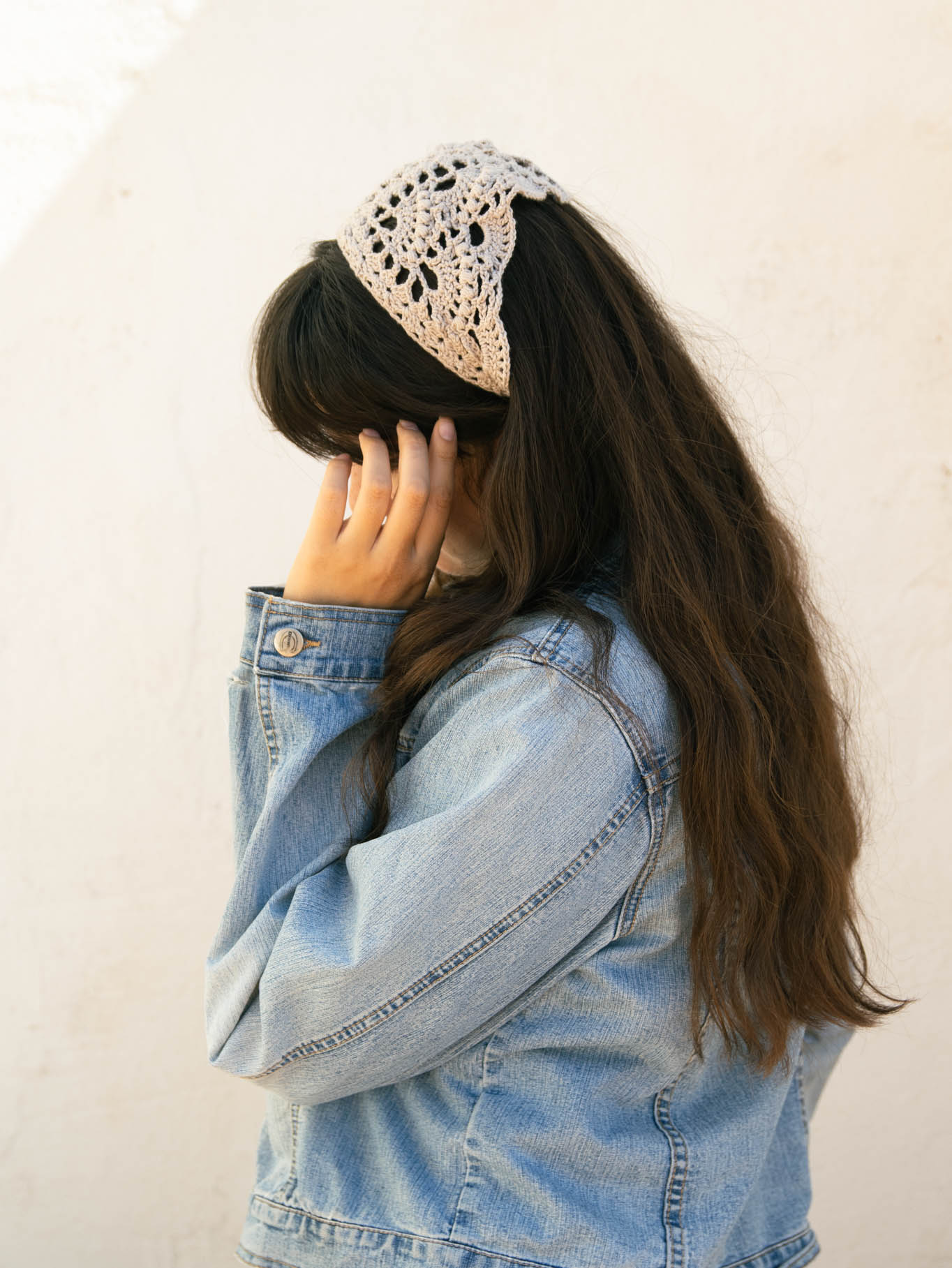
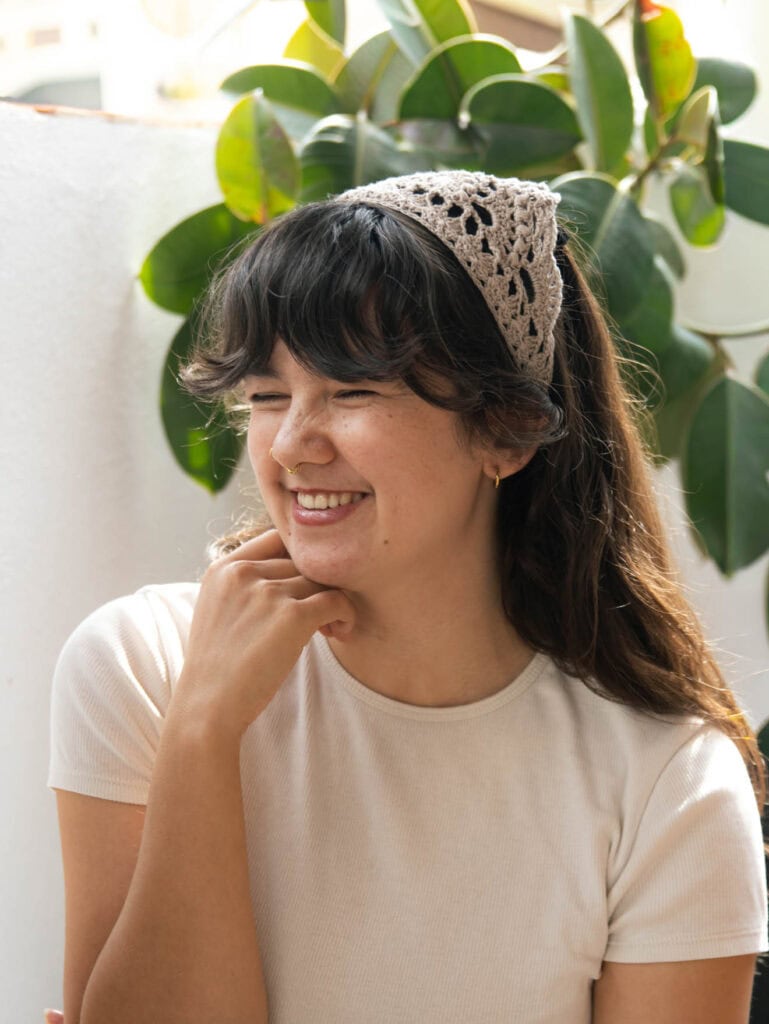
    And the Monaco kerchief? That is architecture for your head. The pattern is not random. It is a grid of intentional spaces — light passing through, hair peeking out, the geometry of beauty meeting the physics of wearability.
    This is not a hat. This is not a headband. This is a statement of intent.

    The Boho Math: Why This Pattern Works

    Let us talk about the Monaco pattern for a second.
    Most kerchiefs are solid triangles. Functional. Boring. The kind of thing you wear to keep hair out of your face while painting a fence.
    The Monaco kerchief is not that. The Monaco kerchief is lace engineering. The openwork creates negative space that frames your face like a photograph. The solid sections give structure, so it does not collapse into a sad rag. The ties are long enough to wrap, bow, or let hang — three personalities in one piece of yarn.
    Here is the math:
    • Solid stitches = weight and drape
    • Open stitches = breathability and light
    • Border stitches = structure and finish
    Add them together and you get something that works at a farmers market, a wedding, a Zoom call where you only need to look good from the eyebrows up.
    This is not beginner crochet. But it is not expert either. It is the sweet spot where you know enough to be dangerous, and the pattern is forgiving enough to let you.

    Monaco Crochet Kerchief Pattern at a Glance

    Table

    Feature Details
    Skill Level Advanced Beginner to Intermediate
    Yarn Weight DK or Light Worsted
    Hook Size 4.0–5.0 mm
    Construction Triangle worked from the center outward
    Finished Size Adjustable
    Techniques Chains, double crochet, lace repeats
    Season Spring, Summer, Early Fall
    This table is your roadmap. The advanced beginner label means you have escaped the “scarf-only” phase and are ready for something that actually fits a head. The DK weight keeps it light enough for summer but substantial enough to hold the lace structure. And the center-outward construction? That is the magic trick — you start small and grow, watching the triangle emerge like a secret being told.

    The Three Ways to Wear a Kerchief (Or: Why You Need More Than One)

    A kerchief is not a one-trick pony. A kerchief is a shape-shifter.
    The Forehead Crown
    Folded narrow, tied at the back, pushing hair up and out. This is the “I woke up like this” look, except you actually woke up, crocheted for three hours, and then styled your hair. Worth it.
    The Neck Scarf
    Tied loose, hanging low, framing your collarbone. This is the “I read French poetry and drink wine at lunch” look. Even if you read romance novels and drink iced coffee. The kerchief does not judge.
    The Ponytail Frame
    Tied over the hair, under the bun, turning a messy updo into intentional art. This is the “I have a meeting in five minutes but I still have standards” look. The one that makes coworkers ask if you have a stylist.
    Three ways. One pattern. Infinite combinations.
    And the best part? The Monaco pattern looks different in every color. Cream and linen for the beach. Charcoal and silver for the city. Terracotta and mustard for the autumn you are already dreaming about in July.
    Free Crochet Head Scarf Pattern: Breezy Boho Bandana

    The Imperfection Doctrine

    Here is something nobody tells you about lace crochet: the holes are supposed to be there.
    In knitting, a hole is a mistake. In lace crochet, a hole is the point. The negative space is the design. The gaps are where the light goes. The imperfections are where the personality lives.
    So if your Monaco kerchief has one slightly larger hole? That is not a flaw. That is a signature. That is the stitch where you got distracted by a podcast, or a child, or a sudden memory of something you needed to do. That stitch holds a story.
    And when someone compliments your kerchief — and they will, constantly, at gas stations and grocery stores and weddings where they are supposed to be looking at the bride — you can point to that hole and say, “That one is mine. I made that.”
    That is the difference between handmade and everything else. Handmade has fingerprints. Handmade has history. Handmade has holes that mean something.

    Your Assignment: Tie One On

    Here is what I want you to do.
    Pick up your hook. Choose a color that scares you a little — the one you always walk past in the yarn store because it is “too much.” It is not too much. It is exactly enough.
    Work the pattern. Count the stitches if you want. Lose count if you don’t. Let the rhythm of the hook become a meditation, a conversation with yourself that needs no words.
    And when you are done, when the triangle is blocked and the ends are woven in, tie it on. Look in the mirror. See the crown. See the lineage. See the woman who decided that a triangle of yarn was enough to make her feel like herself.
    Because it is. It always was.
    Happy hooking, triangle-wearers. May your stitches be even, your holes be intentional, and your kerchief always make strangers ask where you got it. 🧶✨
    P.S. If this article made you want to tie a triangle on your head immediately, share it with someone who needs a reminder that handmade is always in style. The kerchief revolution needs soldiers.
  • Crochet Star Beanie Pattern: The Cozy Hat That Turns Winter Into Magic

    Crochet Star Beanie Pattern: The Cozy Hat That Turns Winter Into Magic

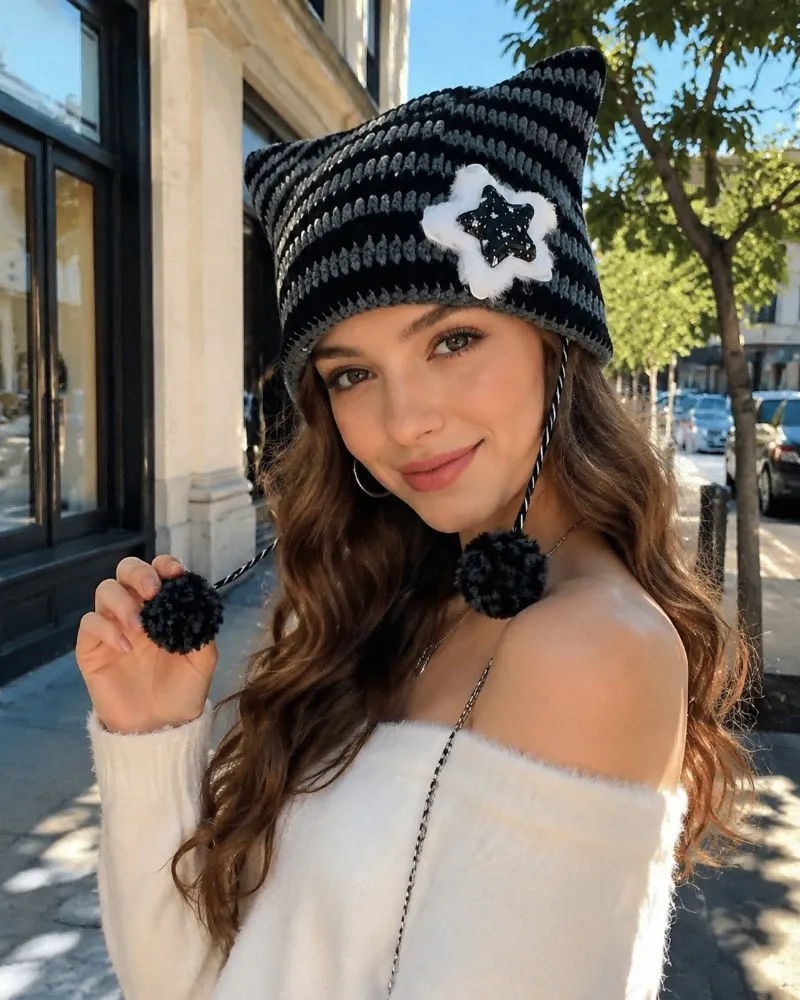
    Womens Y2K Cat Ear Beanie Hat Star Stripe... From MocillureDisclosure: This post contains affiliate links to Creative Fabrica. I only recommend products I genuinely love

     Have you ever looked up at the night sky and wondered what it would feel like to wear the cosmos?

    Not in some abstract, poetic way. I mean literally. What if you could pull on a hat and suddenly the Milky Way was hugging your skull? What if constellations weren’t something you observed — but something you became?
    Sounds impossible, right?
    Wrong.

    The Hat That Breaks Physics

    Let’s start with a paradox.
    Stars are massive balls of burning gas millions of miles away. They can swallow planets whole. They outlive civilizations. And yet — someone, somewhere, figured out how to trap their essence in wool and make it snug.
    The Starstruck Beanie isn’t just a hat. It’s a miniature defiance of astrophysics. It’s what happens when a crochet hook meets ambition and says, “Hold my yarn.”
    Think about it: every star pattern on that beanie is a tiny rebellion against the ordinary. In a world of plain black beanies and forgettable winter gear, you show up wearing the night sky. People don’t just see you. They orbit you.
    And here’s the beautiful twist — you don’t need a telescope to find these stars. You need a crochet hook, some patience, and the kind of audacity that makes strangers stop you on the street.
    Ready to catch some stars of your own? The Starstruck Beanie pattern is waiting for you here →

    Why We Put Stars on Our Heads (A Brief History of Human Weirdness)

    Humans have been obsessed with stars since we first looked up. Ancient Egyptians painted them on ceilings. Sailors navigated by them. Poets wrote terrible sonnets about them.
    But putting them on our heads? That’s relatively new. And genius.
    Here’s why:
    Stars on a beanie aren’t decoration. They’re declaration.
    They say: “I am not afraid to be seen.” In a sea of beige and gray winter coats, a star-patterned beanie is a lighthouse. It says you care about warmth, yes — but you also care about wonder.
    The Starstruck Beanie takes this even further. The pattern isn’t just scattered stars thrown together. It’s intentional. It’s rhythmic. It’s the visual equivalent of a song you can’t stop humming. Each star connects to the next, creating a constellation that wraps around your head like a secret only you know.
    And the best part? No two beanies look exactly the same. The yarn you choose, the tension in your stitches, the way the light hits the texture — your Starstruck Beanie is as unique as your fingerprint. But cooler. Because fingerprints don’t have stars.
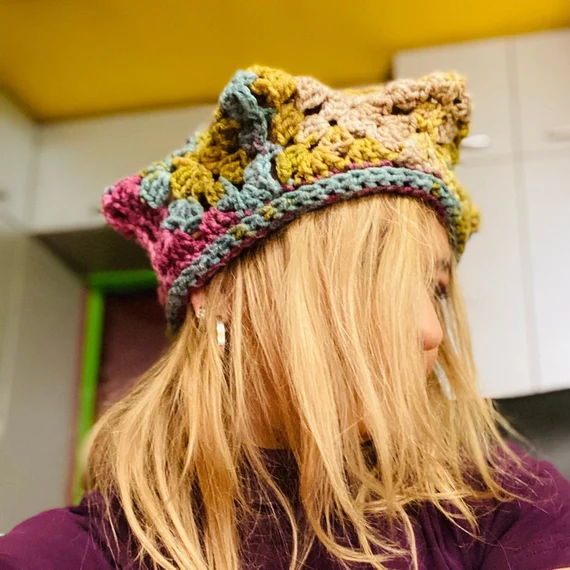
    Buy Crochet Star Hat, Handmade Fairycore Slouchy Beanie, Colorful Granny  Square Star Cap, Boho Hippie Winter Hat, Unique Patchwork Aesthetic Hea  Online in India - Etsy

    The Beanie That Makes Winter Bearable (And Maybe Even Fun)

    Let’s be honest. Winter is hard.
    It’s dark. It’s cold. Your nose runs. Your car won’t start. The only thing between you and seasonal depression is hot chocolate and the desperate hope that spring exists somewhere.
    But what if your winter armor wasn’t just functional? What if it was joyful?
    The Starstruck Beanie is essentially wearable optimism. It’s a reminder that even in the darkest, coldest months, there are still stars. You just have to wear them closer to your face.
    Picture this:
    You’re walking through a snow-covered park. Everyone else is hunched over, bundled in identical puffer jackets, looking like they lost a bet with the weather. And then there’s you — striding through the flurries with a galaxy on your head, steam rising from your coffee, looking like you personally arranged this snowfall for your aesthetic.
    That’s not just a hat. That’s a mood. That’s a lifestyle. That’s the difference between surviving winter and owning it.
    Want to become the person who owns winter? Start with the Starstruck Beanie pattern right here →

    The Hidden Math of Star Patterns (Or: Why Crochet Is Secretly Genius)

    Okay, nerd moment. Bear with me.
    Star patterns in crochet aren’t random. They’re geometry in disguise.
    A five-pointed star is a pentagram. A pentagram is made of golden triangles. The golden ratio — that divine proportion that appears in seashells, hurricanes, and the Parthenon — lives inside every star you crochet.
    So when you make a Starstruck Beanie, you’re not just following a pattern. You’re performing sacred geometry with a stick and some string. You’re proving that math can be cozy. That equations can keep your ears warm.
    And if you mess up a stitch? Congratulations. You’ve just created a new constellation. Name it after your cat. No one will know.
    The pattern is forgiving in the best way. The stars are bold enough to hide minor imperfections, but detailed enough to make people lean in and say, “Wait… did you MAKE that?”
    Yes. Yes, you did. And now you’re a star-wearing, hook-wielding, winter-conquering legend.
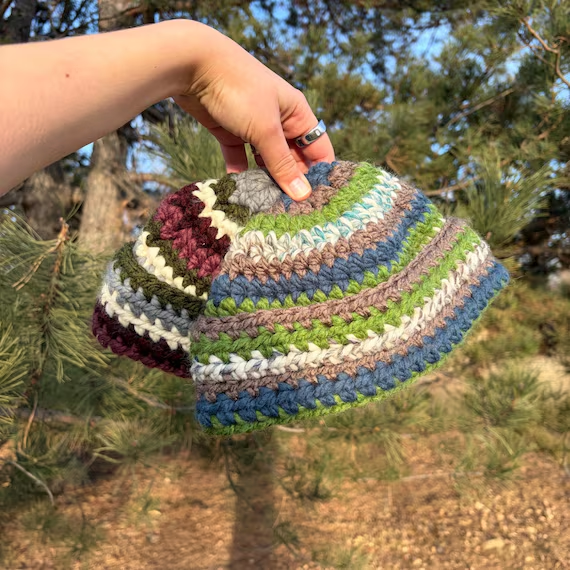
    CUSTOMIZABLE Handmade Beanie | Colorful Chunky Wool Blend Yarn | Cozy  Outdoor Granola Style | Nature Inspired | Crochet Hat - Etsy

    Everything You Need to Know Before You Start

    Here’s the practical stuff Google (and your inner planner) really wants to know:
    Table

    Detail What You Need
    Skill Level Intermediate — perfect if you know basic stitches and are ready for colorwork
    Yarn Worsted weight (Category 4), approx. 150–200 yards main color + 50 yards contrast for stars
    Hook 5.0 mm (H/8) or as needed to match gauge
    Time 4–6 hours for an average adult size
    Season Fall through early spring — ideal for crisp mornings and snowy afternoons
    Sizes Usually includes toddler, child, and adult (adjustable band)
    Special Techniques Color changes, tapestry crochet or intarsia for star motifs
    Pro tip: Use a slightly stretchy wool blend for the best fit and warmth. Merino or a wool-acrylic mix works beautifully and holds the star shapes crisp and clean.

    The Conversation Starter You Didn’t Know You Needed

    Let me tell you a secret.
    The Starstruck Beanie isn’t just a hat. It’s a social hack.
    Wear it to the coffee shop. Someone will ask about it. Wear it to the grocery store. The cashier will smile. Wear it to a party. Suddenly you’re the interesting one. The creative one. The person who makes things.
    In a world where everyone is staring at their phones, a handmade star beanie is an invitation to connect. It’s a bridge between strangers. It’s proof that beauty still matters, that craftsmanship still counts, and that wearing your own art on your head is the ultimate power move.
    Plus — and this is important — it’s warm. Like, actually warm. The kind of warm that makes you forget you ever complained about winter. The kind of warm that feels like a hug from someone who really loves you.
    Or from the universe. Same thing, really.

    Your Head Is a Canvas. The Stars Are Your Paint.

    Here’s the truth: most people go through winter looking like they gave up. Like the cold personally offended them and they’re still processing it.
    You don’t have to be most people.
    You can be the person who wears the sky. The person who turns yarn into constellations. The person who looks at a gray Tuesday in February and says, “Not today. Today, I am the stars.”
    The Starstruck Beanie isn’t just a pattern. It’s a permission slip. To be bold. To be creative. To be warm in every sense of the word.
    So pick up your hook. Choose your colors — midnight blue and silver? Cream and gold? Neon pink and black because you’re a chaotic good energy? — and start stitching.
    The stars are waiting. And they’re much closer than you think.
    Happy hooking, star-child. May your stitches be tight, your stars be bright, and your winter be unforgettable. ✨🧶
    P.S. If this article made you look at your yarn stash with new eyes, share it with someone who needs a little more cosmic energy in their life. The world could always use more handmade stars.
    Понял, извините! Вот блок “YOU MIGHT ALSO LOVE” с кликабельными ссылками для вставки в конец вашей статьи — просто скопируйте и вставьте:

    YOU MIGHT ALSO LOVE

  • 🧶 The Secret Language of Yarn: How a Single Loop Changed the Way We Carry the World

    🧶 The Secret Language of Yarn: How a Single Loop Changed the Way We Carry the World

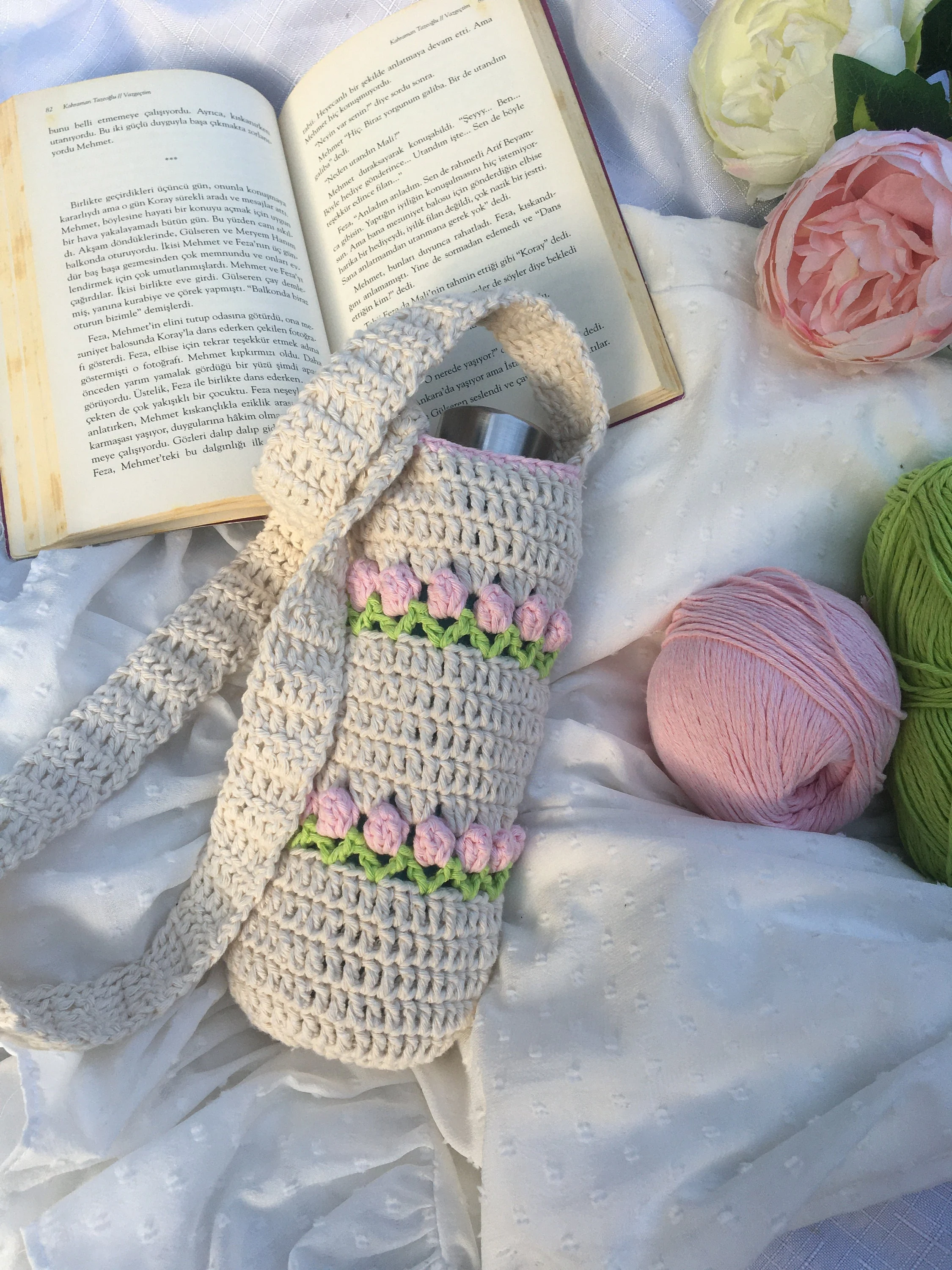
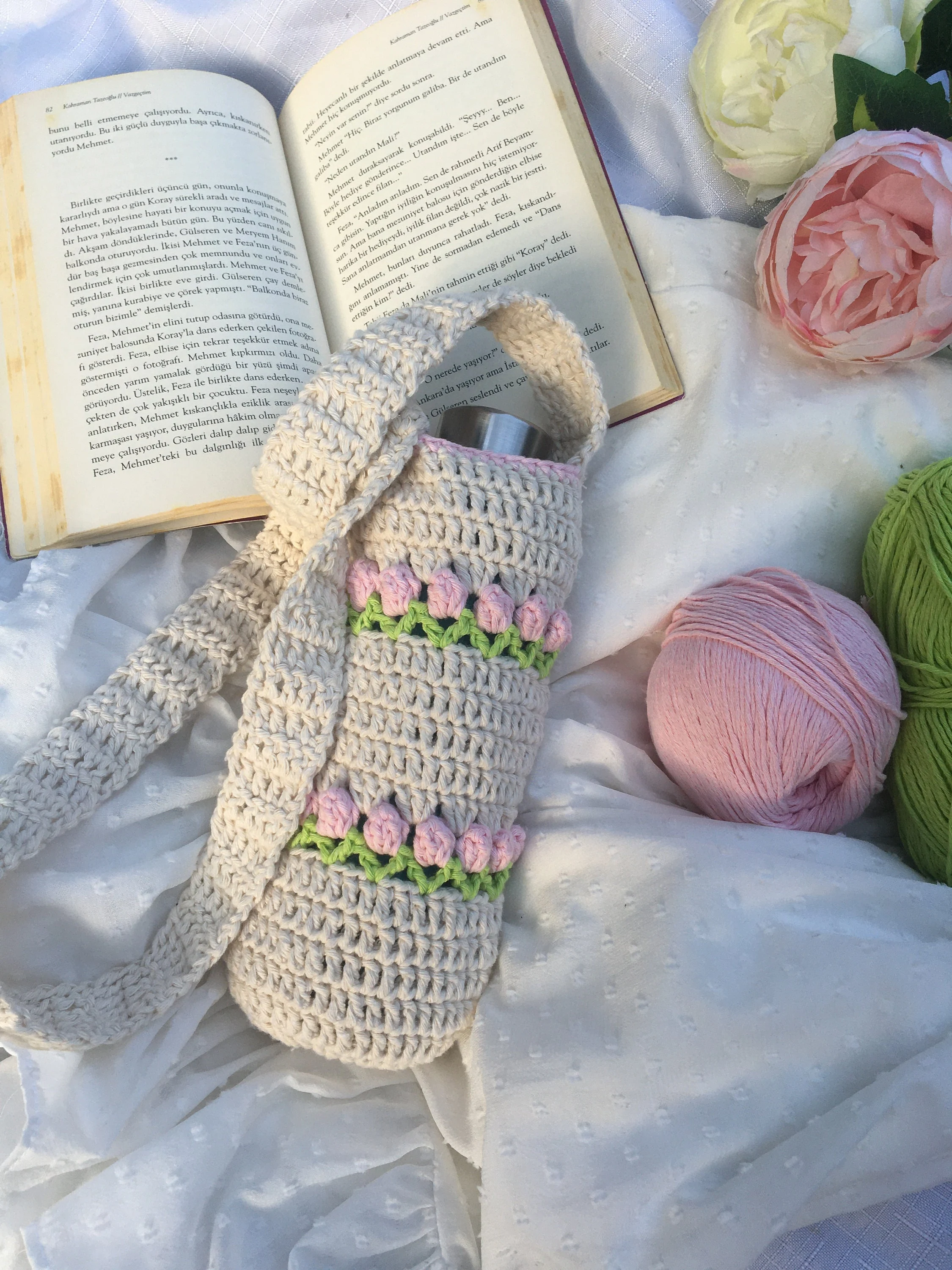
    Crochet Tulip Water Bottle Holder – Handmade Crossbody Cotton Sling Bag

    Disclosure: This post contains affiliate links to Creative Fabrica. I only recommend products I genuinely love

     Have you ever held a ball of yarn and felt like you were holding a tiny universe? Because, technically, you are. That soft, colorful sphere contains infinite possibilities — a sweater, a blanket, a hat… or something far more rebellious. Something that defies logic.

    The Paradox of the Empty Vessel

    Let me explain.
    Here is a riddle that would make Aristotle scratch his head:

    What is something that becomes more useful the emptier it is?
    No, it’s not your bank account after payday. It’s a water bottle holder.
    Think about it. A water bottle holder’s entire purpose is to hold nothing — or rather, to hold the absence of something. It cradles a void. It celebrates emptiness. And yet, without it, your water bottle rolls under the car seat, leaks in your backpack, or — worst of all — becomes that sad, dented thing you find three weeks later behind the couch.
    But here’s where logic gets beautifully twisted:
    A crochet water bottle holder doesn’t just hold a bottle. It transforms it.
    That plain, utilitarian cylinder of hydration? Suddenly it’s wearing a hand-knitted couture gown. It’s no longer just a bottle. It’s a statement. A walking piece of art. A conversation starter at the farmer’s market that makes strangers ask, “Where did you GET that?!”
    And the answer? You didn’t get it. You created it. Or someone with magical fingers did.

    The Crochet Revolution: From Grandma’s Living Room to the Runway

    Let’s shatter a stereotype right now.
    Crochet is not “old-fashioned.” Crochet is not “just for winter scarves.” Crochet is the original 3D printing. Before machines could spit out plastic, human hands were looping cotton into complex geometric structures — using nothing but a stick and some string.
    Best Crochet Accessories to Make and Sell in 2025: Ideas to Inspire!
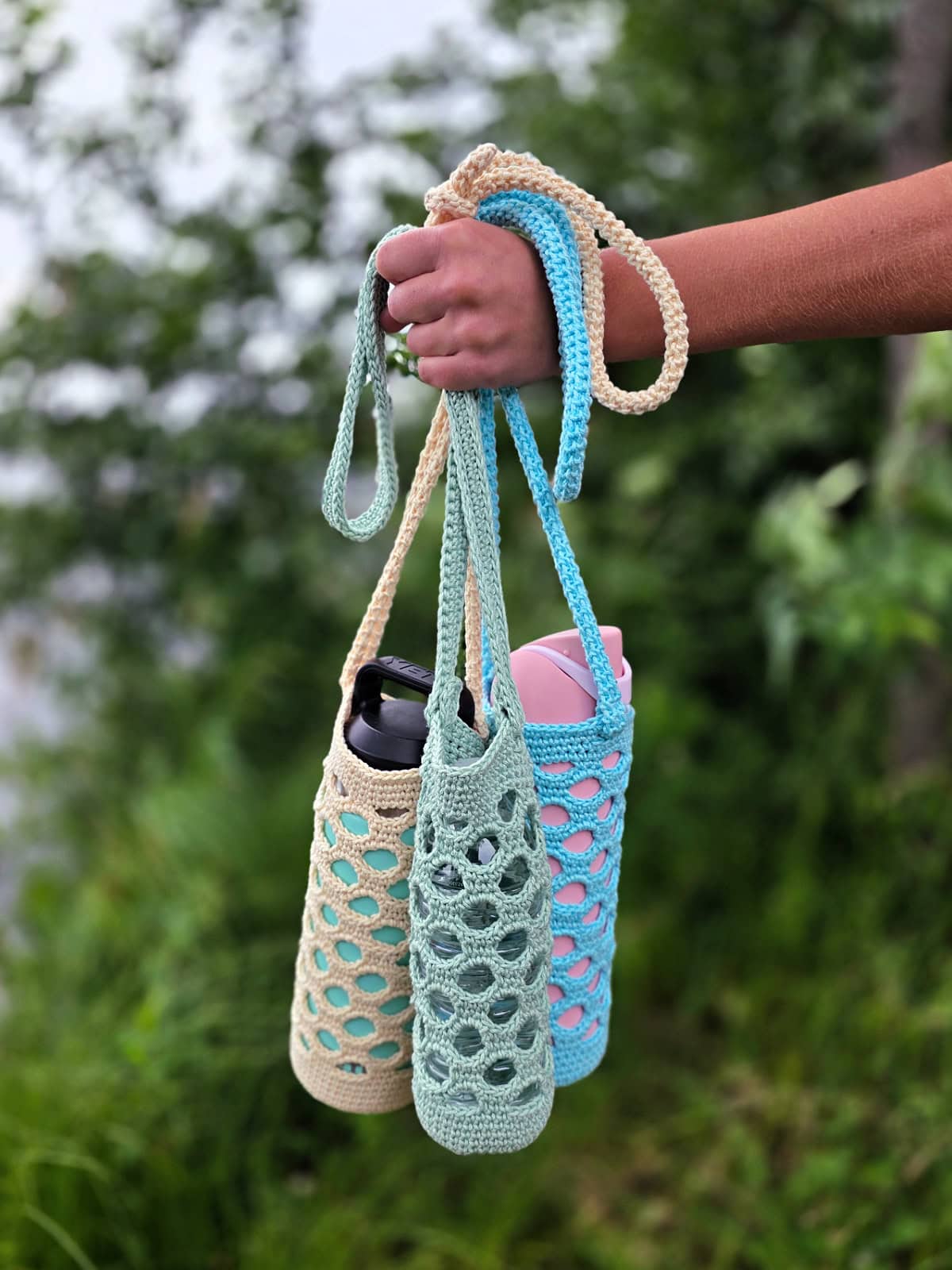
    Look at those water bottle holders in the photo above. Notice the openwork pattern? That’s not decoration. That’s engineering. Those gaps create breathability, reduce weight, and add flexibility. The ancient fishermen of Ireland knew this. The Bedouin nomads knew this. And now? Your Instagram feed knows it too.
    The modern crochet renaissance isn’t about nostalgia. It’s about intentionality. In a world drowning in mass-produced everything, a hand-crocheted item says: “I chose this. Someone cared enough to make this, loop by loop, for hours.”

    The Water Bottle Holder: An Object That Shouldn’t Exist (But Absolutely Must)

    Let’s play philosopher for a moment.
    In a purely logical world, we wouldn’t need water bottle holders. We’d just… hold bottles. Or put them in bags. Or — radical idea — drink faster.
    But humans are not logical creatures. We are meaning-making creatures.
    A water bottle holder says:
    • “I care about hydration, but I also care about aesthetics.”
    • “I go places where my hands need to be free.”
    • “I value craftsmanship over convenience.”
    • “I am the kind of person who accessorizes their water.”
    And honestly? That last one is a power move.
    Ocean Reef Crochet Water Bottle Holder Pattern - A Crocheted Simplicity
    Look at those three holders dangling from one hand like tropical fruit. Each one is a different color, a different pattern, a different personality. The beige one says “Sunday morning farmer’s market.” The sage green whispers “forest hike with a poetry book.” The sky blue? That’s “beach picnic at golden hour.”
    Same object. Three entirely different souls.

    Why Your Water Bottle Deserves a Wardrobe

    Here’s a truth bomb: You are what you carry.
    Your phone case, your keychain, your water bottle holder — these aren’t just objects. They’re identity signals. They’re the difference between “I grabbed whatever was closest” and “I curate my life with intention.”
    A crochet water bottle holder is the ultimate flex because it says three things simultaneously:
    1. “I care about the planet.” (Reusable bottle + handmade = zero waste chic)
    2. “I support artisans.” (Someone’s hands made this. Real hands. With real calluses.)
    3. “I have taste.” (This isn’t from a big-box store. This is art.)
    And if you make it yourself? Oh. That’s the fourth level. That’s “I am a creator. I turn string into magic.”

    The Pattern That Connects Us All

    Here’s something that will break your brain in the best way:
    Every crochet pattern is a mathematical equation disguised as art.
    Double crochet = 2x.
    Half double crochet = 1.5x.
    A granny square? That’s a fractal. A self-repeating geometric miracle that scales infinitely.
    When you crochet, you’re not just making a bag. You’re solving a puzzle. You’re dancing with geometry. You’re proving that beauty and math are the same thing wearing different outfits.
    And when you slip that water bottle into its perfectly sized, lovingly crafted holder? That’s the solution. That’s the moment the equation equals beauty.

    Ready to Start Your Own Loop?

    Maybe you’re reading this and thinking, “I want one. No — I want to MAKE one.”
    Good. That spark? That’s the beginning of something.
    Whether you’re a seasoned hook-wielder or someone who just learned that “yarn” isn’t only what cats play with, there’s a pattern out there waiting for you. A pattern that will turn a simple ball of cotton into something that makes strangers stop you on the street.
    Something that holds water. But also holds wonder.
    Happy hooking, beautiful humans. May your loops be even, your tension be perfect, and your water always stay stylishly hydrated. 💧🧶
    P.S. If this article made you smile, share it with someone who needs a little more yarn in their life. The world could always use more handmade magic. ✨
    Понял, извините! Вот блок “YOU MIGHT ALSO LOVE” с кликабельными ссылками для вставки в конец вашей статьи — просто скопируйте и вставьте:

    YOU MIGHT ALSO LOVE

  • The Lace That Time Forgot

    The Lace That Time Forgot

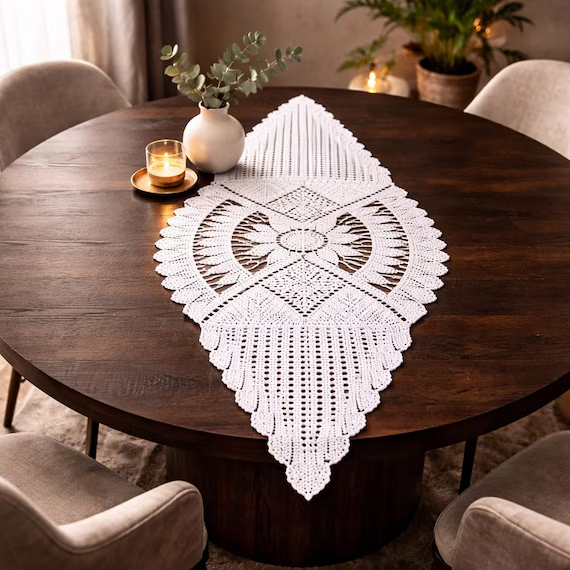
    Crochet Table Runner Crochet Table Doily Doily Runner Center Piece Lace  Runner Home Décor Crochet Table Runner Pattern Written Instructions - Etsy
    The runner that whispered: “Slow down. I’m worth it.
    “Disclosure: This post contains affiliate links to Creative Fabrica. I only recommend products I genuinely love this Crochet Oval Plush Table Runner Pattern in PDF format

     Or: How a Single Thread Resurrected My Dining Room and My Soul

    Chapter 1: The Pinterest Trap

    I fell down a rabbit hole.
    It started innocently. “Quick dining room refresh,” I typed. Thirty-seven tabs later, I was staring at $4,200 Restoration Hardware tables, $800 pendant lights, and a ceramic vase that cost more than my first car.
    My dining room didn’t need a refresh. It needed a mortgage.
    And then — buried between a sponsored post for marble coasters and an influencer’s “affordable” living room reveal — I saw it. A photo so quiet, so unassuming, it almost didn’t register.
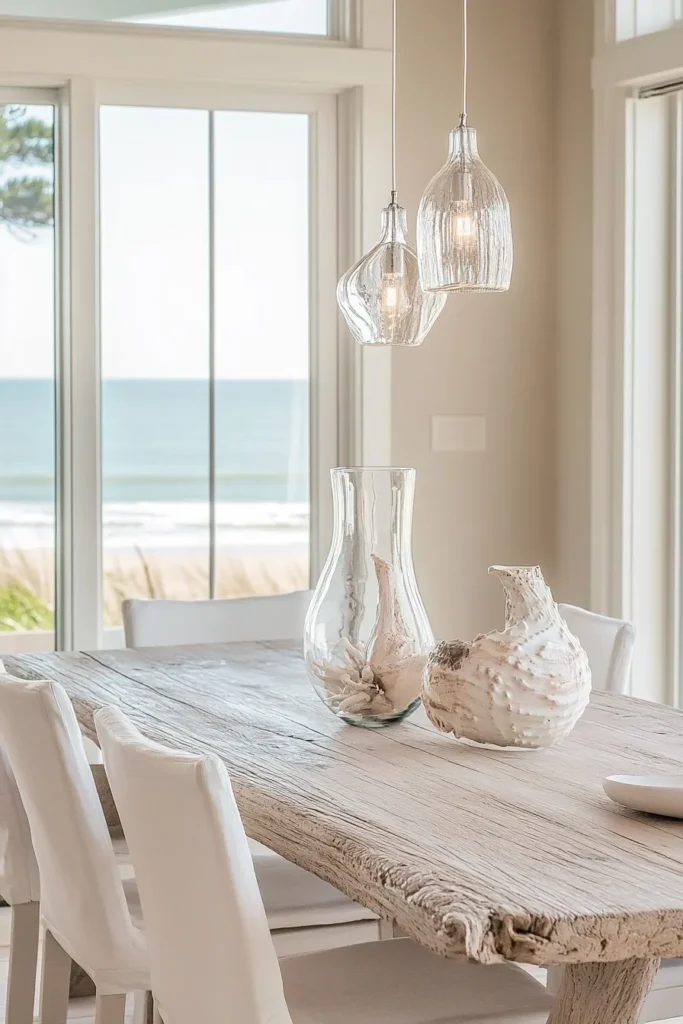
    A wooden table. Natural light streaming through sheer curtains. A white ceramic vase holding dried flowers. And beneath it all, like a secret only the patient could hear: a lace table runner.
    Not just any lace. This was filet crochet. Openwork. Geometric. The kind of lace that looks like someone took a spiderweb, taught it manners, and invited it to dinner.
    I stared at it for eleven minutes. I know because my phone told me.
    And then I did something radical. I closed all thirty-seven tabs. I opened my yarn stash. And I decided to make the thing that had stopped my scroll.

    Chapter 2: The Thread That Time-Traveled

    Handmade Crochet Lace Doily – Vintage Style Cotton Table Decor (14 Inch),  White Dresser Doily, Coffee Table Doily - Etsy
    The language of grandmothers, decoded one square at a time.
    Filet crochet is old. Like, centuries old. It started in the fishing villages of Italy — yes, actual fishermen’s nets — and somehow, through some miracle of human creativity, became the language of Victorian parlors and French châteaux.
    Here’s how it works: you crochet a grid. Some squares are filled (solid blocks of double crochet). Some are empty (chain spaces that let the light through). Together, they form pictures. Patterns. Stories told in negative space.
    It’s basically pixel art. But with cotton. And patience. And the occasional urge to throw your hook across the room.
    I chose white cotton. Not cream. Not ivory. The kind of white that makes you think of fresh sheets, of blank pages, of possibilities. The kind of white that says: “I am a canvas. Make me mean something.”
    The first row took forty minutes. Forty minutes for twelve inches of thread. My husband walked past, saw me counting stitches out loud, and quietly backed away.
    By row three, I understood why filet crochet survived centuries. It’s not fast. It’s not efficient. It’s not “content.” It’s the opposite of everything modern life demands.
    And that’s exactly why it matters.

    Chapter 3: The Geometry of Obsession

    Luxury Hand Crocheted Lace Table Runner, Vintage Beige/white Crochet Decor,  Country Farmhouse Style - Etsy
    Where mathematics meets poetry — one block at a time.
    Filet crochet is secretly math. Don’t tell anyone.
    Each pattern is a grid. Each grid is a decision: fill or empty? Solid or space? And those decisions, repeated hundreds of times, create something your brain recognizes before your eyes can name it.
    I was making a simple geometric pattern — diamonds within diamonds, the kind of design that feels both ancient and utterly modern. But here’s what nobody warns you about: filet crochet is a meditation you can’t escape.
    There’s no autopilot. No “muscle memory” to save you. Every stitch requires you to look at the chart, count your chains, decide: block or space? Over and over. For hours.
    My mind wandered. It came back. It wandered again. And slowly, something strange happened.
    I started noticing things I’d been missing. The way afternoon light hits my kitchen counter at 4 PM. The sound of my neighbor’s wind chime. The fact that my cat’s purr has three distinct frequencies.
    Filet crochet doesn’t just make lace. It makes you present.

    Chapter 4: The Reveal Nobody Expected

    Cozy Modern Cottage Dining Room Designs - Edward George
    The moment handmade meets home — and everything changes.
    Three weeks. That’s how long it took. Not because I’m slow (okay, I’m slow), but because filet crochet refuses to be rushed. It’s like a sourdough starter or a good friendship — it takes the time it takes.
    The day I finished, I washed it. Blocked it. Laid it on my dining table with the kind of ceremony usually reserved for wedding cakes.
    And then I stepped back.
    My dining room — the same room I’d been trying to “refresh” with $4,200 tables and $800 lights — suddenly looked… complete. The wooden table I’d owned for years, the one I’d been planning to replace, suddenly looked intentional. The ceramic vase I’d bought on sale at Target looked curated. The whole room felt like someone had whispered a secret into it.
    My husband walked in. Stopped. Actually looked.
    “Did you make that?”
    “I did.”
    “It looks like it belongs in a magazine.”
    I didn’t tell him it cost $8 in cotton thread and 63 hours of my life. I just smiled and said: “Thanks.”

    Chapter 5: The Philosophy of Negative Space

    White French Crochet Table Runner - Striped, Fringed – SilvesterFabric
    What isn’t there matters as much as what is.
    Let me get slightly philosophical. (I promise it’ll be quick.)
    Filet crochet taught me something about life. About my home. About the spaces we create and why we create them.
    The “empty” squares — the chain spaces, the holes, the negative space — aren’t failures. They’re not “missing” stitches. They’re intentional. They’re what lets the light through. They’re what makes the pattern breathe.
    And I realized: my home was full of “empty squares” I’d been trying to fill. Blank walls I thought needed art. Corners I thought needed furniture. Surfaces I thought needed stuff.
    But maybe the beauty isn’t in the filling. Maybe it’s in the choosing. The curation. The courage to leave space for light, for air, for possibility.
    That lace runner, with its deliberate holes and careful solids, is a metaphor I didn’t ask for but desperately needed.

    Chapter 6: Where to Begin Your Own Time Travel

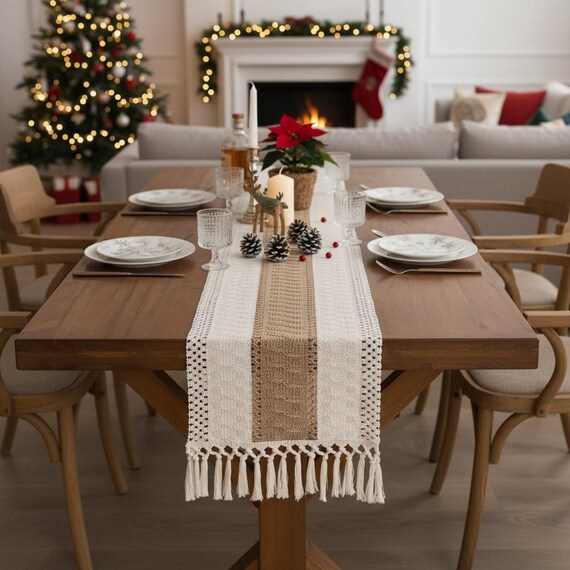
    Boho Crochet Table Runner With Fringe, Macrame Style Beige Runner, Rustic  Farmhouse Decor for Dining or Weddings, Housewarming Gift Idea
    The invitation — your table is waiting.
    Okay. Real talk. You don’t need to be a crochet wizard to make this. I’m not. I’m just persistent. And I had help.
    A good filet crochet pattern is like a treasure map. It shows you where the blocks go, where the spaces live, and how the whole thing comes together into something that looks impossibly complex but is actually just… repetition. Beautiful, meditative, soul-filling repetition.
    The pattern I used was perfect for this. It had a chart (because filet crochet without a chart is like driving without a map). It had clear instructions. And it produced a runner so elegant, so quietly stunning, that my dining room went from “needs a refresh” to “exactly right” with one piece of cotton thread.
    If you’re looking at your own dining table — or coffee table, or dresser, or that sad console table by the door — and thinking “this space needs something, but I don’t know what,” here’s my suggestion:
    Don’t buy something. Make something. Something slow. Something intentional. Something that carries your hours and your attention and your love in every stitch.
    If you want to start with a pattern that holds your hand through the grid, the blocks, and the beautiful emptiness between them, here’s the one I used: this Crochet Oval Plush Table Runner Pattern in PDF format. It’s beginner-friendly, includes detailed charts, and produces a runner that makes any surface feel like it was styled by someone who actually cares.

    Chapter 7: The Side Effects of Slowness

    Rustic Cottage Crochet Placemat Pattern | Beginner-friendly DIY Tutorial |  Crochet Pattern for Home Decor | English PDF | Brushnhook
    One handmade piece invites another — and another.
    Making this runner had consequences I didn’t see coming.
    Consequence 1: I now notice lace everywhere. In museums. In old movies. In my grandmother’s photo albums. I have become a lace-detector. It’s a beautiful curse.
    Consequence 2: My home has slowed down. Not literally — the chaos of daily life continues — but visually. The runner creates a quiet center. A place for the eye to rest. An anchor in the storm of toys, mail, and half-empty coffee cups.
    Consequence 3: I have developed a reputation. I’m “the friend who makes things.” This means I get invited to craft nights and fewer “let’s go shopping” afternoons. I am not complaining.
    Consequence 4: I have become emotionally attached to a piece of cotton thread. I smooth it after meals. I rotate it seasonally. I once panicked when I thought the cat had snagged it. (He hadn’t. He was just sitting on it. Rude.)

    Chapter 8: Your Invitation to the Grid

    Crochet Table Runner Crochet Table Doily Doily Runner Center Piece Lace  Runner Home Décor Crochet Table Runner Pattern Written Instructions
    The finished object — where patience becomes presence.
    So here’s my challenge to you.
    Not “go buy lace.” Not “become a crochet master overnight.”
    Just this: make one slow thing. One thing that takes longer than you think it should. One thing that requires you to look at a chart, count your stitches, and breathe through the frustration when you mess up row seven.
    Start with a table runner. A long, lace, filet declaration of intention. Something that transforms a surface from “functional” to “meaningful.”
    If you need a place to start — a pattern that guides you through the grid and celebrates you when you finish — here’s the one that started my obsession: this complete PDF crochet pattern for an elegant table runner. It comes with charts, step-by-step instructions, and the kind of encouragement that makes you believe you can actually finish something this beautiful.
    Because you can. I promise. If I can turn a Pinterest scroll into a dining room centerpiece, you can too.

    Epilogue: The Lace Lives On

    Cozy Modern Cottage Dining Room Designs - Edward George
    Some stories don’t end — they just keep getting more beautiful.
    It’s been four months since I finished my runner.
    The white has softened slightly. The cotton has relaxed into that perfect lived-in drape. The pattern — those diamonds within diamonds — catches the light differently at every hour of the day.
    And my dining room? It’s no longer a room I want to “refresh.” It’s a room I want to live in. To eat in. To laugh in. To leave empty sometimes, just so I can look at the lace and remember that beauty doesn’t require a credit card.
    My husband still notices it. Every time we have guests, someone asks where I bought it. And I always smile and say: “I didn’t.”
    Then I watch their face do the thing.
    The “wait, you MADE this?!” thing. The thing that makes all the counted stitches worth it.
    The hook is in your hands now.
    What will you make for the spaces you love?
  • The Table Runner That Ate My Weekend

    The Table Runner That Ate My Weekend

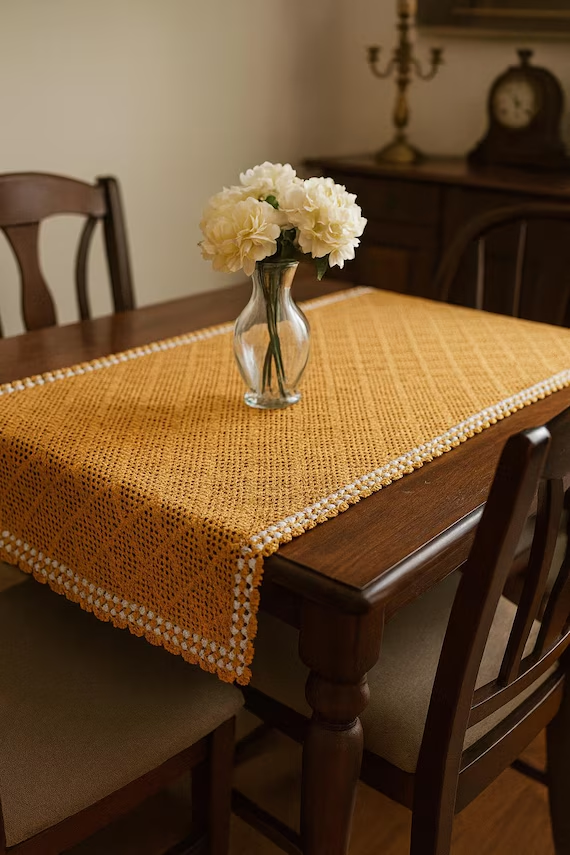
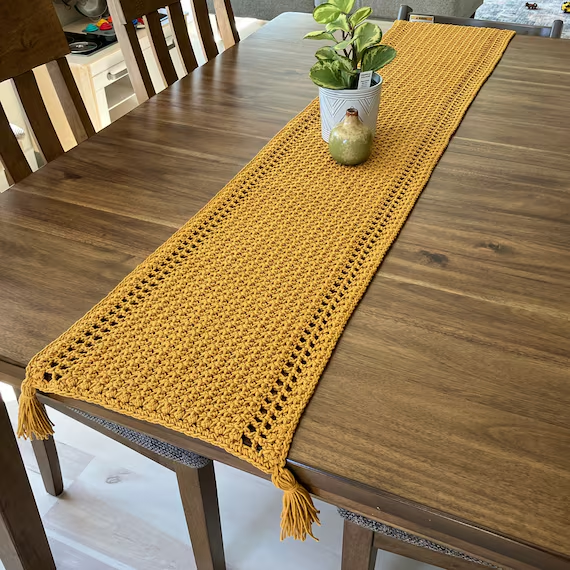
    Mustard Yellow Crochet Table Runner - Daisy Trim Lace Decor. Or: How a Yellow Oval Changed My Relationship With Furniture

    Disclosure: This post contains affiliate links to Creative Fabrica. I only recommend products I genuinely love this Crochet Oval Plush Table Runner Pattern in PDF format

    The runner that started it all. One oval. Zero regrets. Infinite brunch invitations.

    Chapter 1: The Table That Broke Me

    My dining table was sad.
    Not “needs a therapist” sad. More like “wears the same outfit every day and has given up on life” sad. It was a perfectly good wooden table — sturdy, rectangular, the kind of table that says “I am functional and I have accepted my fate.”
    I tried placemats. I tried a vase. I even tried one of those Pinterest-centerpiece situations with floating candles and eucalyptus that smelled like a spa but looked like a funeral.
    Nothing worked.
    The table remained sad. And then, one Tuesday at 11 PM — because all great ideas happen at 11 PM — I had a thought:
    What if I crocheted it a sweater?
    Not a literal sweater. That would be weird. (Though now that I say it out loud, a table sweater has potential.) No. I meant a table runner. A long, plush, yellow oval of happiness that would transform my sad table into a table that dares to dream.
    I grabbed my hook. I grabbed some yarn. And I made a terrible mistake:
    I chose yellow.

    Chapter 2: The Yellow That Wouldn’t Quit

    The color of sunshine, optimism, and mild existential dread.

    Yellow is not a color. Yellow is a personality.
    I picked a bright, buttery, unapologetic yellow. The kind of yellow that doesn’t whisper — it sings. The kind of yellow that makes your morning coffee feel like a celebration. The kind of yellow that says: “I am here. I am oval. Deal with it.”
    I bought four skeins. (Okay, six. Two were “for backup.” Three were “just in case.” One was because the store was closing and they were on sale.)
    The first row was magical. The second row was satisfying. The third row was when I realized: this is an oval. And ovals are not rectangles. Ovals have curves. Ovals have increases and decreases. Ovals have math.
    I hate math.
    But I kept going. Because something strange happens when you crochet a table runner. You start talking to it. You start patting it. You start referring to it as “my oval” in conversations with your partner, who looks at you with increasing concern.
    “How’s my oval doing?” I’d ask, walking past the work-in-progress.
    “It’s… it’s a table runner, babe.”
    “No. It’s MY OVAL.”

    Chapter 3: The Physics of Plush

    Free Easy Bernat Springtime Kitchen Accessories Crochet Pattern |  Yarnspirations
    Where the magic happens — one plush stitch at a time.
    Here’s what nobody tells you about a “plush” table runner: it’s thick. Like, really thick. Like, “this could double as a yoga mat” thick.
    A regular table runner? Flat. Boring. Functional. It lays there and does its job and goes home at 5 PM.
    A plush table runner? It has presence. It has volume. It has the kind of texture that makes people reach out and touch it without asking permission. (Rude, by the way. But also understandable.)
    The plush stitch is basically a double crochet that ate a sandwich. It’s puffy. It’s squishy. It’s the crochet equivalent of a hug. And when you work it in a continuous oval — increasing at the ends, decreasing at the sides, praying to the geometry gods — it creates this beautiful, rounded, cloud-like shape that makes you want to set the table even when you’re eating cereal out of the box.
    I worked on it for three days. My fingers went numb. My couch developed a permanent yarn dent. My cat claimed the work-in-progress as his personal throne and had to be bribed with treats to move.
    But when I finished? When I laid that yellow oval on my sad wooden table?
    The table smiled.
    I swear. It smiled.

    Chapter 4: The Brunch That Changed Everything

    Crochet Table Runner & Placemat Pattern: Modern Boho or Farmhouse Dining  Set (PDF Pattern) - Etsy
    The moment of truth — when handmade meets hospitality.
    I invited my friends over for brunch. Not because I wanted to show off. (Okay, maybe a little.) But mostly because I needed witnesses. I needed people to see what my sad table had become.
    They walked in. They saw the table. They stopped.
    “Oh my god, did you MAKE that?!”
    “It’s so… YELLOW.”
    “Can I touch it?”
    (Yes, Karen, you can touch it. Everyone can touch it. That’s literally the point.)
    We sat down. We ate avocado toast. We drank too much coffee. And the entire time, no one could stop looking at the table runner. It was like a celebrity had joined us for brunch. A flat, oval, yellow celebrity that smelled faintly of yarn store.
    My friend Sarah — who has a master’s degree in interior design and judges everyone’s home silently — actually said: “This looks like something from Anthropologie.”
    I didn’t tell her it cost me $12 in yarn and 72 hours of my life. I just smiled and said: “Thanks. I made it.”
    And then I watched her face do the thing.
    You know the thing. The “wait, you MADE this?!” thing. The thing that makes all the finger cramps worth it.

    Chapter 5: The Secret I Need to Share

    Cozy Cottage Dining Room - The Beauty Revival
    The cozy home — where handmade meets heart.
    Here’s what I learned from this whole oval adventure: your home is a story, and you get to write it.
    That sad table? It wasn’t sad because it was plain. It was sad because I hadn’t given it a story yet. I hadn’t invested in it. I hadn’t spent 72 hours making something specifically for it, with love and yarn and a mild obsession with geometry.
    When you make something for your home — a table runner, a pillow, a blanket — you’re not just decorating. You’re narrating. You’re saying: “This space matters to me. This moment matters. This meal, this coffee, this conversation — they all deserve a beautiful setting.”
    And here’s the wild part: other people feel it.
    My friends didn’t just see a yellow table runner. They saw intention. They saw care. They saw someone who chose to spend three days making something beautiful instead of buying something disposable.
    That energy is contagious. That energy is real.
    If you’re looking at your own sad table — or sad couch, or sad shelf, or sad corner that you’ve been ignoring — and thinking “I wish it felt more like me,” here’s your permission slip: make something for it.
    Start with a table runner. A long, plush, oval hug for your furniture. Something that says “I am here. I am handmade. I am yours.”
    If you need a place to start — a pattern that holds your hand through the increases, the decreases, and the inevitable “why is this lopsided?!” moments — here’s the exact one I used: this Crochet Oval Plush Table Runner Pattern in PDF format. It’s beginner-friendly, includes detailed instructions for that tricky oval shape, and produces a runner so plush you’ll want to nap on it.

    Chapter 6: The Unexpected Side Effects

    The workspace of a maker — where dreams are built one stitch at a time.
    Making this table runner had consequences I didn’t anticipate.
    Consequence 1: I now set the table for everything. Breakfast. Snacks. Midnight cereal. My sad table has become a stage, and the yellow oval is the star.
    Consequence 2: My partner has started calling me “the oval lady.” I am not sure how I feel about this. I am also not sure I can stop it.
    Consequence 3: I have developed a deep, emotional attachment to a piece of fabric. I fluff it before guests arrive. I smooth it after meals. I once yelled at the cat for sitting on it. (He did not care. He sat on it anyway.)
    Consequence 4: I now notice table runners everywhere. Restaurants. Magazines. TV shows. I judge them all. “Too thin.” “Not plush enough.” “Where are the increases?!” I have become a table runner snob. This is my life now.

    Chapter 7: The Philosophy of the Oval

    Page 26 | Crochet texture Images
    The finished object — where geometry and coziness become one.
    Let me get philosophical for a second.
    Why does a handmade table runner matter? In a world where you can buy a perfectly decent one for $15 at IKEA, why spend three days crocheting one?
    Here’s my theory: handmade home decor is love made visible.
    That yellow oval isn’t just yarn. It’s the Netflix episodes I watched while making it. It’s the coffee that went cold. It’s the moment I almost gave up at hour 10 but kept going because I could already see how beautiful it would be.
    You can’t buy that. You can’t download it. You can’t subscribe to it.
    You can only make it.
    And every time someone sits at my table — every time they reach out and touch the plush stitches and say “this is so soft” — they’re feeling that love. They’re experiencing those hours. They’re connecting with something that was made slowly, deliberately, by hand.
    That’s the magic. That’s the whole point.

    Chapter 8: Your Turn to Make Magic

    Free Easy Bernat Springtime Kitchen Accessories Crochet Pattern |  Yarnspirations
    The tools of transformation — where a hook meets a dream.
    So here’s my challenge to you.
    Look at your home. Find the sad spot. The table that gave up. The shelf that’s just holding things. The corner that’s been ignored for too long.
    And make it something.
    Not buy. Make. Because the act of making is the act of claiming space. Of saying “this is mine, and I choose to fill it with beauty.”
    Start with a table runner. A long, plush, oval declaration of intent. Something that transforms a surface from “functional” to “fabulous.”
    If you need a pattern — a roadmap for your oval adventure — here’s the one that started my obsession: this complete PDF crochet pattern for an oval plush table runner. It comes with step-by-step instructions, tips for getting that perfect plush texture, and the kind of encouragement that makes you believe you can actually finish an oval without throwing it across the room.
    Because you can. I promise. If I can turn a sad table into a brunch destination, you can too.

    Epilogue: The Oval Lives On

    Mustard Yellow Crochet Table Runner - Daisy Trim Lace Decor
    The table that learned to dream — one yellow oval at a time.
    It’s been two months since I finished my oval.
    The yellow has softened slightly. The plush texture has settled into that perfect worn-in feel. The table — my formerly sad, formerly hopeless table — has become the heart of our home.
    We eat there. We laugh there. We spill coffee there and wipe it up and keep going.
    And every time I look at that yellow oval, I feel something I rarely feel in modern life: pride. Not the arrogant kind. The quiet, grounded kind that comes from knowing you built something beautiful with your own two hands.
    My partner still calls me “the oval lady.” The cat still sits on the runner. My friends still ask me to make them one.
    And I always smile and say: “Make your own. I’ll bring the coffee.”
    Because the best thing about handmade things isn’t owning them. It’s making them. It’s the journey from “I could never” to “I actually did.”
    The hook is in your hands now.
    What will you make for your home?
  • 🪡 The Bag That Ate My Weekend

    🪡 The Bag That Ate My Weekend

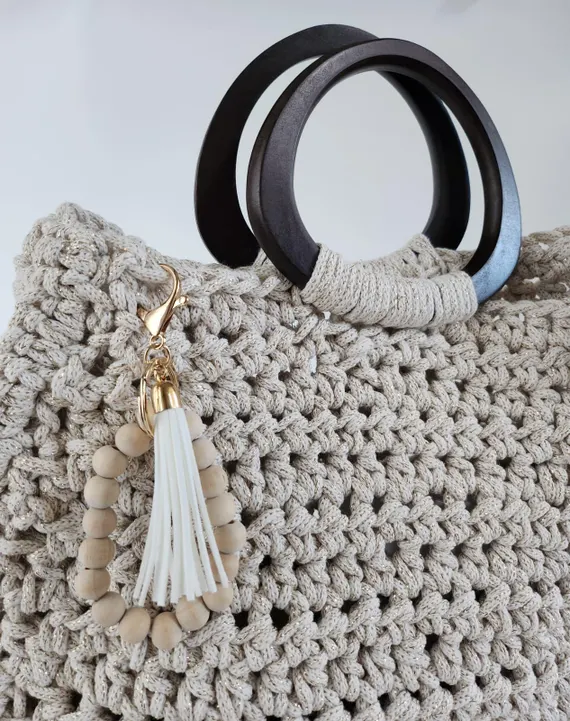
    White Crochet Bag With Wooden Handle Or: How 847 Beads and One Stubborn Thread Taught Me the Meaning of Life

      Disclosure: This post contains affiliate links to Creative Fabrica. I only recommend products I genuinely lovethis complete PDF and video crochet pattern for a beaded bag

    The bag that started it all. 847 beads. Zero regrets. Infinite chaos.

    Chapter 1: The Photo That Ruined My Life

    It was 2 AM. I was scrolling Instagram. You know the drill.
    And then — it appeared. A bag. Not just any bag. A bag that looked like it had been crocheted by a fairy godmother with a PhD in engineering. Tiny beads. Perfect texture. The kind of bag that whispers: “You could never make me.”
    I screenshot it. I stared at it. I did the thing where you zoom in on the stitches and try to reverse-engineer the pattern with your eyes.
    Then I did something stupid.
    I said: “I bet I could make that.”
    Famous last words.

    Chapter 2: The Anatomy of an Obsession

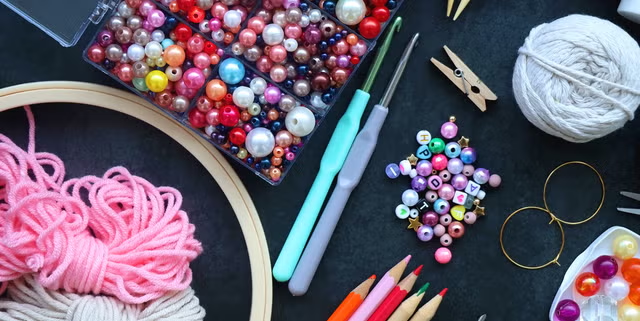
    Bead crochet: How to add beads to your next crochet project
    The tools of madness. Beads. Hooks. Yarn. And a dream that would soon become a nightmare.
    Here’s what nobody tells you about beaded crochet: it’s not crochet with beads. It’s beads with crochet.
    The beads come first. All 847 of them. One by one. Threaded onto the yarn like tiny, colorful prisoners being marched onto a fiber highway. My fingers went numb. My eyes crossed. I developed a weird relationship with a needle that I will not discuss in polite company.
    And then — the actual crocheting.
    Each stitch requires you to slide a bead into place, hold it with your thumb, loop the yarn, pull through, and pray. Pray that the bead doesn’t flip. Pray that the tension is right. Pray that you didn’t just miscount and ruin the entire row.
    I prayed a lot that weekend.
    Hour 1: This is fun! Look at the beads! So shiny!
    Hour 4: Why is my left hand cramping? Why do I smell like metal?
    Hour 8: I have become one with the bead. The bead is me. I am the bead.
    Hour 12: I can see through time.

    Chapter 3: The Physics of Impatience

    Image of Beads Spread On White Background. Background Or Texture Of Beads. Close  Up, Macro,It Is Used In Finishing Fashion Clothes. Make Bead Necklace Or  Beads For Woman Of Fashion,Bead Crochet. Daily
    Close-up of beads — each one a tiny rebellion against instant gratification.
    Let me explain something about beaded crochet using math that I don’t understand.
    A regular crochet bag? Maybe 2,000 stitches. Each stitch takes, say, 2 seconds. That’s… checks calculator …a reasonable amount of time.
    A beaded crochet bag? Each stitch takes 8 seconds. Because of the bead. Because of the sliding. Because of the praying. That’s 16,000 seconds. Which is 4.4 hours. Which is just the stitching. Not counting the threading. Not counting the frogging. Not counting the existential crisis at hour 6 when you realize you threaded the beads in the wrong order and have to start over.
    I started over three times.
    Three.
    Times.
    But here’s the thing — and this is the part that breaks my brain — the struggle is the point.
    In a world where you can buy a bag in 3 clicks and get it tomorrow, the act of making one bead by bead is an act of rebellion. It’s saying: “I don’t want fast. I want mine.”
    And when you finish? When you hold that bag in your hands and feel the weight of every single bead? It’s not just a bag. It’s a time capsule. It’s proof that you can do hard things. Slowly. Deliberately. Beautifully.

    Chapter 4: The Reveal (AKA: Why I Cried in Public)

    Jute Crochet Bag Canvas Tote Bag Market Bag Beige Basket Bag Natural Jute Tote  Bag Wooden Handle Tote Bag Crochet Jute Tote Bag
    The finished object — proof that patience is still a thing that exists.
    I finished the bag on a Sunday evening. My apartment looked like a craft store had exploded. There were beads in the couch. Beads in my hair. Beads in places I didn’t know beads could go.
    I didn’t care.
    I hung the bag on my turquoise wooden wall — the one I’d painted specifically for Instagram photos because I’m that person now — and I just… stared at it.
    The texture. The drape. The way the beads caught the light like tiny diamonds. The way the bag looked both vintage and brand new at the same time. Like something from a grandmother’s attic that had been waiting for me to find it.
    I took a photo. Posted it. Went to bed.
    I woke up to 200 notifications.
    “Where did you buy that?!”
    “Is that handmade?!”
    “TEACH ME.”
    And my favorite: “That looks like it belongs in a boutique.”
    I didn’t tell them it belonged in a boutique. I told them it belonged in my hands first. That I made it. That they could make it too. That the thing that looks impossible is just a series of very small, very possible steps.
    I cried a little. Not gonna lie.

    Chapter 5: Where the Magic Actually Lives

    The bead crochet purse — where engineering meets obsession.
    Here’s what I learned from this whole beaded adventure: the magic isn’t in the finished bag.
    I know. Shocking. Bear with me.
    The magic is in hour 3, when your fingers finally learn the rhythm and you stop thinking about each stitch. The magic is in hour 7, when you look down and realize you’ve made 6 inches of fabric out of nothing but beads and stubbornness. The magic is in the moment you finish the last stitch and your brain goes: “Wait. I actually did that.”
    The bag is just the souvenir. The proof. The thing you carry to the grocery store so the cashier can say “I love your bag” and you can smile and say “Thanks, I made it” and watch their face do the thing.
    You know the thing. The “what do you mean you MADE it?!” thing.
    That thing is worth every single bead.

    Chapter 6: The Pattern That Saved My Sanity

    The workspace of a maker — where dreams are built one bead at a time.
    Okay, real talk. I didn’t wing this bag. I’m not a crochet wizard. I used a pattern.
    A good pattern for beaded crochet is like a GPS for a road trip through a country where you don’t speak the language. It tells you when to turn. When to stop. When to thread the beads and when to just crochet and when to question every life choice that led you to this moment.
    The pattern I used was perfect. It had diagrams. It had photos. It had that rare quality of being detailed enough to hold your hand but not so detailed that it treats you like a child who can’t be trusted with a hook.
    It also had a video tutorial. Which I watched approximately 47 times. At 0.5 speed. While pausing and rewinding and pausing and rewinding until I could do the stitch in my sleep.
    If you’re looking at this bag and thinking “I could never” — I thought the exact same thing. And I was wrong. The pattern proved me wrong.
    If you want to create your own version of this beaded beauty — whether for yourself, for a gift, or just to prove that you can do hard things — here’s the exact pattern that made it possible: this Crochet Bag with Beads Pattern in PDF format with video tutorial. It’s detailed, beginner-friendly, and walks you through every bead, every stitch, and every moment of doubt.

    Chapter 7: The Unexpected Side Effects

    The boho crochet bag on the beach — where handmade meets wanderlust.
    Making this bag had consequences I didn’t see coming.
    Consequence 1: I now notice beads everywhere. On dresses. On jewelry. On the curtains at my friend’s house. I have become a bead-detector. It’s a curse.
    Consequence 2: I have developed a reputation. I’m “the friend who makes things.” This means I get invited to more craft nights and fewer “let’s just go to the bar” nights. I’m not complaining.
    Consequence 3: My sister saw the bag and said “I want one but in blue.” I am now making a blue beaded bag. Send help. And more beads.
    Consequence 4: I have become emotionally attached to an inanimate object. I talk to my bag. I pat it before I leave the house. I get anxious when I can’t find it. This is fine. Everything is fine.

    Chapter 8: The Philosophy of Beads

    Yellow beads — each one a tiny decision, a tiny commitment, a tiny victory.
    Let me get philosophical for a second.
    Why does a beaded bag matter? In a world where you can buy a perfectly good bag for $30 at Target, why spend a weekend threading beads and crocheting until your fingers go numb?
    Here’s my theory: beaded bags are time made visible.
    Each bead is a moment. A decision. A tiny commitment to beauty over convenience. When you look at a beaded bag, you’re not just seeing an object. You’re seeing hours. Days. The Netflix episodes that played in the background. The coffee that went cold. the moment you almost gave up but didn’t.
    You can’t buy that. You can’t download it. You can’t subscribe to it.
    You can only make it.
    And that — that act of making, of choosing slowness in a fast world — is the most radical thing you can do with a weekend.

    Chapter 9: Your Turn to Make Time Visible

    The vintage crochet bag — proof that handmade never goes out of style.
    So here’s my challenge to you.
    Not “go buy beads.” Not “become a crochet master overnight.”
    Just this: make one thing. One hard thing. One thing that takes longer than you think it should. One thing that makes you want to quit at hour 4 but finish at hour 12.
    Start with a bag. A beaded crochet bag that looks impossible but isn’t. That looks boutique but is actually just you, a hook, and 847 tiny acts of patience.
    If you need a place to start — a pattern that holds your hand through the bead-threading, the stitch-learning, and the inevitable “why am I doing this” moments — here’s the one I used: this complete PDF and video crochet pattern for a beaded bag. It comes with step-by-step instructions, a video tutorial, and the kind of encouragement that makes you believe you can actually thread 847 beads without losing your mind.
    Because you can. I promise. If I can turn a 2 AM Instagram scroll into a bag that makes strangers stop me on the street, you can too.

    Epilogue: The Bag Lives On

    The bag that ate my weekend — and gave me something irreplaceable in return.
    It’s been two months since I finished the bag.
    The beads have settled into their places. The yarn has softened. The bag has developed that worn-in patina that only handmade things get — the kind that makes it look like it has stories to tell.
    And it does.
    It tells the story of a weekend spent making something instead of consuming something. Of fingers that learned a new language. Of a 2 AM impulse that turned into a tangible, beautiful, mine thing.
    I still carry it everywhere. To the grocery store. To coffee. To the park where I sit and crochet other things while people walk by and sometimes stop and ask: “Where did you get that bag?”
    And I always smile and say: “I made it.”
    And then I watch their face do the thing.
    The hook is in your hands now.
    What will you make?
  • The Hat That Grew Ears

    The Hat That Grew Ears

    Bucket Hat Crochet Pattern With Flower Baby Sun Hat PDF Pattern Easy Summer  Hat Tutorial Kids & Adult Sizes Easter Finds - EtsyOr: How I Accidentally Became the Coolest Aunt in the Neighborhood

    The hat that started it all. Two ears. One smile. Infinite chaos.
      Disclosure: This post contains affiliate links to Creative Fabrica. I only recommend products I genuinely lovethis Kid’s Bucket Hat with Ears Crochet Pattern in PDF format

    Chapter 1: The Request That Broke My Brain

    It started with a text.
    “Can you make a hat for Emma? Something cute. With ears maybe? For summer. Yellow. Oh, and she hates things that itch. Love you! 💕”
    My sister. Queen of the impossible brief. She might as well have asked me to crochet a spaceship.
    But here’s the thing about being an aunt: you can’t say no. Not when there’s a five-year-old involved. Not when that five-year-old has the kind of smile that makes grown men hand over their last cookie.
    So I said yes. And then I panicked.
    A bucket hat? Fine. Ears? Tricky, but doable. But both? That meant engineering. That meant geometry. That meant… math.
    I hate math.

    Chapter 2: The Yarn That Saved My Sanity

    The color of sunshine, optimism, and mild panic.
    I went to the yarn store. You know the type — walls of color, that peculiar smell of cotton and possibility, and the overwhelming sensation that you might accidentally buy seventeen balls of yarn because they were “on sale.”
    I needed yellow. But not just any yellow. I needed Emma yellow. The kind of yellow that matches her energy. Her chaos. Her ability to turn a quiet Sunday into a full-blown adventure.
    I found it. A soft, buttery cotton that practically hummed with potential. It was the color of sunflowers, of lemonade stands, of that specific moment when you realize summer isn’t just a season — it’s a state of mind.
    I bought three balls. (Okay, five. The other two were “for backup.” That’s my story and I’m sticking to it.)

    Chapter 3: The Anatomy of a Hat With Ears

    Close up of hands crocheting a colorful pattern with crochet hook and yarn  61377019 Stock Photo at Vecteezy
    Where the magic happens — one loop at a time.
    Here’s what nobody tells you about crocheting a hat with ears: it’s basically architecture.
    A regular bucket hat? Simple. Circle for the crown. Straight sides for the brim. Done.
    But ears? Ears require volume. They require structure. They require the ability to stand up and say “hello, I am an ear, and I am proud of it” without flopping over like a sad pancake.
    I tried three versions.
    Version 1: Too small. Looked like a hat with two pimples. Emma would have cried. I would have cried.
    Version 2: Too big. Looked like a hat with satellite dishes. The neighbors would have called the authorities.
    Version 3: Just right. The Goldilocks of ears. Perky but not aggressive. Cute but not cartoonish. The kind of ears that make you go “aww” instead of “uhh.”
    And then came the beads. Because Emma loves beads. Because Emma loves everything shiny. Because I am a fool who thought “oh, a few beads won’t take that long.”
    They took three hours. Three hours of threading tiny colorful beads onto a yarn that kept trying to escape. My fingers looked like I’d been in a fight with a jewelry box. And I lost.
    But when I saw the finished product? When I saw those little ears with their beaded crown, sitting there like a tiny monarch?
    Worth it. Every single bead. Every single swear word.

    Chapter 4: The Reveal

    Crochet Pattern / Crochet Sun Hat Pattern / Kids Sun Hat / Crochet Pattern  for Hats / Summer Hat / Cleo Wide Brim Fedora Pattern PDF - Etsy UK
    The moment of truth — when handmade meets sunshine.
    The day of the reveal, I was nervous. Actually nervous. Like I was presenting a thesis to a panel of judges instead of handing a hat to a kindergartener.
    Emma opened the box. She looked at it. She looked at me. She looked at it again.
    And then — she put it on.
    No hesitation. No “does it itch?” No “can I take it off?” She just… wore it. Like it had always been hers. Like I’d simply uncovered something that was already meant to be on her head.
    She ran to the mirror. She ran back. She hugged me. She ran to the mirror again. She ran back. She hugged me again.
    This went on for approximately forty-five minutes.
    By the end of the day, the hat had been to the park, the ice cream shop, and a very enthusiastic show-and-tell at preschool. It had collected grass stains, chocolate fingerprints, and the admiration of at least six other children who now wanted “the exact same one but in purple.”
    My sister sent me a photo that night. Emma, asleep, still wearing the hat. The ears slightly squished against her pillow. A smile on her face.
    I cried. I’m not ashamed.

    Chapter 5: The Secret I Need to Share

    The tools of the trade — where patience meets possibility.
    Here’s what I learned from this whole adventure: making things for kids is different.
    Not easier. Not harder. Just different. Because kids don’t care about perfection. They care about intention. They can feel when something was made with love. They can sense the hours. The frustration. The joy.
    Emma doesn’t know that I frogged the crown three times. She doesn’t know that the left ear is slightly taller than the right. She doesn’t know that I stayed up until 2 AM because I was determined to finish it before her birthday.
    She just knows that her aunt made her a hat. And that it has ears. And that she is, therefore, the coolest kid in existence.
    And honestly? That’s the whole point.
    If you’re thinking about making something for a special little person in your life — a hat, a toy, a blanket — just start. The mistakes won’t matter. The imperfections will become character. And the love? The love will be felt through every single stitch.

    Chapter 6: Where to Begin

    How to Crochet: Easy Beginner's Guide
    Every expert was once a beginner — and every masterpiece started with a single loop.
    Okay, confession time. I didn’t wing this hat. I’m not that talented. I used a pattern.
    A good pattern is like a really patient friend who doesn’t judge you when you mess up the same row four times. It holds your hand through the tricky parts. It celebrates with you when you finally get it right.
    The pattern I used for Emma’s hat was perfect for this project. It had clear instructions for the bucket shape, the brim, and — most importantly — those adorable ears. Plus, it included sizing options so I could adjust for Emma’s specific head circumference (which I measured while she was sleeping, because trying to measure a awake five-year-old is like trying to measure a tornado).
    If you want to create your own version of this hat — whether for a birthday, a holiday, or just because you want to see a tiny human lose their mind with joy — here’s the exact pattern that made it possible: this Kid’s Bucket Hat with Ears Crochet Pattern in PDF format. It’s beginner-friendly, includes multiple sizes, and walks you through every step from the first chain to the final bead.

    Chapter 7: The Unexpected Side Effects

    The aftermath of creativity — a workspace that tells a story.
    Making this hat had consequences I didn’t anticipate.
    Consequence 1: I now have a reputation. I’m “the aunt who makes things.” This is both a blessing and a curse. Blessing: I feel useful. Curse: I now have a list of twelve requested items, including “a dinosaur with wings” and “a blanket that looks like a pizza.”
    Consequence 2: Emma has developed a hat obsession. She wears her yellow bucket hat to breakfast. To the dentist. To bed, occasionally. I’ve created a monster. A very stylish monster.
    Consequence 3: My sister has started sending me photos of other crocheted items with the caption “you could totally make this.” She is enabling my addiction. I am not complaining.
    Consequence 4: I have become emotionally attached to an inanimate object. I see that hat in photos and I feel pride. Actual, chest-swelling pride. In a hat. With ears. This is my life now.

    Chapter 8: The Science of Why This Works

    The quiet magic of creation — where two hands and a hook defy logic.
    Let me get slightly philosophical for a moment.
    Why does a handmade hat matter? In a world where you can buy a perfectly good bucket hat for $12.99 on Amazon, why spend hours — days — making one?
    Here’s my theory: handmade objects carry memory.
    That yellow hat isn’t just cotton and beads. It’s the afternoon I spent choosing the exact right shade. It’s the evening I spent wrestling with ear placement. It’s the moment I saw Emma’s face when she put it on.
    You can’t buy that. You can’t download it. You can’t subscribe to it.
    It only exists because I made it. Because I chose to spend my time creating something for someone I love. And every time she wears it, she’s carrying a piece of that love with her.
    That’s the science. That’s the magic. That’s the whole point.

    Chapter 9: Your Turn to Make Magic

    Bucket Hat Crochet Pattern With Flower Baby Sun Hat PDF Pattern Easy Summer  Hat Tutorial Kids & Adult Sizes Easter Finds - Etsy
    The finished object — proof that love can be worn on your head.
    So here’s my challenge to you.
    Find a child in your life. Your kid. Your niece. Your neighbor’s kid who waves at you every morning. Someone who deserves to feel special.
    And make them something.
    It doesn’t have to be perfect. It doesn’t have to be complex. It just has to be made by you.
    Start with a hat. A simple bucket hat with a brim that keeps the sun out of their eyes. Add ears if you’re feeling brave. Add beads if you’re feeling patient. Add whatever makes you smile, because that smile will transfer to the person wearing it.
    If you need a place to start — a pattern that holds your hand and whispers “you’ve got this” when you’re ready to give up — here’s the one I used: this complete PDF crochet pattern for a kid’s bucket hat with adorable ears. It comes with step-by-step instructions, sizing charts, and the kind of encouragement that makes you believe you can actually do this.
    Because you can. I promise. If I can figure out how to make ears that don’t look like pancakes, you can too.

    Epilogue: The Hat Lives On

    Crochet Pattern / Crochet Sun Hat Pattern / Kids Sun Hat / Crochet Pattern  for Hats / Summer Hat / Cleo Wide Brim Fedora Pattern PDF - Etsy UK
    Some stories don’t end — they just keep getting better.
    It’s been three months since Emma got her hat.
    The yellow has faded slightly from sun exposure. One bead has gone missing (Emma insists a squirrel stole it). The ears have been squished, stretched, and used as handles during an impromptu game of “catch the hat.”
    And she still wears it. Every single day.
    Last week, I saw her at the park. She was running around, chasing a butterfly, her yellow hat bobbing up and down like a little sunbeam. She saw me, waved, and yelled: “Auntie! My hat has magic!”
    I didn’t correct her. I didn’t explain that it’s just cotton and beads and a lot of patience.
    I just smiled and said: “I know, baby. I know.”
    Because she’s right. It does have magic.
    The magic of being made with love.