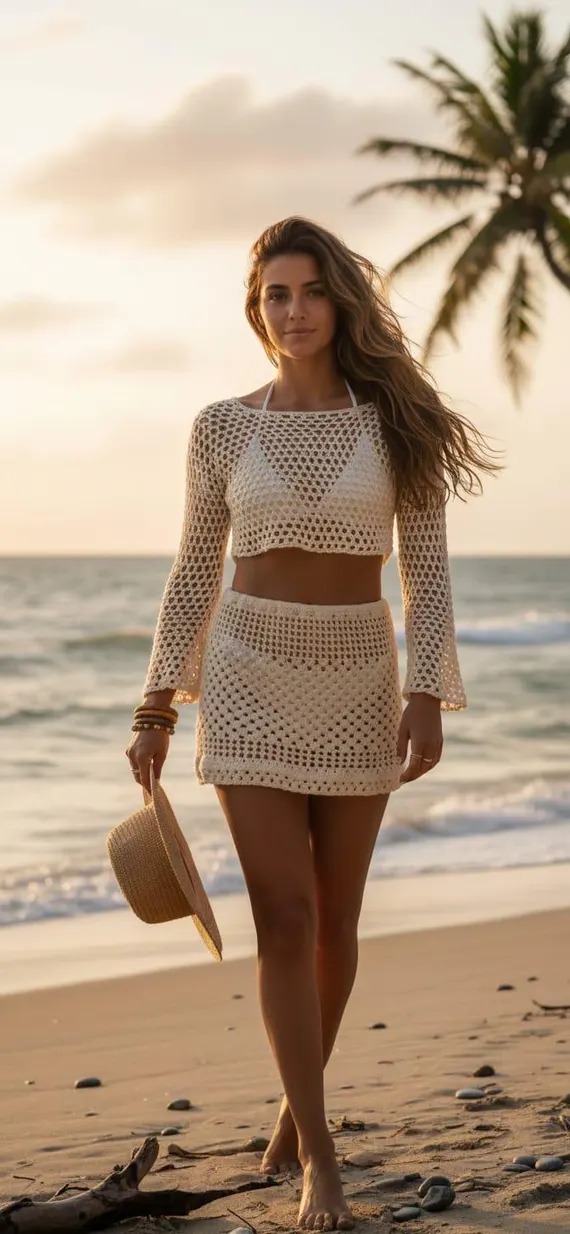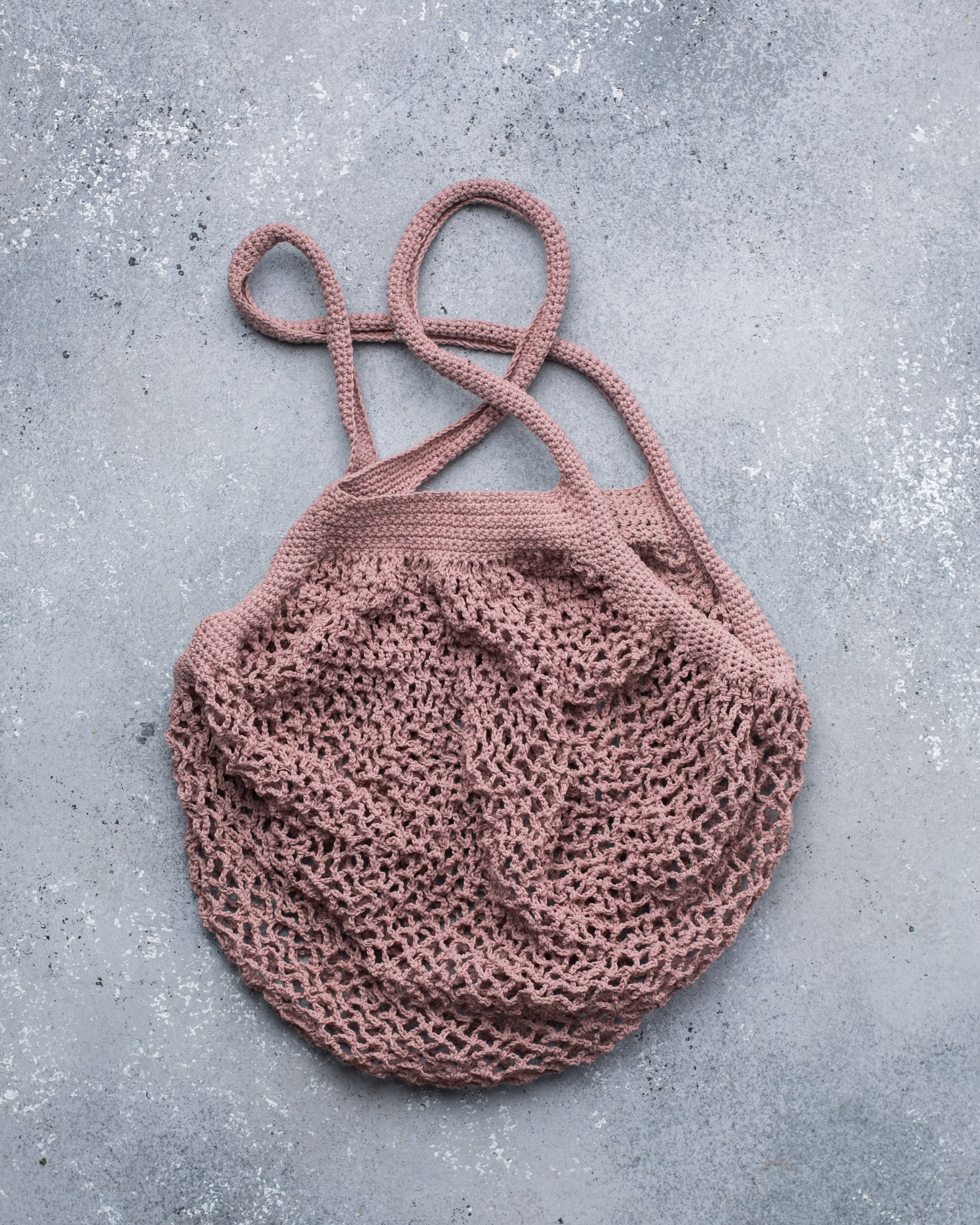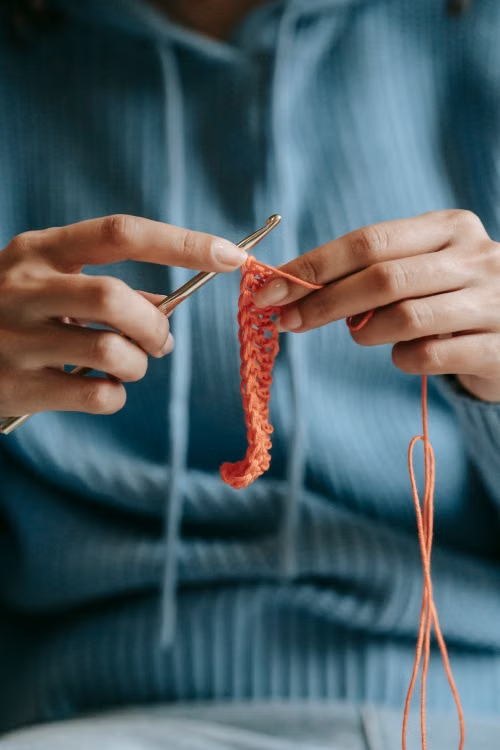
Author: Admin-0Hmjt

  • The Crochet Market Bag That Makes Grocery Shopping Feel Like a Ritual

    The Crochet Market Bag That Makes Grocery Shopping Feel Like a Ritual

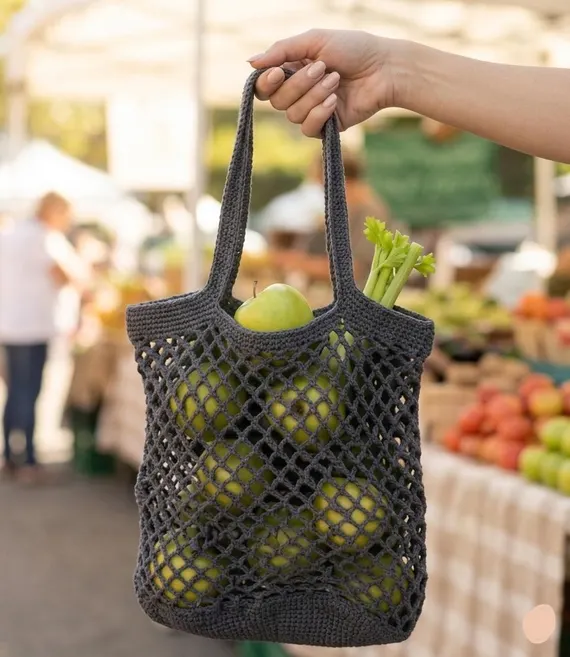
    Hand holding a grey crocheted mesh market bag filled with green apples and celery at a farmers market There is a moment, somewhere between the bread stall and the tomato stand, when a plastic bag would already be splitting at the handles — and your crocheted mesh bag simply… settles. The net stretches, the oranges nestle into the diamond holes, the bag wraps around its cargo like a hammock instead of fighting it. A woman at the cheese counter nods at it. Someone asks where you bought it. You say, with the calmest possible smile: “I made it.”

    This is not an article about a bag. It’s an article about what the bag does to an errand.

    Part One: The Geometry Secret (Why Mesh Beats Fabric)

    Here’s the counterintuitive logic at the heart of every crochet market bag: the holes are the storage. A solid tote has a fixed volume. A mesh bag starts small — roughly the size of your two hands cupped together — and grows toward its load. Drop in a melon, and the net expands. Carry only a baguette, and it contracts. The bag is not a container; it’s an agreement between yarn and gravity.
    Crocheters call the classic structure a “mesh net”: rows of chain stitches and double crochets that form diamonds. Under tension, those diamonds open; relaxed, they close. A relatively small amount of cotton can make a surprisingly roomy bag because the mesh uses yarn efficiently — far less material is spent on walls, and far more on structure.
    And here’s the quiet beauty of it: open mesh market bags have a long history, and the basic principle has changed surprisingly little. A flexible net expands around its load rather than relying on a rigid container. The physics hasn’t changed in generations. Only the yarn has gotten softer.
    Green crocheted mesh tote bag standing on a table in soft daylight next to a woven plant basket

    Part Two: The Craft — What Your Hands Need to Know

    (The practical part — written for your hands, not your Pinterest board.)
    Choose your yarn like an engineer, not a decorator. A market bag works hard, so:
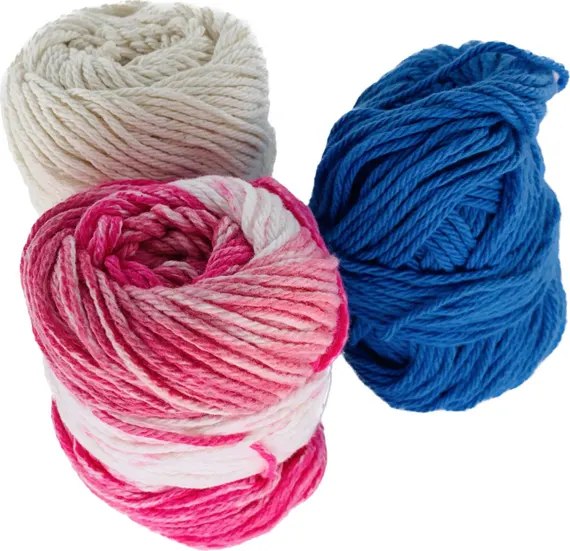
    • Medium-weight cotton (or a cotton–linen blend) is a practical choice for many market bags. It gives the bag a relatively firm structure while remaining washable and durable — and it softens, rather than pills, with use.
    • Recycled t-shirt yarn is the sturdy modern alternative: thick, forgiving, and practically indestructible. One old garment becomes a base. The trade-off: it’s heavier, so the empty bag has presence.
    • For a grocery bag, cotton is usually the more practical choice over pure acrylic: natural hand-feel, easy washing, and it ages gracefully.
    Close-up of hands crocheting a green bag with a crochet hook and variegated cotton yarn
    The pattern logic — all market bags are the same four decisions:
    1. The base — a flat circle or oval (crocheted in rounds from a magic ring). Bigger base = wider bag.
    2. The mesh body — the repeating diamond or square net. This is the fast part; once the rhythm sets in, a round can take minutes.
    3. The top band — several solid rows of single crochet. This is the bag’s belt: it stops the mesh from stretching upward and keeps handles anchored. Skip this and your bag becomes a funnel. Don’t skip this.
    4. The handles — reinforced by crocheting over the existing band multiple times. For a shoulder bag, make the handles long enough to sit comfortably over your shoulder when the bag is loaded — and test them before finishing the ends.
    A first bag can take several evenings, depending on the pattern and your crochet speed. Once the mesh rhythm becomes familiar, the body works up much faster.
    Hands holding a crocheted cotton bag strap with a ball of pink craft cotton yarn and scissors on the table

    Part Three: The Honest Part (Load, Care, and Failure Modes)

    • Test before you trust. A well-made cotton mesh bag can carry a useful grocery load — but its safe capacity depends heavily on the yarn, construction, and handles. Fill yours with books at home and lift it. If the handles elongate more than a couple of centimeters, reinforce them. This five-minute test prevents a dramatic tomato incident in a parking lot.
    • Wet cotton is honest cotton. Cotton can behave differently when wet, so wash and reshape the finished bag according to the yarn manufacturer’s care instructions. For many cotton bags, reshaping while damp helps restore the intended form — and drying it over something means it dries in bag-shape, not blob-shape.
    • The most common beginner mistake is mesh tension that’s too tight — the bag will look like a solid potholder instead of a net. If your diamonds won’t open under load, go up a hook size. The second most common mistake is too-loose handles; see “belt,” above.
    • It’s not for everything. Pointy-edged packaging can poke through the mesh. Heavy bottles belong at the bottom, inside the solid base rounds, where the structure is strongest.
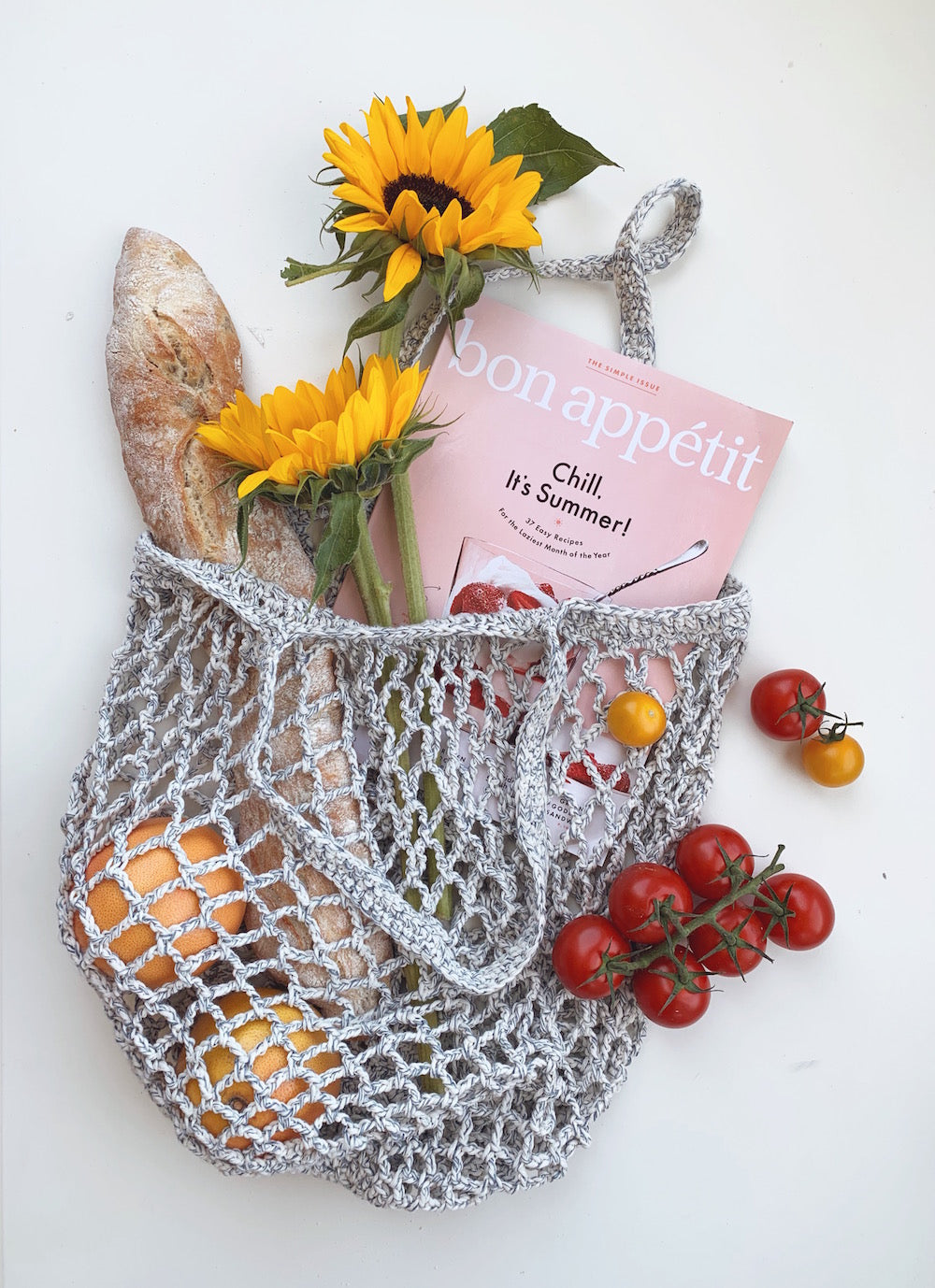
    Grey crocheted market bag flat lay with a baguette, sunflowers, oranges, cherry tomatoes and a magazine

    Part Four: The Ritual Itself

    Now the part no pattern includes.
    Saturday morning. The bag, empty and folded into itself, hangs by the door — it takes up less space than a fist. At the market, you fill it in a deliberate order: bread against the back, so it doesn’t get crushed; soft tomatoes in the front pockets of mesh; flowers through a handle, stems down. The net keeps everything visible. There is no rummaging. There is no “where did the lemons go.”
    And here’s the subtle transformation: the errand acquires a beginning, a middle, and an end. The bag opening is the beginning. The filling is the middle. Walking home with the net swinging against your hip, the produce still cool from the stall — that is the end. Three acts. A ritual.
    There is something surprisingly powerful about giving an ordinary errand a small, repeatable ritual. Crocheters describe it more simply: the bag makes you want to go. That’s not decoration doing that. That’s thousands of small loops, made by your own hands, quietly insisting that this hour matters.
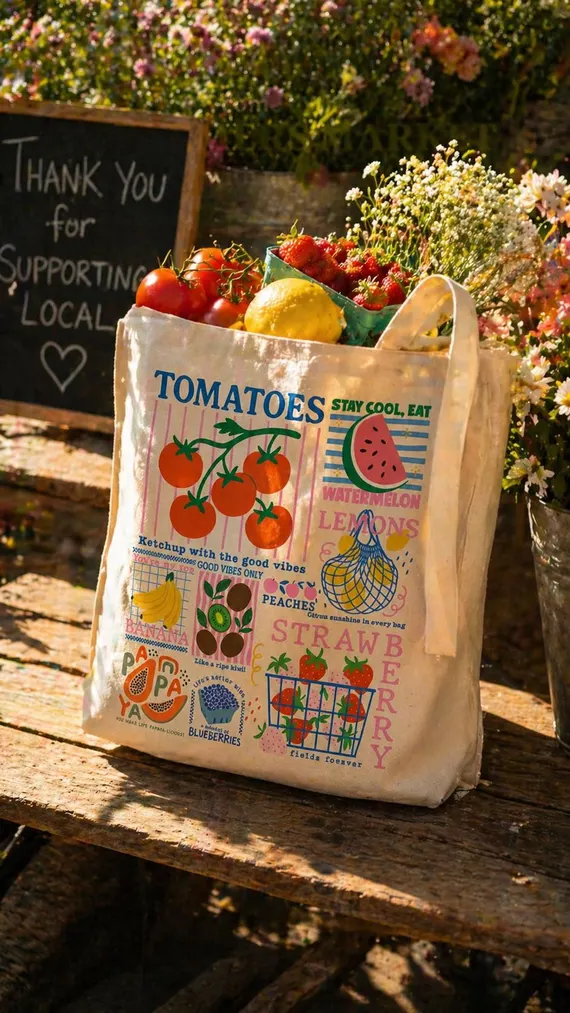
    Canvas market tote bag filled with strawberries, lemons and tomatoes next to a chalkboard sign thanking customers for supporting local farmers

    Final Thought

    A crochet market bag will not save the planet by itself, and it will not make you a different person. What it will do is more precise: it will turn a chore into a ceremony, a container into a companion, and an ordinary Saturday into the kind of small, well-made hour that a well-made life is actually built from.
    Thousands of loops. One ritual. Worth every one.
    YOU MIGHT ALSO LOVE
  • The Slipper Revolution: How Two Needles and a Ball of Yarn Can Rewire Your Brain (and Your Winter)

    The Slipper Revolution: How Two Needles and a Ball of Yarn Can Rewire Your Brain (and Your Winter)

     There is a moment — every knitter knows it — when a chaotic tangle of wool suddenly becomes a sock. Not metaphorically. Literally. One row of loops, then another, and somewhere between the fourth episode of your favorite series and the bottom of a mug of tea, your hands have quietly manufactured warmth out of thin air. It’s the closest most of us will ever get to alchemy.

    And the humble knitted slipper? That’s the gateway spell.
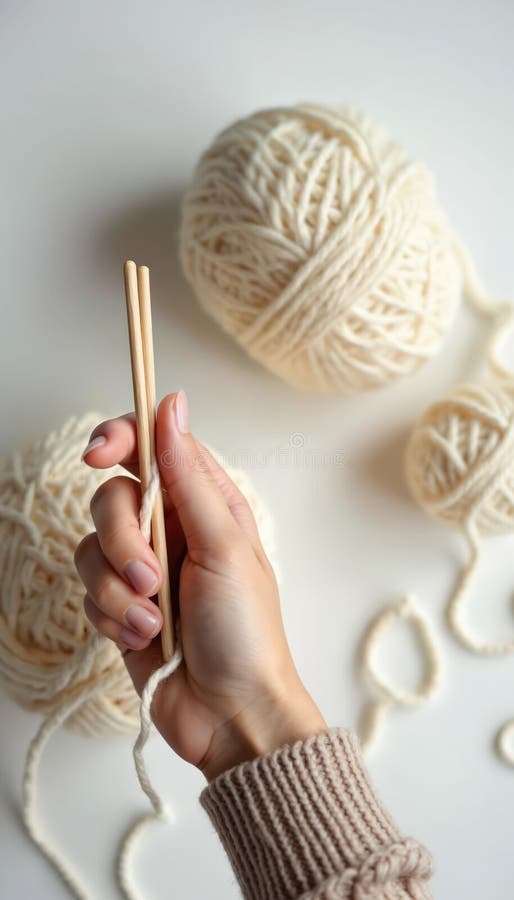
    alt="Colorful balls of wool yarn with wooden knitting needles — materials for handmade knitted slippers"

    Chapter One: Why Slippers, of All Things?

    Let’s be honest. Nobody dreams of knitting a cardigan first. Cardigans are commitments. Slippers are flirtations. They’re small, forgiving, and — here’s the beautiful secret — they don’t have to fit perfectly. A slightly roomy slipper is “cozy.” A slightly snug slipper is “snug.” Knitting doesn’t give you many free passes like that; take them.
    A pair of house slippers is essentially three decisions repeated with confidence:
    1. The sole — knit a rectangle or an oval, roughly the length of your foot plus a thumb’s width of wiggle room.
    2. The walls — pick up stitches around the sole and knit upward until the fabric kisses your ankle.
    3. The heart — the upper, where garter stitch, cables, or lazy stockinette turn plain wool into personality.
    That’s it. Three moves. The same three moves grandmothers on three continents have been making for centuries, often without written patterns, often while gossiping.
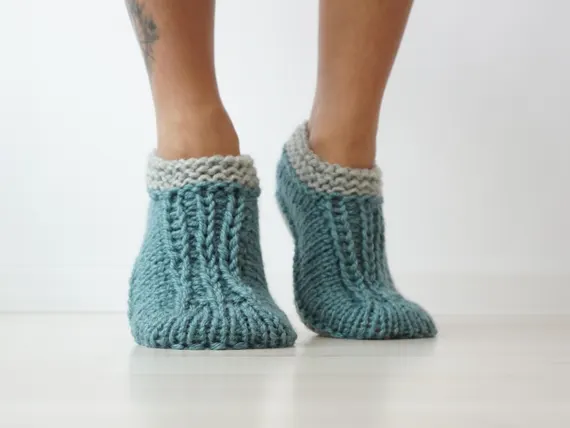
    alt="Cozy teal hand-knitted merino wool slippers with grey cuffs worn at home"

    Chapter Two: The Physics of Cozy

    Here’s something no one tells beginners: knitting is just controlled loops. Every stitch is a small lasso thrown by one needle and caught by the other, roughly 25 to 30 times per row, hundreds of times per slipper. Your brain, which spends all day juggling notifications and deadlines, is suddenly asked to do exactly one thing: pass the yarn, pull the loop, slide it off. Repeat.
    Neuroscientists call this a “flow state.” Knitters call it Tuesday. Heart rate slows. Shoulders drop. And the wool itself does half the work — merino fibers trap microscopic air pockets, holding heat like a thermostat with a soul. Wool is technically just sheep hair, and yet it outperforms most synthetic insulation humans have ever engineered. Sheep, it turns out, are geniuses.
    alt="Close-up of hands knitting with bright red wool yarn and wooden needles — knitting therapy and flow state"

    Chapter Three: The Pattern Logic (Yes, There Is Logic)

    “Creativity” and “logic” aren’t opposites — they’re dance partners, and the slipper is their ballroom. Here’s the elegant math hiding inside a simple slipper:
    • Gauge is destiny. Knit a small square first (about 10 × 10 cm). Count the stitches. Divide your foot length by that number. Congratulations — you’ve just done the exact calculation engineers use for load distribution, except your load is a foot and your material is joy.
    • Decreases are conversation. At the toe, you’ll “k2tog” — knit two stitches together — shaping the curve the way a sculptor removes marble. Every decrease is a decision: here, the fabric must turn.
    • The heel is a fold, not a puzzle. Most beginner slippers cheat beautifully: instead of turning a heel like a sock, you simply seam or graft the back. The slipper forgives. The slipper understands.
    Once you see the logic, you can’t unsee it. Scarves become boring — flat, endless, one-dimensional. Slippers are architecture.
    alt="Woman holding wooden knitting needles with cream wool yarn — beginner slipper pattern and gauge swatch"

    Chapter Four: The Twist That Will Ruin Store-Bought Slippers for You Forever

    Ready for the revelation? A handmade slipper is the only footwear in your life that gets more comfortable the longer you own it. Machine-made foam flattens, cracks, and dies. Wool felts slightly with wear — the fibers interlock tighter, conforming to your exact foot shape. After a month, your slipper fits you like a fingerprint. No factory on Earth can do that.
    And then there’s the sole hack: knit the sole with a double strand of yarn, or add a layer of leather or suede underneath, and your slippers survive tile floors, morning dashes to the mailbox, and the occasional dance party. Functional. Rugged. Secretly luxurious.
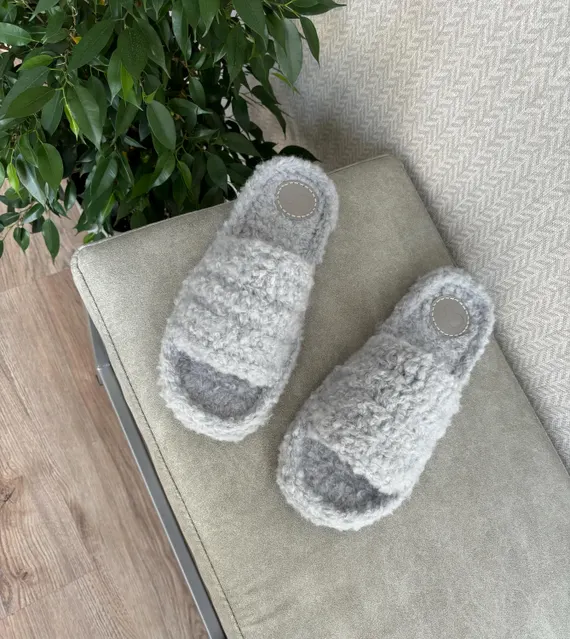
    alt="Fluffy handmade grey knitted wool slippers on soft soles — comfortable felted house shoes"

    Epilogue: Your First Pair Awaits

    So here’s the real tutorial, hidden inside the story: cast on, knit, trust, repeat. Make ugly slippers first — everyone does. The second pair will be better. The third, you’ll gift. And one winter evening, someone will slide their feet into your knitted wool and say, almost suspiciously, “You made these?”
    Yes. Yes, you did. With two sticks and a string, you built warmth from nothing.
    The ancients knitted to survive the winter. We knit to survive everything else.
    alt="Collection of handmade knitted wool slippers in different colors and patterns on wooden floor"

    Happy knitting.

  • The Knitted Slippers That Hug Your Feet Before You Ask

    The Knitted Slippers That Hug Your Feet Before You Ask

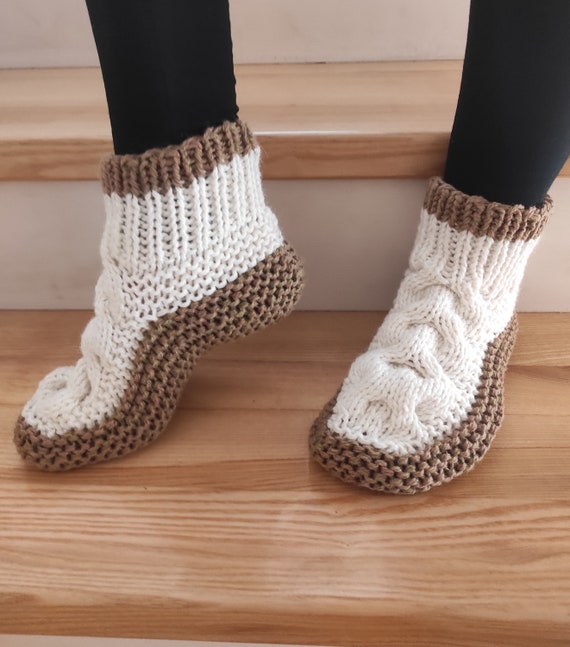
    Hand-knit white and brown cable-knit house slippers on wooden stairs — cozy chunky wool booties with folded cuff 

    You do not put on these slippers.
    You surrender to them. Your foot crosses the threshold of wool, and before your heel touches the floor, the yarn has already assessed your mood, adjusted its warmth, and offered you a squeeze that feels surprisingly like forgiveness. This is not footwear. This is a therapist — trained in the ancient art of making you feel like you belong exactly where you are standing.
    Welcome to the only accessory in the house that understands comfort is not bought. It is constructed — from fiber, from tension, from the exact number of rows between your toes and your ankle.
    In this article, you will learn:
    • Why chunky knit slippers are the single most powerful upgrade for your evening routine
    • The exact yarn weight that creates a slipper instead of a sock
    • How to use a simple garter stitch to build architecture for your feet
    • The felting formula that turns soft wool into armor against cold floors
    • The 5 mistakes that make handmade slippers feel like punishment
    Now, pick up your needles. The floor is waiting.
    A pair of slippers so polite they apologize for the floor being cold.

    Part I: The Yarn Is a Cloud You Can Walk On

    Look at it. A strand of wool so thick it could hold a secret. It does not wrap around your foot. It envelops it.
    Here is the textile paradox that breaks footwear logic: thin socks separate you from the floor. Chunky slippers negotiate with the floor. The super-bulky yarn — size 6 or 7, sometimes called “roving” or “jumbo” — creates a cushion so dense it absorbs the shock of hardwood, tile, and bad news. You are not walking on the ground. You are walking on a sheep’s best idea.
    And the hand-knit construction? It is not nostalgia. It is engineering. A machine-knit slipper is uniform. It does not care about your high arch, your bunion, your tendency to curl your toes when the heating bill arrives. But hand-knit fabric has memory. It learns your foot. After three evenings of wear, the slipper stops being a shape and becomes a biography — your biography, written in wool.
    Practical tip: For house slippers that actually stay on, choose yarn labeled “super bulky” (6) or “jumbo” (7). A single strand of super bulky on 10 mm needles creates a fabric thick enough to insulate but flexible enough to forgive. If you want a slipper that feels like a mattress, hold two strands of bulky together. The result is a loft so high your feet will need seatbelts.
    Fiber matters: Use 100% wool or a wool-alpaca blend for structure and warmth. Acrylic is a liar — it feels soft in the ball, but underfoot it turns into a plastic bag within a week. Wool felts slightly with wear, which means your slippers get denser, warmer, and more personal over time. Acrylic just gets sad.
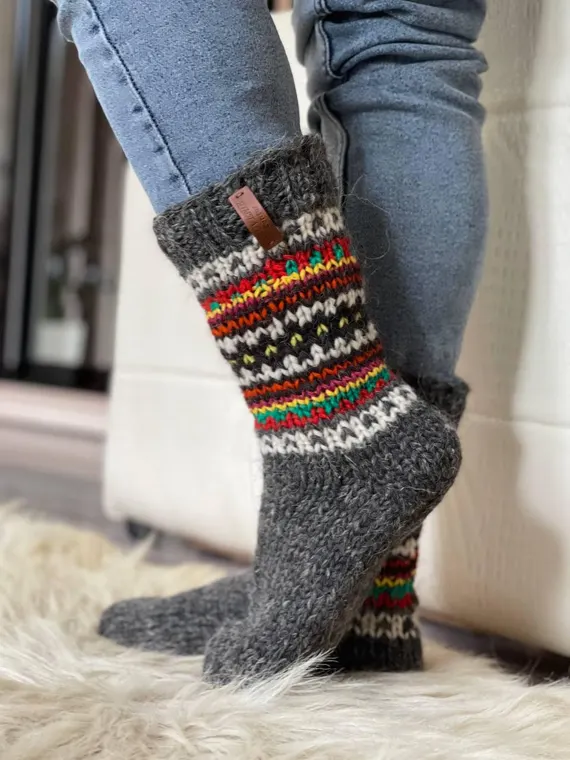
    Hand-knit grey wool slipper socks with colorful Nordic fair-isle pattern — warm chunky house footwear on sheepskin rug
    When your feet wear a rainbow and your soul finally breathes.

    Part II: The Stitch Is a Conversation

    Now, look closer. A garter stitch. Knit every row. That is the entire vocabulary of the simplest slipper.
    But here is the twist: garter stitch is not laziness. It is geometry. The ridges create friction against the floor. The fabric is naturally wider than it is tall, which means it wraps around the foot like a hug instead of a tourniquet. And because every row is knit, the fabric is double-thick compared to stockinette — a built-in sole without sewing a second layer.
    The megalogic that defeats complicated patterns: a slipper is not a sweater. It does not need cables. It does not need lace. It needs to stay on, stay warm, and stay out of the way. A basic garter-stitch rectangle, folded and seamed at the toe and heel, creates a bootie shape so intuitive it feels like the wool invented itself.
    The basic architecture: Cast on 24 to 32 stitches depending on foot width. Knit a rectangle until it measures the length of your foot plus 2 inches. Fold in half. Seam the toe with Kitchener stitch or a simple three-needle bind-off. Seam the heel, leaving a 3-inch opening for your ankle. That is it. No heel flap. No gusset. No drama.
    Sizing rule: The slipper should be ½ to 1 inch smaller than your actual foot length before wearing. Wool relaxes. A slipper that fits perfectly off the needles will turn into a flip-flop by February. Knit it snug. Let the yarn do the stretching.
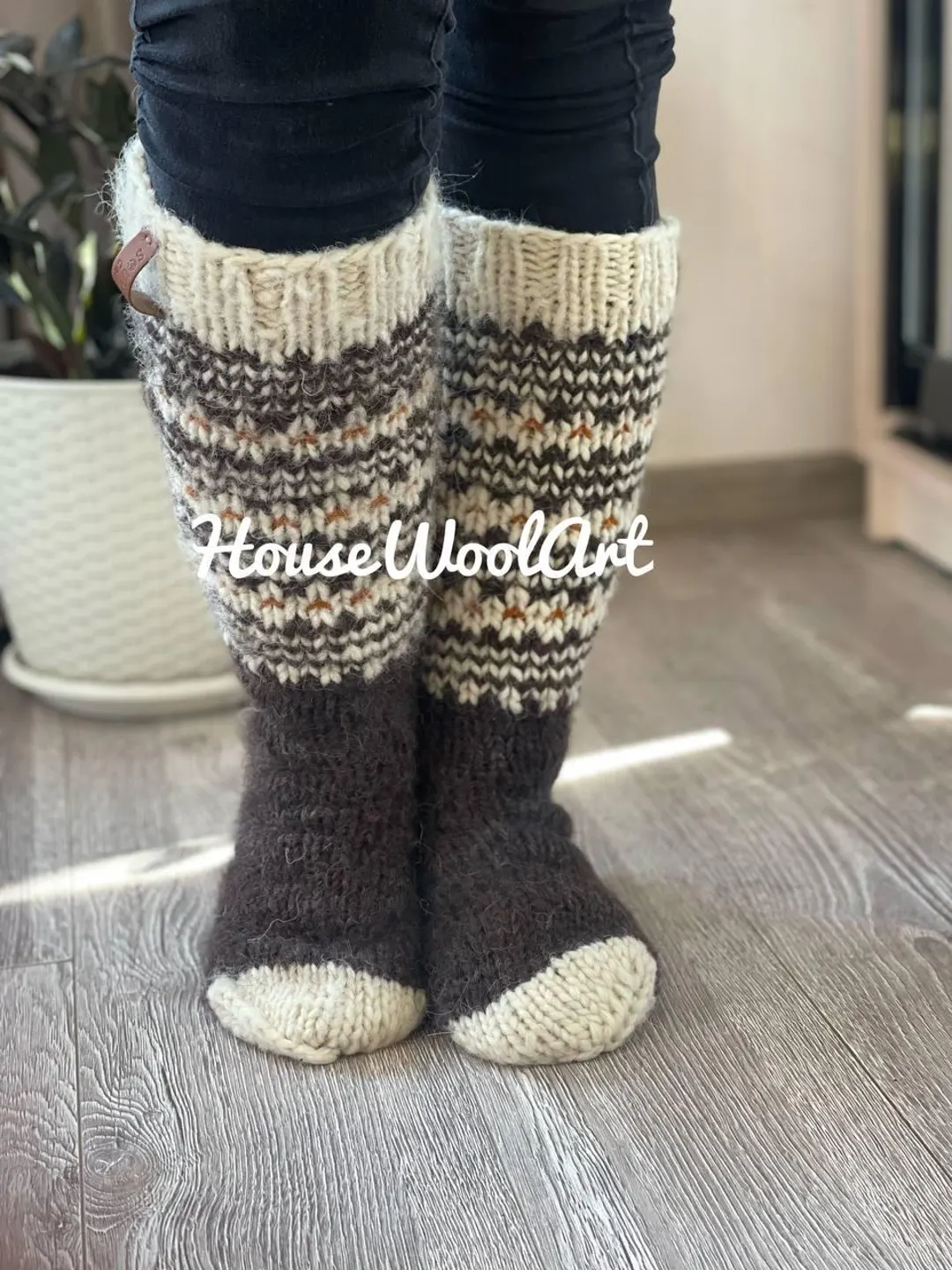
    Handmade tall wool house boots with cream cuff and Nordic pattern — thick knitted slipper socks on wooden floor
    Boots so tall they judge your thermostat settings.

    Part III: The Cuff Is a Doorway

    Above the ankle, the wall rises. A ribbed cuff, two inches tall, folded over like a collar on a winter coat. It does not just keep the draft out. It announces that the slipper has boundaries.
    Here is the secret that will ruin store-bought socks for you forever: a ribbed cuff is elastic architecture. Knit two, purl two. The columns of knit stitches recede. The purl stitches advance. The result is a tube that grips without squeezing, that stays up without leaving a mark, that says “I am secure here” without yelling.
    And the practical magic? The cuff catches the warmth that rises from your foot like steam from tea. Without it, heat escapes through the ankle gap. With it, your entire lower leg enters a microclimate of coziness. The difference between a slipper with a cuff and a slipper without is the difference between a tent and a cabin.
    DIY or buy: If you knit, cast on 8 to 10 fewer stitches than the foot on smaller needles (8 mm instead of 10 mm) and work K2, P2 ribbing for 15 to 20 rows. Fold the top row inward and whip-stitch it down for a doubled, pillowy edge. If you buy handmade, look for a cuff that stands up on its own when empty. A floppy cuff is a draft waiting to happen.
    Chunky beige crochet house booties on woven mat — soft handmade home slippers with cozy texture
    When your slippers look like they just woke up from a nap.

    Part IV: The Sole Is a Secret

    Look down. The bottom of the slipper. It looks like the top. Same yarn. Same stitches. Same trust.
    But here is the twist: the sole is where slippers die. Friction. Moisture. The slow abrasion of daily existence. A pure wool sole on hardwood will felt into a flat, dense pad within a month — which is beautiful, unless you wanted it to stay fluffy.
    The solution is not a second sole. It is prevention. Before you wear them, apply a thin layer of liquid latex or fabric puff paint to the bottom in a dot pattern. It dries clear, flexible, and grippy. Your slippers gain traction without losing soul. Or, for the purists, knit the bottom in a tighter gauge — go down two needle sizes for the sole section only. The fabric becomes armor. The top stays cloud.
    Felting wisdom: If your slippers are too loose, throw them in the washing machine with hot water and a pair of jeans. Agitation + heat = controlled shrinkage. Check every five minutes. Pull them out when they fit like they were born on your feet. Block them over your actual feet while damp. You now have custom-molded footwear that no factory can replicate.
    Color temperature pairing: If your living room is warm neutrals, choose oatmeal, taupe, or rust. If your soul needs joy, choose mustard, teal, or a Nordic fair-isle pattern that makes your ankles look like they are attending a festival. Mismatched slippers — one teal, one rust — are not a mistake. They are a personality.
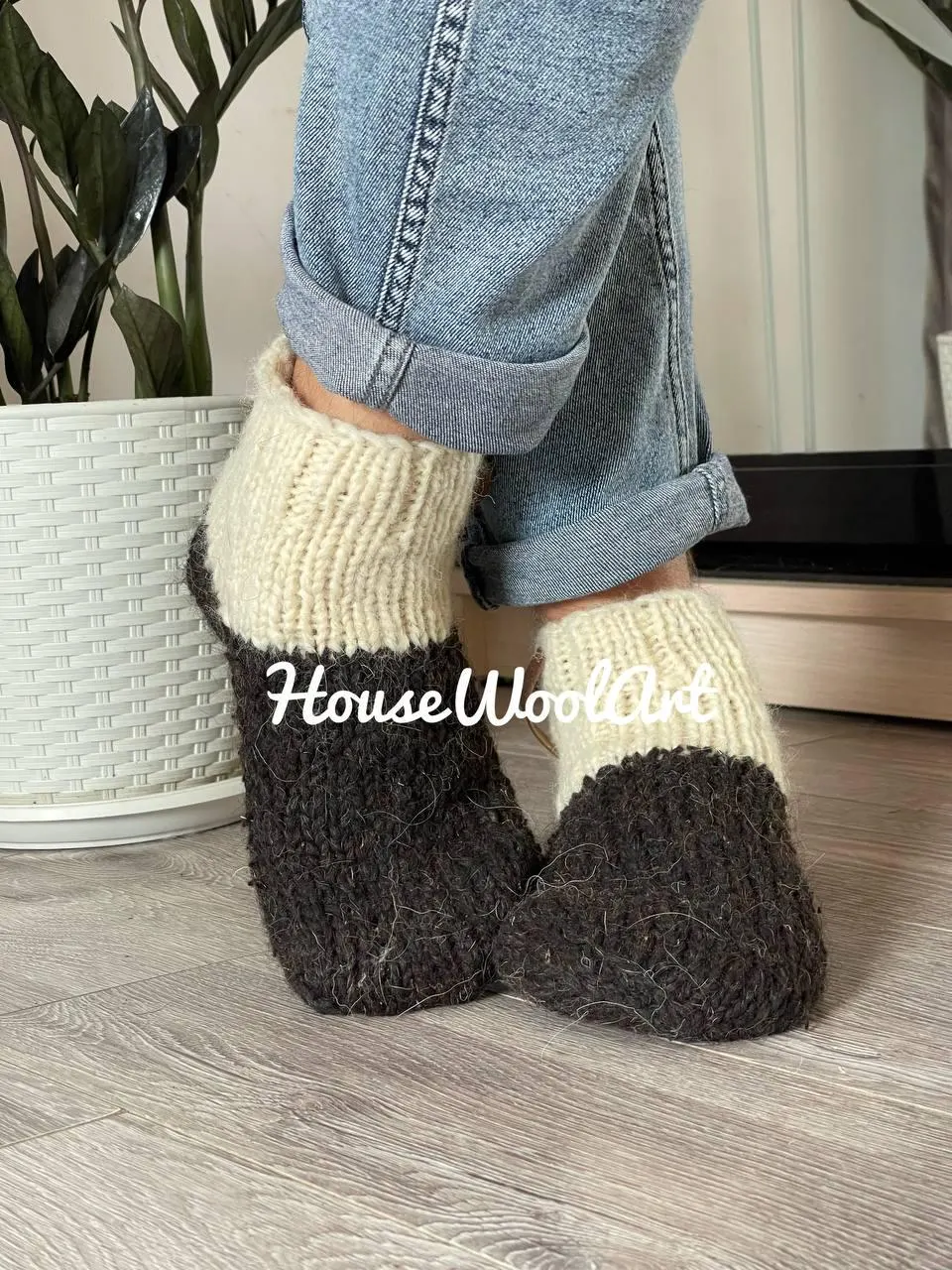
    Black and cream chunky knit wool slipper socks — thick handmade house shoes with ribbed cuff.
    For days when you want your feet to feel like they are wearing a fortress.

    Part V: The Ritual Is the Point

    A jute basket by the door. Natural fiber, slightly rough, the color of sand. Inside, a pair of hand-knit slippers waits like a handshake — the house’s way of saying, “I am solid. You are safe. Take off your shoes.”
    Here is where logic completely dissolves: a handmade slipper should not feel too precious to wear. The hand-spun art yarn is beautiful, yes, but fragile. The practical slipper is knit from sturdy wool, slightly rough, built for duty. It catches the day’s residue so the rest of your evening does not have to. It is the only element in your wardrobe that exists to be used, not admired.
    Sizing rule for gifts: If you are knitting for someone else, measure the length of their foot from heel to longest toe. Subtract 1 inch. That is your target length before seaming. A slipper that fits a stranger is a slipper that stays in the closet. A slipper that fits like a secret is a slipper that gets worn until it has holes.
    Plant placement: This has nothing to do with slippers. But every knitter needs a plant nearby. Something low-light and forgiving. A snake plant in a ceramic pot that echoes your yarn basket. Water it when you finish a pair. Celebrate completion with growth.
    Fuzzy emerald green chunky knit slippers on white wooden floor — bright handmade house footwear with textured stitch.
    When your feet look like they are wearing happiness itself.

    The 5 Mistakes That Ruin Handmade Slippers

    1. Using acrylic yarn
      Acrylic repels moisture but also repels warmth. It is literally plastic. A wet acrylic slipper is a clammy foot that never recovers. Use 100% wool or prepare for regret.
    1. A needle that is too small
      A 6 mm needle creates a fabric so dense it could be used as a potholder. The 10 mm to 12 mm needle gives you loft and air. Do not fight the fiber.
    2. Knitting them to fit perfectly
      If your finished slipper matches your foot exactly, it will be a sock by Wednesday. Knit it ½ to 1 inch short. Wool grows. Trust the process.
    1. Ignoring the sole
      A beautiful slipper with a worn-through bottom is a tragedy. Reinforce before you wear. Latex dots, tighter gauge, or a sewn-in leather pad. Choose one.
    2. Forgetting a cuff
      An ankle-height slipper without a cuff is a sock that gave up. The cuff keeps the warmth in and the slipper on. Without it, you are just dragging yarn around the house.

    Epilogue: The Footwear That Remembers

    So here is the truth, delivered with the gentleness of wool against tired skin:
    Your feet do not need another factory slipper with a corporate logo. They need a slipper that remembers your arches. A slipper that took three evenings, two podcasts, and one moment of “Did I decrease at the right row?” A slipper that makes coming home feel like a ritual instead of a routine.
    Knit the pair. Choose the color that makes you smile. Wrap them in twine for the friend who just bought a house, or for the friend who needs to remember that handmade things still exist.
    Or keep them. Leave them by the bed. Let the garter stitch welcome you every morning. Let the cuff hold the warmth in. Let the wool forgive the floor.
    Because the knitted slippers that hug your feet before you ask are not about warmth. They are about noticing. Noticing that your feet work hard. That wool is kind. That a handmade thing is a small rebellion against a disposable world.
    Now go cast on 28 stitches. The kettle is boiling.
    Happy knitting.
  • The Crochet Hand Towel That Makes Drying Your Hands Feel Like a Spa Ritual

    The Crochet Hand Towel That Makes Drying Your Hands Feel Like a Spa Ritual

    Colorful crochet dishcloths and hand towels in wicker basket on kitchen counter — handmade cotton kitchen linens in green, yellow, blue and striped patterns. 


    You do not dry your hands with this towel.
    You thank them. You thank them for holding the coffee mug, for carrying the groceries, for typing the emails. And in return, they meet cotton — soft, thirsty, striped in colors that have no business being this cheerful in a room where drains live.
    This is not a towel. It is a mood regulator disguised as household linen.
    In this article, you will learn:
    • Why three bright stripes are the secret to a kitchen that feels alive
    • The exact stitch combo (SC + DC) that creates texture without complexity
    • How one cone of white cotton becomes an entire gift set
    • The border trick that elevates “homemade” to “artisan”
    • The 5 mistakes that turn a hand towel into a dish rag
    Now, pick up your hook. The sink is waiting.

    Part I: The Stripe Is a Conversation

    Look at it. White, interrupted. A band of guava pink. A band of pastel blue. A band of sunflower yellow. Each stripe is only two rows tall — barely a whisper — but together they form a sentence. White says “I am clean.” Guava says “I am fun.” Blue says “I am calm.” Yellow says “I am awake.”
    Here is the color theory that breaks interior design rules: you do not need to match your towels to your tiles. You need them to apologize for your tiles. Beige countertop? Boring. Beige countertop with a hand-crocheted towel in tropical stripes? Curated. The towel becomes the accessory that makes everything else look intentional.
    And the practical magic of the stripe placement in this pattern? It is symmetrical. Guava at the top, Guava at the bottom. Blue and Sunflower mirror each other around the center. The eye reads this as balance, even if the viewer has never crocheted a stitch. It feels designed. Because it is.
    Yarn math that will make you feel smart: One 700-yard cone of white cotton + three 131-yard rolls of color = one hand towel + three matching dishcloths. That is four handmade gifts from four skeins. The economics of generosity have never looked better.

    Part II: The Stitch Is a Lie Your Hands Love

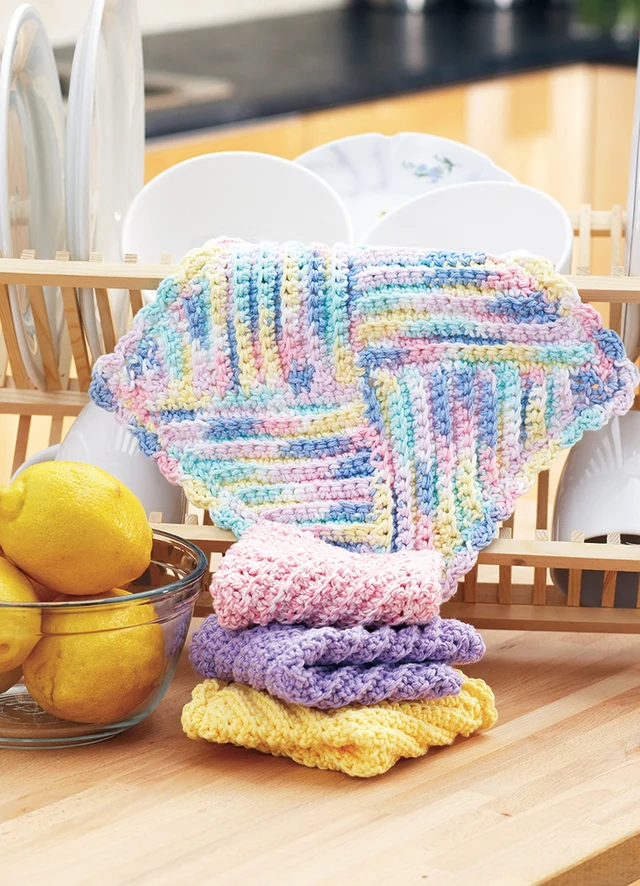
    Pastel crochet dishcloths stacked on wooden counter next to bowl of lemons — soft cotton washcloths in pink, blue, yellow and purple
    Single crochet. Double crochet. That is the entire vocabulary of this towel.
    But here is the twist: alternating them creates a texture illusion. The single crochet sinks. The double crochet rises. Row by row, they negotiate with each other until the fabric becomes a ridged landscape — absorbent, scrubby, yet soft enough for your face. It looks like waffle weave. It behaves like a sponge. It is actually just SC, DC, SC, DC repeated until your row counter tells you to stop.
    The megalogic that defeats complicated patterns: repetition is meditation. You do not need to count to twelve. You do not need to front-post, back-post, or twist yourself into a cable. You need one row of singles and doubles, then one row of doubles and singles. The pattern reverses itself every other line, which means your brain can wander while your hands do the work.
    The foundation chain: 45 chains. That is it. Not 145. Not 445. Forty-five. Small enough to finish in an evening, large enough to actually dry a human hand without feeling like a coaster.

    Part III: The Cotton Is a Promise

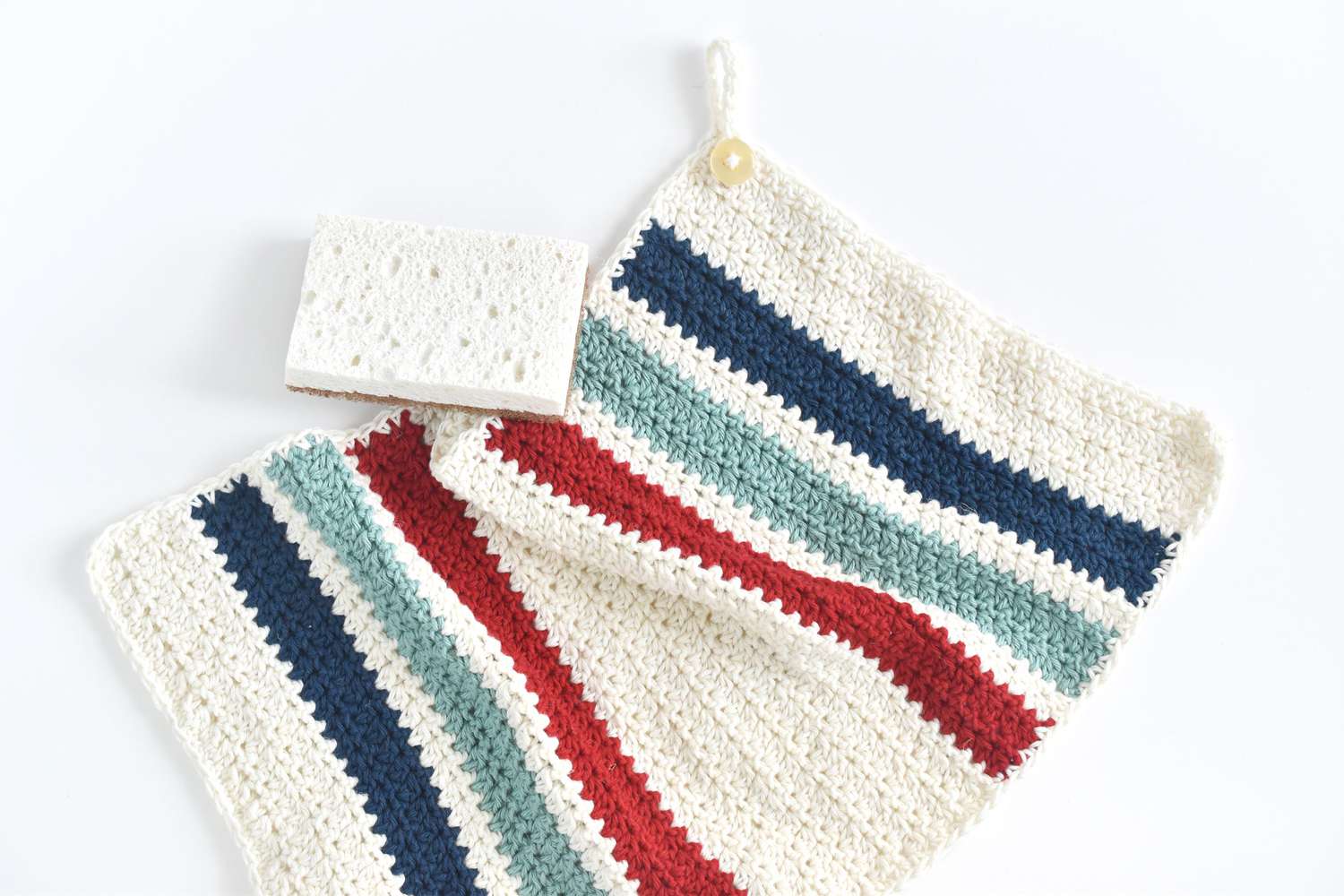
    White crochet hand towel with diagonal red, teal and navy blue stripes — colorful cotton kitchen towel with button loop on white background
    Premier Home Cotton. Not acrylic. Not wool. Not that fuzzy yarn that sheds like a golden retriever in July.
    Cotton makes promises that synthetic fibers cannot keep. It absorbs. It launders. It softens with every wash instead of pilling into sadness. A cotton hand towel used daily for six months will feel better than it did on day one — the fibers relax, the texture blooms, the stripes settle into their identity.
    And the color? Cotton takes dye honestly. Guava is guava. Sunflower is sunflower. There is no metallic sheen, no plastic shine — just pigment doing its job. When you hang this towel on a brass hook by the sink, it does not compete with the hardware. It complements it.
    Care instructions that will save your sanity: Machine wash warm, tumble dry low. No special treatment. No hand-washing guilt. Cotton forgives. Cotton forgets. Cotton shows up tomorrow ready to dry another set of hands.

    Part IV: The Pattern Is a Journey

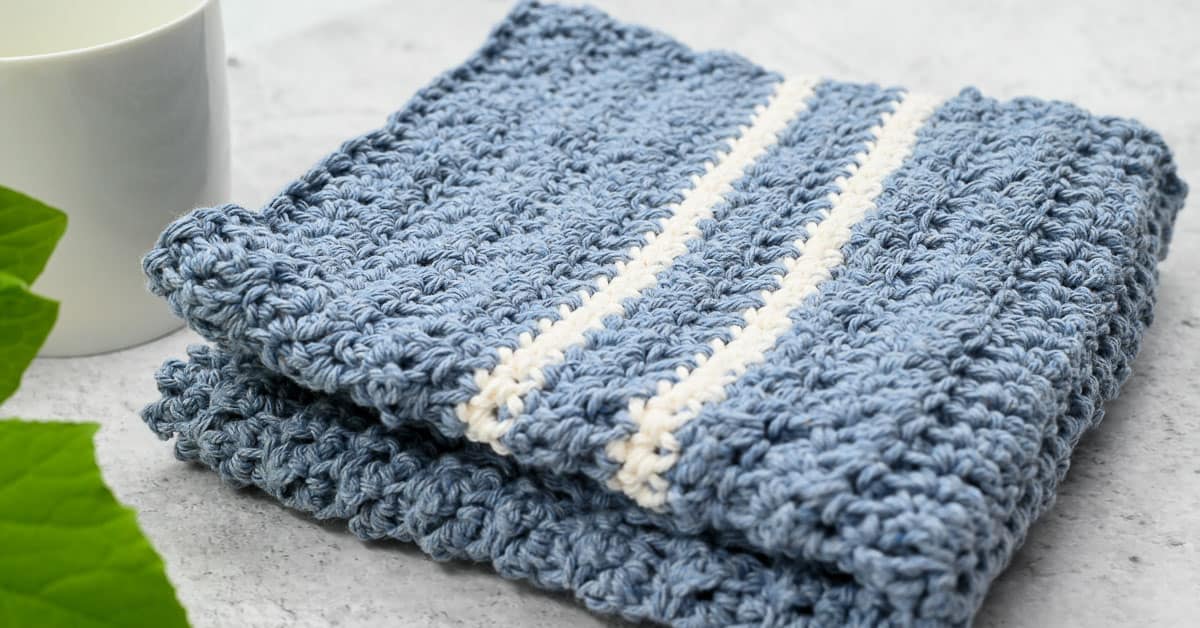
    Folded blue crochet hand towel with two white stripes on marble surface — textured cotton kitchen linen next to white mug
    Now, the practical magic. Here is how you turn one cone of white and three pops of color into a towel that makes guests ask, “Where did you buy this?”
    The Setup:
    • Hook: Size H (5.00 mm) — the Goldilocks of crochet hooks, not too tight, not too loose
    • Foundation: Chain 45
    • Base row: Single crochet in the second chain from hook, then alternate DC, SC across. End with a DC in the final stitch. Chain 1, turn.
    The Rhythm:
    Rows 2–5: Continue the SC, DC dance in white. At the end of Row 5, switch to Guava (Color A).
    Rows 6–7: Two rows of Guava. Switch back to white.
    Rows 8–9: Two rows of white. Switch to Pastel Blue (Color B).
    Rows 10–11: Two rows of Blue. Back to white.
    Rows 12–13: Two rows of white. Switch to Sunflower (Color C).
    Rows 14–15: Two rows of Sunflower. Back to white.
    The Mirror:
    Rows 16–42: White continues the rhythm. Then you mirror the color sequence in reverse — Sunflower, white, Blue, white, Guava, white — until Row 57. The towel becomes a palindrome. The top half and bottom half are reflections of each other, separated by a wide white center that says “I have room to breathe.”
    The Color Change Trick: Do not cut the yarn at every stripe. Carry the inactive color loosely up the side edge, trapping it in the turning chain. When you finish the towel, the carried strands become invisible inside the border. Less weaving. More living.

    Part V: The Border Is Optional (But You Will Want It)

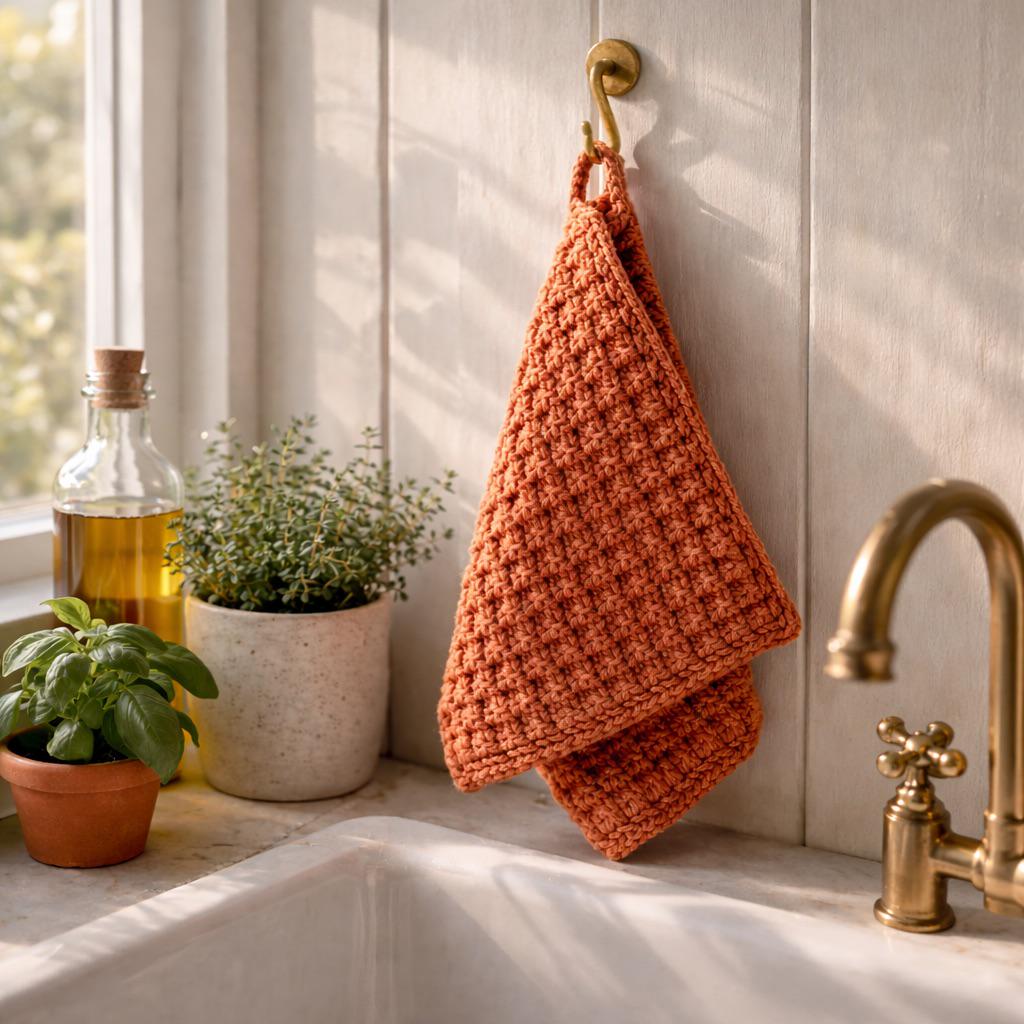
    Terracotta crochet hand towel hanging on brass hook by white farmhouse sink — handmade cotton towel in sunny kitchen with herbs
    At Row 57, you have a choice. You can fasten off, weave in the ends, and call it finished. The towel works. It dries. It hangs. It is enough.
    Or — and this is where “homemade” becomes “heirloom” — you can add a slip-stitch border around all four edges. Chain 1, do not turn, slip stitch down the side, across the bottom, up the other side, across the top. One round. Five minutes. The result? A smooth, corded frame that makes the towel look like it came from a boutique in Provence, not your couch at 10 PM.
    Here is the practical truth: crochet edges are wobbly. The tension varies. The sides pucker. A slip-stitch border is not decoration. It is arbitration. It negotiates peace between the top edge and the side edge. It gives the towel a spine.

    The 5 Mistakes That Ruin a Crochet Towel

    1. Using acrylic yarn
    Acrylic repels water. It is literally plastic. A wet acrylic towel is a wet dog that never dries. Use 100% cotton or prepare for mildew and regret.
    2. A hook that is too small
    A 4.00 mm hook creates a fabric so dense it could be used as armor. The H (5.00 mm) hook gives you drape and absorbency. Do not fight the fabric.
    3. Skipping the gauge swatch
    If your 44 stitches measure 8 inches instead of 10, your towel will be a washcloth. Swatch. Block. Measure. Then proceed.
    4. Cutting yarn at every color change
    You will have 47 ends to weave in. Carry the yarn up the side. Your future self — the one who has to finish this before the birthday party — will thank you.
    5. Forgetting the hanging loop
    Add a chain-8 loop at one corner before the final border round. Every hand towel needs a way to live on a hook. Otherwise it lives on the counter, and a counter towel is a towel that has given up.

    Epilogue: Hang the Happiness

    White crochet dish towel with turquoise border and corner accent on rustic wood — textured cotton kitchen towel with decorative edge
    So here is the truth, delivered with the gentleness of cotton against wet skin:
    Your kitchen does not need another factory towel with a corporate logo. It needs a towel that remembers your hands. A towel that took three evenings, two podcasts, and one moment of “Did I switch to Guava at the right row?” A towel that makes drying your hands feel like a ritual instead of a chore.
    Make the set. Three dishcloths with single stripes. One hand towel with the full rainbow. Wrap them in twine. Give them to the friend who just bought a house, or to the friend who needs to remember that handmade things still exist.
    Or keep them. Hang them where you will see them every morning. Let the Guava wake you up. Let the Sunflower stay with you through dinner. Let the Pastel Blue calm you down before bed.
    Because the crochet hand towel that makes drying your hands feel like a spa ritual is not about drying. It is about noticing. Noticing that your hands work hard. That cotton is kind. That a stripe is a small rebellion against a beige world.
    Now go chain 45. The water is running.

    Happy crocheting.
  • The Crochet Tote That Carries Your Whole Aesthetic

    The Crochet Tote That Carries Your Whole Aesthetic

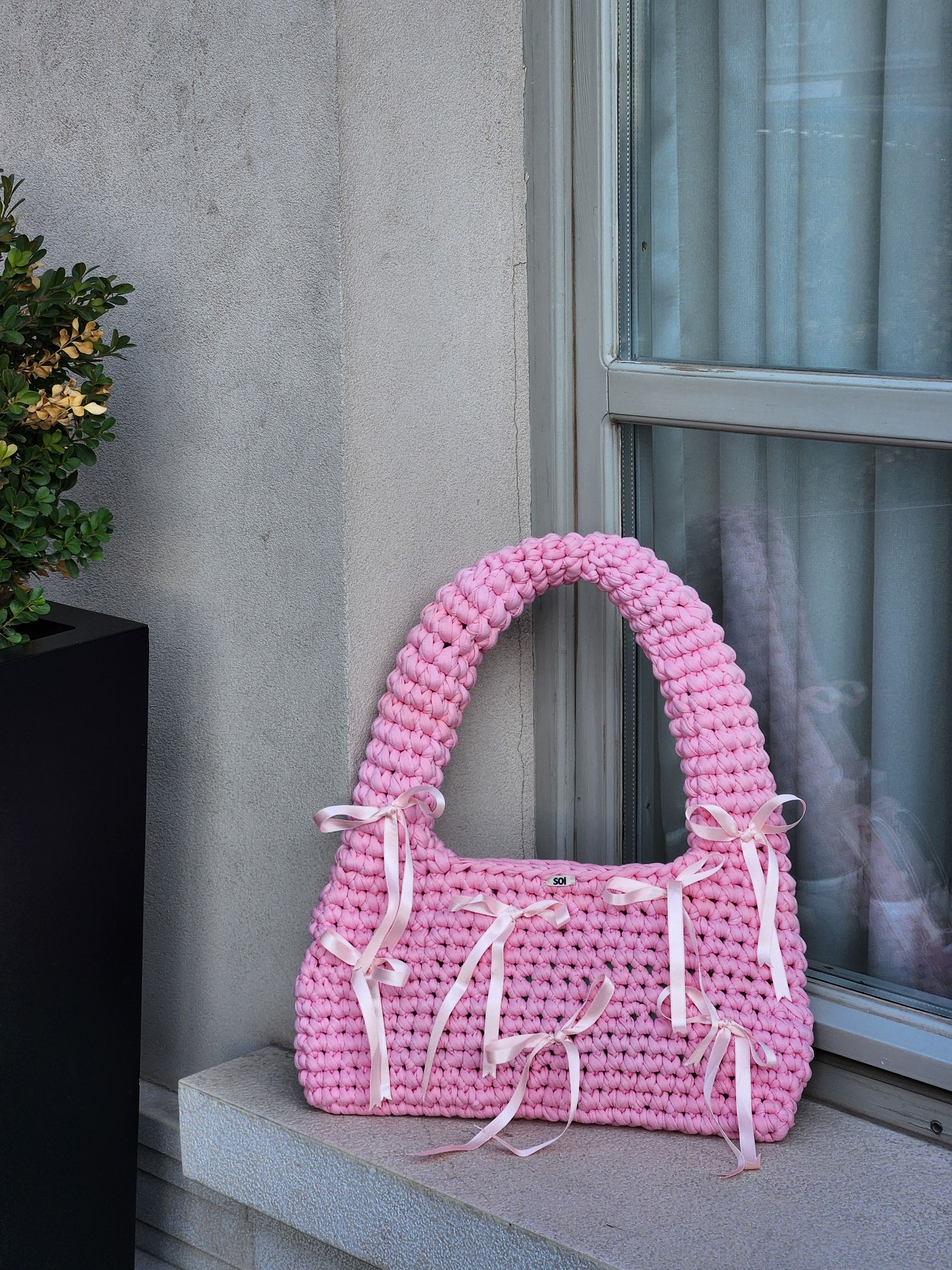
    Handmade color-blocked crochet tote bag in pink, peach and lavender with tassel, leather tag and QR code pattern label on marble surface You do not buy this bag.

    You download its potential. You scan a code, open a PDF, and suddenly your evening has a purpose that has nothing to do with Netflix. Three hours later, your hands smell like cotton. Your couch is covered in yarn crumbs. And there — on the coffee table — is a tote bag in shades of strawberry, peach, and lavender that looks like it was born in a boutique, not on your lap.
    Welcome to the only accessory that comes with a QR code and a personality.
    In this article, you will learn:
    • Why color-blocked crochet totes are the easiest “wow” project for confident beginners
    • How to read a PDF pattern without throwing your hook across the room
    • The exact yarn weight and hook size for a structured bag that does not sag
    • How to attach a leather tag and tassel like a professional maker
    • The 5 mistakes that turn a boutique-style tote into a craft-fair casualty
    Now, let us talk about the bag that comes with homework.

    Part I: The Color Gradient Is a Mood Ring

    Look at it. Pink melting into peach melting into lavender — like a sunrise had a baby with a macaron. This is not just a color scheme. This is a mood gradient. The top is bubblegum optimism. The middle is peachy calm. The bottom is lavender introspection. You are not carrying a bag. You are carrying the emotional arc of a perfect Tuesday.
    Here is the paradox that breaks color theory: these three colors should clash. Pink and orange are neighbors on the wheel — they fight for attention. Purple is across the ring — it should create discord. But in pastel tones, at equal saturation, they form a truce. They become a gradient. And a gradient, in crochet, is the easiest way to look like you planned something complicated when you simply ran out of the first color and refused to go to the store.
    Practical tip: For a smooth color transition in a tote, work two rows of the new color while carrying the old color along the top of the stitches (tapestry crochet technique). This creates a clean line with no weaving-in later. Or — embrace the jogless stripe: change colors at the beginning of the row, chain one in the new color, and continue. The slight step is invisible after blocking.
    Yarn math: For a medium tote (12″ wide × 10″ tall × 3″ deep), you need approximately 200 yards of Color A, 150 yards of Color B, and 150 yards of Color C in worsted-weight cotton. Lily Sugar’n Cream or Paintbox Cotton DK work beautifully. Do not use acrylic — it stretches under weight and your tote will become a hammock by week three.

    Part II: The QR Code Is a Portal

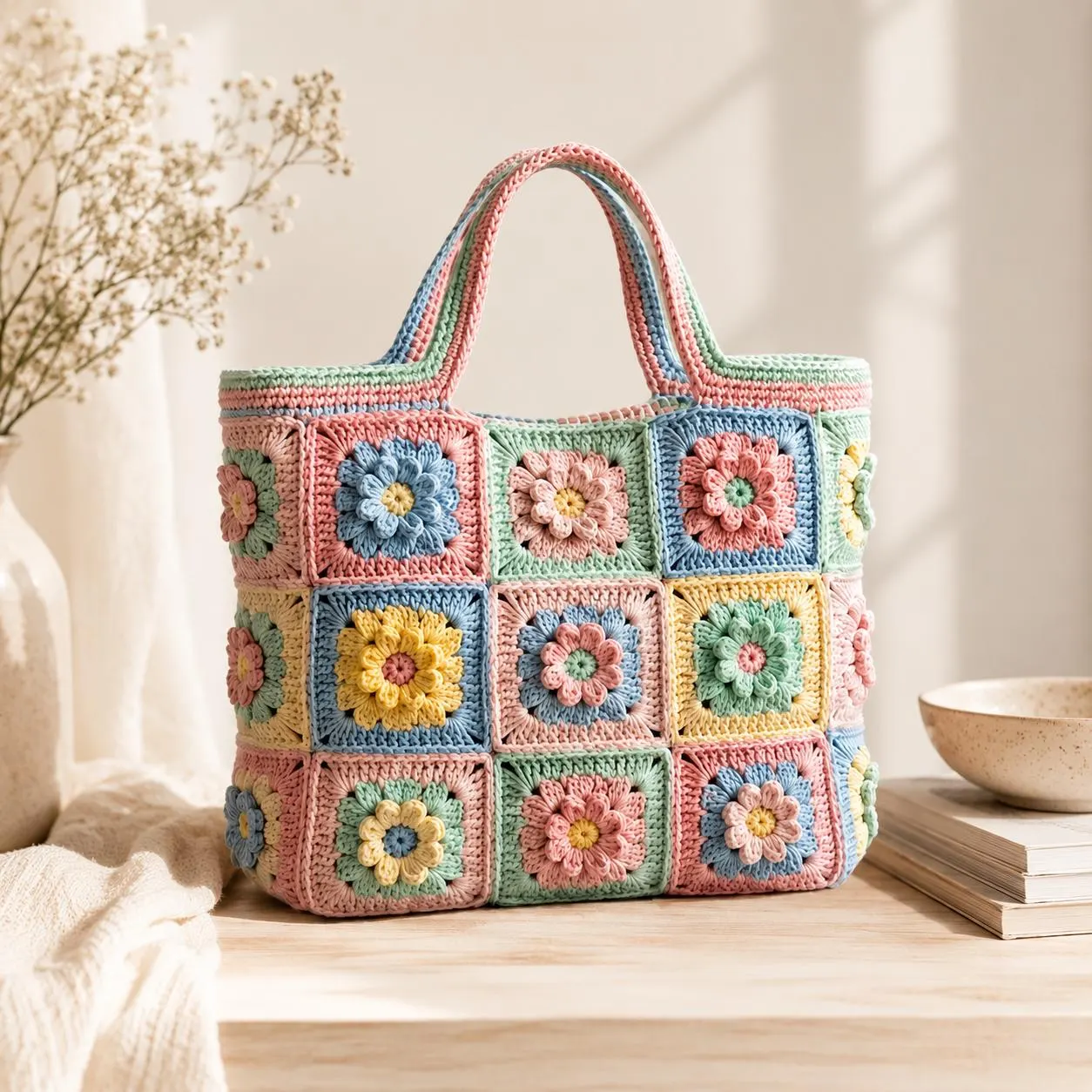
    Handmade pastel crochet tote bag with 3D flower granny squares in pink, blue, yellow and green — artisan floral crochet purse on wooden shelf with dried flowers
    There it is. A small paper tag, tied with twine, printed with a QR code that says “Download PDF Pattern.” This is the modern equivalent of a spell book. You point your phone at it, and a document appears — pages of abbreviations, stitch counts, and diagrams that look like hieroglyphics drawn by a very organized alien.
    But here is the twist: the QR code is not just a link. It is a permission slip. It gives you the right to make this exact thing. It transforms you from a consumer into a maker. Without the code, the bag is a product. With the code, it is a curriculum.
    How to read a PDF pattern without trauma:
    1. Print only the first page — the materials list and gauge swatch instructions. Everything else stays digital for zooming.
    2. Highlight your size — if the pattern offers multiple dimensions, highlight only your numbers. The rest is noise.
    3. Use a row counter app — your phone can track rows better than your memory, especially during Netflix.
    4. Stitch glossary first — if the pattern says “fpdc” and you do not know what that means, stop. Look it up. Do not guess. Front post double crochet is not intuitive.
    5. Save the PDF to a cloud folder named “Current Projects” so you can access it from any device when inspiration strikes at the dentist’s office.
    The megalogic of digital patterns: A PDF pattern costs $3–$8. The bag it produces would retail for $60–$90. That is a 1,000% return on investment — if you measure ROI in compliments per dollar.

    Part III: The Tassel Is a Signature

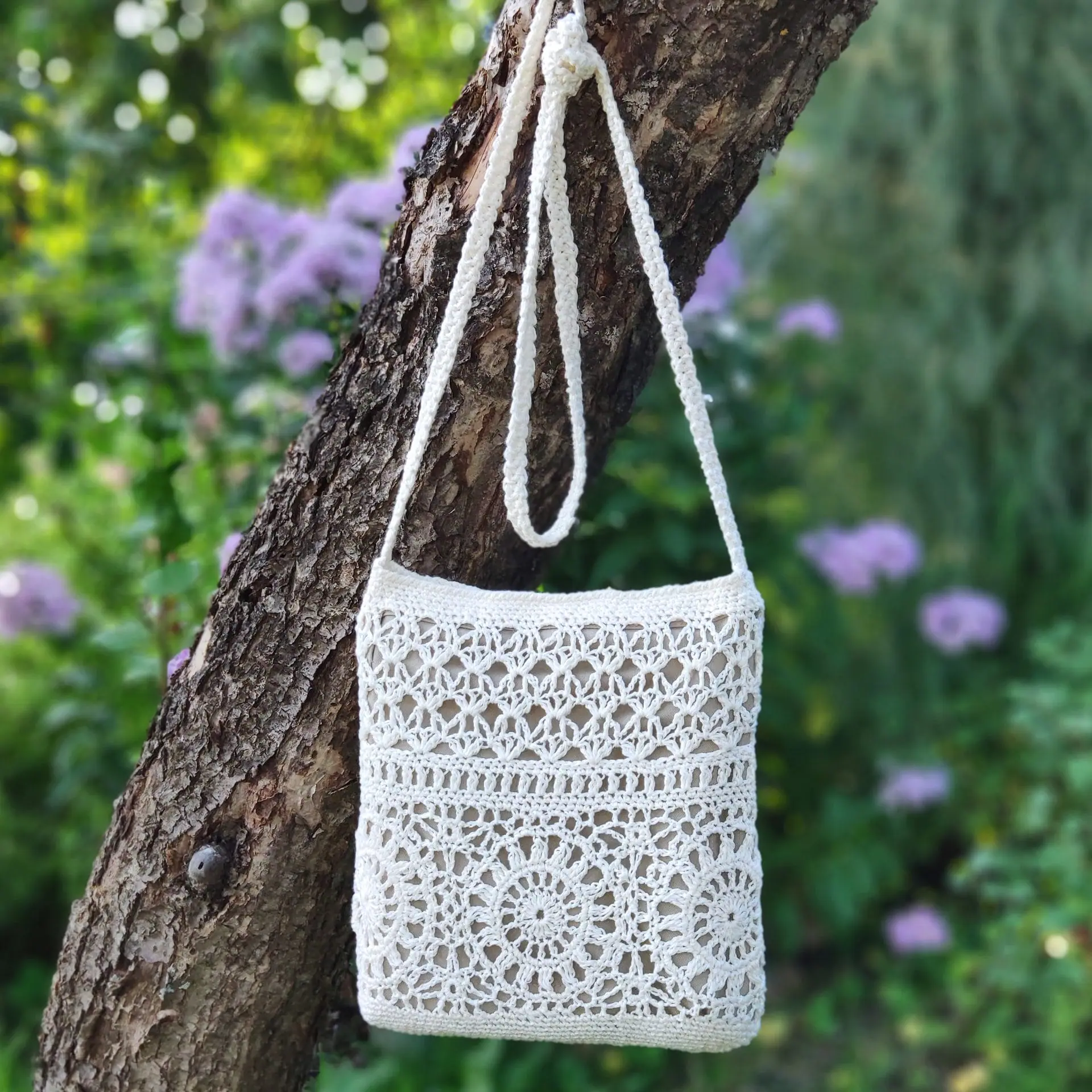
    Crochet summer small bag pattern Crochet handmade tutorial
    A tassel is not decoration. It is a period at the end of a sentence. It says, “This bag is finished, and I am proud enough to add one more thing.” The tassel on your tote — ombre, matching the gradient, tied with a leather cord — moves when you walk. It catches the breeze. It draws the eye downward, elongating the silhouette, making the bag look taller and more expensive than it is.
    Here is the practical magic: tassels take 10 minutes to make and add $20 to the perceived value. They are the cosmetic surgery of crochet accessories — minimal effort, maximum impact.
    How to make a professional tassel:
    1. Wrap yarn around a 4-inch piece of cardboard 30 times.
    2. Slide a separate 12-inch strand under the wraps and tie tightly at the top.
    3. Cut the bottom loops.
    4. Wrap another strand around the neck (1 inch below the top tie) 5 times. Knot. Hide ends inside.
    5. Attach to the bag with a jump ring (jewelry finding, $3 for 50 pieces) threaded through a reinforced stitch.
    The leather tag: If your bag has a “Handmade with Love” or “Download PDF” tag, attach it with a small brass screw post through a reinforced square of faux leather on the inside. Do not just sew it to the crochet — the weight will pull the stitches out. Create a leather sandwich: faux leather on the inside, crochet in the middle, tag on the outside, held together by the screw post.

    Part IV: From PDF to Shoulder — The Pattern Economy

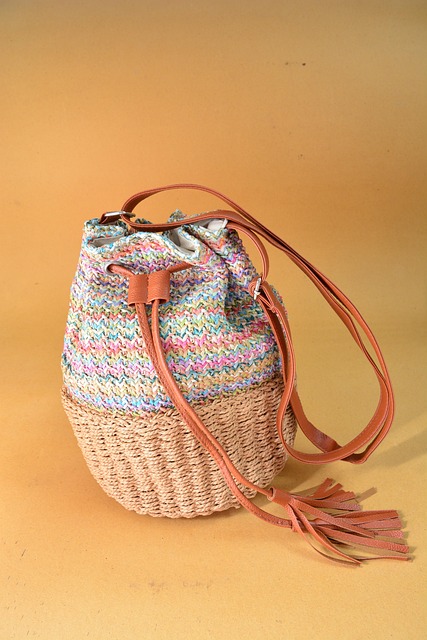
    Pastel striped crochet bucket bag with leather tassel straps on yellow background — handmade boho purse with woven texture
    This is where logic bends into entrepreneurship. You bought the PDF once. You made the bag. Your friend saw it. Your friend wants one. You have the PDF. You have the yarn. You have the Netflix subscription.
    The pattern economy works like this: one PDF = infinite bags. Unlike a physical book that wears out, a digital pattern is immortal. You can make the tote in pink for spring, in black for winter, in mustard for fall. You can make a mini version for your niece. You can omit the bottom panel and turn it into a pillowcase. The PDF is not a recipe for one meal. It is a cooking class.
    Sizing variations from one pattern:
    • Mini: Stop after Row 20. Add a zipper. Crossbody bag.
    • Maxi: Add 10 rows to the body and 4 rows to the depth. Market tote.
    • Clutch: Work only the front panel, fold in half, add a magnetic snap. Evening bag.
    Time investment: A color-blocked tote takes 6–8 hours for a confident beginner. That is two movies, one podcast series, or four episodes of a reality show you will not admit to watching. The bag outlasts all of them.

    The 5 Mistakes That Ruin a Boutique-Style Tote

    1. Skipping the gauge swatch
    If the pattern says 16 stitches = 4 inches and yours is 14 stitches = 4 inches, your bag will be a bucket. Not a tote. A bucket. Swatch. Block. Measure. Then proceed.
    2. Using the wrong yarn
    Worsted-weight cotton is non-negotiable for structure. DK will drape like a dress. Bulky will look like a dog bed. Sport weight will require a lining so thick it defeats the purpose.
    3. No bottom reinforcement
    A crochet tote without a base is a black hole. Cut a piece of plastic canvas or foam board to the bag’s bottom dimensions. Cover in fabric. Slip inside. Your bag will stand upright. Your dignity will remain intact.
    4. Loose handles
    Crocheted straps stretch. It is physics. It is destiny. Reinforce them with a fabric tube inside or use purchased leather/cotton webbing handles attached with metal hardware.
    5. Forgetting the lining
    Unlined crochet bags eat your keys, your lip balm, and your patience. A simple cotton muslin lining with a slip pocket takes 30 minutes and elevates the bag from “homemade” to “artisan.”

    Epilogue: Carry the Curriculum

    So here is the truth, delivered with the gentleness of pastel yarn against a marble table:
    You do not need another black bag from a factory. You need a bag that tells a story — about the evening you learned front post double crochet, about the podcast that made you laugh so hard you dropped a stitch, about the QR code that turned a Tuesday into a talent.
    Download the PDF. Buy the yarn in colors that make no logical sense together but somehow sing. Make the tassel. Attach the tag. Carry it to the farmers’ market. Carry it to the coffee shop. Carry it like the diploma it is.
    Because the crochet tote that carries your whole aesthetic is not an accessory. It is a transcript of your patience.
    Now grab your hook. The gradient is waiting.

    Happy crocheting.
  • The Crochet Slippers That Make Your Feet Feel Loved

    The Crochet Slippers That Make Your Feet Feel Loved

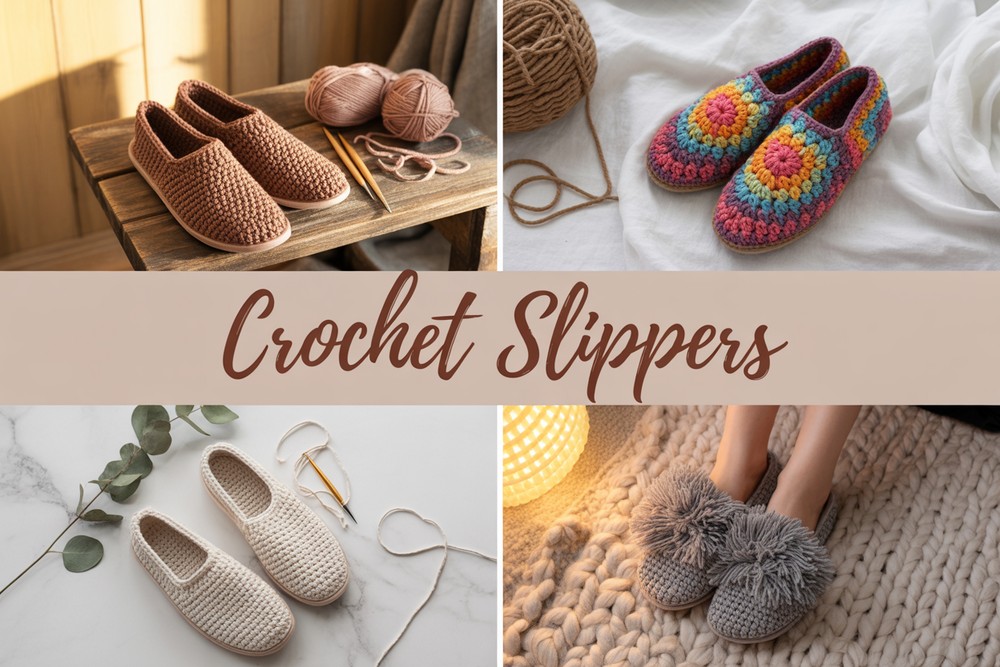
    Two handmade crochet slipper styles on wooden table — rainbow granny square slippers and textured blue-gray cable knit slippers with yarn balls You do not put on these slippers.

    You slip into a decision. A decision that the floor is no longer allowed to be cold. That your toes deserve a hug. That the 47 steps between your bed and the coffee maker should feel like walking on a cloud made of good intentions.
    Welcome to the only footwear that understands you are not going anywhere — and celebrates it.

    Part I: The Rainbow Is a Threat (to Bad Moods)

    Look at them. A granny square exploded into footwear. Red, orange, yellow, green, blue, purple — all the colors of a weather phenomenon, compressed into something that fits under your jeans.
    Here is the first paradox that breaks footwear logic: the louder the slipper, the quieter the morning. You wake up gray. The sky is gray. Your inbox is gray. And then — your feet are wearing a carnival. It is impossible to remain pessimistic when your toes are dressed like a pride parade. The rainbow slipper is not fashion. It is pharmaceutical fiber. It is a serotonin delivery system that happens to keep your soles warm.
    And the granny square? That is not just a pattern. That is geometry made by grandmothers. Each color change is a decision someone made while listening to a podcast, drinking tea, and refusing to rush. The center of the square is a mandala. The rounds radiate outward like ripples from a good decision. When you wear granny-square slippers, you are literally walking on someone’s patience — even if that someone was you, three Netflix episodes ago.
    The practical magic: granny squares are modular. You make two squares. You fold them. You seam the toe, the heel, the instep. That is it. No shaping. No increasing. No crying over a pattern that assumes you have a PhD in spatial reasoning. Two squares. Folded. Done. Your feet are now art galleries.

    Part II: The Texture Is a Secret Language

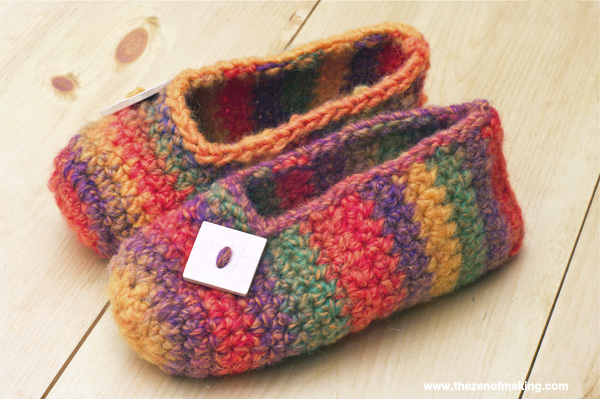
    Colorful rainbow striped crochet slippers with button detail on light wooden floor — handmade granny square house shoes
    Now, the other pair. Not rainbow. Not loud. But textured — deeply, satisfyingly textured — in shades of blue and gray that look like the ocean decided to knit itself a blanket for your feet.
    Here is the twist: this texture is not decoration. It is braille for the soul. When you run your thumb across the cables and bobbles, your nervous system receives a message it cannot translate into words. Something about safety. Something about being held. Something about the fact that your mother used to tuck you in, and now you are 34 and someone — maybe you — made you slippers that tuck in your feet.
    The cable stitch in crochet is a lie. It pretends to be complicated. It looks like it required a degree in textile engineering. But it is just front-post double crochet arranged in a sequence. You skip a stitch, you work around the post of the next, you go back and catch the skipped one. That is the entire secret. The slipper looks like it was made in an Irish cottage by a woman who has never heard of Wi-Fi. It was actually made in your living room while you watched a true-crime documentary.
    And the fit? Cable stitches have memory. They compress when you step, then expand when you lift. They learn your foot. After a week, these slippers do not just fit you — they recognize you. They are the closest thing to a footprint made of wool.

    Part III: The Yarn Is a Time Machine

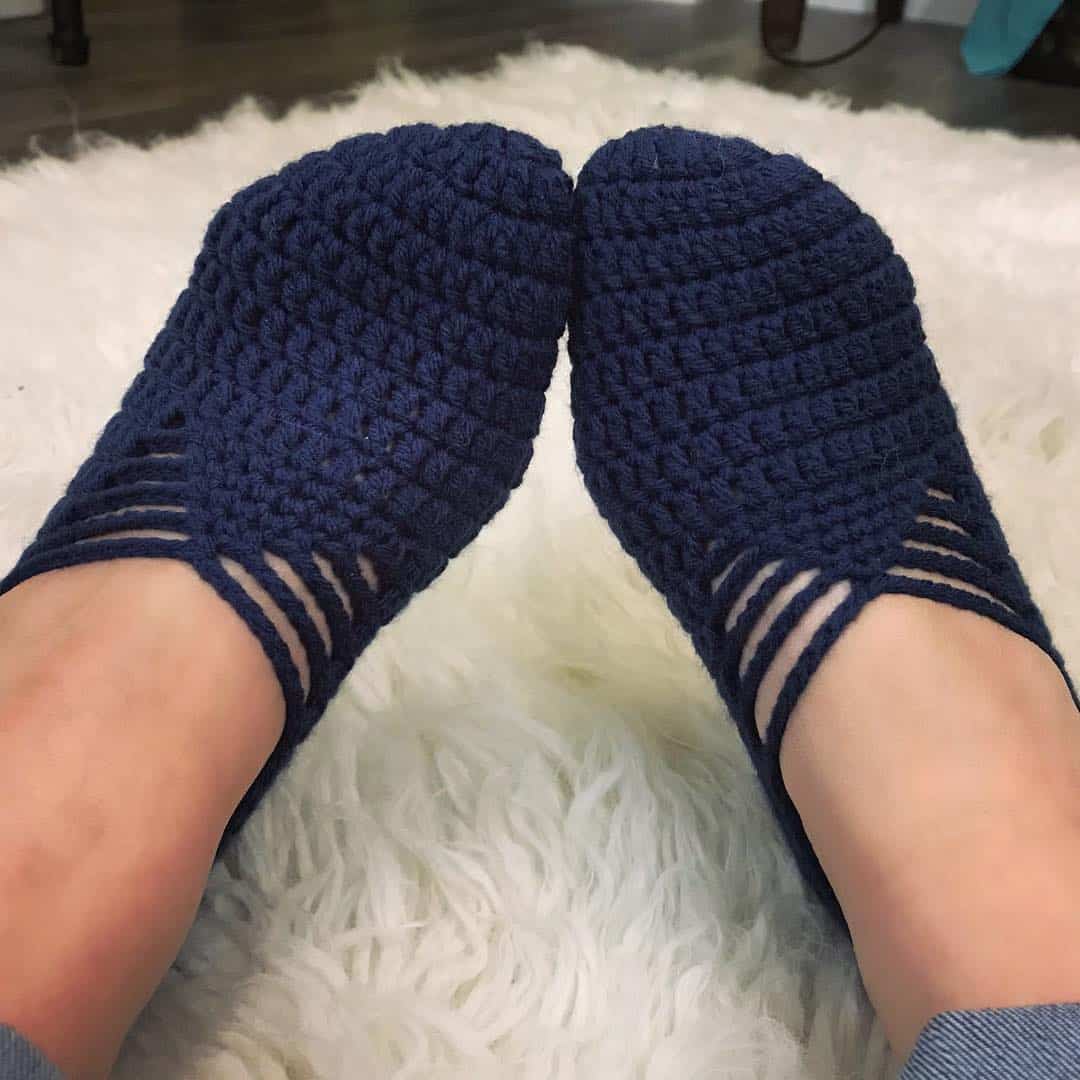
    Navy blue textured crochet ballet slippers on white fluffy rug — cozy handmade house shoes with cable knit pattern
    Look at the balls of yarn on the table. One is a rainbow swirl, still wound tight, still full of potential. The other is a variegated gray, half-used, trailing off like a sentence that does not need to end.
    Here is the megalogic that defeats fast fashion: yarn remembers. The rainbow ball remembers being a sheep, or a cotton plant, or a factory in Turkey — depending on its label. It remembers the dye bath. It remembers being wound. It remembers sitting in a craft store, waiting for someone brave enough to take it home.
    And when you crochet it into a slipper, you are not just making footwear. You are encoding time. The two hours it took to make the left slipper are now trapped in the stitches. They cannot be deleted. They cannot be optimized. They exist, permanently, as warmth. Every time you put on that slipper, you are stepping into two hours of your own life that you chose to spend slowly, deliberately, with your hands instead of your thumbs.
    A store-bought slipper costs time at a factory you will never see. A crochet slipper costs time at your own kitchen table. The difference is: one is anonymous. The other is autobiographical.

    Part IV: The Sole Is a Philosophy

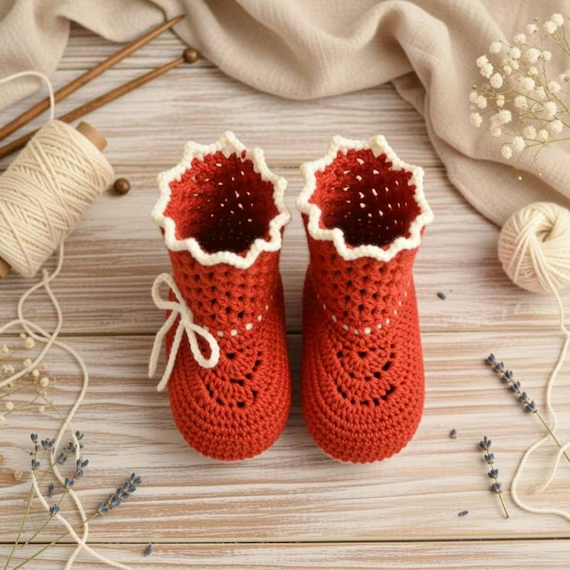
    Red crochet baby booties with white scalloped edges on wooden surface — handmade cozy footwear with yarn and lavender
    Now, look down. Your feet, inside these handmade vessels, touching the ground.
    Here is where logic completely dissolves. A crochet slipper has no sole — not really. It is just more yarn. It offers no arch support, no gel cushioning, no patented technology developed by NASA. And yet, people who wear them report feeling more grounded than in orthopedic inserts.
    Why? Because the ground is not the enemy. The cold floor is not attacking you. It is simply existing at a different temperature, and the crochet slipper mediates that conversation. It does not block the floor. It translates it. You still feel the wood grain. You still feel the tile’s coolness. But it is filtered through wool, through cotton, through the intention of someone who wanted your feet to be comfortable.
    And when the slipper finally wears thin — when the heel goes fuzzy and the toe goes transparent — you do not throw it away. You patch it. You add a new sole. You darn the hole. You extend its life because its life is intertwined with yours. You remember making it. You remember the movie that was on. You remember the cat sitting on the pattern.
    You are not wearing slippers. You are wearing a diary that walks.

    Epilogue: Choose Your Cozy

    So here is the truth, delivered with the gentleness of wool against morning-cold skin:
    You need these slippers. Not because your feet are cold — though they are. You need them because your soul is tired of speed. Tired of notifications. Tired of things that arrive in two days and break in two weeks.
    Make the rainbow pair. Make the textured pair. Make both, or make neither and simply buy them from someone who understood that the world needs more softness. But whatever you do, put them on. Stand up. Walk to the kitchen. Feel the floor through the filter of handmade patience.
    Your feet will thank you. Your morning will thank you. And the cold tiles will finally, mercifully, give up.

    Happy crocheting.
  • The Crochet Bag That Carries Summer by the Handles

    The Crochet Bag That Carries Summer by the Handles

     You do not buy this bag.

    You harvest it. You harvest the color of late August wheat. The curve of bamboo that grew faster than your to-do list. The texture of stitches that look like they were pressed into clay by someone who had nowhere else to be.
    This is not an accessory. This is a season in bag form. And the season is now.

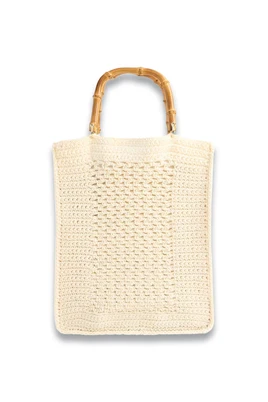
    Part I: Bamboo Handles Are a PhilosophyCream crochet tote bag with natural bamboo handles — minimalist handmade summer handbag on white background

    Look at the handles. Not leather. Not plastic. Not the cold aluminum of a thousand factory bags that all sigh the same sigh.
    Bamboo.
    Here is the first paradox: bamboo is technically a grass. It is not a tree. It does not grow rings or tell decades. It grows feet per day. It is the fastest-growing plant on earth, and yet — when you hold it — it feels ancient. Smooth. Warm. Slightly imperfect, with nodes that mark time the way a clock should: organically, unevenly, honestly.
    A plastic handle says: “I was molded in a mold.” A bamboo handle says: “I was a forest last year.” When you loop this bag over your arm, you are wearing evidence that speed and slowness can coexist. The bamboo grew in a hurry. The crochet took twelve hours. The bag is a treaty between them.
    And the weight distribution? Bamboo is hollow. It is light. It does not dig into your shoulder like a chain strap or a leather cord. It sits on your forearm like a bracelet made by a giant. You forget you are carrying anything — until someone stops you at the farmers’ market and asks where you got it.
    You smile. You say the four most satisfying words.

    Part II: The Texture Is a Lie Your Fingers Love

    Chunky neutral beige crochet bag with braided handles — textured handmade cotton tote in minimal style
    Now, the body. That raised, ridged pattern that looks like corduroy, like sand dunes, like the spine of a book you have not read yet.
    Here is the twist: this texture is functional deception. It looks heavy. It looks like it required industrial machinery and a patent. But it is just yarn. Cotton yarn, probably, or a cotton-linen blend, worked in front-post double crochet that pushes the stitches forward like bread rising.
    The ridges create shadows. In morning light, the bag looks carved. In afternoon light, it looks quilted. In evening light, it becomes a landscape of tiny valleys that your fingers cannot stop exploring. You will find yourself running your thumb across it while waiting in line, while talking on the phone, while pretending to listen to a podcast. It is tactile ASMR you can carry.
    But deeper than that: the texture hides wear. A smooth leather bag shows every scratch like a confession. This bag? A snag becomes part of the topography. A loose thread adds character. The texture is not just decoration. It is forgiveness made visible.
    You are not carrying a purse. You are carrying a geological formation that happens to hold your keys.

    Part III: Mustard Is the Color of Permission

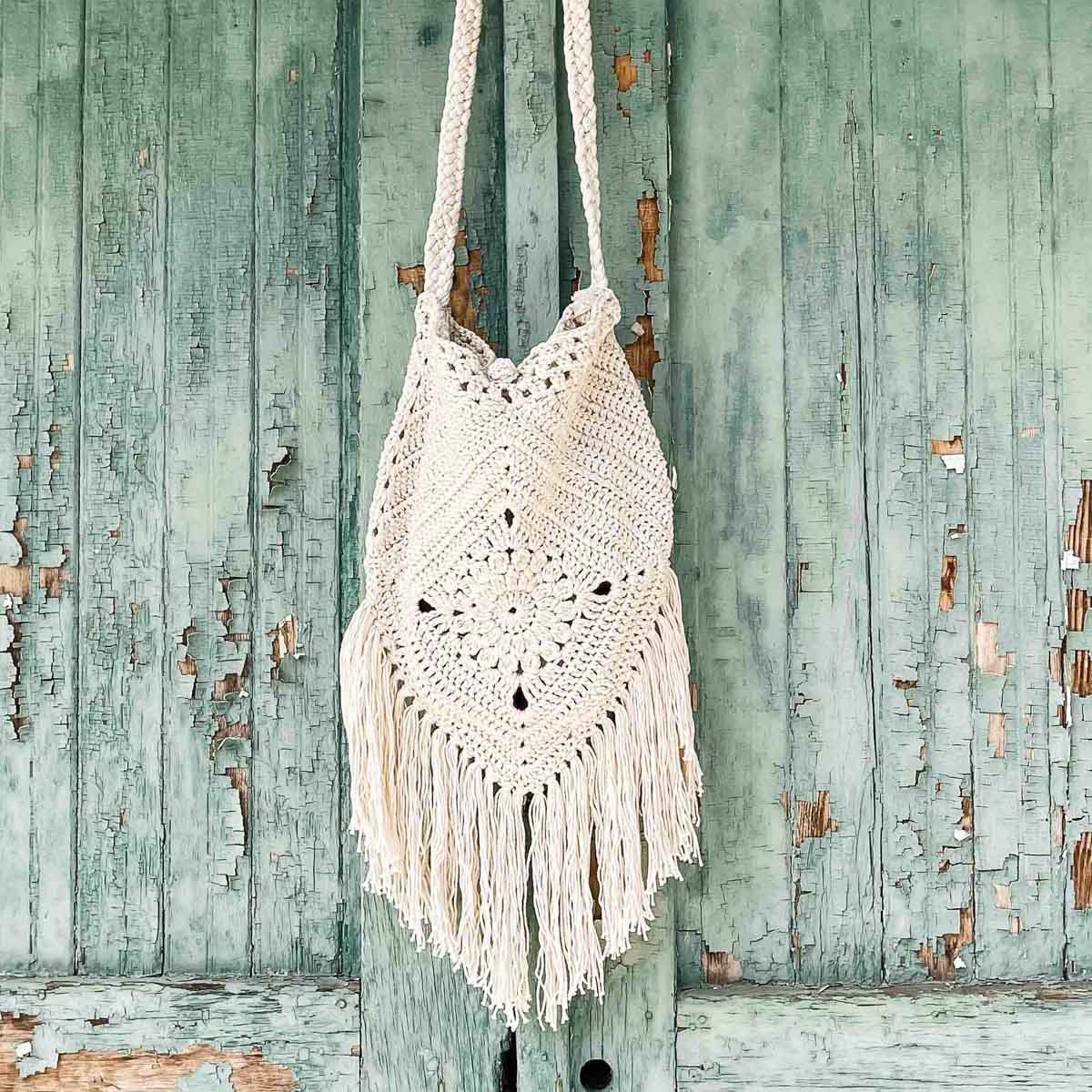
    White boho crochet bag with long fringe hanging on weathered turquoise wooden wall — handmade summer purse with tassels
    The color. Oh, the color.
    Not yellow. Yellow is a caution light, a sticky note, a child’s drawing. This is mustard. Olive-mustard. The color of Dijon in sunlight. The color of a field right before harvest. The color of “I am interesting but not trying to prove it.”
    Here is the megalogic that defeats the beige monopoly: mustard goes with everything you already own. With denim. With white. With black. With navy. With that floral dress you bought three summers ago and never knew what bag to pair it with. Mustard is not a statement color. It is a conversationalist color. It listens. It complements. It does not compete.
    And in crochet specifically, mustard has depth. The stitches catch light differently across the ridges, creating a gradient that factory dye cannot replicate. The top of a stitch is lighter. The shadow between stitches is darker. The bag is literally self-shading. It photographs like a painting. It ages like a spice — darker at the edges, richer in the center.
    You did not choose a color. You chose a mood that happens to be wearable.

    Part IV: The Bag That Gets Heavier (In the Best Way)

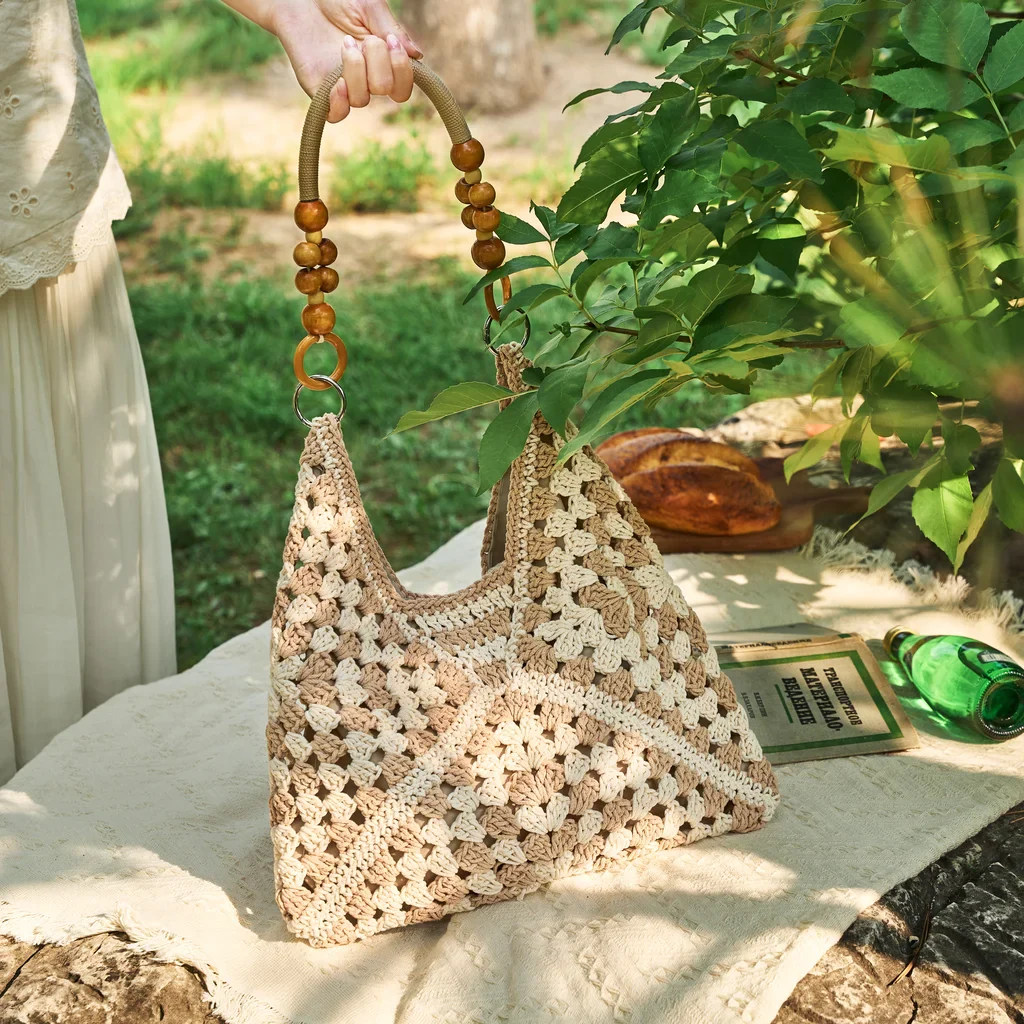
    Beige crochet bag with wooden bead handles on outdoor picnic blanket — handmade summer tote in garden setting
    A strange thing will happen to this bag over time.
    At first, it is empty. Light. A structure of air and cotton. But slowly — imperceptibly — it will fill with meaning. The ticket stub from the outdoor concert where it sat on the grass beside you. The pebble your niece gave you because it was “the color of your bag.” The lip balm you bought at a gas station in a town whose name you have already forgotten.
    The bag does not have pockets for these things. It has gravity. It attracts small memories the way a bamboo forest attracts mist.
    And because it is handmade — because someone (maybe you) looped every stitch while a kettle whistled and the world spun indifferently — the bag understands that carrying things is not just about weight. It is about witness. It was there. It held your sunscreen at the beach, your notebook at the café, your courage on the first date where you did not know what to wear.
    A factory bag holds objects. A crochet bag holds context.

    Epilogue: Carry the Season

    So here is the truth, delivered with the gentleness of bamboo on sun-warmed skin:
    Summer is not a date on a calendar. It is a frequency. And this bag — with its grass-grown handles, its ridged mustard landscape, its impossible lightness — is tuned to that frequency.
    Make it. Buy it. Inherit it from someone who understood that the best bags do not shout designer names. They whisper: “I was made slowly, with intention, and I will carry your season with the same care.”
    Now grab your hook. Or your wallet. Or simply your keys. The bag is waiting. And so is the sun.
    Happy crocheting.
    YOU MIGHT ALSO LOVE
  • The Yellow Crochet Set: Why Wearing Sunshine Requires Holes

    The Yellow Crochet Set: Why Wearing Sunshine Requires Holes

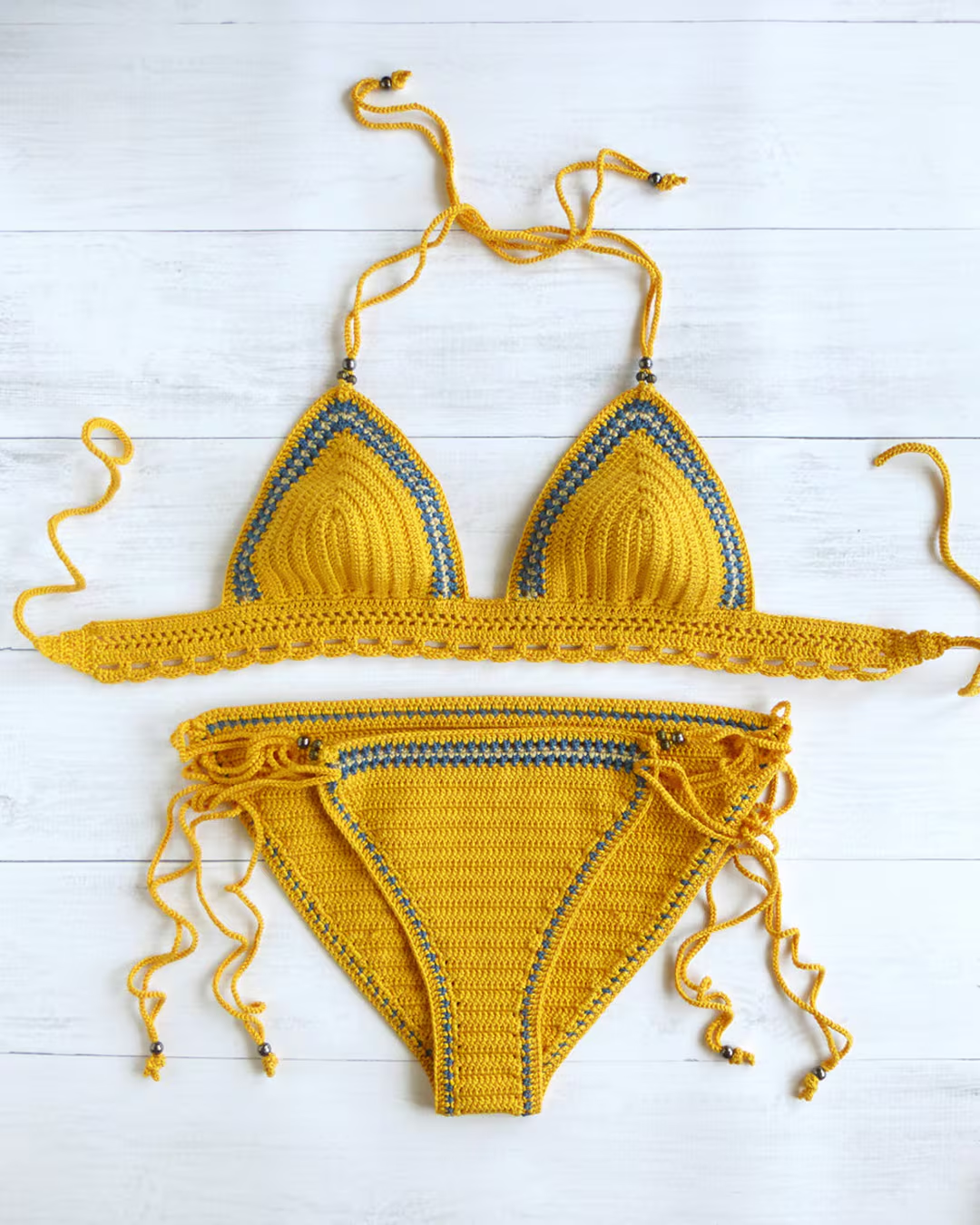
    Handmade yellow crochet bikini set laid flat on white wooden surface — mustard cotton two-piece with scalloped edges and tie straps You do not put on this outfit.

    You step into a conspiracy between fiber and physics. You agree to become visible. Not in the polite, Instagram-filtered way. I mean actually visible — the way a sunflower is visible to a bee from three gardens away. The way a traffic light is visible to someone who has not had coffee yet. The way joy is visible when it refuses to apologize for existing.
    Welcome to the yellow crochet two-piece. The garment that asks: What if confidence had a color?

    Part I: The Holes Are the Point

    Look at it. Mustard-bright, unapologetic, full of gaps that would make a tailor weep.
    Here is the first paradox that unravels fashion logic: coverage is not protection. A denim jacket covers you completely and weighs you down like a denim exoskeleton. A crochet set covers you selectively and somehow makes you feel more held. The holes are not defects. They are ventilation for the soul. They let the breeze in. They let the self out. They announce to the world: “I am here, and I am not interested in hiding.”
    Each open stitch is a tiny window. A window into the skin, yes, but also into the philosophy of the maker. Someone — a real person with real fingers, probably while listening to a podcast about true crime or sourdough — looped this cotton one stitch at a time. They chose the yellow. They chose the holes. They chose to make something that cannot be mass-produced because no machine has the patience to pause, adjust, and continue.
    The holes are not absence. They are intentional vulnerability. And vulnerability, it turns out, is the most magnetic thing you can wear.

    Part II: The Skirt Is a Mandala

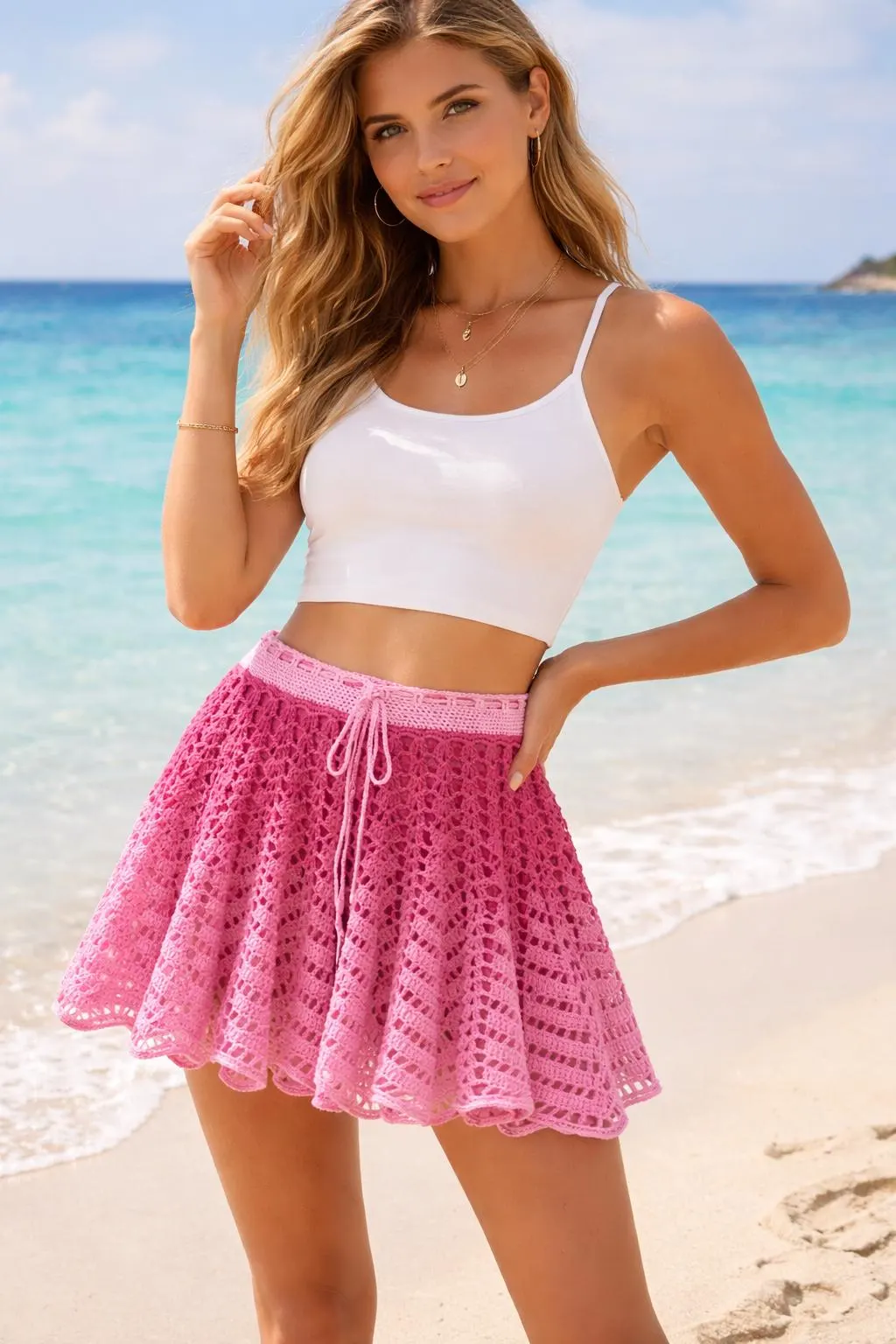
    Woman wearing pink crochet mini skirt on tropical beach — handmade cotton beachwear over white crop top with ocean background
    Now, the skirt. Flared. Circular. A geometry lesson in wearable form.
    A circle skirt is not just a shape — it is a philosophy of expansion. It starts at the waist, small and controlled, and grows outward with mathematical generosity. Row by row, the increases create waves. By the hem, the fabric is doing calisthenics. It spins. It floats. It creates a personal weather system of air and motion around your legs.
    But here is the twist: a crochet circle skirt is a fractal. Each round is a larger version of the one before it. The pattern repeats, but the scale changes. You are wearing a Mandelbrot set made of cotton. You are wearing the same logic that builds seashells and galaxies. And when you twirl — and you will twirl, because physics demands it — the skirt becomes a yellow hurricane, a personal sunspot, a vortex that pulls the attention of everyone in the farmers’ market.
    The flat-lay does not capture this. The flat-lay is a corpse. The skirt is alive only when it moves, when gravity and centrifugal force negotiate its shape in real time.
    You are not wearing a skirt. You are wearing a conversation between you and the air.

    Part III: The Top Is a Frame

    Woman in cream crochet two-piece set walking on sunset beach — handmade boho crop top and skirt with palm trees and golden hour light
    A two-piece set is not two garments. It is one statement, bisected by a waistline.
    The top — cropped, scalloped, perhaps with a bow at the center — does not cover the torso so much as curate it. It frames the collarbone like a museum piece. It draws a line under the bust and says, “Everything below this is skirt territory. Everything above this is sky.”
    And the bow. Let us discuss the bow. In a world of zippers and snaps and the violent efficiency of fasteners, a bow is a romantic anachronism. It says: “I could have been closed with Velcro, but I chose drama.” A bow requires two hands. A bow requires patience. A bow requires someone else — or yourself, in a mirror, performing a small daily ritual of self-tying.
    The scalloped edges? They are not decorative. They are soft geometry. A straight edge says factory. A scalloped edge says human hands were here. Each curve is a tiny rebellion against the tyranny of the straight line. The top does not end; it ripples to a conclusion.
    You are not wearing a crop top. You are wearing a frame for your own solar plexus. And it is glowing.

    Part IV: Yellow Is Not a Color — It Is a Frequency

    Model wearing colorful crochet bikini top and shorts against bright blue sky — handmade summer beachwear with shell detail and tie sides
    Now, the yellow. Oh, the yellow.
    Science tells us that yellow is the most visible color to the human eye. It sits in the spectrum at around 570 nanometers, screaming for attention while blue sulks in the corner and gray files its taxes. But this is not just any yellow. This is mustard crochet yellow — warm, earthy, slightly vintage, the exact shade of a 1970s kitchen and a sunflower having a baby.
    Here is the megalogic that breaks the color wheel: yellow does not reflect light. It generates it. A black dress absorbs photons like a velvet vampire. A white dress reflects them politely. But a yellow crochet set? It seems to produce its own luminescence. It glows in shade. It hums in sunlight. It turns overcast Tuesday afternoons into personal music videos.
    And when you wear it to the beach — because this is where this set was born to live — something alchemical happens. The yellow against blue water. The crochet against bare skin. The handmade against the infinite. You become a color correction for a world that has forgotten how bright it can be.
    You are not wearing yellow. You are wearing the visible spectrum’s best argument for optimism.

    Epilogue: The Outfit That Makes You Brave

    So here is the truth, delivered with the gentleness of cotton against sun-warmed skin:
    You will hesitate before wearing this. You will hold it up in the mirror and think, “Is this too much?” The answer is yes. It is absolutely too much. That is the entire point.
    We live in an era of beige safety. Of algorithmic fashion. Of outfits designed to offend no one and inspire no one. The yellow crochet two-piece is the antidote. It is handmade. It is loud. It has holes where society says there should be walls. It spins. It glows. It demands to be seen.
    And when you finally put it on — when you tie the bow, when you step into the skirt, when you walk into the light — you will feel something shift. Not in the fabric. In you.
    You will feel brave. Because you chose to wear sunshine. And sunshine does not ask for permission.
    Now grab your hook. Or your credit card. Or simply your courage. The yellow is waiting. And so is the world.
    Happy crocheting.
  • Crochet Bags You’ll Want to Make This Fall

    Crochet Bags You’ll Want to Make This Fall

    Crochet Sunflower Pattern Tote Bag You do not need another bag.

    What you need is a portable autumn. A vessel that carries not just your keys and lip balm, but the entire philosophy of October — crisp edges, warm layers, and the quiet refusal to rush. You need something that holds your groceries and your grief with equal tenderness. You need a crochet bag.
    And not just any crochet bag. You need the one that makes strangers stop you on leaf-strewn sidewalks and ask, “Where did you get that?” so you can smile and say the four most addictive words in the English language: “I made it myself.”
    Welcome to the season of loops.

    Part I: The Bag That Harvests Light

    Look at this. Sunflowers frozen in wool. A tote that looks like it grew in a field instead of on a hook.
    Here is the first paradox: fall is a season of dying. Leaves surrender. Days shorten. The world pulls inward. And yet — we crave color more than ever. We do not want beige bags in October. We want gold, amber, rust, the exact yellow of a sunflower refusing to bow to frost.
    The granny-square bag understands this. Each square is a stained-glass window. Each join is a conversation between colors. When you carry a sunflower tote through a pumpkin patch, you are not accessorizing. You are echoing the landscape. The bag does not compete with autumn; it collaborates with it.
    And the logic that breaks retail: a bag this beautiful costs less than a latte in materials. One skein of mustard, one of cream, a few hours of your evening while the rain hits the window and something simmers on the stove. You are not crafting. You are harvesting joy with a hook.

    Part II: The Geometry of Empty Space

    Crochet Bag Pictures | Download
    Now, this. A bag made of holes.
    At first glance, it makes no sense. A bag with gaps. A container that leaks. A purse that confesses: “I cannot hold everything.”
    But that is exactly why it works.
    Fall is the season of strategic shedding. We let go of summer’s weight — the expectations, the SPF 50, the relentless pressure to be outdoors and radiant. We pare down. We choose layers that breathe. And this mesh bag? It breathes. It carries your essentials and nothing more. It forces you to ask: What do I actually need today?
    The holes are not a flaw. They are editorial decisions. The bag edits your life in real time. A wallet. A phone. A single perfect apple from the farmer’s market. The mesh bag says: “You have enough.” In a world designed to make you want more, a crochet bag that literally cannot hold excess is a radical act of minimalism.
    Plus — and here is the secret — the holes catch light. In the low, golden angles of October sun, this bag casts lace shadows on the sidewalk. You are not carrying a purse. You are carrying a sundial made of yarn.

    Part III: The Bag That Remembers

    Crochet Sunflower Pattern Tote Bag
    Two bags, side by side, resting in the grass like they have all the time in the world.
    Here is where logic bends into nostalgia. A store-bought bag has no memory. It was assembled by a machine that does not dream, shipped across an ocean it will never see, and sold to you with a price tag that includes someone else’s overtime.
    But a crochet bag? It remembers.
    It remembers the movie you were half-watching while your fingers found the rhythm. It remembers the tea that went cold because you were counting stitches. It remembers the moment you realized you had made a mistake ten rows back and chose — gloriously, humanly — to keep going anyway.
    The small bag with the embroidered flowers? That was the weekend your niece visited and asked what you were making. The larger one? That was the week you needed something to do with your hands because your mind would not stop spinning.
    You do not carry these bags. You carry time made tangible. Every loop is a timestamp. Every color choice is a mood ring. When you set your crochet bag on a café table, you are placing evidence that patience is still possible, that creation is still accessible, that you can still make something from nothing but string and stubbornness.

    Part IV: The Bag That Is Not Finished

    Crochet Bag Pictures | Download
    Two balls of yarn. A half-formed base. A leather label waiting to be claimed.
    This is the most honest photo of all. Because a crochet bag, like autumn itself, is always in process.
    Fall is not a destination. It is a transition. We do not arrive at October; we pass through it. And the bag on your hook right now? It is the same. It is becoming. The tension is imperfect. The edges are learning. The yarn is still deciding what it wants to be.
    That is the megalogic that defeats fast fashion: the making is the point. The finished bag is lovely, yes. But the half-finished bag — the one sitting in your project bag while you ride the train, while you wait for soup to boil, while you ignore a text you do not have the energy to answer — that bag is saving you. It is giving your hands a purpose and your mind a silence.
    And when it is done? When the last end is woven in and the leather tag is stitched on? You will carry it through orchards and bookstores and streets that smell like woodsmoke. You will fill it with pinecones and poetry and the small treasures fall leaves behind. And every time you reach inside, you will touch the stitches and remember: you built this. You built something that holds your life.

    Epilogue: Make the Big, Keep the Season

    So here is the truth, delivered with the gentleness of yarn slipping through fingers:
    Fall will end. The sunflowers will bow. The leaves will finish their performance and the world will turn toward winter. But the bag you make this October will outlast the season. It will carry you into November, into December, into the gray days when you need a reminder that you are still capable of color.
    Make the sunflower tote. Make the mesh market bag. Make the tiny crossbody that holds nothing but your courage. Make them all, or make just one. But make something.
    Because the crochet bag you’ll want to make this fall is not about fall at all. It is about proving to yourself that you can still create warmth — even as the world grows cold.
    Now grab your hook. The yarn is waiting. And so is the season.
    Happy crocheting. 🍂
  • Unlimited Crochet Patterns (Stop Buying Them One by One)

    Unlimited Crochet Patterns (Stop Buying Them One by One)


    Hands crocheting orange yarn - close up of crochet vest stitches in progress

    Unlimited Crochet Patterns (Stop Buying Them One by One)

    Looking for unlimited crochet patterns — including bags, amigurumi, home decor and more?

    I use Creative Fabrica All Access.

    It gives you unlimited downloads + a commercial license, so you can sell what you make.

    → Get All Access here

    Instead of buying patterns one by one, you can download as many as you want. New patterns are added regularly.

    If you crochet often, this is one of the most convenient and affordable options.

    Click the link above and start downloading today.