What if luxury had less to do with what something costs—and more to do with what went into making it?
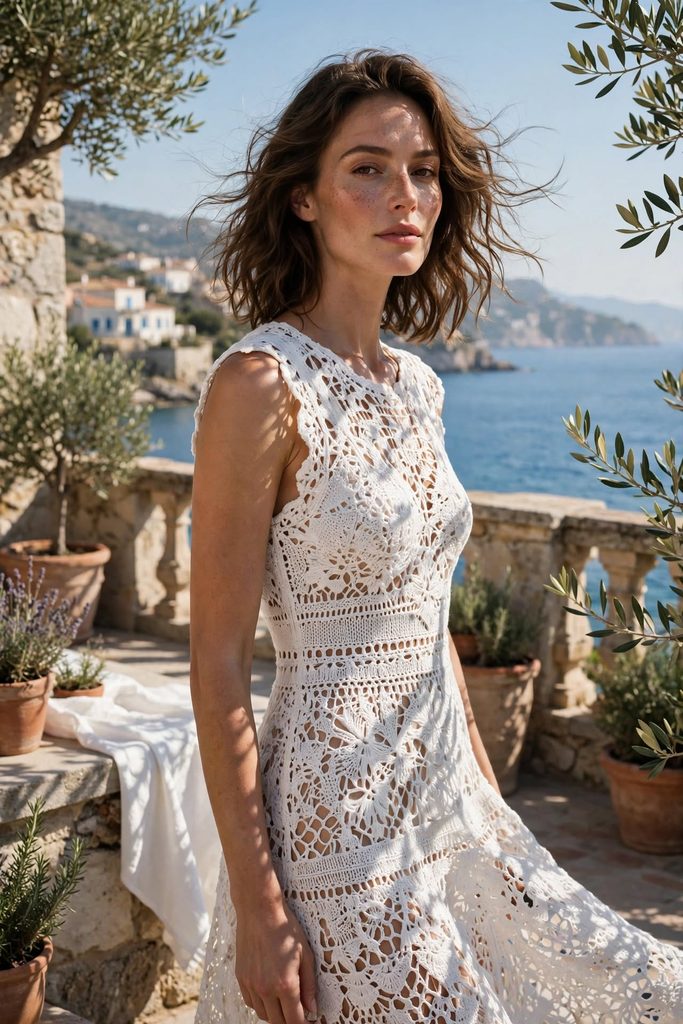
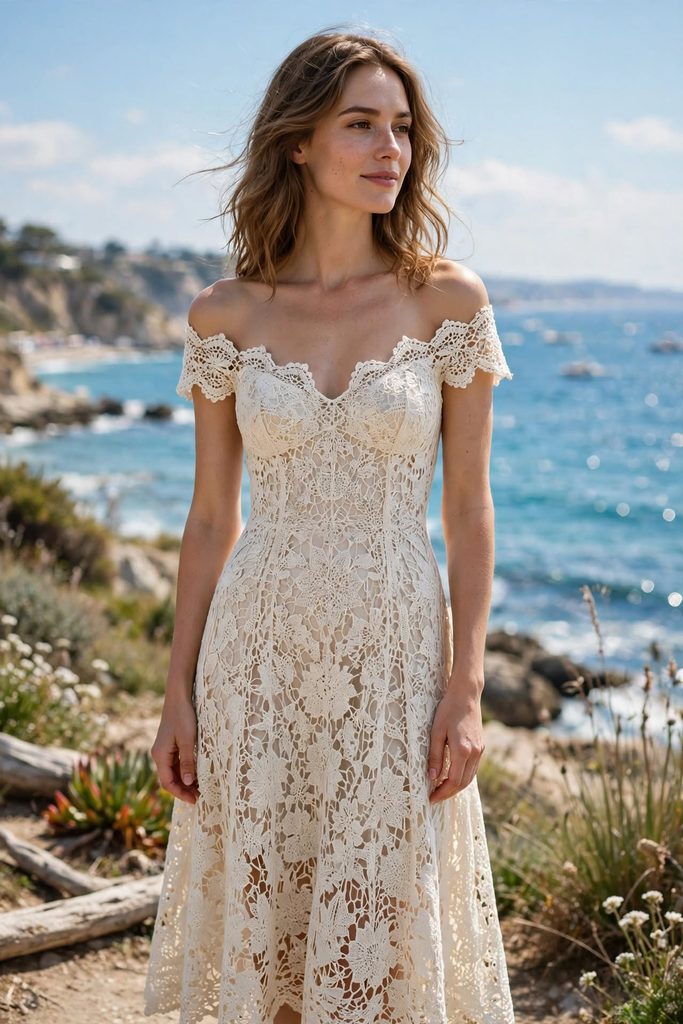
Imagine a white crochet dress on a Mediterranean terrace. The sea breeze moves through its open stitches. Sunlight catches the delicate pattern, creating little shadows across the fabric. There is no visible logo, no dramatic embellishment, no obvious sign of a designer label.
Yet the dress feels special.
Not necessarily because it costs more than a designer garment. Not because handmade clothing is always superior. But because crochet brings together qualities we often associate with luxury: texture, craftsmanship, thoughtful detail, and a sense of individuality.
In a world full of familiar silhouettes and rapidly changing trends, a well-made crochet piece can feel refreshingly personal. It can make an everyday outfit more expressive and remind us that clothing can be appreciated for more than its label.
And perhaps that is the most interesting kind of luxury: something chosen because you genuinely love it, not because its price tells you what to think.
The Paradox of the Price Tag
Walk into a luxury boutique and you will find carefully arranged displays, beautiful materials, precise finishing, and labels with recognizable histories. Price is part of the experience. So are the atmosphere, the presentation, and the expectations attached to the brand.
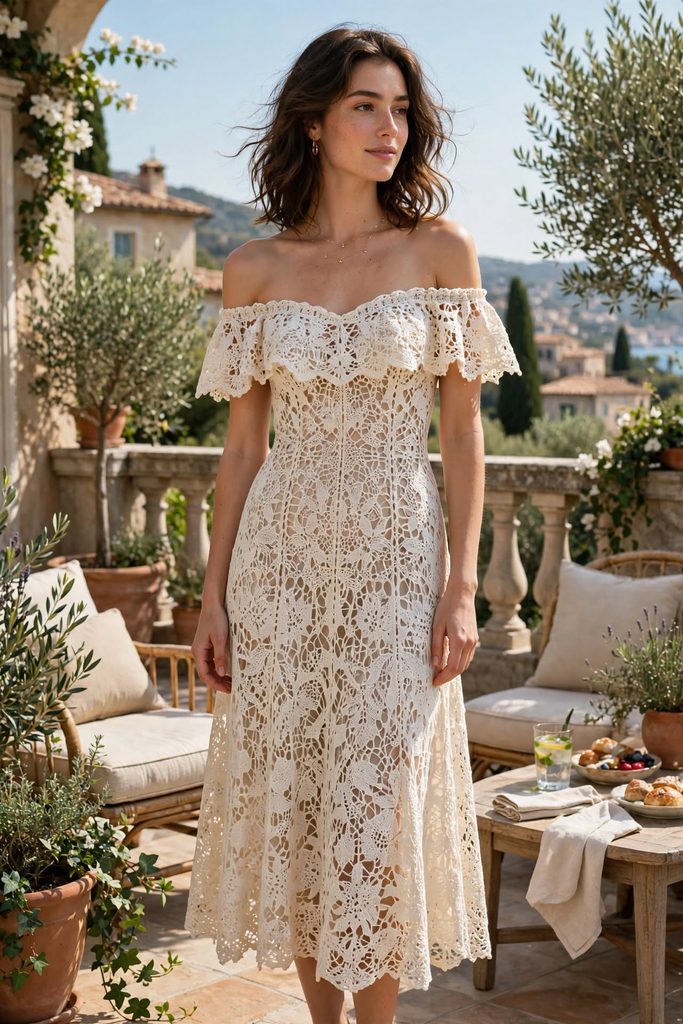
Now imagine a woman wearing a simple ivory crochet dress with delicate lacework, understated sandals, and a woven bag. The dress has no prominent logo. Its appeal comes from its pattern, its silhouette, and the way the light moves through the stitches.
Both outfits can be luxurious in their own way. But they communicate different things.
Designer fashion may offer a distinctive design, carefully selected materials, a particular fit, or the pleasure of wearing a brand you admire. Handmade crochet offers a different attraction: visible construction and a tactile quality that can make the garment feel personal.
The price tag tells you what a garment costs. It cannot tell you the whole story of how beautiful, meaningful, or satisfying it will be to wear.
That distinction matters when building a wardrobe. A high price does not guarantee that a garment will suit you, and a modest price does not prevent a well-chosen piece from looking polished.
The most compelling outfits are often those in which the wearer, the garment, and the styling feel naturally connected.
Why Handmade Crochet Feels So Personal
Part of crochet’s appeal lies in the visibility of its construction.
In many garments, the fabric is the background. With crochet, the fabric can become the main attraction. You can follow the stitches, notice the pattern’s rhythm, and see how individual motifs or rows combine to create the finished shape.
This gives the garment a quality that goes beyond color or silhouette.
A simple crochet top can feel interesting because of its stitch pattern. A cardigan can become a statement piece through its texture and edging. A dress made from repeating motifs can create a visual rhythm that changes as the wearer moves.
These details invite a closer look without requiring elaborate decoration.
The Beauty of Visible Craftsmanship
Crochet makes the process of construction part of the finished design.
A shell stitch creates a different effect from a tight, compact stitch. Open lace produces a lighter, airier appearance than dense crochet. Scalloped borders, geometric motifs, and textured panels each bring their own character.
When these elements are thoughtfully combined, the result can feel distinctive even when the overall design is simple.
However, intricate work is not automatically better work. A beautiful crochet garment also needs sound construction, comfortable proportions, and secure finishing. The stitch pattern may attract attention, but the details determine whether the garment feels complete.
Look at the neckline, the joins between motifs, the hem, and any straps or closures. A well-finished piece should look intentional from more than one angle.
Individuality Without a Logo
Handmade crochet can also appeal to people who want their wardrobes to feel less predictable.
A particular color combination, a vintage-inspired motif, a custom fit, or an unusual silhouette can give a garment its own identity. If the piece is genuinely handmade, there may be small variations that distinguish it from another item.
Those variations can contribute to its character, but they are not proof of quality by themselves. The more important question is whether the design feels considered and the garment is well made.
The strongest handmade pieces combine personality with craftsmanship. They feel individual without looking unfinished.
The Invisible Labor Behind a Beautiful Garment
Crochet takes time. Even a relatively simple garment may require planning, repeated stitches, shaping, joining, and finishing. More elaborate designs can involve complex motifs or careful adjustments to achieve the intended fit.
That labor is part of what makes crochet meaningful to many makers and wearers.
When you look at a crochet dress, you are not seeing only the final pattern. You are seeing the result of a sequence of decisions: which yarn to use, how tightly to work the stitches, where to change the pattern, how to shape the garment, and how to finish the edges.
For someone who crochets, those decisions are familiar. For someone who does not, the finished piece can reveal just how much thought goes into creating a garment from thread.
Still, it is important to distinguish the time spent making something from its overall quality or monetary value. A labor-intensive piece may be beautifully made, but the result also depends on skill, materials, design, and construction.
Likewise, a factory-made garment can involve substantial design and technical expertise.
The value of handmade crochet is not that every other form of fashion lacks care. It is that the making process can be unusually visible—and that visibility gives the finished piece a special kind of appeal.
The Texture of Authenticity
Texture changes the way we experience clothing.
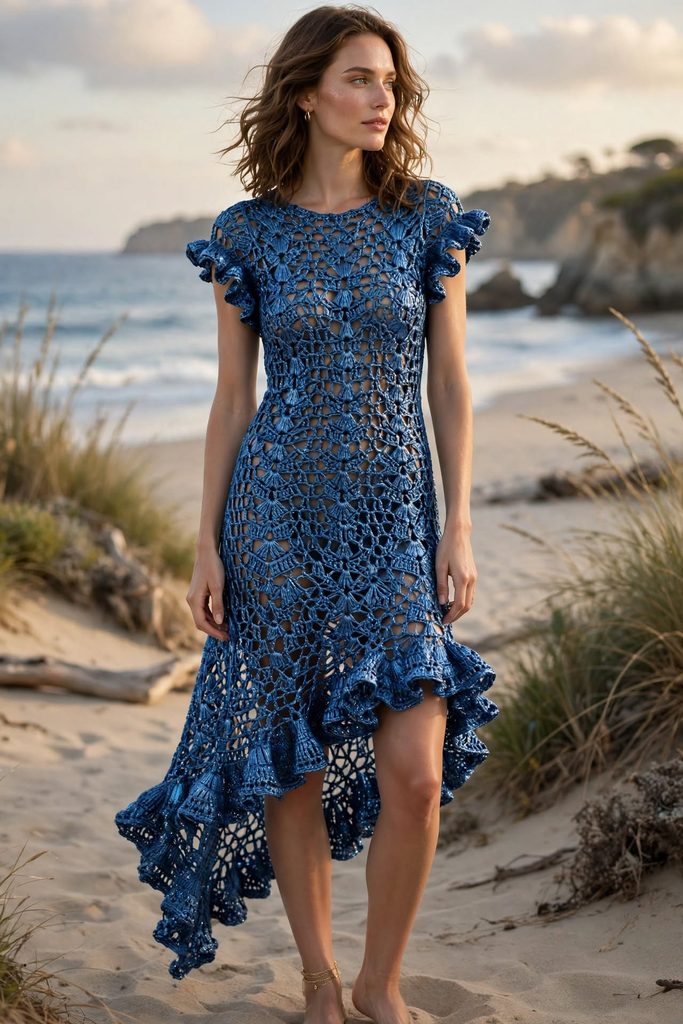
Silk can feel fluid and smooth. Linen often has a relaxed, slightly irregular surface. Denim provides structure. Crochet introduces raised stitches, open spaces, and patterns that create their own interplay of light and shadow.
None of these materials is inherently more luxurious than the others. Their effect depends on the quality of the fabric, the design, and how the garment is worn.
Crochet simply offers a particularly visible kind of texture.
The Appeal of Structured Transparency
The openings between crochet stitches are not merely decorative. They affect the garment’s appearance, coverage, and relationship with the body.
A delicate lace pattern can create a romantic effect. A bold geometric pattern may feel modern and graphic. A looser design can look relaxed and summery.
The layer underneath also matters. A tonal camisole or slip can create a more continuous appearance, while a contrasting layer can emphasize the pattern. The choice changes the visual effect, even when the crochet garment stays exactly the same.
For a polished result, consider where you intend to wear the piece and how much coverage you want. Check the outfit in natural light, especially if the crochet is open or lightweight.
The goal is not to hide the crochet’s character. It is to make the transparency feel intentional and comfortable.
When Contrast Makes the Outfit
Crochet often looks particularly effective alongside fabrics with different textures.
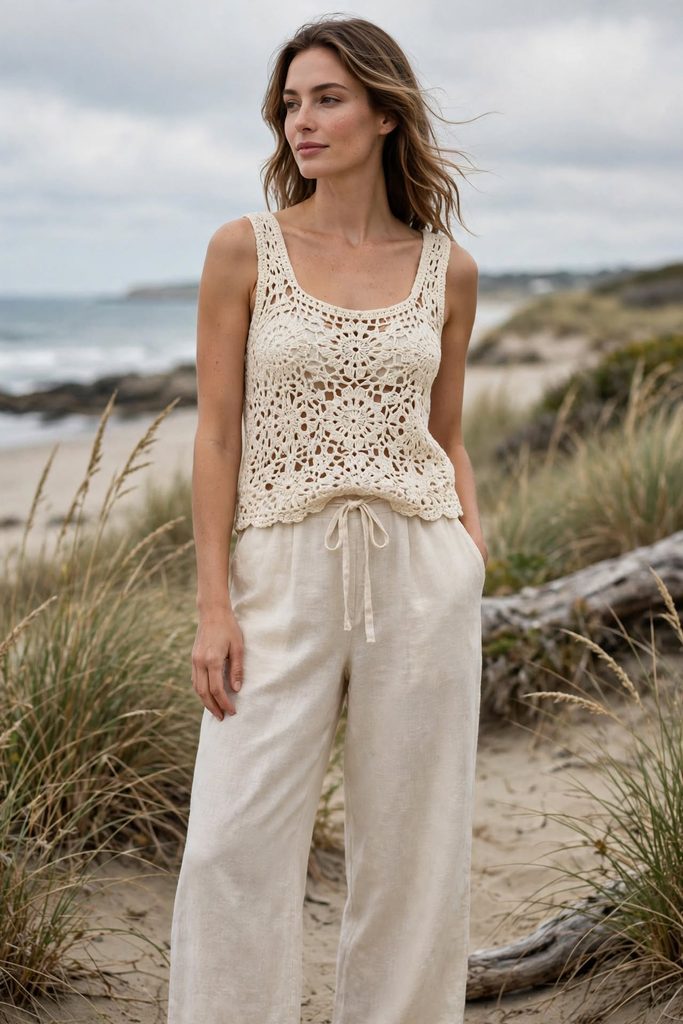
A crochet top paired with smooth, tailored trousers creates contrast between intricate stitches and clean lines. A crochet cardigan worn over a simple cotton tank gives the outfit depth without adding visual clutter. A crochet dress with minimal sandals lets the pattern remain the main feature.
The secret is balance.
If the crochet already has a complicated pattern, you may not need a busy print or several statement accessories. If the garment is simple, you can introduce more color or stronger shapes elsewhere.
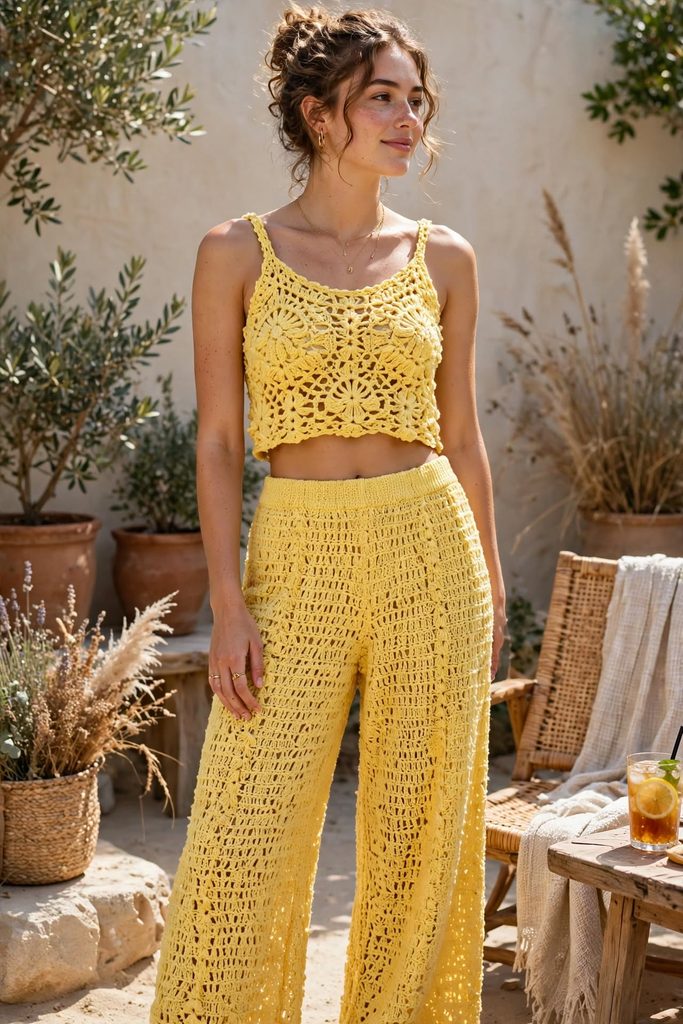
ALT: Yellow crochet two-piece outfit with a textured crop top and wide-leg trousers styled for a relaxed summer look.
Handmade Crochet and the Meaning of Slow Fashion
Crochet naturally invites us to think about time. A maker works through the pattern one stitch at a time, and the finished garment may represent hours of attention.
For some people, wearing handmade clothing is a way to feel closer to that process. For others, it is simply an opportunity to own something with a texture or design they cannot easily find elsewhere.
Either reason is enough.
Handmade crochet can fit into a slower approach to fashion when the garment is chosen carefully, worn regularly, and looked after. Making a piece yourself can also give you more control over its color, dimensions, and design.
But handmade does not automatically mean sustainable, and factory-made does not automatically mean disposable. Materials, production methods, durability, care, and how frequently a garment is worn all matter.
A crochet garment made from unsuitable yarn may stretch or deteriorate sooner than expected. A carefully constructed machine-made garment may remain useful for years. The production method is only one part of the story.
Choosing Pieces You Will Wear Again
Rather than buying crochet simply because it is fashionable, consider whether the piece fits your actual wardrobe.
Can you wear it with jeans you already own? Does it work with your favorite trousers or skirt? Is it comfortable enough for the occasions you have in mind? Can you care for it without difficulty?
A garment that suits your life is more likely to earn repeated wear than one that looks beautiful in a photograph but rarely leaves the wardrobe.
That is where the idea of slow fashion becomes practical. It is not about owning only handmade clothing or rejecting every trend. It is about choosing with intention and giving your clothes the opportunity to become lasting favorites.
How to Make Handmade Crochet Look Refined
You do not need an elaborate outfit to make crochet look special. A few thoughtful decisions can help the texture, shape, and craftsmanship stand out.
1. Start with the Fit
A beautiful stitch pattern cannot compensate for a garment that pulls in the wrong places, slips off the shoulders, or twists as you move.
Pay attention to the neckline, shoulder line, waist, and hem. If you are buying online, compare the garment measurements with a piece you already own that fits well.
For handmade garments, check whether the maker offers sizing adjustments or custom measurements.
2. Look for Thoughtful Finishing
Examine the seams, edges, joins, and closures. If the piece has straps, make sure they feel secure. If it is made from individual motifs, check how those motifs connect.
Finishing details may be less noticeable than the overall pattern in a photograph, but they can make a major difference to how the garment looks and wears.
3. Choose Materials for the Intended Use
Different yarns behave differently. Some create a soft drape, while others provide more structure. Some are easier to care for than others.
Think about the climate, the garment’s weight, and how often you plan to wear it. A light summer top has different needs from a heavy cardigan or a fitted dress.
Read the care instructions rather than assuming that all crochet garments should be washed or stored in the same way.
4. Let One Element Take the Lead
If you wear a detailed crochet top, try pairing it with simple trousers or jeans. If the dress is the focal point, choose accessories that support its shape and color.
This does not mean that crochet must always be styled with neutrals. A colorful crochet piece can work beautifully with other colors, provided the combination feels deliberate.
The aim is not minimalism for its own sake. It is a clear visual direction.
5. Treat Underlayers as Part of the Outfit
With openwork crochet, the layer underneath can change the entire appearance.
A matching layer may emphasize the garment’s silhouette, while a contrasting color can bring attention to the stitch pattern. Choose a combination that provides the coverage you want and works for the occasion.
Check the outfit in different lighting conditions before wearing it out, especially if the garment is particularly sheer.
6. Care for the Piece Properly
Follow the maker’s or manufacturer’s care guidance. Depending on the yarn and construction, crochet may need gentle washing, careful drying, or flat storage to help maintain its shape.
Avoid assuming that every garment can tolerate the same treatment. The correct care depends on its materials and how it has been constructed.
Good care cannot make every garment last forever, but it can help preserve a well-made piece for longer.
The Luxury of a Story
A garment can carry a story without needing to tell it loudly.
Perhaps you made the crochet top yourself, learning the pattern one evening at a time. Perhaps an independent maker created it in a color you had been searching for. Perhaps you found a vintage piece and gave it a new place in your wardrobe.
Or perhaps you simply loved the design the moment you saw it.
The meaning does not have to be dramatic. Sometimes, a garment becomes special because you reach for it again and again. It fits comfortably, works with the rest of your clothes, and makes you feel like yourself.
That kind of attachment is difficult to measure by price alone.
Designer clothing can also carry personal meaning. A carefully chosen luxury piece may represent an important occasion, exceptional design, or years of appreciation for a particular brand. Handmade and designer fashion do not have to compete for legitimacy.
They simply offer different ways to experience clothing.
Crochet’s distinctive contribution is the visibility of its pattern and the possibility of a close relationship between the maker, the material, and the wearer.
Your Handmade Manifesto
You do not have to choose between handmade fashion and designer clothing. You do not have to reject luxury labels to appreciate the beauty of a crochet garment.
Instead, look beyond the label.
Notice the texture. Examine the finishing. Consider how the garment fits, how it moves, and how it works with the pieces you already own. Appreciate the time and skill involved in making it, while remembering that craftsmanship can take many forms.
Choose crochet because you love its pattern, its character, or the way it transforms a familiar outfit. Wear it with jeans, linen, tailoring, or simple accessories. Let it be expressive without requiring it to prove anything.
And if you make crochet yourself, remember that the goal is not simply to finish a garment. It is to create something you will enjoy wearing.
True luxury does not have to mean the highest price, the rarest label, or the most elaborate design. Sometimes it means finding a piece that feels thoughtful, suits you beautifully, and earns a lasting place in your life.
May your wardrobe reflect what you love. May your favorite pieces be worn often. And may your style feel unmistakably yours—not because of what something costs, but because of what makes it worth wearing.