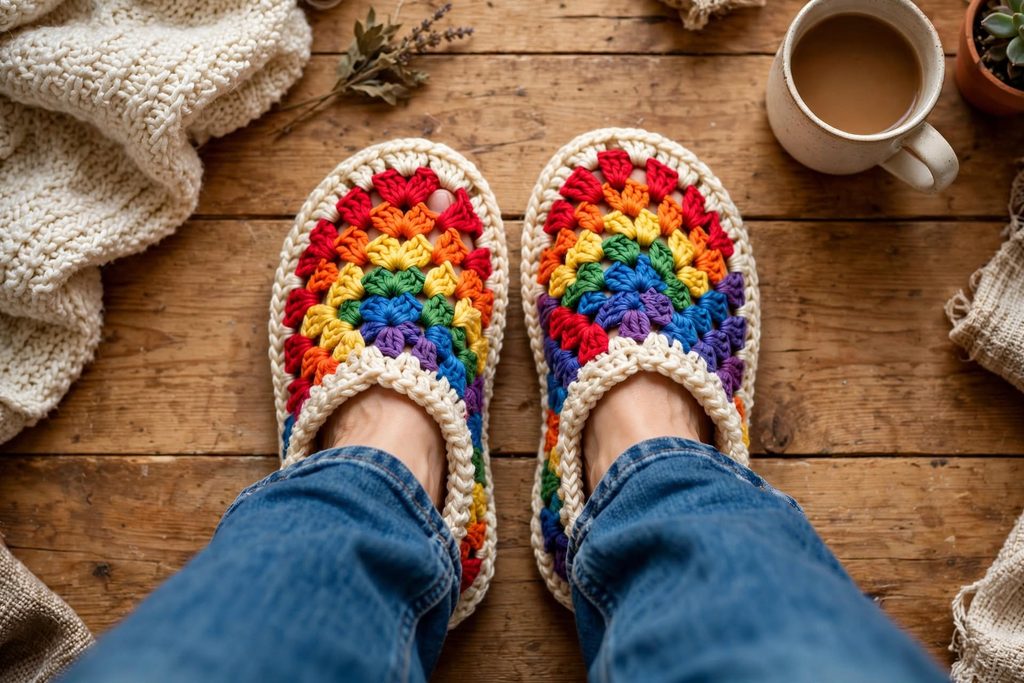
Multicolor granny square slippers worn with jeans — the classic look this article is about.
There is a moment every crocheter knows. You finish the last square, weave in the final tail, hold the pair up to the light — and it is perfect. A dozen tiny rainbow windows of yarn. The kind of object that makes guests ask, “Wait, you made these?”
Then you walk to the kitchen. And on step four, the left slipper executes a quiet betrayal: it slides off, sails under the stool, and leaves you standing on a cold tile like a heron in a draft.
I have been there. I have also made slippers that survived two winters of daily wear. The difference between those two pairs was never skill. It was engineering. Granny square slippers fail — or become beloved footwear — in exactly four places: the yarn, the sole, the heel, and the cuff. Understand those four decisions, and the prettiest squares of your life become the pair you reach for every cold morning.
Why Beautiful Slippers Betray You
Let me tell you about my first pair, because it died the way most of them die. Rainbow squares. Cream border. A pom-pom with more confidence than sense. The sole? One layer of double crochet. On hardwood, I could read the floor through my feet. After a couple of weeks, the bottom had felted into a grey pancake, and the ankle opening had stretched until the slippers fit like paper bags.
Here is the uncomfortable truth that pretty photos tend to skip: a granny square is a decoration. A slipper is a machine. A machine has load-bearing parts. If you build the decoration and skip the chassis, you have made house jewelry.
The good news: the chassis is simple, and none of it requires advanced skill.
Decision One: Choose a Yarn That Springs Back
Some fibers recover well after being squashed under a foot; others stretch out and stay that way. Wool and most wool-acrylic blends tend to hold their shape and spring back overnight. Pure cotton, in my experience, is the classic disappointment: it relaxes with wear and rarely returns to its original shape, which is why my first pair slowly turned into sad oven mitts.
A word of honesty, though: this is a tendency, not a law. Cotton varies a lot depending on how the yarn is spun and finished, acrylics differ enormously from brand to brand, and the only care instructions you can truly rely on are the ones on your ball band. The practical advice is simple:
- For warm, hard-wearing slippers, a worsted-weight wool or wool-acrylic blend is the most reliable starting point.
- Check the label before assuming machine washability — not every blend tolerates it.
- If you are making slippers for someone else, ask about wool sensitivity before committing.
Decision Two: Build the Sole in Layers
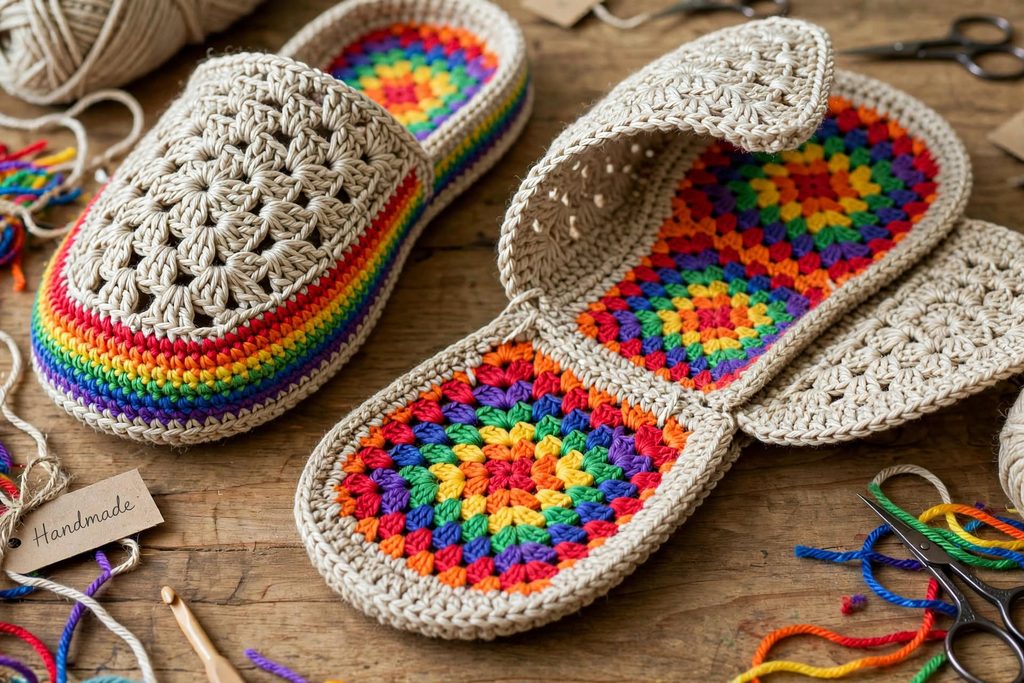
A single layer of crochet fabric is thin — dishcloth territory. For a foot that will meet hardwood, tile, or cold concrete all winter, that is not enough. The most common structural answer is a doubled sole: two sole layers worked separately — a sturdy outer and a softer inner — joined along the edge, with the upper worked through both layers so the cushion is built into the construction rather than glued in afterward.
How exactly this is done varies from pattern to pattern: some have you crochet two identical ovals and stitch them together, others fold one long oval double, others still attach the upper to a single sole and add a sewn-in insole later. All of these can work. What matters is that you are following a tested pattern with clear joining instructions, because the weak point of any layered sole is always the join. If the pattern you are using describes the sole construction vaguely, that is a red flag — comfort problems usually start there.
One optional upgrade deserves mention: a felt or fleece insole, cut slightly smaller than the inner sole and hand-sewn in place. It adds softness, absorbs moisture, and stops the crocheted fabric from felting against bare skin over time.
A pair of granny square slippers with a proper shaped footbed — the insole and sole are separate, deliberate parts of the construction.
Decision Three: The Cuff Is the Seatbelt
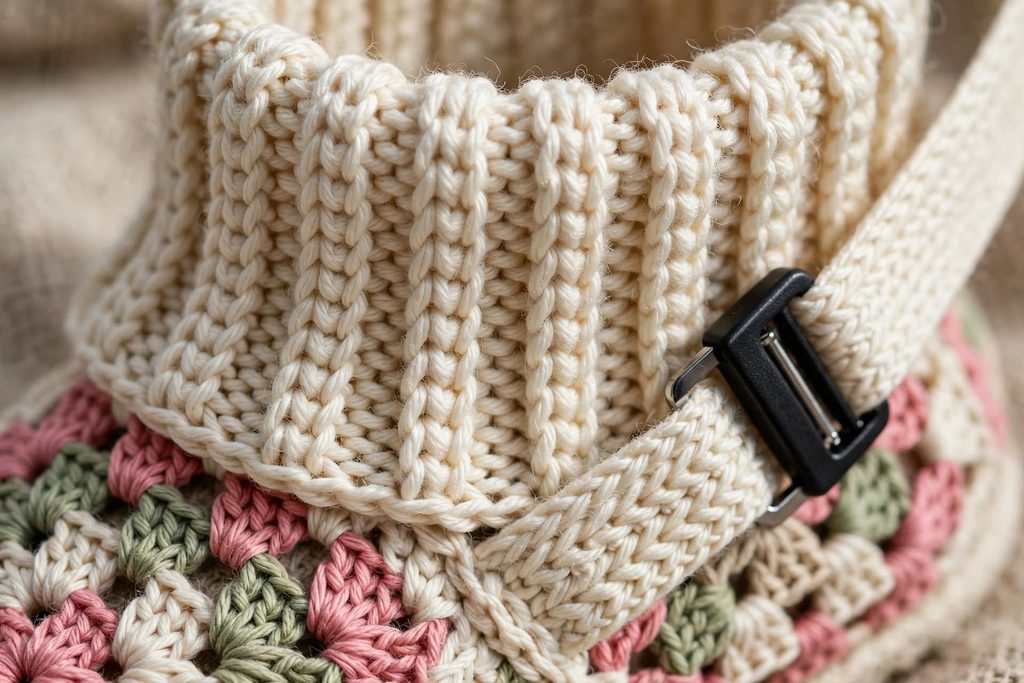
Physics is unkind to loose slippers. With every step, your heel lifts and the slipper lags a beat behind. The answer is not a tighter slipper — a too-tight slipper simply hurts. The answer is a cuff that stretches where it should and grips where it should.
The classic solution is ribbing worked in alternating front-post and back-post double crochet. The raised post stitches form vertical ribs with sideways stretch: the cuff hugs the ankle firmly without elastic, buttons, or drawstrings. Worked to a reasonable height — several rounds, not one — it behaves like a firm handshake: present, supportive, never crushing.
Think of it this way: the squares are the body of the slipper, the sole is its bones, and the cuff is the seatbelt. Nobody admires a car for its paint job and skips the seatbelts.
Decision Four: Shape the Heel Cup
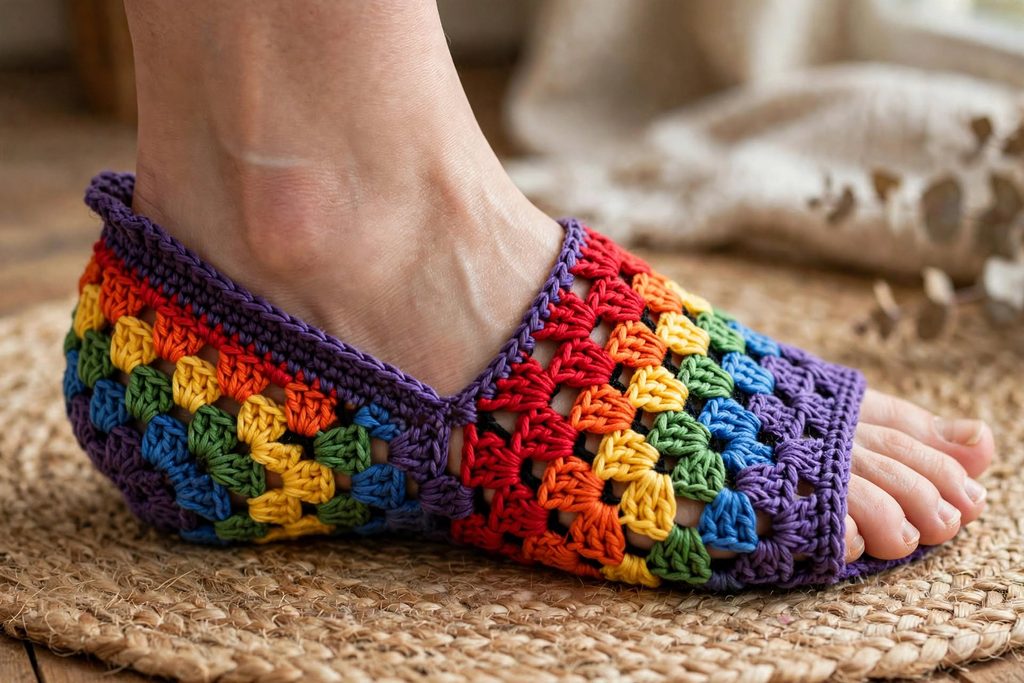
Where the upper meets the back of the sole, a few quiet decreases at each side of the heel opening — spaced out over several rounds — create a shallow heel cup. It looks like a minor detail. It is not. A flat, straight opening lets the foot slide backward with every step; a shaped cup cradles the heel and anchors the whole slipper. If your finished slipper gapes at the back, this is the first place to look.
Sizing: Measure the Foot, Not the Chart
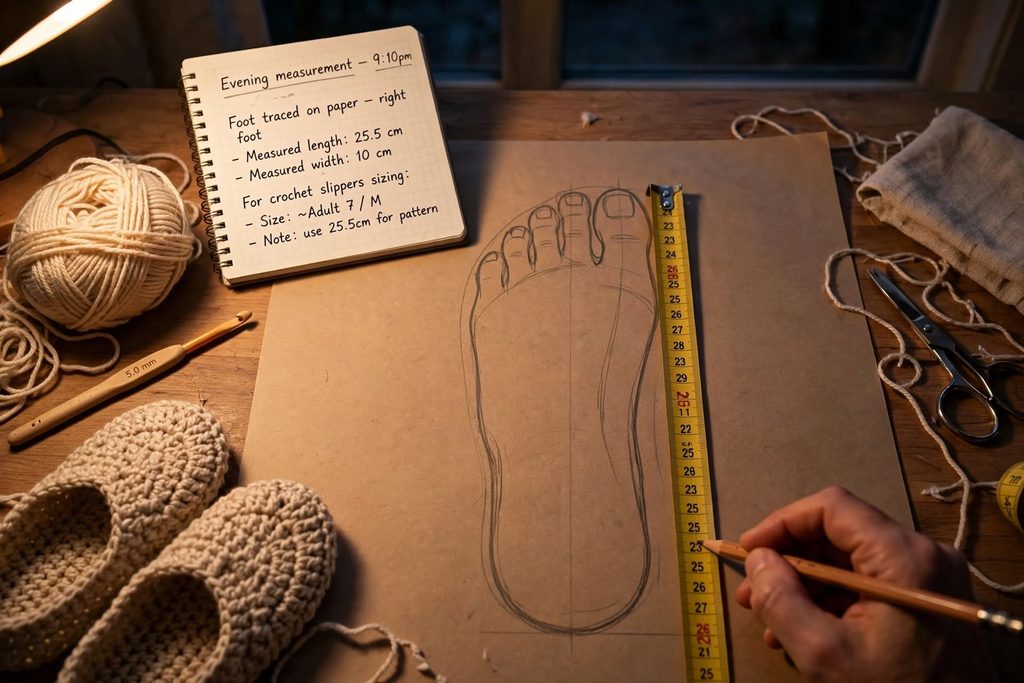
Shoe-size charts are a rough guide at best — a size 38 foot can be surprisingly long or wide depending on the person. The reliable method is wonderfully low-tech:
- Stand on a sheet of paper and trace your foot in the evening (feet swell during the day).
- Measure from the longest toe to the back of the heel.
- Make the sole slightly longer than that measurement, and check it against your actual foot as you work — hold the sole up, step on it, and look.
- For a high instep, add height over the bridge of the foot (extra rounds on the upper) rather than making the whole slipper bigger.
- For a wide ankle, add rounds to the ribbed cuff or go up half a hook size for the cuff only.
Crochet stretches a little with wear, so a brand-new slipper should feel gently snug, not loose. If it slides at all on day one, it will only get worse by day thirty.
Granny square slippers that grip the foot — the shaped upper and snug opening do the holding, not luck.
Care, Honesty, and Safety
Because I would rather you trust me than admire me, here is the fine print:
- Washing: follow the yarn label. Many wool-acrylic blends tolerate a gentle machine cycle in cold water, dried flat; pure wool usually wants hand-washing unless the label says otherwise.
- Stretch: all crochet relaxes somewhat with wear — which is exactly why the ribbed cuff matters. The ribs are what recover the fit day after day.
- Two different problems: a slipper sliding off your foot and a sole sliding on the floor are separate issues. A perfect cuff solves the first and does nothing for the second. Crochet on smooth flooring is genuinely slippery.
- Grip, done responsibly: sew-on faux-leather sole pads or dots of dimensional fabric paint can improve traction, but use products intended for fabric footwear, apply them to a clean dry sole, and test on your actual floors. They improve grip; they do not guarantee it in every condition. Treat this as essential for stairs and for anyone with balance concerns — comfort is not worth a fall.
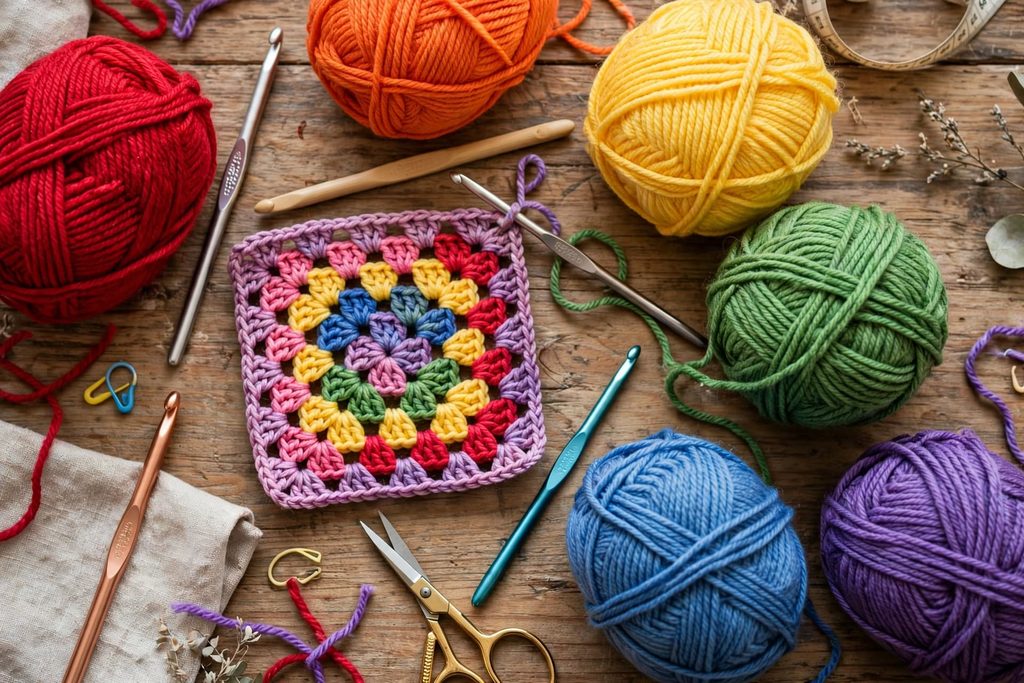
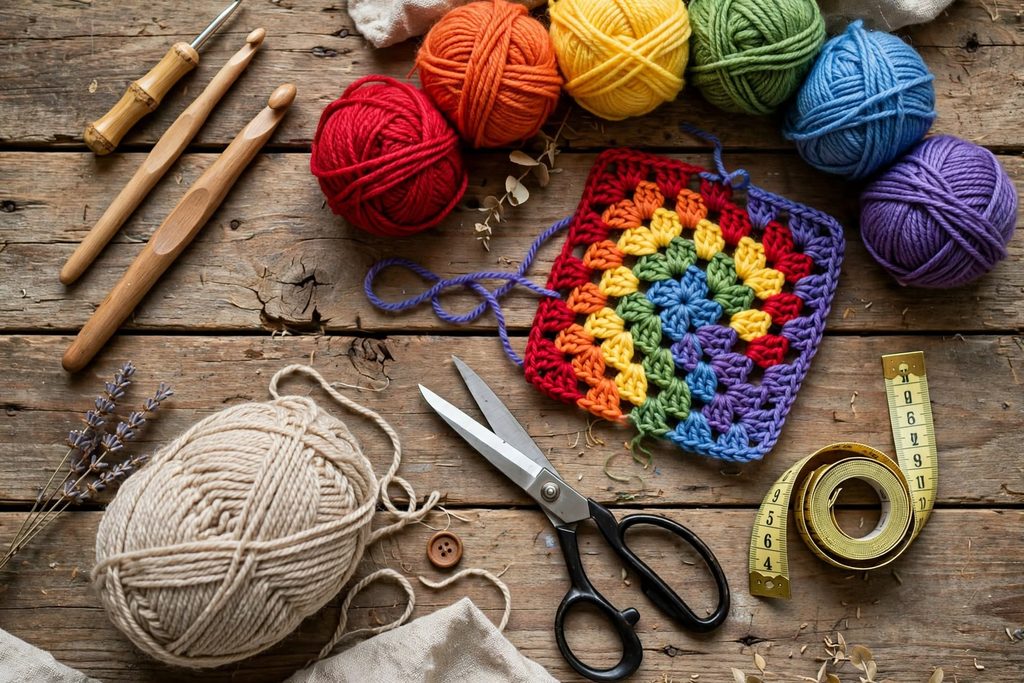
Materials matter: hooks, worsted-weight yarn, and a granny square in progress.
Frequently Asked Questions
Are granny square slippers hard to make? No. The squares themselves and the basic stitches — double crochet, half-double crochet, single crochet — are beginner territory. The part that requires patience, not skill, is joining the pieces neatly.
How long does a pair take? For most crocheters, somewhere between four and six hours for an adult pair, including finishing. Your first pair will take longer. That is normal and does not mean you are slow.
My slippers slide off — what did I do wrong? Usually it is the opening, not the size. Before reworking anything, try adding two or three more rounds of ribbing to the cuff, or a round or two of decreases near the heel to deepen the cup. In most cases, that solves it.
Do they stretch out over time? Somewhat — all crochet does. Well-chosen yarn and a ribbed cuff keep the fit stable; cotton and loose openings do not.
Can I wear them outside? They are house shoes. A quick trip to the mailbox on a dry day is fine; anything more asks for a sturdier sole than crochet will give you.
The Final Word
Granny square slippers sit at a lovely crossroads: quick enough for a weekend gift, personal enough to become a keepsake, and — when the yarn, sole, heel, and cuff are given real thought — genuinely good footwear. The squares get all the glory. The engineering gets all the comfort.
Make the pair. Take the photo. But this time, photograph them after a month of wear — softened, scuffed, and molded to your feet. That is what success looks like: not slippers too pretty to use, but slippers that never make it back to the shelf.
Granny square slippers worn as everyday shoes — proof that the “granny” in granny square is honorary.