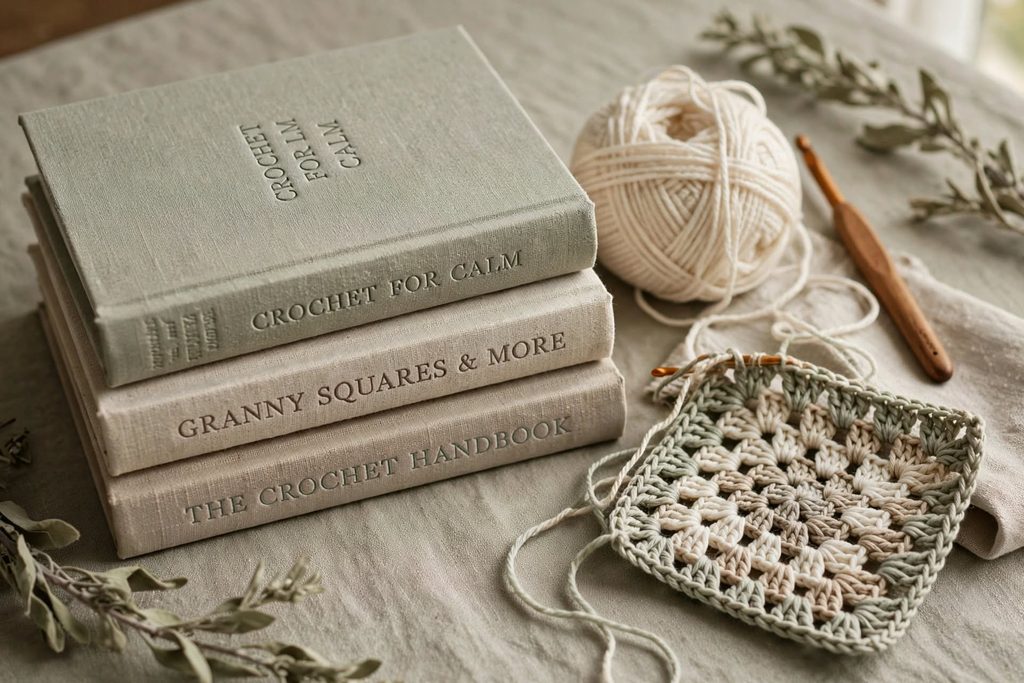
The best guides for learning your first stitches, finding your rhythm, and discovering a craft you may never want to put down.
What if the best crochet teacher isn’t a person — but a page?
We’ve been trained to believe that learning happens on screens. A YouTube tutorial at twice the speed. A TikTok clip that demonstrates a stitch in fifteen seconds. An Instagram carousel that promises to teach you granny squares between subway stops.
The screen is immediate, infinite, and always ready to answer the question: How do I do this?
But sometimes, the question you really need answered is a little different.
Why does this stitch look wrong? Why are my edges getting wider? Why does the pattern say to turn when I’m not finished with the row?
A good crochet book helps you understand the craft behind the instructions. It gives you something to return to, something to annotate, and something that doesn’t disappear beneath the next seventeen recommended videos.
And no, a book won’t magically fix your tension. It won’t untangle the yarn that has somehow knotted itself inside your project bag. But the right one can make the learning process feel less like a test you forgot to study for and more like a skill you’re gradually making your own.
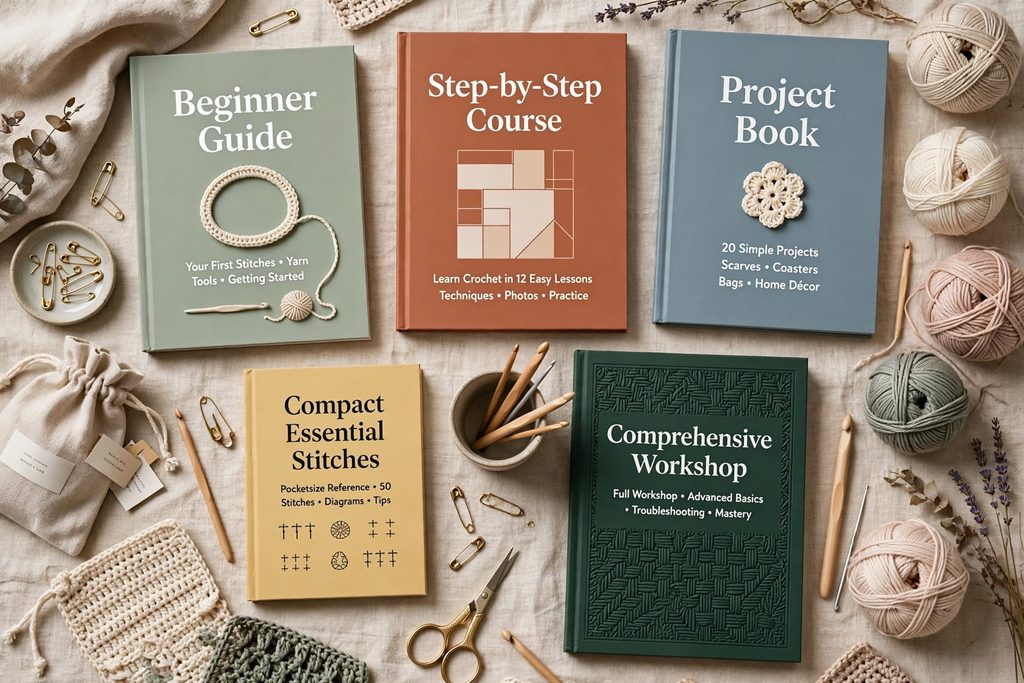
Here are five crochet books worth considering, what each type of guide can offer, and how to choose the right first book for the way you want to learn.
The Page vs. the Screen
Let’s start with an important distinction: videos aren’t the enemy.
Watching someone demonstrate how to hold a hook can be incredibly helpful. Seeing a stitch formed in real time may explain something that a paragraph of written instructions never quite manages to communicate.
But crochet asks your hands to do one thing while your eyes do another. When you’re learning, that coordination can be surprisingly difficult.
You watch the video. You pause it. You try the stitch. You lose your place. You pick up your phone again, and the video has somehow returned to the beginning of the sponsored segment.
A book offers a different rhythm.
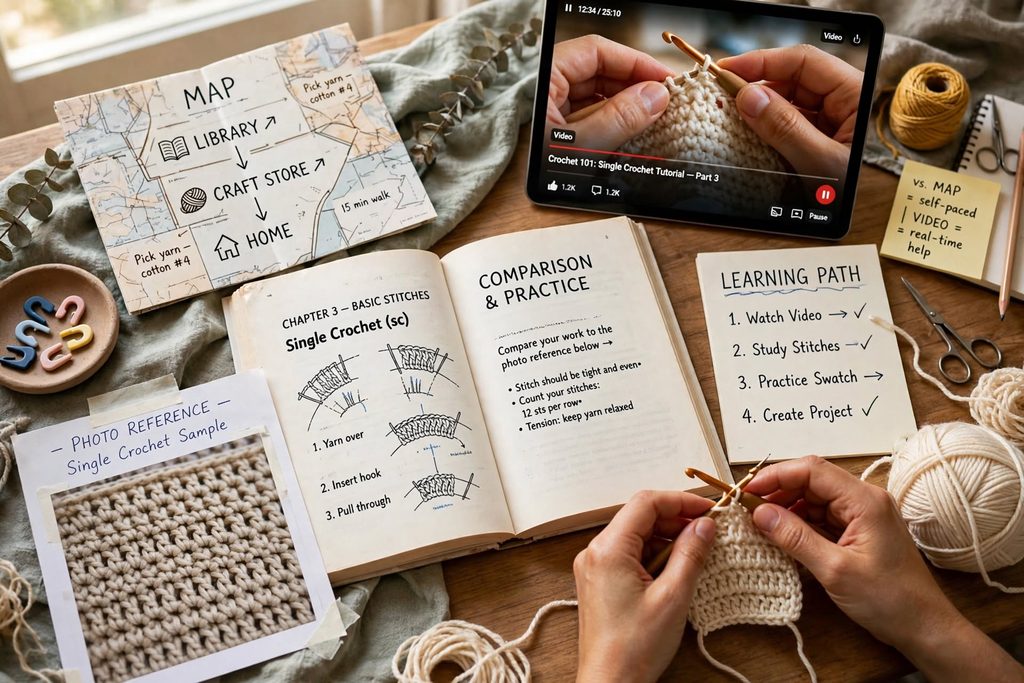
It can remain open on the table while you work. You can compare your stitches with a photograph, reread a paragraph, or mark the exact instruction that finally made sense. You don’t have to remember which timestamp contained the explanation you needed.
The best approach is often to use both: a book for structure and reference, and a video when you need to see a movement in action.
Think of the book as your map and the video as someone showing you how to take the next turn.
What Makes a Crochet Book Worth Buying?
Not every book with a ball of yarn on the cover is a good first teacher. Some are beautiful collections of patterns that assume you already know what you’re doing. Others explain the basics well but offer projects you won’t be excited to make.
Before buying, look for these five features.
1. Clear, Close-Up Photography
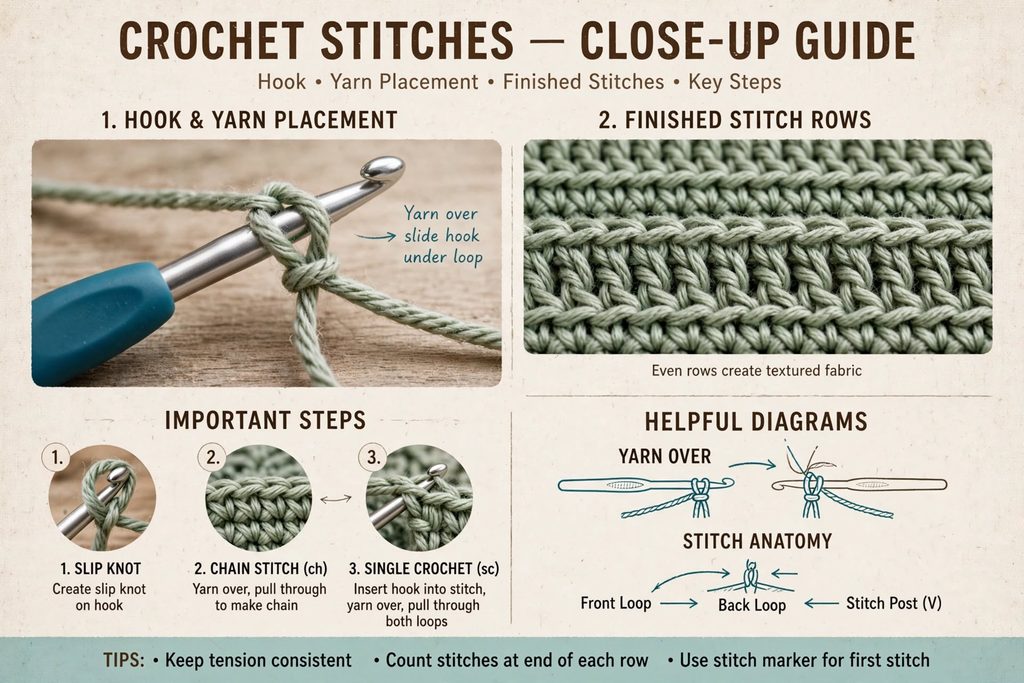
You need to see the actual stitches, not just a beautiful finished blanket photographed from across the room.
Look for close-ups of the hook, yarn placement, finished stitch rows, and important steps. Photographs should make the technique easier to understand rather than merely making the book look attractive.
2. A Logical Learning Sequence
A beginner-friendly guide should build skills gradually. Ideally, it starts with the tools and materials before introducing basic stitches, increases, decreases, working in the round, color changes, and more involved projects.
You don’t need to master everything on page twelve. You need a next step that feels achievable.
3. Written Instructions and Helpful Diagrams
Written patterns are useful, but crochet charts can make stitch placement and repeated motifs easier to understand.
A book that offers both gives you more than one way to approach a confusing instruction. For complete beginners, explanations of abbreviations and pattern punctuation are especially valuable.
4. Help With Common Mistakes
A good teacher doesn’t pretend that every stitch comes out perfectly.
Look for guidance on counting stitches, recognizing the first and last stitch of a row, maintaining even tension, and correcting mistakes. These small explanations can save you from unraveling an entire project because you accidentally added three stitches along the way.
5. Projects You’ll Actually Want to Make
A beginner book should offer manageable projects, but manageable doesn’t have to mean boring.
If you love home decor, look for coasters, baskets, cushions, or blankets. If you want to make clothes, choose a guide that gradually introduces shaping and construction. If tiny stuffed animals make you happy, an amigurumi-focused book may keep you practicing longer than a collection of dishcloths ever could.
The best beginner project is one that teaches you something and makes you want to pick up your hook again.
Best Crochet Books for Beginners: 5 Types to Consider
Different books serve different learning styles and interests. Rather than buying several books at once, start with the type that matches your current needs.
1. Best for Learning the Basics: The Beginner’s Guide
Best for: Complete beginners who want a structured introduction.
If you’ve never held a crochet hook before, a book that explains the fundamentals clearly is usually a better starting point than one promising hundreds of projects.
Look for a guide that introduces tools and materials, holding the hook, making your first stitches, fastening off, and reading patterns. Step-by-step photographs and a small selection of beginner projects are especially useful.
That combination matters because learning crochet isn’t simply about memorizing stitch names. You also need to understand how instructions translate into movements and how those movements build a finished object.
Why choose this type: A structured approach and visual instructions can make the first few lessons less intimidating.
Keep in mind: A basic guide is a foundation, not a lifetime library. You can explore more specialized techniques once you feel comfortable with the essentials.
2. Best for Learning Through Projects: A Step-by-Step Crochet Course
Best for: Beginners who prefer a plan instead of an enormous reference book.
Some people learn best when they can see the next step. Others open a book containing hundreds of stitches and immediately wonder whether they should change their name and move to the countryside.
A day-by-day or lesson-by-lesson format offers a more manageable route.
Look for a book that introduces a few techniques at a time and then asks you to use them in a project. A well-planned course might begin with chains and basic stitches before progressing to color changes, increases, decreases, granny squares, and simple three-dimensional shapes.
The appeal is the combination of learning and making. Rather than studying techniques indefinitely before beginning a real project, you get opportunities to put new skills into practice.
Why choose this type: A structured progression can help you build a regular practice and avoid jumping between unrelated patterns.
Keep in mind: A learning schedule is a guide, not a deadline. You don’t have to master crochet in three weeks or finish a lesson a day. Repeat the techniques that need more practice.
3. Best for a Friendly Introduction: A Beginner-Friendly Project Book
Best for: New crocheters who want an approachable guide with simple projects.
A good introductory project book combines basic stitches with achievable things to make. It might include coasters, small bags, simple accessories, or other projects that don’t require complicated shaping.
The goal isn’t to create something extraordinary on the first try. It’s to understand the instructions, finish a project, and recognize that the slightly uneven edges are evidence of learning rather than a personal failure.
Why choose this type: Small projects provide opportunities to practice and see the results of your progress.
Keep in mind: Check the sample pages before buying, if available. Some project books are intended for people who already know the basics, even when their projects look simple.
4. Best for a Compact Introduction: A Short Essential-Stitches Guide
Best for: Beginners who want a small, focused reference.
Not everyone wants to begin with a thick manual. A compact guide can be a good choice if you prefer to learn a handful of essential stitches before moving on to larger projects.
Look for step-by-step instructions, clear photographs, illustrations, and a few easy patterns that help you practice what you’ve learned.
Why choose this type: A concise guide can feel less overwhelming and gives you a manageable place to start.
Keep in mind: A short book may not cover every question that comes up as your skills develop. You may eventually want a more comprehensive reference or additional pattern books.
5. Best for Exploring More Techniques: A Comprehensive Crochet Workshop Book
Best for: Beginners who want to move from their first stitches toward a wider variety of projects.
A workshop-style book introduces techniques in stages and reinforces them through practical projects. It may progress from basic stitches to textured patterns, motifs, accessories, home decor, or simple garments.
The advantage is variety. As you learn, you can discover which part of crochet interests you most before investing in specialist books.
Why choose this type: The workshop format combines explanations with practical application and offers a route toward more varied projects.
Keep in mind: Check the contents and sample pages to ensure the first lessons match your current experience. A comprehensive book can still feel too advanced if it assumes you already know how to read patterns.
Which Crochet Book Should You Choose?
You don’t need to buy all five. In fact, buying five books before you’ve completed your first chain is an excellent way to own a beautiful collection of books about a hobby you haven’t started yet.
Use this guide to narrow your choice.
| If you want to… | Choose a book that… |
|---|---|
| Learn the fundamentals in a structured way | Explains tools, basic stitches, and pattern terminology step by step |
| Follow a learning plan | Organizes techniques into manageable lessons |
| Learn through practical projects | Introduces skills and then uses them in small projects |
| Keep your first guide short | Focuses on essential stitches and a few simple patterns |
| Build toward more complex projects | Progresses gradually into motifs, shaping, and varied techniques |
One detail is worth checking before you begin: crochet terminology differs between US and UK patterns. A US single crochet is called a double crochet in UK terminology, while a US double crochet corresponds to a UK treble crochet.
A book may be perfectly clear and still seem confusing if you mix the two systems. Look for an explanation of the terminology used, and follow that system consistently.
You Don’t Need a Library. You Need a Learning Path.
A good first book should help you move from one skill to the next. You don’t need an encyclopedia of every stitch, a book dedicated entirely to granny squares, and a specialist amigurumi manual on day one.
Start with one comprehensive beginner guide. Once you’ve made a few projects, you’ll have a much clearer idea of what you want to learn next.
Perhaps it’s a stitch dictionary because you love texture. Perhaps it’s a granny-square collection because you want to make a blanket from colorful motifs. Or perhaps you’ll discover that your real ambition is to crochet tiny animals with expressions more emotionally complex than those of most people you know.
Let your next book respond to your curiosity rather than trying to anticipate every possible future project.
How to Get More From Your Crochet Book
Buying the book isn’t the lesson. Using it is.
Read the Introduction Before Starting the First Project
The opening chapters often explain the author’s terminology, materials, abbreviations, and assumptions about your skill level. A few minutes spent here can prevent confusion later.
Make a Small Practice Swatch
If the book recommends a particular yarn weight and hook size, use those materials for your first practice sample when practical. This makes it easier to compare your work with the instructions.
You can experiment with substitutions later, once you understand how yarn, hook size, and tension affect the result.
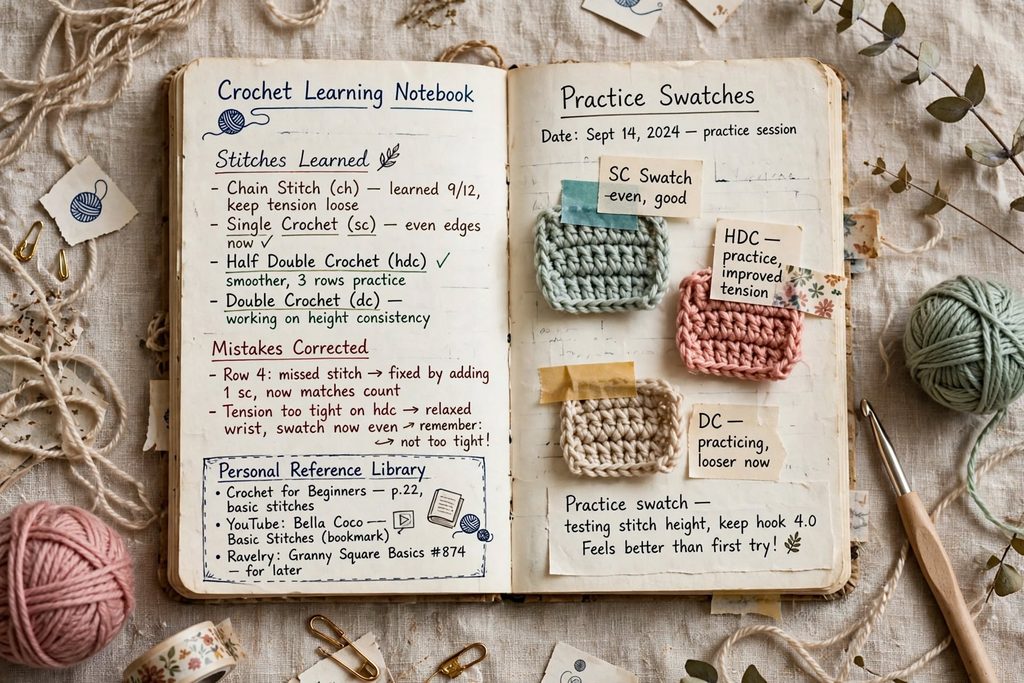
Keep a Small Learning Notebook
Record the stitches you’ve learned, the mistakes you’ve corrected, and the techniques you want to practice again. You can even keep small labeled swatches if you enjoy learning through touch.
Write down the book title and page number next to each sample. Over time, you’ll create a personal reference library that reflects your own experience.
Mark the Pages That Help You
A pencil note, a bookmark, or a simple annotation can make a useful explanation easier to find next time.
If you prefer to keep your books pristine, use sticky notes or a separate notebook. The point is not to damage the book. It’s to make the information accessible when you need it.
Finish a Few Projects Before Buying Another Book
This is perhaps the least glamorous advice in the entire article, but it’s a practical way to avoid collecting more instructions than you have time to use.
Try two or three projects from your first guide. Notice what you enjoyed, what frustrated you, and what you want to make next. That experience will help you choose your next book more intelligently.
What About Stitch Dictionaries, Granny Squares, and Amigurumi Books?
Specialist books can be wonderful, but they make more sense once you know what you’re looking for.
A stitch dictionary is useful when you want to explore shells, bobbles, ripples, textured stitches, and other variations. Look for clear swatch photographs, written instructions, and charts where they help explain the pattern.
A granny-square book is ideal if you enjoy motifs and want to combine them into blankets, bags, cushions, or garments. Check whether the book explains joining methods and finishing, not just how to make individual squares.
An amigurumi book focuses on three-dimensional crochet, usually worked in continuous spirals. It can help you develop skills in counting, increasing, decreasing, shaping, and maintaining consistent tension. For a first amigurumi book, look for clear instructions on starting rounds, placing stitch markers, and assembling the finished pieces.
These are not compulsory stages in a crochet education. They are different directions you can explore when one particular part of the craft captures your imagination.
The Secret Life of Crochet Books
Here is something nobody tells you: the best crochet book isn’t necessarily the one you read from cover to cover. It’s the one you actually use.
The page you return to because it contains the only explanation of a stitch that ever made sense. The note beside a pattern that says, “Remember to count the first stitch.” The project you abandoned in February and finally understood in September.
A book can become a record of learning. Its value isn’t only in the printed instructions, but in the skills and memories you build around them.
And a screen has its own advantages. It can show you a technique in motion, connect you with other makers, and offer fresh inspiration when you need it. There is room for both.
But there is something lovely about having a physical reference open beside you while your hands work. You can return to the same page as many times as you need. You can take your time. You can make mistakes without feeling that you have to keep up with anyone else’s pace.
The hook doesn’t know how many followers a teacher has. The yarn doesn’t care whether your first square is perfectly even. And the page doesn’t turn itself while you’re still figuring things out.
Your First Crochet Book Is a Beginning, Not a Test
If you’re choosing your first crochet book, look for clear explanations, useful photographs, manageable projects, and a teaching style that makes you want to keep going.
Don’t worry about finding the one perfect book that contains everything you’ll ever need. No single guide has to teach you every stitch, every construction method, and every possible project.
Choose a good starting point. Learn a few stitches. Make something small. Let your hands become familiar with the rhythm.
Then, when you’re ready, choose the next book because it answers a question you genuinely want to explore.
May your first projects be forgiving, your yarn reasonably untangled, and your shelves filled slowly with books that earn their place.
And may you discover that the best crochet teacher isn’t necessarily the one with the most followers or the most complicated patterns. Sometimes, it’s the book that stays open on your table while you figure things out, loop by loop, row by row, at your own pace.