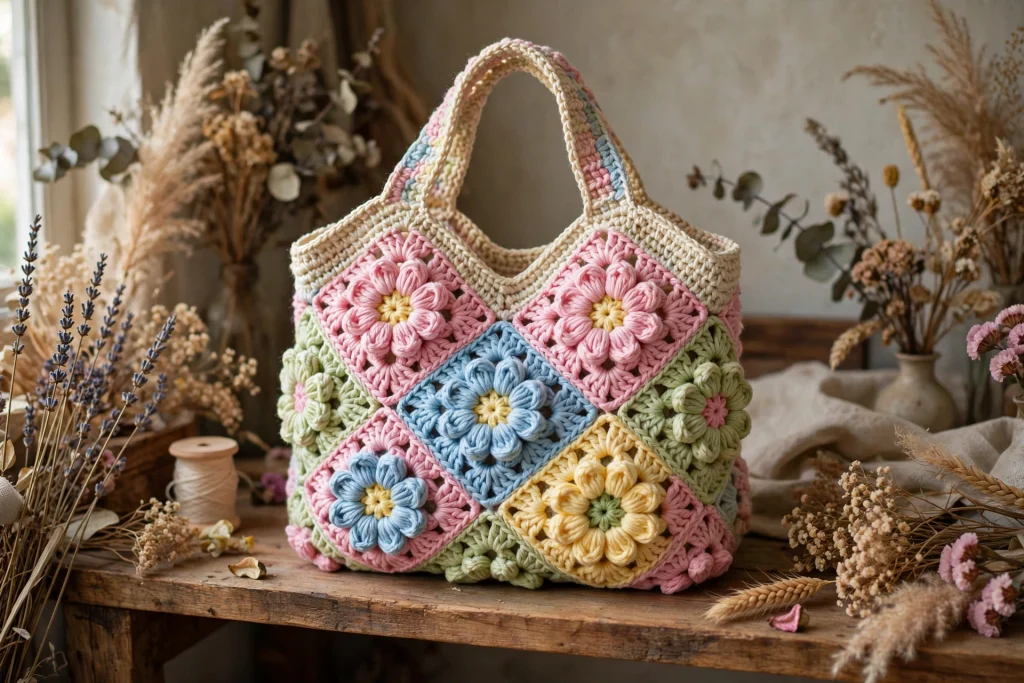
You do not buy this bag.
You download its potential. You scan a code, open a PDF, and suddenly your evening has a purpose that has nothing to do with Netflix. Three hours later, your hands smell like cotton. Your couch is covered in yarn crumbs. And there — on the coffee table — is a tote bag in shades of strawberry, peach, and lavender that looks like it was born in a boutique, not on your lap.
Welcome to the only accessory that comes with a QR code and a personality.
In this article, you will learn:
- Why color-blocked crochet totes are the easiest “wow” project for confident beginners
- How to read a PDF pattern without throwing your hook across the room
- The exact yarn weight and hook size for a structured bag that does not sag
- How to attach a leather tag and tassel like a professional maker
- The 5 mistakes that turn a boutique-style tote into a craft-fair casualty
Now, let us talk about the bag that comes with homework.
Part I: The Color Gradient Is a Mood Ring
Look at it. Pink melting into peach melting into lavender — like a sunrise had a baby with a macaron. This is not just a color scheme. This is a mood gradient. The top is bubblegum optimism. The middle is peachy calm. The bottom is lavender introspection. You are not carrying a bag. You are carrying the emotional arc of a perfect Tuesday.
Here is the paradox that breaks color theory: these three colors should clash. Pink and orange are neighbors on the wheel — they fight for attention. Purple is across the ring — it should create discord. But in pastel tones, at equal saturation, they form a truce. They become a gradient. And a gradient, in crochet, is the easiest way to look like you planned something complicated when you simply ran out of the first color and refused to go to the store.
Practical tip: For a smooth color transition in a tote, work two rows of the new color while carrying the old color along the top of the stitches (tapestry crochet technique). This creates a clean line with no weaving-in later. Or — embrace the jogless stripe: change colors at the beginning of the row, chain one in the new color, and continue. The slight step is invisible after blocking.
Yarn math: For a medium tote (12″ wide × 10″ tall × 3″ deep), you need approximately 200 yards of Color A, 150 yards of Color B, and 150 yards of Color C in worsted-weight cotton. Lily Sugar’n Cream or Paintbox Cotton DK work beautifully. Do not use acrylic — it stretches under weight and your tote will become a hammock by week three.
Part II: The QR Code Is a Portal
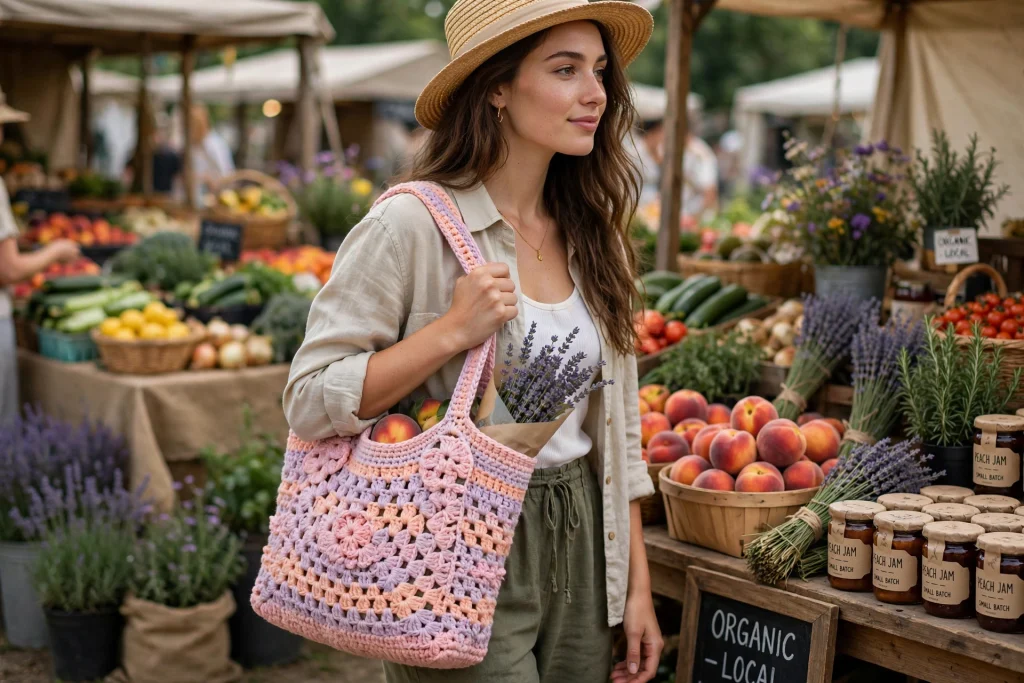
There it is. A small paper tag, tied with twine, printed with a QR code that says “Download PDF Pattern.” This is the modern equivalent of a spell book. You point your phone at it, and a document appears — pages of abbreviations, stitch counts, and diagrams that look like hieroglyphics drawn by a very organized alien.
But here is the twist: the QR code is not just a link. It is a permission slip. It gives you the right to make this exact thing. It transforms you from a consumer into a maker. Without the code, the bag is a product. With the code, it is a curriculum.
How to read a PDF pattern without trauma:
- Print only the first page — the materials list and gauge swatch instructions. Everything else stays digital for zooming.
- Highlight your size — if the pattern offers multiple dimensions, highlight only your numbers. The rest is noise.
- Use a row counter app — your phone can track rows better than your memory, especially during Netflix.
- Stitch glossary first — if the pattern says “fpdc” and you do not know what that means, stop. Look it up. Do not guess. Front post double crochet is not intuitive.
- Save the PDF to a cloud folder named “Current Projects” so you can access it from any device when inspiration strikes at the dentist’s office.
The megalogic of digital patterns: A PDF pattern costs $3–$8. The bag it produces would retail for $60–$90. That is a 1,000% return on investment — if you measure ROI in compliments per dollar.
Part III: The Tassel Is a Signature
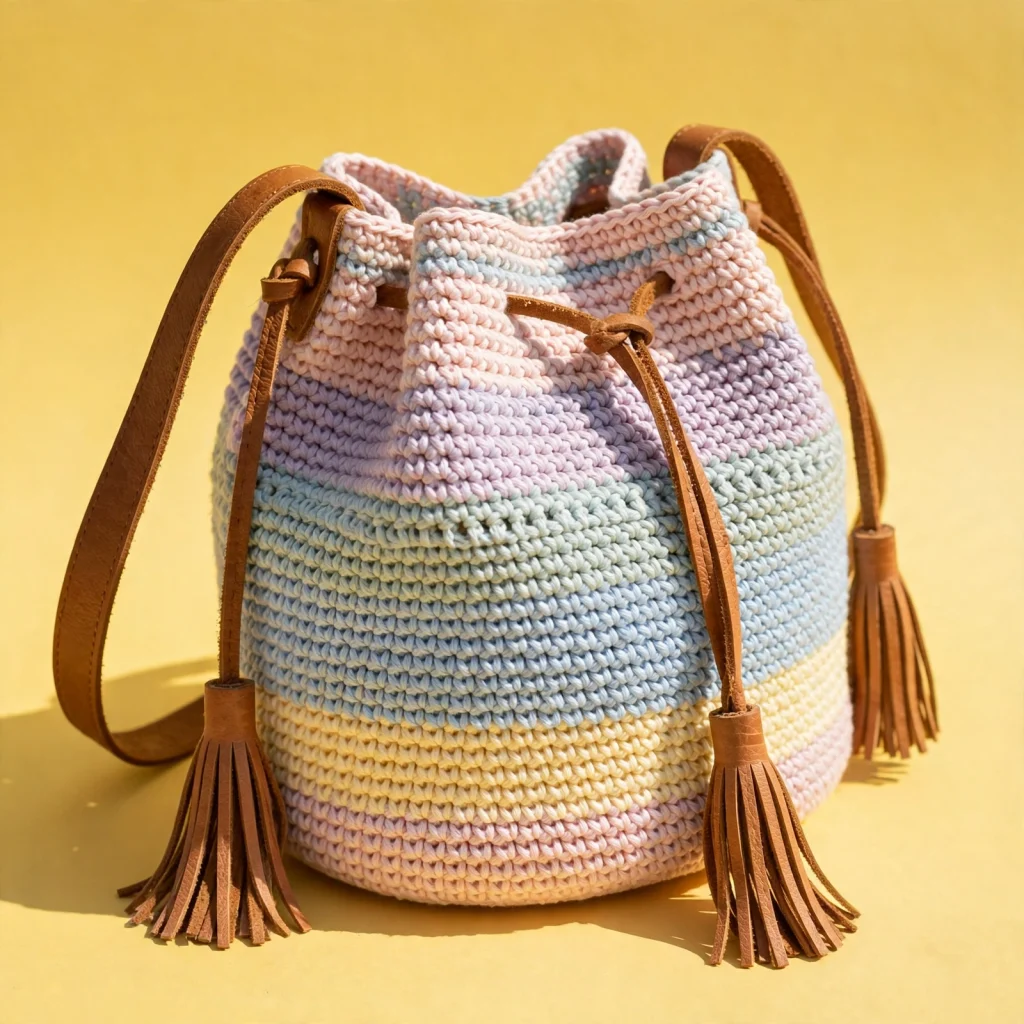
A tassel is not decoration. It is a period at the end of a sentence. It says, “This bag is finished, and I am proud enough to add one more thing.” The tassel on your tote — ombre, matching the gradient, tied with a leather cord — moves when you walk. It catches the breeze. It draws the eye downward, elongating the silhouette, making the bag look taller and more expensive than it is.
Here is the practical magic: tassels take 10 minutes to make and add $20 to the perceived value. They are the cosmetic surgery of crochet accessories — minimal effort, maximum impact.
How to make a professional tassel:
- Wrap yarn around a 4-inch piece of cardboard 30 times.
- Slide a separate 12-inch strand under the wraps and tie tightly at the top.
- Cut the bottom loops.
- Wrap another strand around the neck (1 inch below the top tie) 5 times. Knot. Hide ends inside.
- Attach to the bag with a jump ring (jewelry finding, $3 for 50 pieces) threaded through a reinforced stitch.
The leather tag: If your bag has a “Handmade with Love” or “Download PDF” tag, attach it with a small brass screw post through a reinforced square of faux leather on the inside. Do not just sew it to the crochet — the weight will pull the stitches out. Create a leather sandwich: faux leather on the inside, crochet in the middle, tag on the outside, held together by the screw post.
Part IV: From PDF to Shoulder — The Pattern Economy
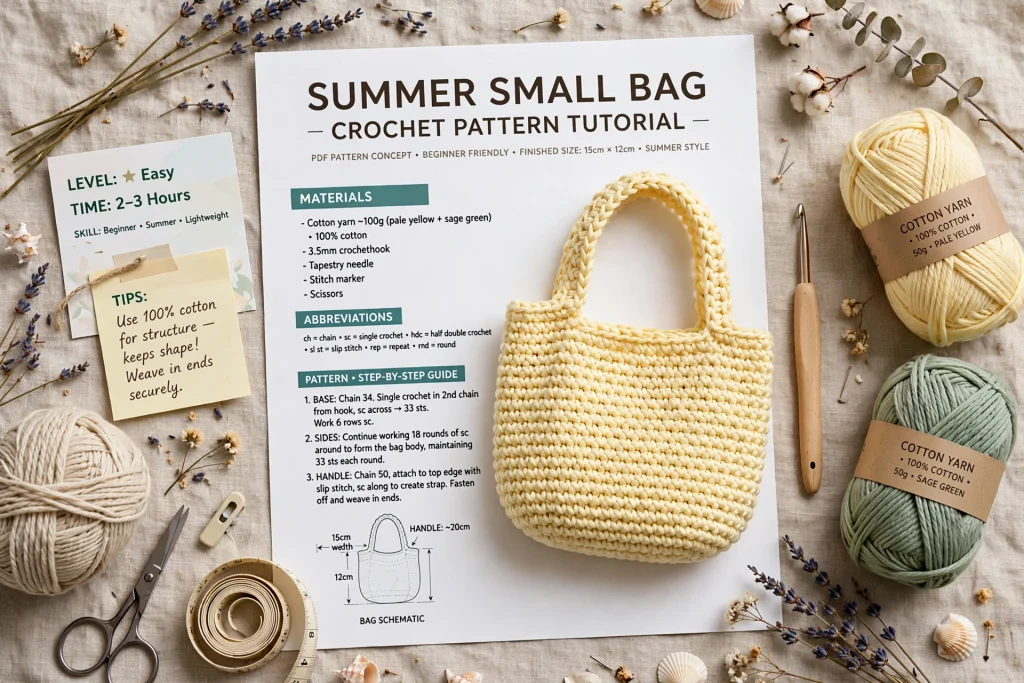
This is where logic bends into entrepreneurship. You bought the PDF once. You made the bag. Your friend saw it. Your friend wants one. You have the PDF. You have the yarn. You have the Netflix subscription.
The pattern economy works like this: one PDF = infinite bags. Unlike a physical book that wears out, a digital pattern is immortal. You can make the tote in pink for spring, in black for winter, in mustard for fall. You can make a mini version for your niece. You can omit the bottom panel and turn it into a pillowcase. The PDF is not a recipe for one meal. It is a cooking class.
Sizing variations from one pattern:
- Mini: Stop after Row 20. Add a zipper. Crossbody bag.
- Maxi: Add 10 rows to the body and 4 rows to the depth. Market tote.
- Clutch: Work only the front panel, fold in half, add a magnetic snap. Evening bag.
Time investment: A color-blocked tote takes 6–8 hours for a confident beginner. That is two movies, one podcast series, or four episodes of a reality show you will not admit to watching. The bag outlasts all of them.
The 5 Mistakes That Ruin a Boutique-Style Tote
1. Skipping the gauge swatch
If the pattern says 16 stitches = 4 inches and yours is 14 stitches = 4 inches, your bag will be a bucket. Not a tote. A bucket. Swatch. Block. Measure. Then proceed.
2. Using the wrong yarn
Worsted-weight cotton is non-negotiable for structure. DK will drape like a dress. Bulky will look like a dog bed. Sport weight will require a lining so thick it defeats the purpose.
3. No bottom reinforcement
A crochet tote without a base is a black hole. Cut a piece of plastic canvas or foam board to the bag’s bottom dimensions. Cover in fabric. Slip inside. Your bag will stand upright. Your dignity will remain intact.
4. Loose handles
Crocheted straps stretch. It is physics. It is destiny. Reinforce them with a fabric tube inside or use purchased leather/cotton webbing handles attached with metal hardware.
5. Forgetting the lining
Unlined crochet bags eat your keys, your lip balm, and your patience. A simple cotton muslin lining with a slip pocket takes 30 minutes and elevates the bag from “homemade” to “artisan.”
Epilogue: Carry the Curriculum
So here is the truth, delivered with the gentleness of pastel yarn against a marble table:
You do not need another black bag from a factory. You need a bag that tells a story — about the evening you learned front post double crochet, about the podcast that made you laugh so hard you dropped a stitch, about the QR code that turned a Tuesday into a talent.
Download the PDF. Buy the yarn in colors that make no logical sense together but somehow sing. Make the tassel. Attach the tag. Carry it to the farmers’ market. Carry it to the coffee shop. Carry it like the diploma it is.
Because the crochet tote that carries your whole aesthetic is not an accessory. It is a transcript of your patience.
Now grab your hook. The gradient is waiting.
Happy crocheting.