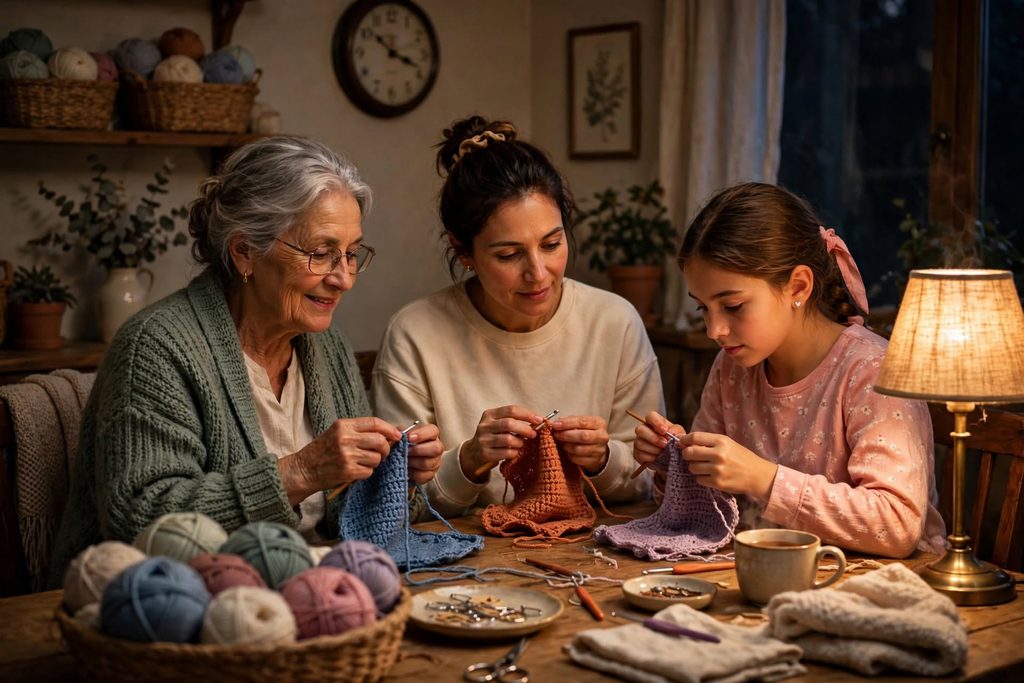
On creativity, the comfort of repetition, and the things we grow into rather than leave behind.
Your mother did it. Your grandmother did it. And now you do it at 3 a.m. while the world sleeps, telling yourself you’ll finish just one more row.
What if crochet isn’t something you outgrow — but something you grow into?
We’ve been taught to think of hobbies as temporary residents in our lives. The things we love at twenty are supposed to give way to more serious pursuits by forty. Crochet, especially, gets assigned its own little boxes: a youthful craft phase, a new-mother nesting phase, a retirement pastime. As if there comes a point when a woman should put down her hook and graduate to something more sophisticated. Wine tasting. Yoga. Minimalist watercolor painting that requires only three brushes and a sense of superiority.
But here’s the plot twist: women who keep crocheting aren’t necessarily stuck in the past.
They’re rooted.
And roots, unlike trends, don’t need to rotate.
The Age Myth
Open a craft magazine and you might find projects marketed to teenagers, young adults, new parents, and retirees. Somewhere in between, the story often goes quiet — as if women in the middle of life are too busy holding everything together to make something simply because they want to.
Yet crochet can change with the person who practices it.
At first, you might crochet because you want a scarf you can afford to make yourself. Later, you might enjoy the challenge of a complicated pattern, the satisfaction of a handmade gift, or the pleasure of spending an hour on something that doesn’t need to become a career, a side hustle, or a personal improvement project.
And sometimes, you simply want to sit down and make a few stitches.
There is no universal timetable. Some people discover crochet at sixty. Others begin as children and never stop. Some leave it for years and return when life makes room for it again.
The point isn’t that crochet becomes more meaningful at a particular age. It’s that its meaning can keep changing.
A finished scarf has an end. The relationship with the craft doesn’t have to.
Why the Hook Stays
A crochet hook doesn’t care how old you are. Yarn doesn’t check your ID. The loop is the same whether you’re fifteen or eighty-five.
What changes is what you bring to it.
You may bring patience you didn’t have ten years ago. You may bring a new appreciation for quiet. You may bring grief, restlessness, curiosity, or the simple desire to make something with your hands after a day spent answering emails and solving other people’s problems.
The woman crocheting beside a cooling cup of tea isn’t necessarily trying to escape her life. Perhaps she is enjoying a small part of it that belongs entirely to her.
The yarn in her lap is becoming something that didn’t exist that morning. The afternoon light is fading. The hook moves at the pace her hands have learned.
Nothing spectacular is happening.
That may be precisely the point.
Crochet can offer a steady, familiar activity when the rest of life feels unpredictable. For some people, repeating stitches feels grounding; for others, it’s the pleasure of learning, making, or watching a project take shape. It isn’t a cure for stress or sadness, and it doesn’t feel the same to everyone. But it can be a meaningful part of an ordinary day.
Why abandon something that continues to give you a reason to sit down, pay attention, and make a little room for yourself?
7 Signs Crochet Has Become Part of Your Life
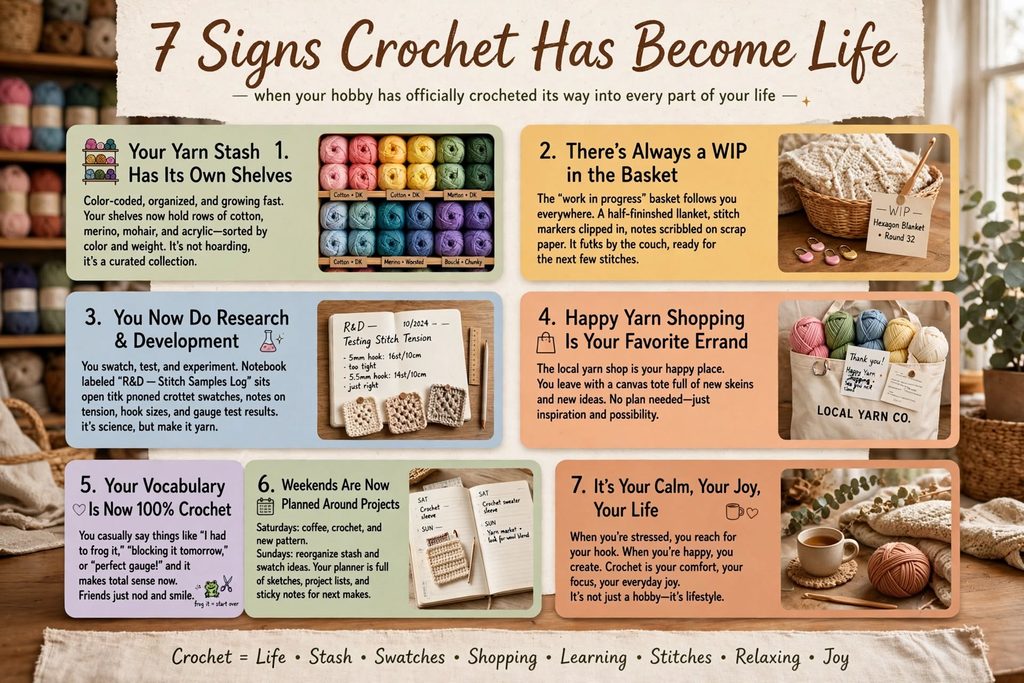
Not sure whether crochet is a passing interest or a lifelong companion? Consider these signs. There’s no official score, and you don’t have to recognize yourself in all seven. This isn’t an exam. You have enough of those already.
1. You Always Have a WIP
There is no such thing as “between projects.”
One blanket is on the sofa, one scarf is in your bag, and one ambitious cardigan is hibernating in a basket with a note that says, “Fix neckline someday.”
An empty hook feels strangely wrong, like a hand without a purpose.
You may not finish every project. But there is usually something waiting for you.
2. Yarn Shopping Makes You Happy — Even When You Don’t Need Yarn
You have enough yarn to survive a very colorful winter. You know this.
And yet, a new colorway catches your eye. You run your fingers over a skein of merino. You walk into a yarn shop “just to look” and leave carrying the raw materials for a project that hasn’t been invented yet.
Your stash isn’t hoarding. It’s research and development.
At least, that’s what you tell yourself while rearranging the shelves.
3. You Reach for a Hook When You Want a Different Kind of Evening
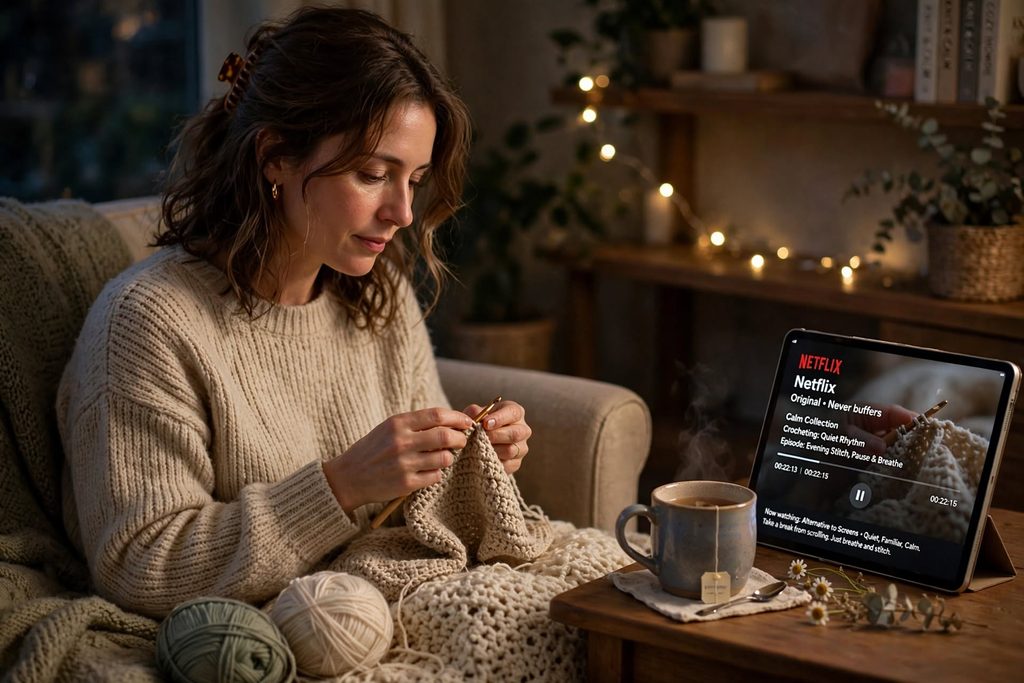
After a day of screens, messages, meetings, and notifications, you may not want another activity demanding your attention.
Crochet offers an alternative: something tactile, familiar, and easy to pause. Once you know a pattern, your hands may find a rhythm that leaves your mind free to wander.
The rhythm is the original Netflix, and it never buffers.
Of course, some projects require more concentration than others. A complicated lace pattern may demand your full attention. But even that can be a welcome change from the demands of the day.
4. Handmade Gifts Mean Something Special to You
When a birthday approaches, you don’t only ask, “What should I buy?”
You ask, “What could I make?”
A blanket becomes a collection of evenings. A hat carries the memory of choosing the yarn, correcting a mistake, and finally weaving in the last end.
Handmade gifts aren’t automatically better than store-bought ones, and love doesn’t need to be measured in hours. But when making something is your way of showing care, the process becomes part of the gift.
And if you run out of time and buy something instead? You’re still allowed to love the person just as much.
5. You Notice Stitches Everywhere
You can’t look at a sweater without wondering how it was constructed. You see a geometric fence and imagine a filet crochet pattern. You touch a textured cushion and start thinking about stitch combinations.
The world has become a catalog of potential projects.
You don’t have to make every idea. Sometimes it’s enough to notice it and think, That would look lovely in moss stitch.
6. You Collect Yarn “Just in Case”
That beautiful skein of hand-dyed alpaca has no pattern attached to it. Not yet.
But you bought it because someday the right project might appear, and you’ll be ready.
Your stash is a library of possibilities, though admittedly one that sometimes requires better shelving and a firm promise not to buy more yarn this month.
The important thing isn’t how much you own. It’s that imagining what you could make still excites you.
7. Crochet Feels Like Coming Home
Not necessarily because of the finished objects.
It’s the familiar weight of a blanket on your lap. The feel of yarn passing through your fingers. The quiet satisfaction of recognizing a pattern without checking every instruction.
When you pick up the hook, you don’t always feel as if you’re starting a hobby.
Sometimes it feels like returning to yourself.
If you recognize these moments, crochet may have become more than something you do in your spare time. It may be one of the ways you make that time feel like your own.
Crochet at Every Age: What Can Change?
There is no single path from beginner to lifelong crocheter. Still, the reasons people make things can shift as their circumstances, skills, and interests change.
| Stage of life | What might draw you to crochet | What you might discover |
|---|---|---|
| Early adulthood | Experimenting, learning, making useful things on a budget | Skill grows through practice |
| Busy years | Finding a creative outlet between other responsibilities | Even small pockets of personal time matter |
| Midlife | Trying more complex projects or returning to old interests | Your pace doesn’t have to match anyone else’s |
| Later years | Sharing skills, making gifts, exploring familiar patterns in new ways | Creativity has no fixed retirement age |
| Any age | Curiosity, pleasure, community, or simply loving yarn | There is no final destination |
These are possibilities, not rules. A twenty-year-old can crochet for peace. A seventy-year-old can chase a challenging new pattern. Someone may crochet for decades without ever wanting to make an heirloom blanket.
You don’t have to fit a stage. You get to choose the project.
5 Reasons Crochet Can Stay With You
1. It Gives Your Hands Something to Do When Life Gets Difficult
Life changes. Parents age. Children leave home. Relationships shift. Plans fall apart. Sometimes the future feels like a row of stitches you can’t quite see clearly yet.
Crochet cannot solve those problems. But a familiar project can offer a small, manageable task in the middle of a difficult day.
You can make one stitch. Then another.
The loop doesn’t care if you’re crying. It doesn’t demand that you explain yourself before you continue.
Sometimes a small, familiar action is enough for the moment.
2. It Refuses to Be Rushed
So much of modern life is measured in speed: faster replies, shorter deadlines, more output.
Crochet has its own pace. You can learn techniques that make you more efficient, but you can’t make a blanket appear without putting in the stitches.
That can be frustrating when you want the finished object immediately. It can also be a relief.
Not everything has to be optimized. Not every hour needs to produce something profitable. You are allowed to spend time making an object simply because you want it to exist.
3. It Leaves You With Something You Can See and Touch
Many kinds of work disappear as soon as they’re done. Messages are answered, meals are eaten, tasks are checked off, and the day moves on.
A crocheted object remains.
It may become a blanket on your sofa, a hat someone wears every winter, or a small gift that reminds a friend you were thinking of them. It may be imperfect. It may have a border that wanders a little.
It is still something you made.
A project doesn’t have to last forever to matter. But there is a particular satisfaction in seeing the evidence of your time take shape in your hands.
4. It Can Offer a Quiet, Repetitive Rhythm
Crochet is sometimes described as a form of meditation. For some people, that comparison makes sense: familiar stitches can create a rhythm that feels calming and gives attention somewhere simple to rest.
For others, crochet is lively, social, challenging, or occasionally infuriating. Dropping a stitch in a complicated pattern is not necessarily a spiritual experience.
There is no need to turn every hobby into a wellness routine. If crochet helps you slow down, enjoy that. If it makes you swear at a tangled skein, you’re still allowed to love it.
The benefit is not that every row transforms your nervous system. It’s that you have found an activity that means something to you.
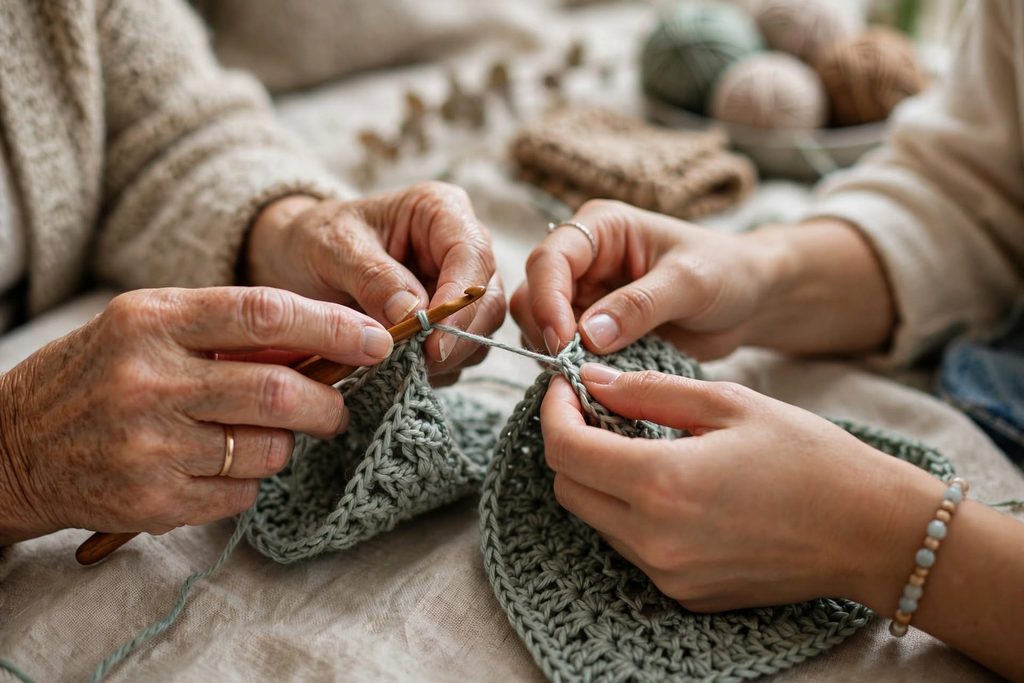
5. It Connects Generations Without Requiring a Speech
Imagine sitting beside someone who taught you to crochet. You both work on your projects. One of you remembers an old pattern; the other pulls a new one up on a phone.
You don’t have to fill every silence.
Skills can pass from hand to hand: how to hold the yarn, how to recognize a mistake, how to keep going when a pattern becomes confusing. The younger maker may introduce a new technique. The older one may share a trick learned long before video tutorials existed.
Not every family shares this tradition, and crochet doesn’t belong to one generation or gender. But when people do share it, the craft can become a language of its own.
Sometimes the lesson is in the stitches. Sometimes it’s simply in sitting together.
The Heirloom Effect
Consider an old cream afghan resting on a sofa. The fringe is a little tangled. The stitches have softened with use. Perhaps it was made decades ago; perhaps it was finished last winter.
It isn’t just decoration anymore.
It has become part of the room’s life: the blanket someone reaches for on a cold evening, the one folded over the back of a chair, the one that appears in photographs without anyone planning it.
Maybe the person who made it intended it to become an heirloom. Maybe she was simply cold and wanted a blanket.
That is part of the beauty of handmade objects. Their meaning can grow after the making is over.
A crocheted blanket might pass from one generation to another. It might be kept for years, worn out through daily use, or eventually unravel at the edges. None of those outcomes cancels the care that went into it.
Not every project has to outlast its maker to be worthwhile.
Still, when a handmade object does survive, it can carry something beyond its fiber: the memory of the person who made it, the room where it lived, and the hands that reached for it.
Every loop can become part of a story that continues after the hook is put down.
The Granny Square Time Machine
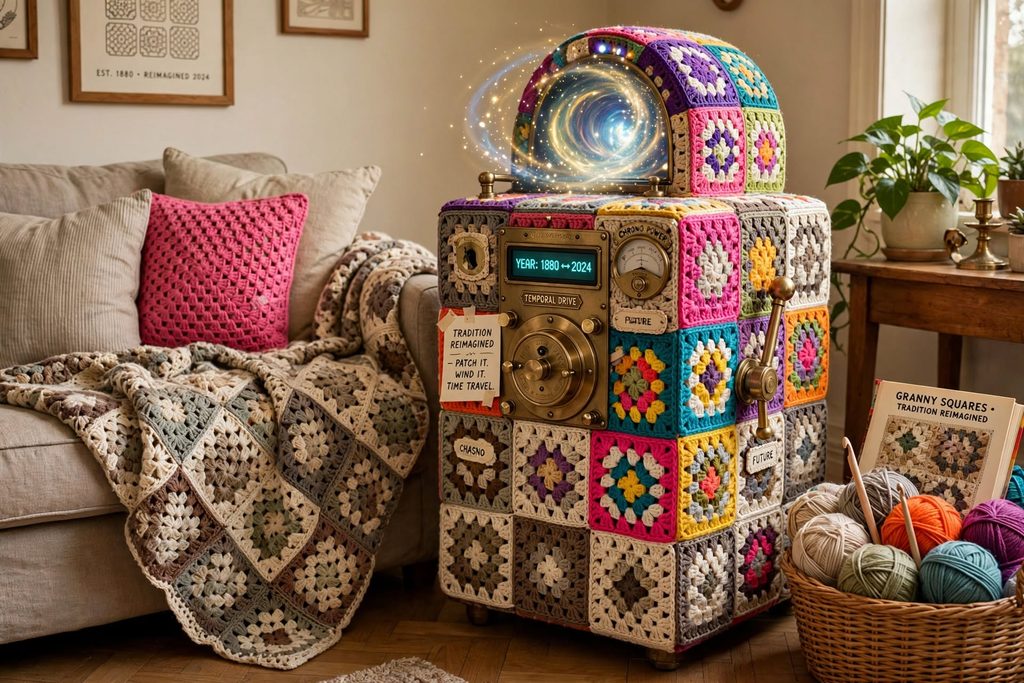
The granny square has been made, adapted, and rediscovered by generations of crocheters. Its basic structure is familiar, but its colors, proportions, and uses can change with the maker.
A traditional square can become a bright blanket with a dark border, a modern cushion, a bag, or a garment. One person chooses muted neutrals; another puts together colors that appear to have met during a very loud party.
Both can be beautiful.
That is what makes a granny square so enduring. It doesn’t have to stay frozen in the past to preserve its connection to tradition. It can be repeated, reimagined, passed along, and made personal.
The pattern remains recognizable, but no two makers bring exactly the same hands, choices, or memories to it.
Tradition doesn’t have to mean doing things exactly as they were done before. Sometimes it means carrying an old idea into a new life.
Your Hook, Your Life
Here is the part worth remembering: you don’t owe crochet a lifetime commitment.
You can love it for a season, leave it in a cupboard for five years, and return when the time feels right. You can make elaborate blankets or tiny coasters. You can give your work away, keep it all, sell a few pieces, or crochet without ever showing anyone the result.
You can finish every project. You can have a basket full of WIPs. You can change your mind.
A hobby doesn’t have to justify its place in your life by making you calmer, more productive, or more useful to other people.
It can simply bring you pleasure.
So pick up the hook you put down, if you feel like it. Start the complicated project. Make another granny square in a color you love. Or spend an evening undoing a row because the stitch count is wrong and apparently the yarn has decided to test your character.
There is no deadline for becoming the kind of person who crochets.
And there is no age at which you have to stop.
May your yarn stay untangled, your favorite hook remain within reach, and your projects bring you the kind of satisfaction that doesn’t need to be measured.
Because perhaps the women who never outgrow crochet have discovered something simple: growing older doesn’t mean leaving every old love behind.
Sometimes, it means finding new reasons to return to it.