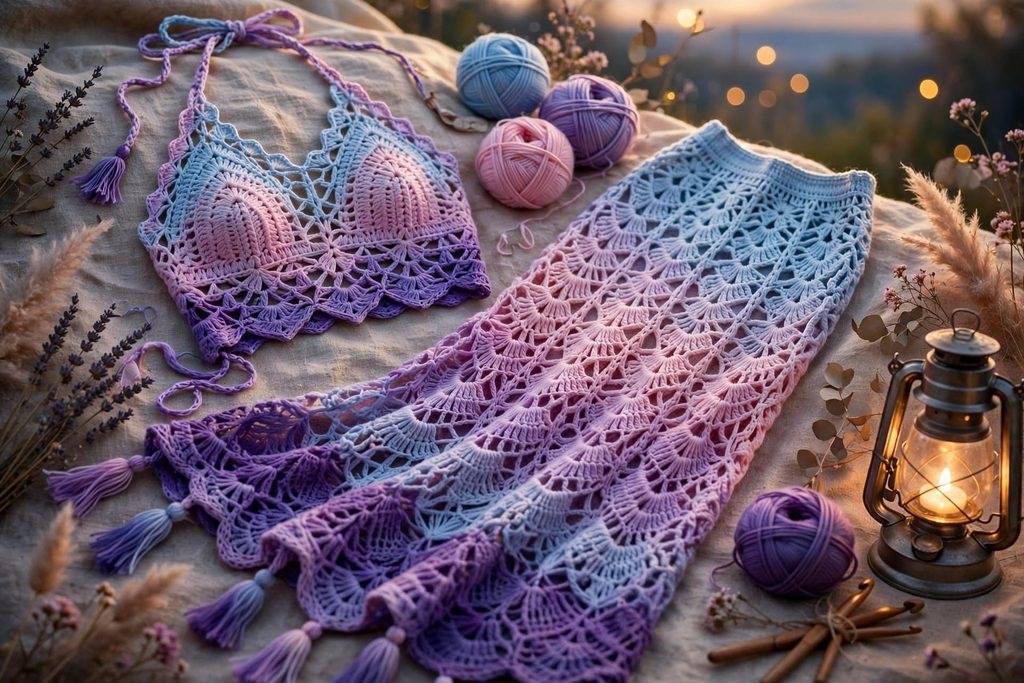
Clothing used to come from plants and animals. Then it came from factories. Now, somehow, it comes from patience.
Here is the first lie we tell about fashion: that it must be fast.
We accept the conveyor belt. The seasonal drop. The shirt that travels 12,000 miles to reach our closet and falls apart after four washes. We call this “modern.” But somewhere between the warehouse and the wardrobe, we lost a crucial ingredient: time.
Enter the crochet set. Not knitted — knitted is industrial. Crocheted. One hook. One thread. One loop pulled through another by a human hand moving at the speed of thought, not machinery. The result is an outfit that didn’t roll off a belt. It grew. Like a vine. Like a decision. Like something that took Tuesday afternoon and turned it into sleeves.
And that is precisely why it is winning.
The Holes Are the Point
We spend our lives trying to eliminate gaps. We patch jeans. We buy opaque leggings. We layer tank tops under sheer blouses because somewhere, someone decided that skin must be either fully revealed or fully concealed — no in-between.
Crochet laughs at this binary.
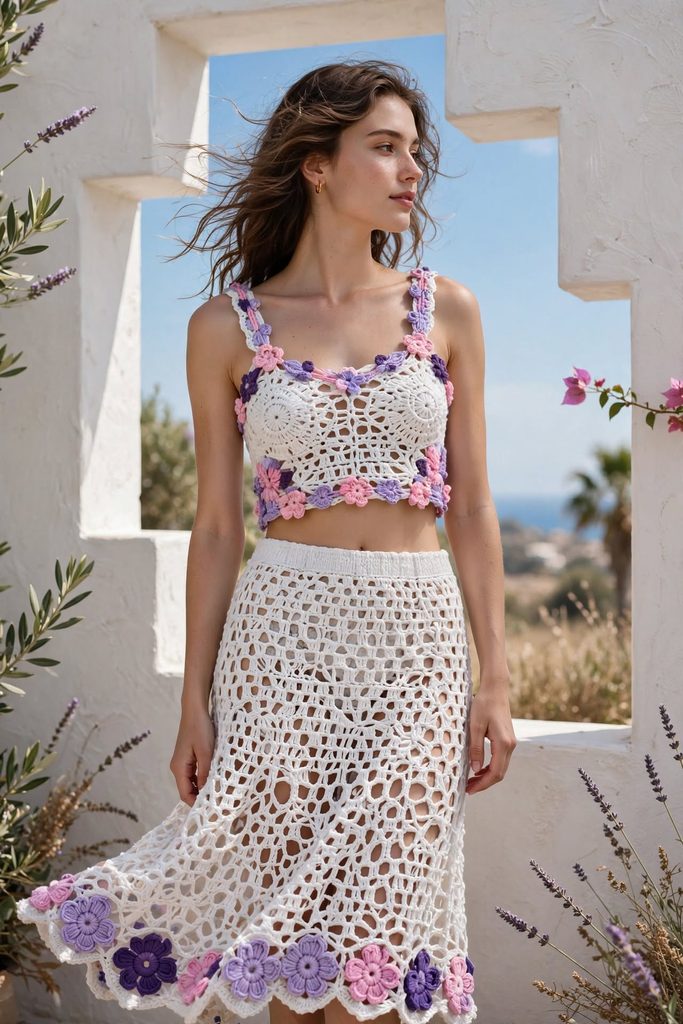
The holes in a crochet top are not a manufacturing error. They are architecture. Each negative space is a window the breeze requested. The pattern doesn’t hide the body; it negotiates with it. From three feet away, you see a silhouette. From one foot away, you see the geometry of the stitch. From six inches away, you see skin framed by cotton like a photograph in a handmade frame.
The mega-logic? A crochet outfit breathes better than linen, moves better than silk, and weighs less than a secret. It is the only clothing that gets cooler when the sun hits it — not because of some lab-engineered fabric, but because the air simply walks through it.
Wear it to a festival. Wear it to the market. Wear it on the day you decide that your body deserves to be housed in something that took time to exist.
The Flower That Moved to Your Chest
There was a time when flowers on clothing meant one of two things: grandmother’s couch, or a Hawaiian shirt worn ironically at a barbecue. The crochet set changed the terms.
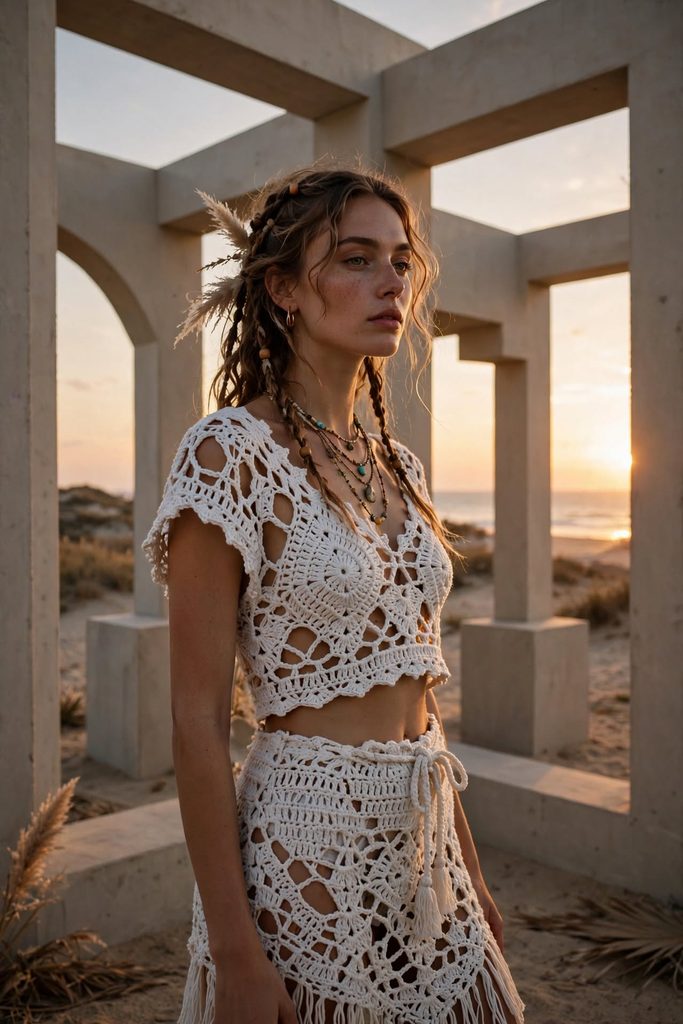
A flower appliquéd onto a crop top is not decoration. It is relocation. The maker looked at a garden, decided the bloom was in the wrong place, and moved it to the exact center of the chest. Now it doesn’t need soil. It needs a heartbeat.
The psychology is almost aggressive in its gentleness. A machine-printed floral dress says: I bought a pattern. A crocheted flower says: I built a bloom, petal by petal, and then I attached it to myself. It is wearable botany. It is the declaration that nature is not something you visit on weekends — it is something you wear on Tuesday.
And when the flower sits in a gradient of lavender, violet, and blush — colors that don’t exist in any single real blossom — it becomes something better than nature. It becomes intention. A flower that knows exactly where it belongs.
The Skirt That Refuses to Be a Circle
Most skirts obey geometry. A-line. Pencil. Circle. They start at the waist and follow a predictable path to the hem, like a good student drawing within the lines.
A crochet skirt with ruffles? It dropped out of geometry school.
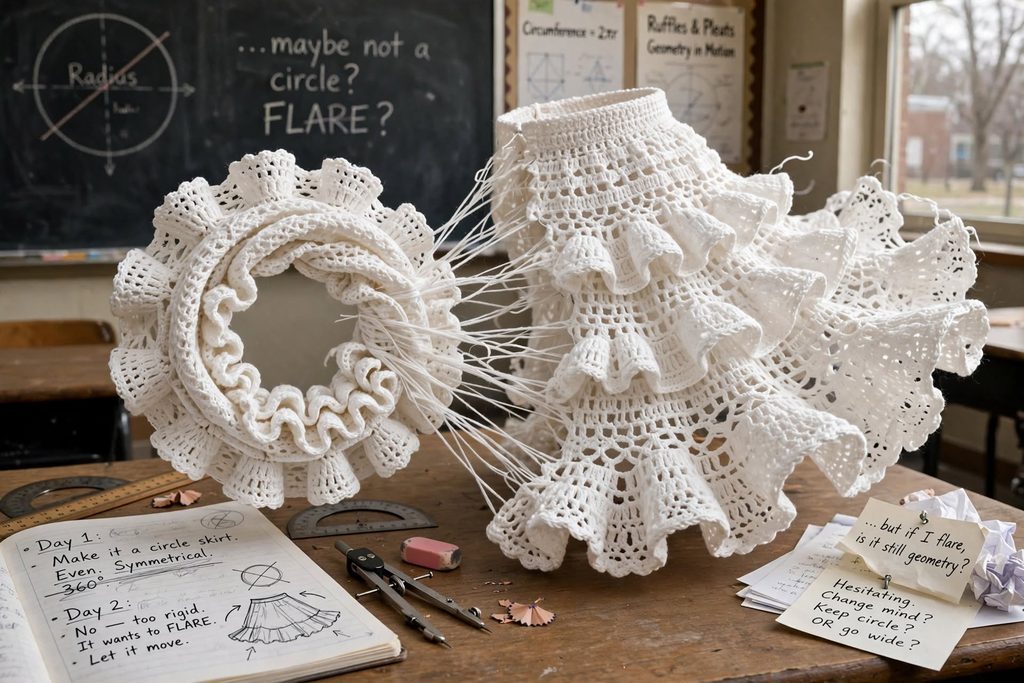
The ruffles don’t cascade evenly. They flare, they hesitate, they change their mind. The hemline argues with itself. One side wants to be shorter. The other side wants more volume. The result is a skirt that moves like a conversation — unpredictable, alive, slightly chaotic in the best way.
This is the secret power of handmade clothing: it doesn’t fit a pattern. It fits a person. The ruffles land where the body needs them. The waistband stretches exactly where hips exist. The skirt doesn’t hang on you; it agrees with you.
And when you walk, the ruffles do something no factory hem can replicate: they catch air, hold it for a split second, and release it like a sigh. You don’t walk in a crochet skirt. You sway. You become weather.
The Color Gradient Nobody Asked For
Here is the final surprise, the logic that ties the holes, the flower, and the ruffles together:
The colors of this set — lavender melting into violet, violet blushing into pink, pink cooling into sky — are not found in nature’s wardrobe department. Nature separates its colors. Lavender grows in fields. Pink grows in cherry trees. Blue grows in the sky above them both.
But crochet negotiates between kingdoms. It says: why should lavender and pink be neighbors only in a sunset? Why can’t they be neighbors on a waistband?
The gradient is not a dye job. It is a diplomatic mission. Each row of color argues with the next until they reach a compromise. The result is an outfit that looks like it was dipped in a twilight and pulled out before the dark could win.
Wear it at golden hour and you will disappear into the light. Wear it at noon and you become the only soft thing in a hard world. Wear it at midnight and you glow like a lantern made of yarn.
The Invisible Thread
A crochet set is not clothing. It is a timeline. Someone — maybe you, maybe a stranger on the other side of the world — sat with a hook and a ball of cotton and made a thousand tiny decisions. Tighter here. Looser there. A flower here. A ruffle there. Each stitch is a moment that cannot be rushed, duplicated, or automated.
In a world obsessed with speed, the crochet set is the ultimate rebellion: an outfit that says I took time. I took care. I took this Tuesday and turned it into something that makes summer apologize for ending.
Pick up a hook. Choose a color that doesn’t exist in fast fashion. And remember: the best outfit you will ever wear is the one that grew, stitch by stitch, from patience.