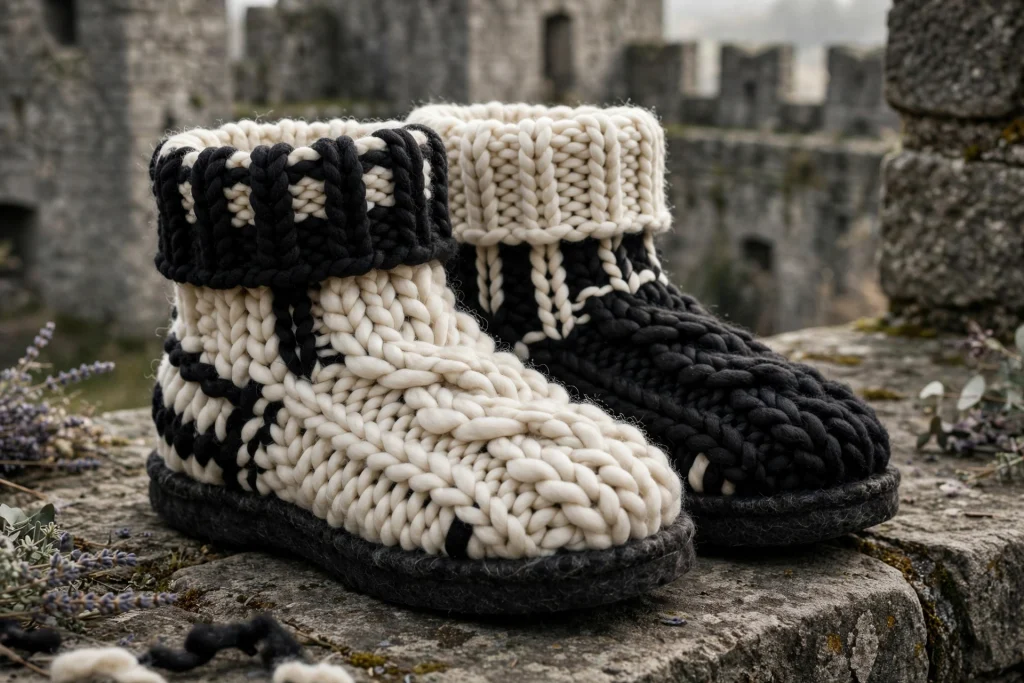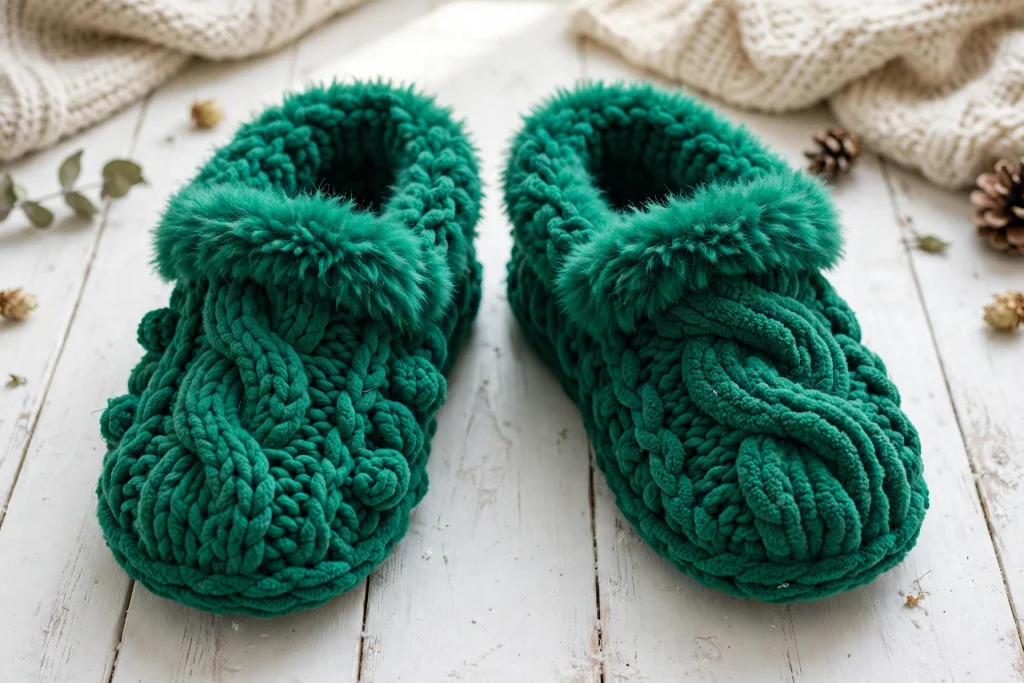
This post contains an affiliate link. If you click, you can check out and purchase the Cable Knit Slippers Knitting Pattern if you’d like. New users get 10 free downloads.
You do not put on these slippers.
You surrender to them. Your foot crosses the threshold of wool, and before your heel touches the floor, the yarn has already assessed your mood, adjusted its warmth, and offered you a squeeze that feels surprisingly like forgiveness. This is not footwear. This is a therapist — trained in the ancient art of making you feel like you belong exactly where you are standing.
Welcome to the only accessory in the house that understands comfort is not bought. It is constructed — from fiber, from tension, from the exact number of rows between your toes and your ankle.
In this article, you will learn:
- Why chunky knit slippers are the single most powerful upgrade for your evening routine
- The exact yarn weight that creates a slipper instead of a sock
- How to use a simple garter stitch to build architecture for your feet
- The felting formula that turns soft wool into armor against cold floors
- The 5 mistakes that make handmade slippers feel like punishment
Love Cable Knit Slippers Like Mine?
- • ✅ Worsted Weight Yarn – only 375 yards
- • ✅ 6mm Needles – Easy Project
- • ✅ Includes Video Tutorial + PDF
- • ✅ Perfect for Home & Everyday Use
New users get 10 free downloads on Creative Fabrica
Now, pick up your needles. The floor is waiting.
A pair of slippers so polite they apologize for the floor being cold.
Part I: The Yarn Is a Cloud You Can Walk On
Look at it. A strand of wool so thick it could hold a secret. It does not wrap around your foot. It envelops it.
Here is the textile paradox that breaks footwear logic: thin socks separate you from the floor. Chunky slippers negotiate with the floor. The super-bulky yarn — size 6 or 7, sometimes called “roving” or “jumbo” — creates a cushion so dense it absorbs the shock of hardwood, tile, and bad news. You are not walking on the ground. You are walking on a sheep’s best idea.
And the hand-knit construction? It is not nostalgia. It is engineering. A machine-knit slipper is uniform. It does not care about your high arch, your bunion, your tendency to curl your toes when the heating bill arrives. But hand-knit fabric has memory. It learns your foot. After three evenings of wear, the slipper stops being a shape and becomes a biography — your biography, written in wool.
Practical tip: For house slippers that actually stay on, choose yarn labeled “super bulky” (6) or “jumbo” (7). A single strand of super bulky on 10 mm needles creates a fabric thick enough to insulate but flexible enough to forgive. If you want a slipper that feels like a mattress, hold two strands of bulky together. The result is a loft so high your feet will need seatbelts.
Fiber matters: Use 100% wool or a wool-alpaca blend for structure and warmth. Acrylic is a liar — it feels soft in the ball, but underfoot it turns into a plastic bag within a week. Wool felts slightly with wear, which means your slippers get denser, warmer, and more personal over time. Acrylic just gets sad.
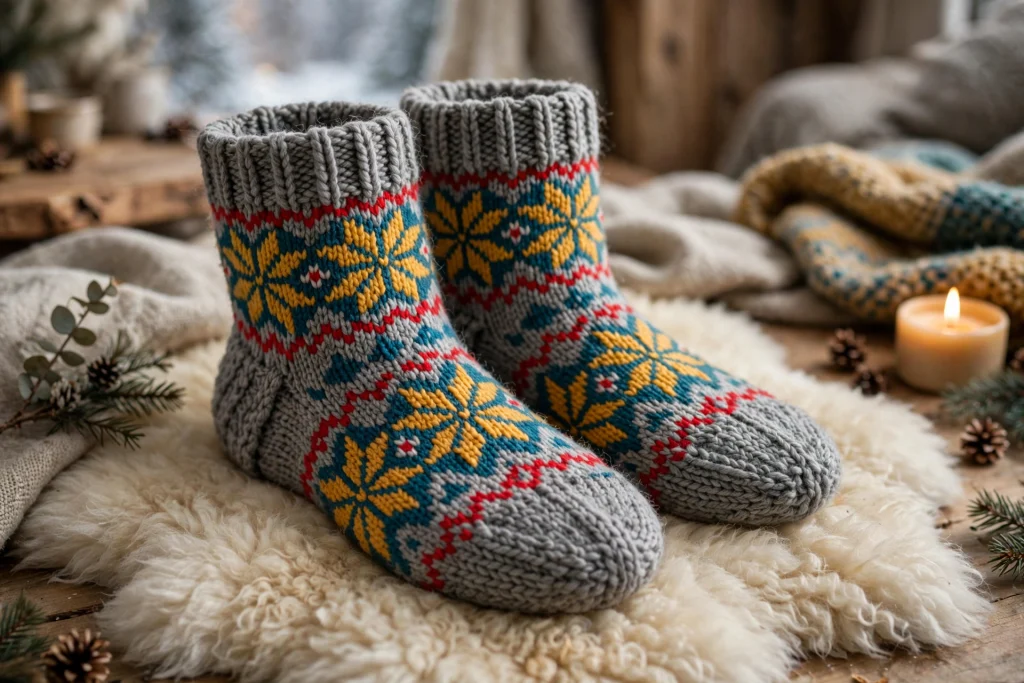
When your feet wear a rainbow and your soul finally breathes.
Part II: The Stitch Is a Conversation
Now, look closer. A garter stitch. Knit every row. That is the entire vocabulary of the simplest slipper.
But here is the twist: garter stitch is not laziness. It is geometry. The ridges create friction against the floor. The fabric is naturally wider than it is tall, which means it wraps around the foot like a hug instead of a tourniquet. And because every row is knit, the fabric is double-thick compared to stockinette — a built-in sole without sewing a second layer.
The megalogic that defeats complicated patterns: a slipper is not a sweater. It does not need cables. It does not need lace. It needs to stay on, stay warm, and stay out of the way. A basic garter-stitch rectangle, folded and seamed at the toe and heel, creates a bootie shape so intuitive it feels like the wool invented itself.
The basic architecture: Cast on 24 to 32 stitches depending on foot width. Knit a rectangle until it measures the length of your foot plus 2 inches. Fold in half. Seam the toe with Kitchener stitch or a simple three-needle bind-off. Seam the heel, leaving a 3-inch opening for your ankle. That is it. No heel flap. No gusset. No drama.
Sizing rule: The slipper should be ½ to 1 inch smaller than your actual foot length before wearing. Wool relaxes. A slipper that fits perfectly off the needles will turn into a flip-flop by February. Knit it snug. Let the yarn do the stretching.
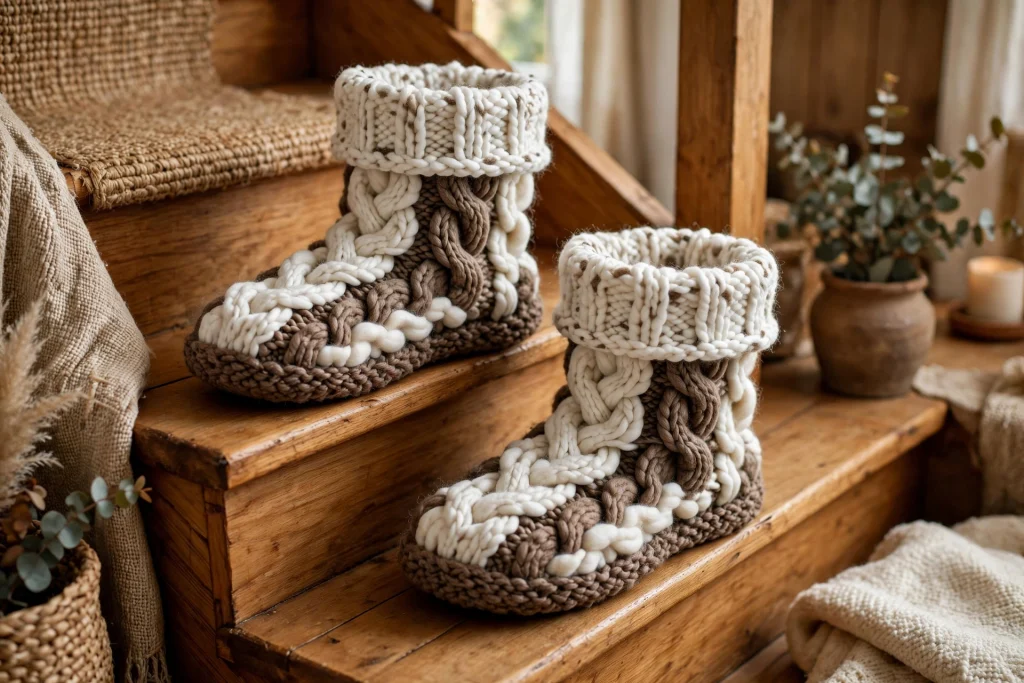
Boots so tall they judge your thermostat settings.
Part III: The Cuff Is a Doorway
Above the ankle, the wall rises. A ribbed cuff, two inches tall, folded over like a collar on a winter coat. It does not just keep the draft out. It announces that the slipper has boundaries.
Here is the secret that will ruin store-bought socks for you forever: a ribbed cuff is elastic architecture. Knit two, purl two. The columns of knit stitches recede. The purl stitches advance. The result is a tube that grips without squeezing, that stays up without leaving a mark, that says “I am secure here” without yelling.
And the practical magic? The cuff catches the warmth that rises from your foot like steam from tea. Without it, heat escapes through the ankle gap. With it, your entire lower leg enters a microclimate of coziness. The difference between a slipper with a cuff and a slipper without is the difference between a tent and a cabin.
DIY or buy: If you knit, cast on 8 to 10 fewer stitches than the foot on smaller needles (8 mm instead of 10 mm) and work K2, P2 ribbing for 15 to 20 rows. Fold the top row inward and whip-stitch it down for a doubled, pillowy edge. If you buy handmade, look for a cuff that stands up on its own when empty. A floppy cuff is a draft waiting to happen.
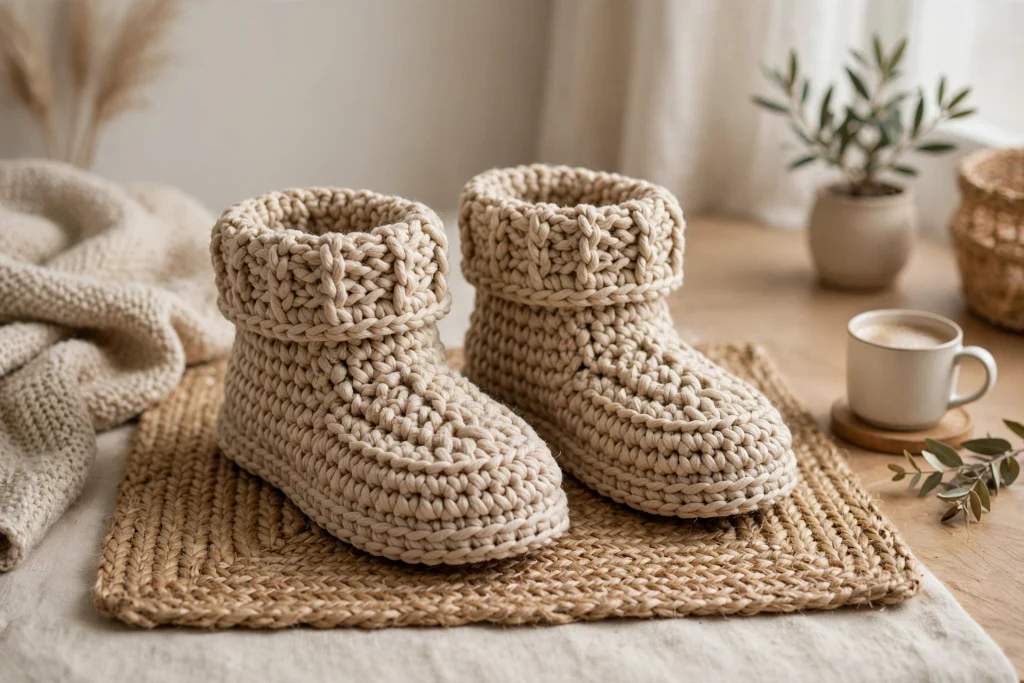
When your slippers look like they just woke up from a nap.
Part IV: The Sole Is a Secret
Look down. The bottom of the slipper. It looks like the top. Same yarn. Same stitches. Same trust.
But here is the twist: the sole is where slippers die. Friction. Moisture. The slow abrasion of daily existence. A pure wool sole on hardwood will felt into a flat, dense pad within a month — which is beautiful, unless you wanted it to stay fluffy.
The solution is not a second sole. It is prevention. Before you wear them, apply a thin layer of liquid latex or fabric puff paint to the bottom in a dot pattern. It dries clear, flexible, and grippy. Your slippers gain traction without losing soul. Or, for the purists, knit the bottom in a tighter gauge — go down two needle sizes for the sole section only. The fabric becomes armor. The top stays cloud.
Felting wisdom: If your slippers are too loose, throw them in the washing machine with hot water and a pair of jeans. Agitation + heat = controlled shrinkage. Check every five minutes. Pull them out when they fit like they were born on your feet. Block them over your actual feet while damp. You now have custom-molded footwear that no factory can replicate.
Color temperature pairing: If your living room is warm neutrals, choose oatmeal, taupe, or rust. If your soul needs joy, choose mustard, teal, or a Nordic fair-isle pattern that makes your ankles look like they are attending a festival. Mismatched slippers — one teal, one rust — are not a mistake. They are a personality.
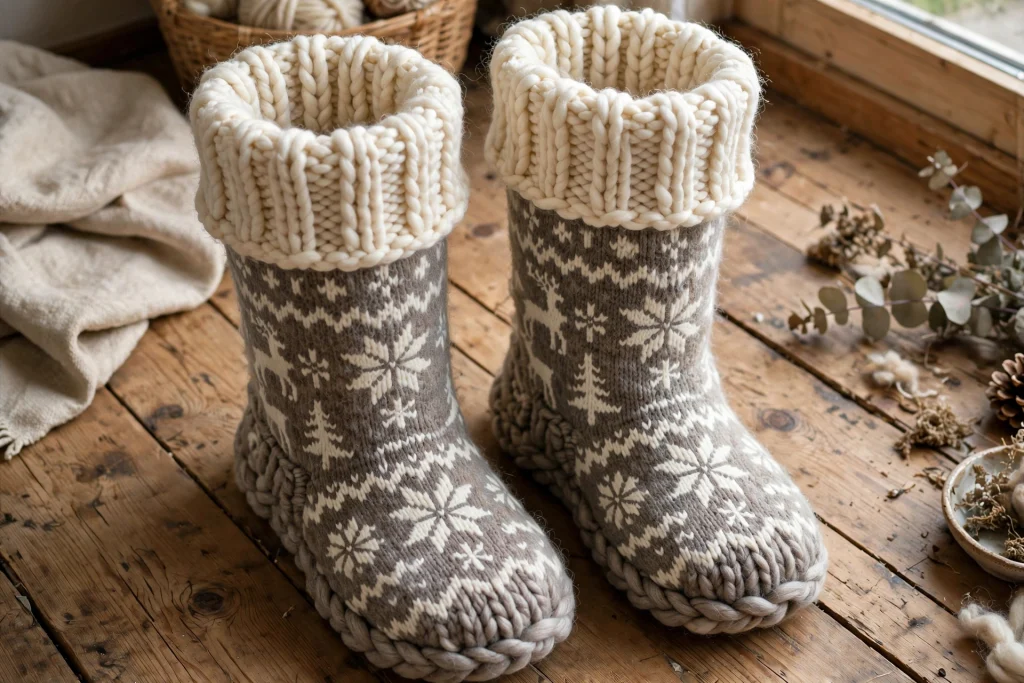
For days when you want your feet to feel like they are wearing a fortress.
Part V: The Ritual Is the Point
A jute basket by the door. Natural fiber, slightly rough, the color of sand. Inside, a pair of hand-knit slippers waits like a handshake — the house’s way of saying, “I am solid. You are safe. Take off your shoes.”
Here is where logic completely dissolves: a handmade slipper should not feel too precious to wear. The hand-spun art yarn is beautiful, yes, but fragile. The practical slipper is knit from sturdy wool, slightly rough, built for duty. It catches the day’s residue so the rest of your evening does not have to. It is the only element in your wardrobe that exists to be used, not admired.
Sizing rule for gifts: If you are knitting for someone else, measure the length of their foot from heel to longest toe. Subtract 1 inch. That is your target length before seaming. A slipper that fits a stranger is a slipper that stays in the closet. A slipper that fits like a secret is a slipper that gets worn until it has holes.
Plant placement: This has nothing to do with slippers. But every knitter needs a plant nearby. Something low-light and forgiving. A snake plant in a ceramic pot that echoes your yarn basket. Water it when you finish a pair. Celebrate completion with growth.