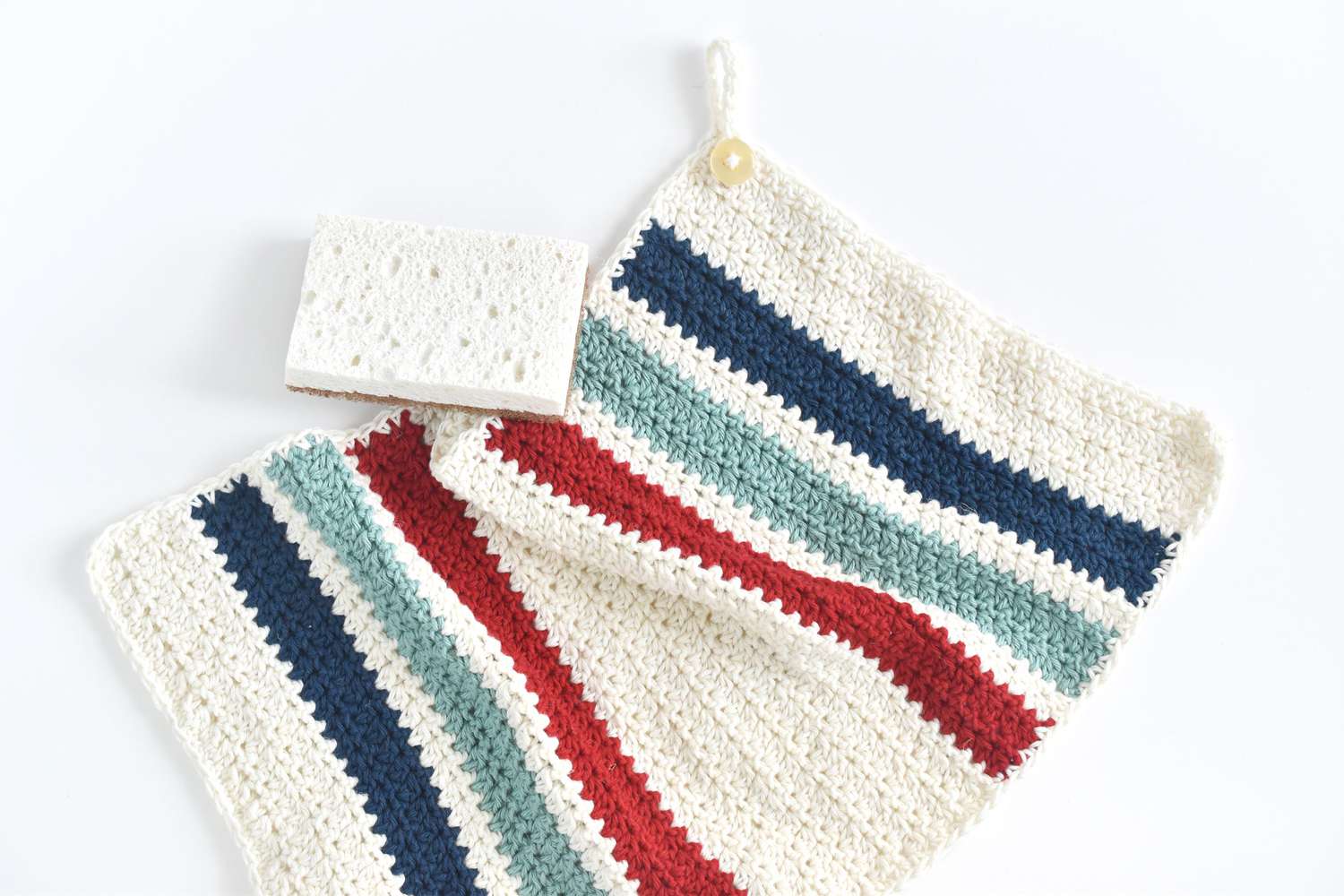
You do not dry your hands with this towel.
You thank them. You thank them for holding the coffee mug, for carrying the groceries, for typing the emails. And in return, they meet cotton — soft, thirsty, striped in colors that have no business being this cheerful in a room where drains live.
This is not a towel. It is a mood regulator disguised as household linen.
In this article, you will learn:
-
Why three bright stripes are the secret to a kitchen that feels alive
-
The exact stitch combo (SC + DC) that creates texture without complexity
-
How one cone of white cotton becomes an entire gift set
-
The border trick that elevates “homemade” to “artisan”
-
The 5 mistakes that turn a hand towel into a dish rag
Now, pick up your hook. The sink is waiting.
Part I: The Stripe Is a Conversation
Look at it. White, interrupted. A band of guava pink. A band of pastel blue. A band of sunflower yellow. Each stripe is only two rows tall — barely a whisper — but together they form a sentence. White says “I am clean.” Guava says “I am fun.” Blue says “I am calm.” Yellow says “I am awake.”
Here is the color theory that breaks interior design rules: you do not need to match your towels to your tiles. You need them to apologize for your tiles. Beige countertop? Boring. Beige countertop with a hand-crocheted towel in tropical stripes? Curated. The towel becomes the accessory that makes everything else look intentional.
And the practical magic of the stripe placement in this pattern? It is symmetrical. Guava at the top, Guava at the bottom. Blue and Sunflower mirror each other around the center. The eye reads this as balance, even if the viewer has never crocheted a stitch. It feels designed. Because it is.
Yarn math that will make you feel smart: One 700-yard cone of white cotton + three 131-yard rolls of color = one hand towel + three matching dishcloths. That is four handmade gifts from four skeins. The economics of generosity have never looked better.
Part II: The Stitch Is a Lie Your Hands Love
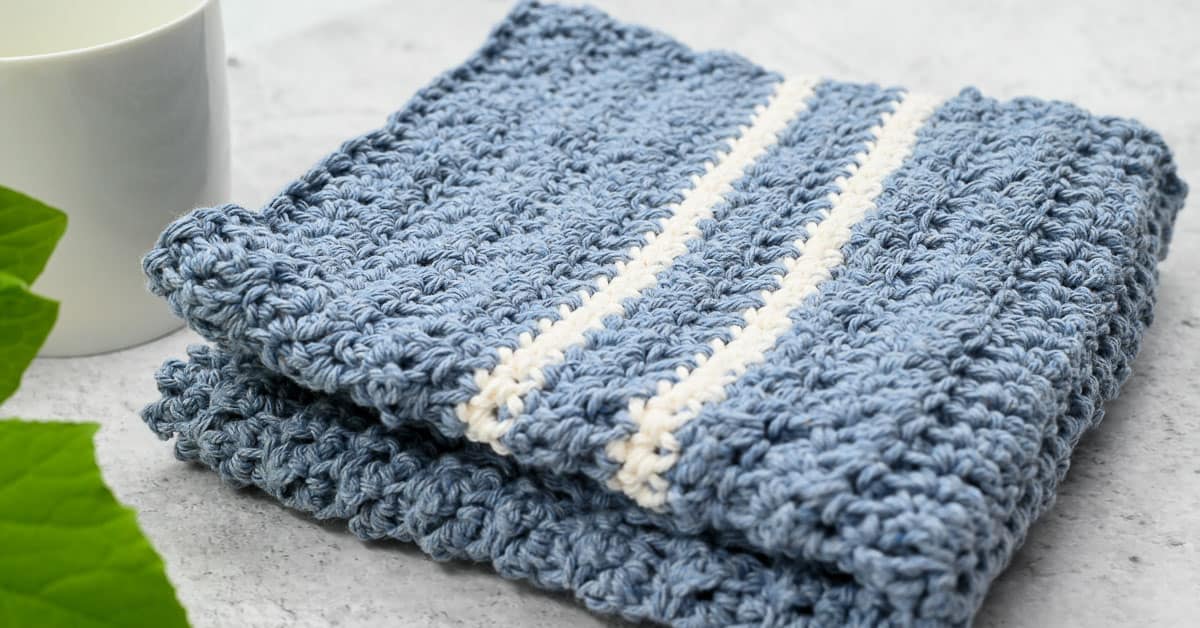
Single crochet. Double crochet. That is the entire vocabulary of this towel.
But here is the twist: alternating them creates a texture illusion. The single crochet sinks. The double crochet rises. Row by row, they negotiate with each other until the fabric becomes a ridged landscape — absorbent, scrubby, yet soft enough for your face. It looks like waffle weave. It behaves like a sponge. It is actually just SC, DC, SC, DC repeated until your row counter tells you to stop.
The megalogic that defeats complicated patterns: repetition is meditation. You do not need to count to twelve. You do not need to front-post, back-post, or twist yourself into a cable. You need one row of singles and doubles, then one row of doubles and singles. The pattern reverses itself every other line, which means your brain can wander while your hands do the work.
The foundation chain: 45 chains. That is it. Not 145. Not 445. Forty-five. Small enough to finish in an evening, large enough to actually dry a human hand without feeling like a coaster.
Part III: The Cotton Is a Promise
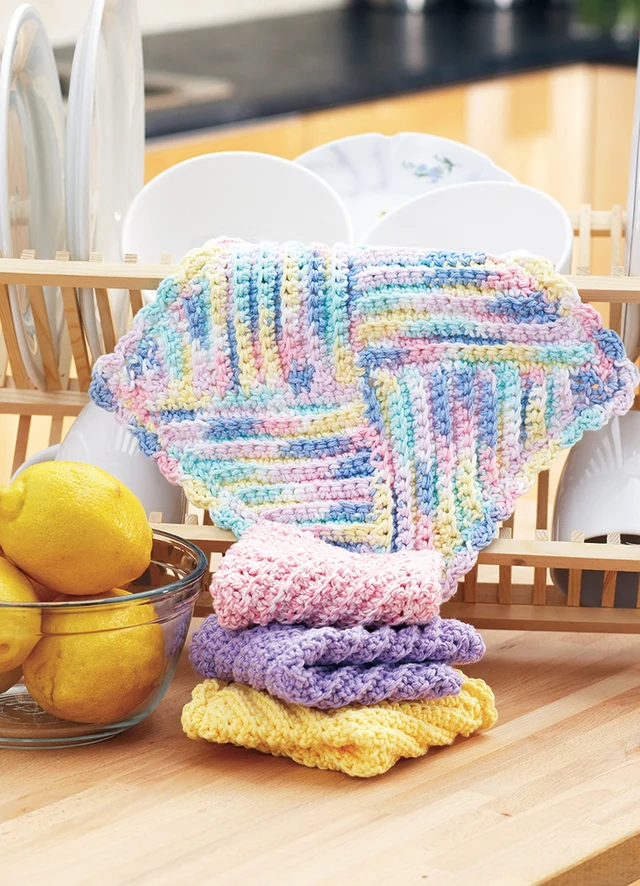
Premier Home Cotton. Not acrylic. Not wool. Not that fuzzy yarn that sheds like a golden retriever in July.
Cotton makes promises that synthetic fibers cannot keep. It absorbs. It launders. It softens with every wash instead of pilling into sadness. A cotton hand towel used daily for six months will feel better than it did on day one — the fibers relax, the texture blooms, the stripes settle into their identity.
And the color? Cotton takes dye honestly. Guava is guava. Sunflower is sunflower. There is no metallic sheen, no plastic shine — just pigment doing its job. When you hang this towel on a brass hook by the sink, it does not compete with the hardware. It complements it.
Care instructions that will save your sanity: Machine wash warm, tumble dry low. No special treatment. No hand-washing guilt. Cotton forgives. Cotton forgets. Cotton shows up tomorrow ready to dry another set of hands.
Part IV: The Pattern Is a Journey

Now, the practical magic. Here is how you turn one cone of white and three pops of color into a towel that makes guests ask, “Where did you buy this?”
The Setup:
-
Hook: Size H (5.00 mm) — the Goldilocks of crochet hooks, not too tight, not too loose
-
Foundation: Chain 45
-
Base row: Single crochet in the second chain from hook, then alternate DC, SC across. End with a DC in the final stitch. Chain 1, turn.
The Rhythm:
Rows 2–5: Continue the SC, DC dance in white. At the end of Row 5, switch to Guava (Color A).
Rows 2–5: Continue the SC, DC dance in white. At the end of Row 5, switch to Guava (Color A).
Rows 6–7: Two rows of Guava. Switch back to white.
Rows 8–9: Two rows of white. Switch to Pastel Blue (Color B).
Rows 10–11: Two rows of Blue. Back to white.
Rows 12–13: Two rows of white. Switch to Sunflower (Color C).
Rows 14–15: Two rows of Sunflower. Back to white.
The Mirror:
Rows 16–42: White continues the rhythm. Then you mirror the color sequence in reverse — Sunflower, white, Blue, white, Guava, white — until Row 57. The towel becomes a palindrome. The top half and bottom half are reflections of each other, separated by a wide white center that says “I have room to breathe.”
Rows 16–42: White continues the rhythm. Then you mirror the color sequence in reverse — Sunflower, white, Blue, white, Guava, white — until Row 57. The towel becomes a palindrome. The top half and bottom half are reflections of each other, separated by a wide white center that says “I have room to breathe.”
The Color Change Trick: Do not cut the yarn at every stripe. Carry the inactive color loosely up the side edge, trapping it in the turning chain. When you finish the towel, the carried strands become invisible inside the border. Less weaving. More living.
Part V: The Border Is Optional (But You Will Want It)

At Row 57, you have a choice. You can fasten off, weave in the ends, and call it finished. The towel works. It dries. It hangs. It is enough.
Or — and this is where “homemade” becomes “heirloom” — you can add a slip-stitch border around all four edges. Chain 1, do not turn, slip stitch down the side, across the bottom, up the other side, across the top. One round. Five minutes. The result? A smooth, corded frame that makes the towel look like it came from a boutique in Provence, not your couch at 10 PM.
Here is the practical truth: crochet edges are wobbly. The tension varies. The sides pucker. A slip-stitch border is not decoration. It is arbitration. It negotiates peace between the top edge and the side edge. It gives the towel a spine.
The 5 Mistakes That Ruin a Crochet Towel
1. Using acrylic yarn
Acrylic repels water. It is literally plastic. A wet acrylic towel is a wet dog that never dries. Use 100% cotton or prepare for mildew and regret.
Acrylic repels water. It is literally plastic. A wet acrylic towel is a wet dog that never dries. Use 100% cotton or prepare for mildew and regret.
2. A hook that is too small
A 4.00 mm hook creates a fabric so dense it could be used as armor. The H (5.00 mm) hook gives you drape and absorbency. Do not fight the fabric.
A 4.00 mm hook creates a fabric so dense it could be used as armor. The H (5.00 mm) hook gives you drape and absorbency. Do not fight the fabric.
3. Skipping the gauge swatch
If your 44 stitches measure 8 inches instead of 10, your towel will be a washcloth. Swatch. Block. Measure. Then proceed.
If your 44 stitches measure 8 inches instead of 10, your towel will be a washcloth. Swatch. Block. Measure. Then proceed.
4. Cutting yarn at every color change
You will have 47 ends to weave in. Carry the yarn up the side. Your future self — the one who has to finish this before the birthday party — will thank you.
You will have 47 ends to weave in. Carry the yarn up the side. Your future self — the one who has to finish this before the birthday party — will thank you.
5. Forgetting the hanging loop
Add a chain-8 loop at one corner before the final border round. Every hand towel needs a way to live on a hook. Otherwise it lives on the counter, and a counter towel is a towel that has given up.
Add a chain-8 loop at one corner before the final border round. Every hand towel needs a way to live on a hook. Otherwise it lives on the counter, and a counter towel is a towel that has given up.
Epilogue: Hang the Happiness
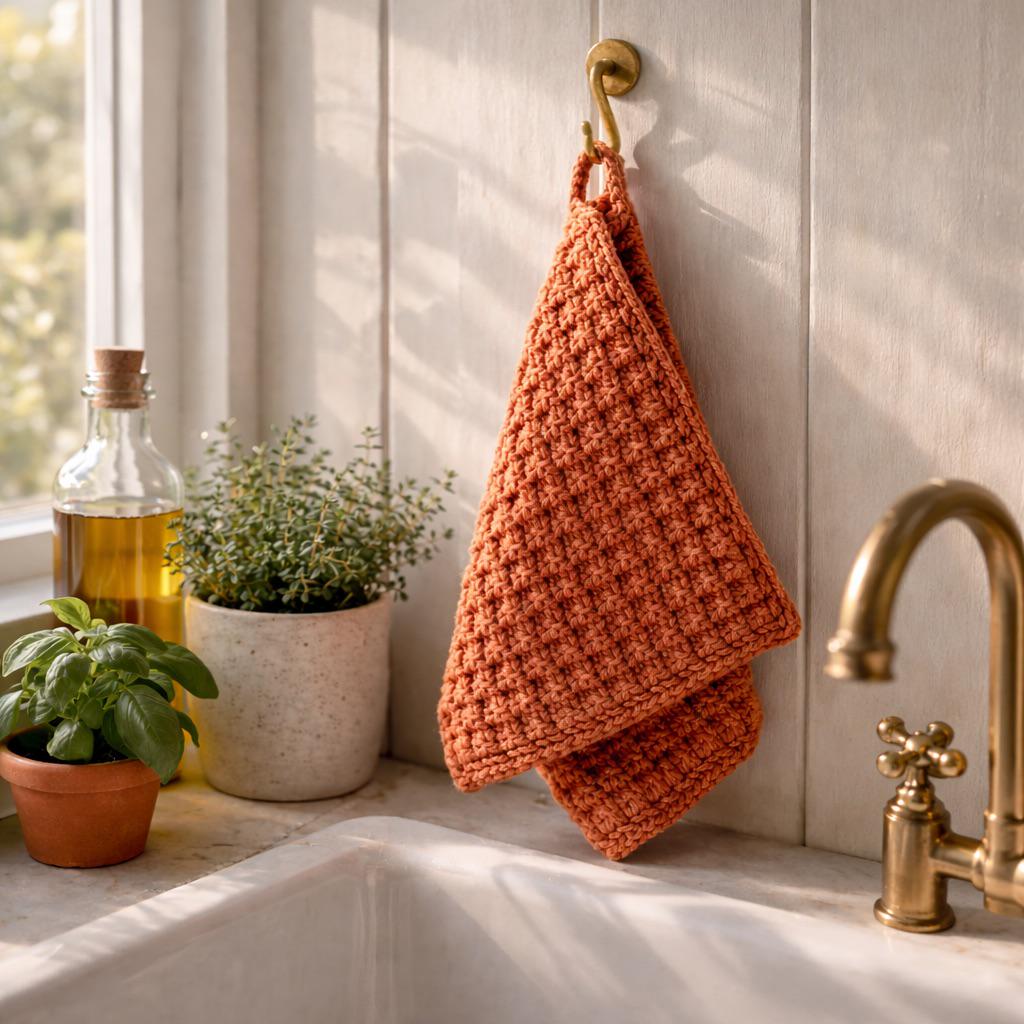
So here is the truth, delivered with the gentleness of cotton against wet skin:
Your kitchen does not need another factory towel with a corporate logo. It needs a towel that remembers your hands. A towel that took three evenings, two podcasts, and one moment of “Did I switch to Guava at the right row?” A towel that makes drying your hands feel like a ritual instead of a chore.
Make the set. Three dishcloths with single stripes. One hand towel with the full rainbow. Wrap them in twine. Give them to the friend who just bought a house, or to the friend who needs to remember that handmade things still exist.
Or keep them. Hang them where you will see them every morning. Let the Guava wake you up. Let the Sunflower stay with you through dinner. Let the Pastel Blue calm you down before bed.
Because the crochet hand towel that makes drying your hands feel like a spa ritual is not about drying. It is about noticing. Noticing that your hands work hard. That cotton is kind. That a stripe is a small rebellion against a beige world.
Now go chain 45. The water is running.
Happy crocheting.