Tag: crochet clothing

  • The Yellow Crochet Set: Why Wearing Sunshine Requires Holes

    The Yellow Crochet Set: Why Wearing Sunshine Requires Holes

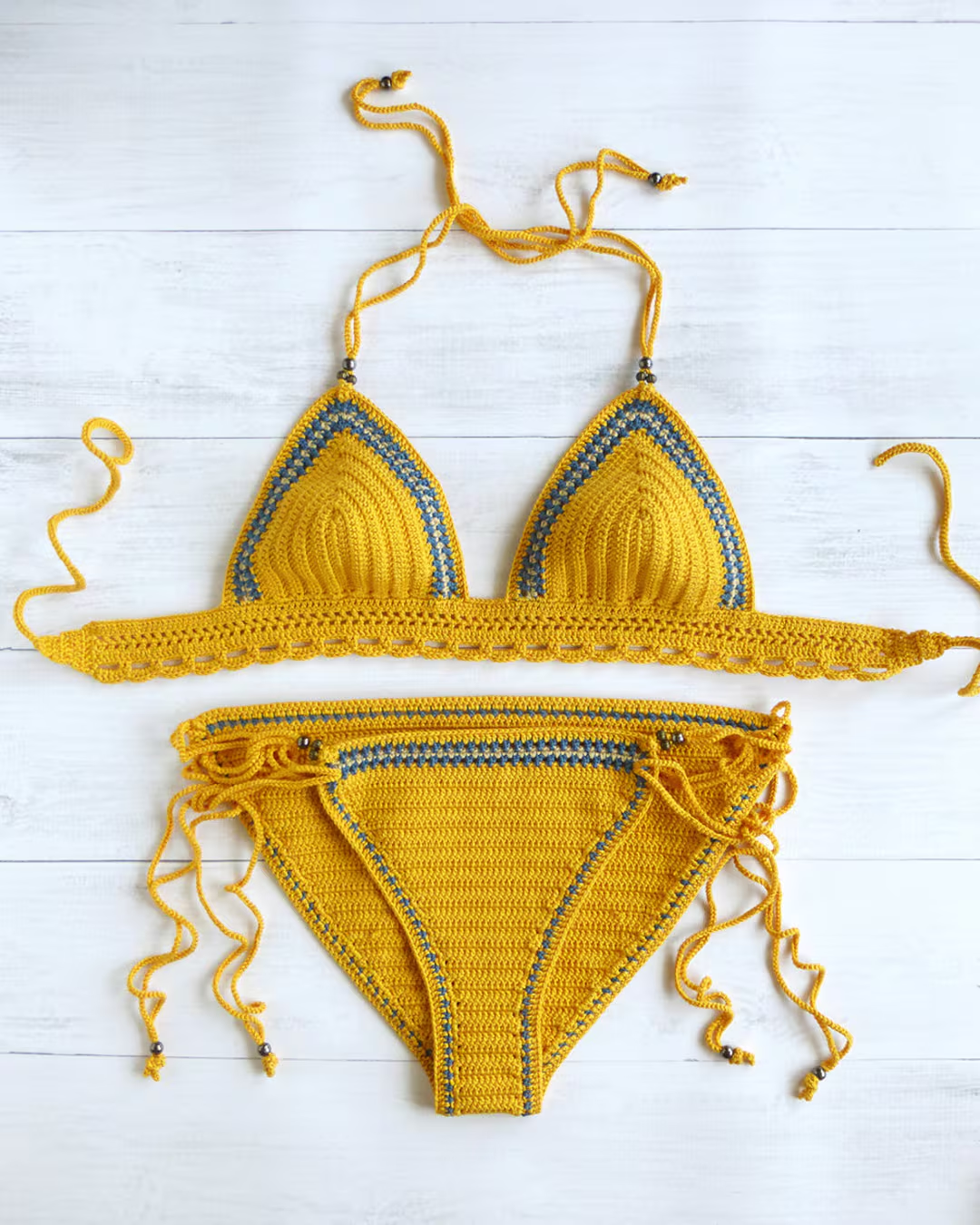
    Handmade yellow crochet bikini set laid flat on white wooden surface — mustard cotton two-piece with scalloped edges and tie straps You do not put on this outfit.

    You step into a conspiracy between fiber and physics. You agree to become visible. Not in the polite, Instagram-filtered way. I mean actually visible — the way a sunflower is visible to a bee from three gardens away. The way a traffic light is visible to someone who has not had coffee yet. The way joy is visible when it refuses to apologize for existing.
    Welcome to the yellow crochet two-piece. The garment that asks: What if confidence had a color?

    Part I: The Holes Are the Point

    Look at it. Mustard-bright, unapologetic, full of gaps that would make a tailor weep.
    Here is the first paradox that unravels fashion logic: coverage is not protection. A denim jacket covers you completely and weighs you down like a denim exoskeleton. A crochet set covers you selectively and somehow makes you feel more held. The holes are not defects. They are ventilation for the soul. They let the breeze in. They let the self out. They announce to the world: “I am here, and I am not interested in hiding.”
    Each open stitch is a tiny window. A window into the skin, yes, but also into the philosophy of the maker. Someone — a real person with real fingers, probably while listening to a podcast about true crime or sourdough — looped this cotton one stitch at a time. They chose the yellow. They chose the holes. They chose to make something that cannot be mass-produced because no machine has the patience to pause, adjust, and continue.
    The holes are not absence. They are intentional vulnerability. And vulnerability, it turns out, is the most magnetic thing you can wear.

    Part II: The Skirt Is a Mandala
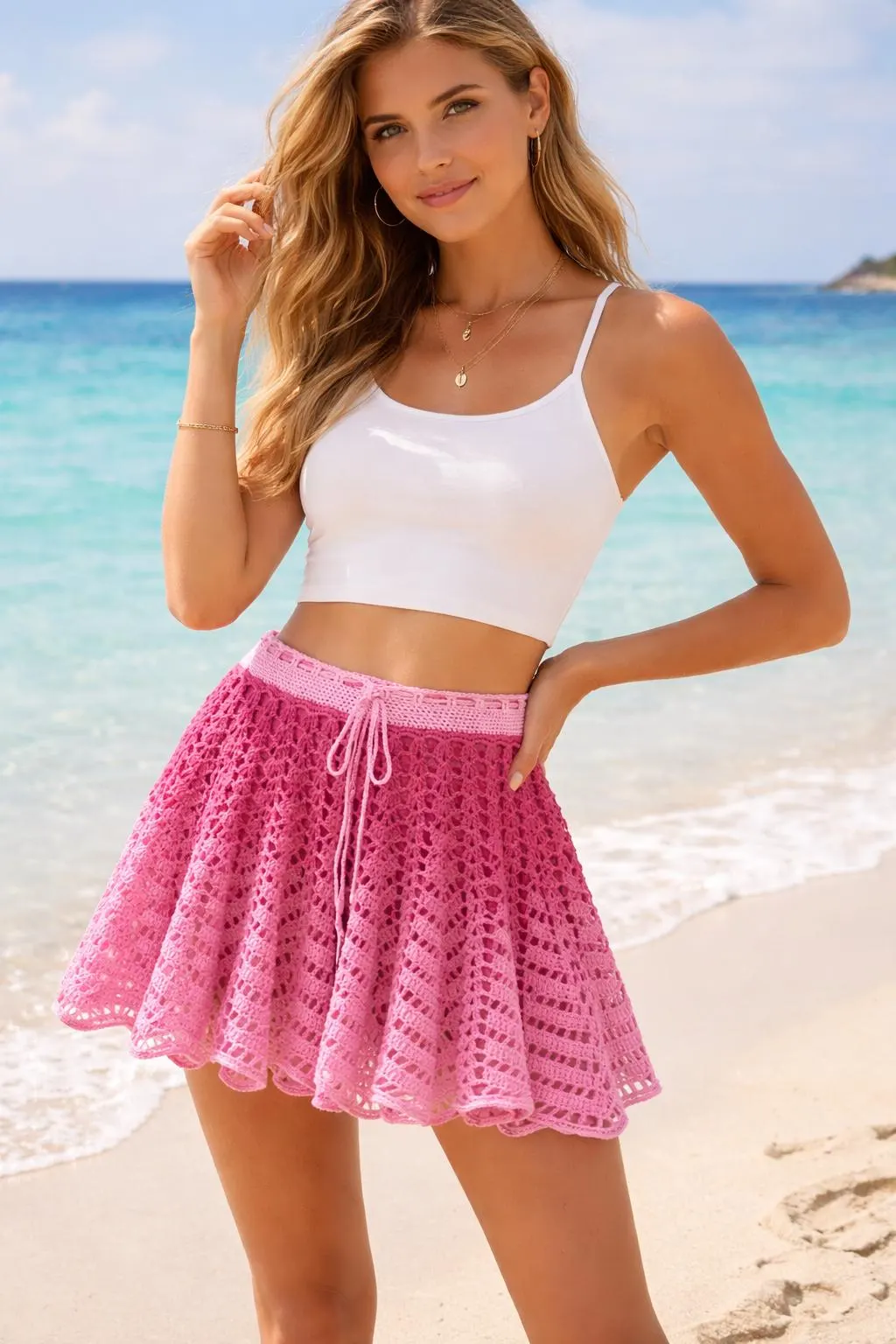
    Woman wearing pink crochet mini skirt on tropical beach — handmade cotton beachwear over white crop top with ocean background
    Now, the skirt. Flared. Circular. A geometry lesson in wearable form.
    A circle skirt is not just a shape — it is a philosophy of expansion. It starts at the waist, small and controlled, and grows outward with mathematical generosity. Row by row, the increases create waves. By the hem, the fabric is doing calisthenics. It spins. It floats. It creates a personal weather system of air and motion around your legs.
    But here is the twist: a crochet circle skirt is a fractal. Each round is a larger version of the one before it. The pattern repeats, but the scale changes. You are wearing a Mandelbrot set made of cotton. You are wearing the same logic that builds seashells and galaxies. And when you twirl — and you will twirl, because physics demands it — the skirt becomes a yellow hurricane, a personal sunspot, a vortex that pulls the attention of everyone in the farmers’ market.
    The flat-lay does not capture this. The flat-lay is a corpse. The skirt is alive only when it moves, when gravity and centrifugal force negotiate its shape in real time.
    You are not wearing a skirt. You are wearing a conversation between you and the air.

    Part III: The Top Is a Frame
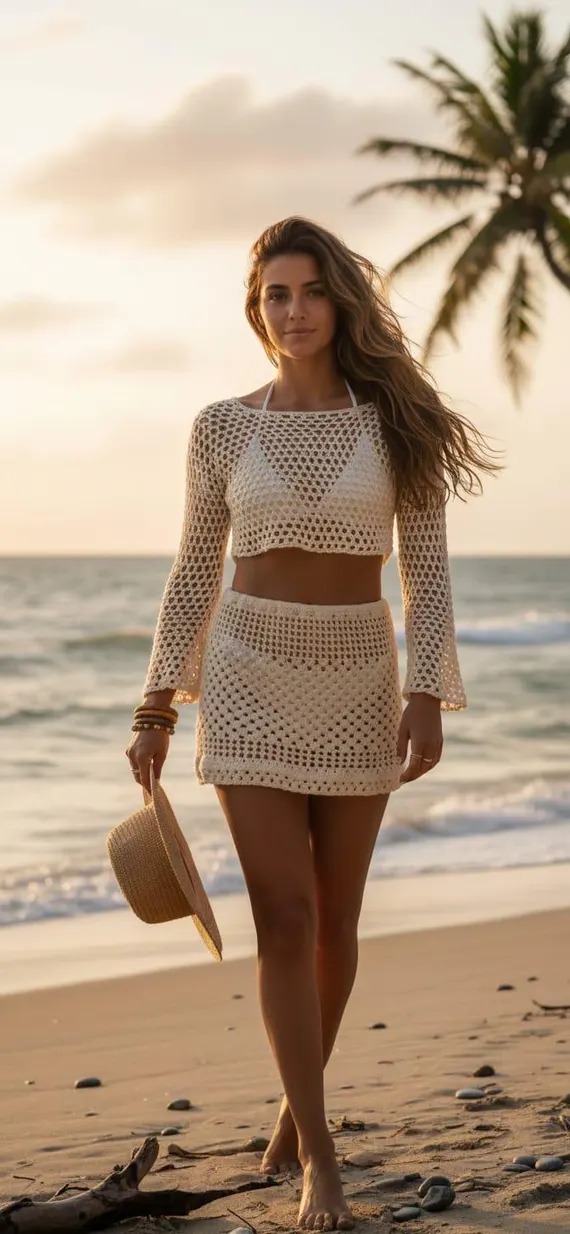
    Woman in cream crochet two-piece set walking on sunset beach — handmade boho crop top and skirt with palm trees and golden hour light
    A two-piece set is not two garments. It is one statement, bisected by a waistline.
    The top — cropped, scalloped, perhaps with a bow at the center — does not cover the torso so much as curate it. It frames the collarbone like a museum piece. It draws a line under the bust and says, “Everything below this is skirt territory. Everything above this is sky.”
    And the bow. Let us discuss the bow. In a world of zippers and snaps and the violent efficiency of fasteners, a bow is a romantic anachronism. It says: “I could have been closed with Velcro, but I chose drama.” A bow requires two hands. A bow requires patience. A bow requires someone else — or yourself, in a mirror, performing a small daily ritual of self-tying.
    The scalloped edges? They are not decorative. They are soft geometry. A straight edge says factory. A scalloped edge says human hands were here. Each curve is a tiny rebellion against the tyranny of the straight line. The top does not end; it ripples to a conclusion.
    You are not wearing a crop top. You are wearing a frame for your own solar plexus. And it is glowing.

    Part IV: Yellow Is Not a Color — It Is a Frequency

    Model wearing colorful crochet bikini top and shorts against bright blue sky — handmade summer beachwear with shell detail and tie sides
    Now, the yellow. Oh, the yellow.
    Science tells us that yellow is the most visible color to the human eye. It sits in the spectrum at around 570 nanometers, screaming for attention while blue sulks in the corner and gray files its taxes. But this is not just any yellow. This is mustard crochet yellow — warm, earthy, slightly vintage, the exact shade of a 1970s kitchen and a sunflower having a baby.
    Here is the megalogic that breaks the color wheel: yellow does not reflect light. It generates it. A black dress absorbs photons like a velvet vampire. A white dress reflects them politely. But a yellow crochet set? It seems to produce its own luminescence. It glows in shade. It hums in sunlight. It turns overcast Tuesday afternoons into personal music videos.
    And when you wear it to the beach — because this is where this set was born to live — something alchemical happens. The yellow against blue water. The crochet against bare skin. The handmade against the infinite. You become a color correction for a world that has forgotten how bright it can be.
    You are not wearing yellow. You are wearing the visible spectrum’s best argument for optimism.

    Epilogue: The Outfit That Makes You Brave

    So here is the truth, delivered with the gentleness of cotton against sun-warmed skin:
    You will hesitate before wearing this. You will hold it up in the mirror and think, “Is this too much?” The answer is yes. It is absolutely too much. That is the entire point.
    We live in an era of beige safety. Of algorithmic fashion. Of outfits designed to offend no one and inspire no one. The yellow crochet two-piece is the antidote. It is handmade. It is loud. It has holes where society says there should be walls. It spins. It glows. It demands to be seen.
    And when you finally put it on — when you tie the bow, when you step into the skirt, when you walk into the light — you will feel something shift. Not in the fabric. In you.
    You will feel brave. Because you chose to wear sunshine. And sunshine does not ask for permission.
    Now grab your hook. Or your credit card. Or simply your courage. The yellow is waiting. And so is the world.
    Happy crocheting.
  • The Vest That Rewired My Brain: A Love Letter to Crochet Geometr

    The Vest That Rewired My Brain: A Love Letter to Crochet Geometr


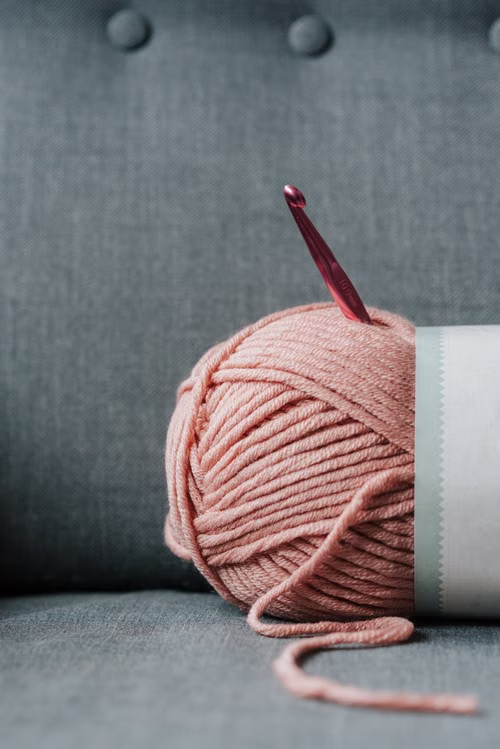
    Soft pink yarn ball with crochet hook - beginner crochet vest supplies
    They say the fastest way to slow down time is to learn something new. I disagree. The fastest way to slow down time is to crochet a vest.
    Not knit. Crochet. There is a difference, and that difference is the exact reason your brain — yes, yours, scrolling at 2 AM through Pinterest patterns — is quietly begging for this kind of therapy.
    Let me explain the illogical logic of it all.

    Part I: The Yarn Is a Liar (And That’s Beautiful)

    Look at this innocent ball of yarn. Soft. Pink. Docile. You think you’re buying a craft supply. You’re wrong. You’re buying a temporal contract.
    Here’s the paradox: yarn is one continuous line. A single thread, mathematically infinite in its divisibility, yet finite in your hands. When you crochet a vest, you are not creating fabric. You are creating loops within loops within loops — a topological miracle where every stitch is both a beginning and an ending.
    The ancient Greeks would have lost their minds. Zeno’s paradox asks: if you keep dividing a distance in half, do you ever reach the end? A crochet vest answers: Yes, but only if you enjoy the journey so much that you stop caring about the destination.
    Each double crochet is a tiny rebellion against instant gratification. In a world of one-click shopping and 15-second videos, the crochet vest demands something radical: your sustained attention for twelve consecutive hours. And here’s the twist — your brain loves it. The repetitive motion triggers a theta-wave state, the same neural frequency achieved by seasoned meditators. You’re not making a garment. You’re hacking your own consciousness.

    Part II: The Geometry of Cozy

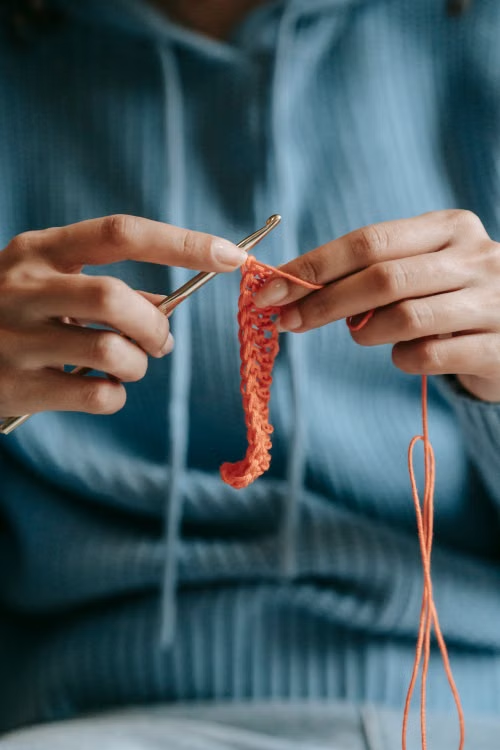
    Hands crocheting orange yarn - close up of crochet vest stitches in progress
    Now, observe the hands. The fingers. The hook piercing the loop with surgical precision.
    What you’re witnessing is applied geometry in motion. That zigzag pattern on the vest you saw? It’s not just boho aesthetics. It’s a chevron wave — a mathematical function made tactile. When you follow a crochet vest pattern, you are essentially reading a spatial algorithm and executing it with wool. Row by row, you’re solving a three-dimensional equation where the variables are tension, yarn weight, and your own patience.
    But here’s where logic bends: the vest has no seams. Think about that. Unlike sewn clothing — assembled from flat panels like architectural blueprints — a crochet vest emerges as a continuous, organic structure. It grows like coral. Like a snowflake. Like something alive.
    Scientists call this emergent complexity: simple rules creating infinitely complex results. One stitch. Repeat. Increase. Decrease. And suddenly — suddenly — you’re wearing a garment that did not exist in the universe twelve hours ago. You have pulled order from chaos, warmth from string, identity from nothingness.
    Is it any wonder that people who crochet report lower cortisol levels? You’re not crafting. You’re conducting a symphony of serotonin.

    Part III: The Vest as Autobiography

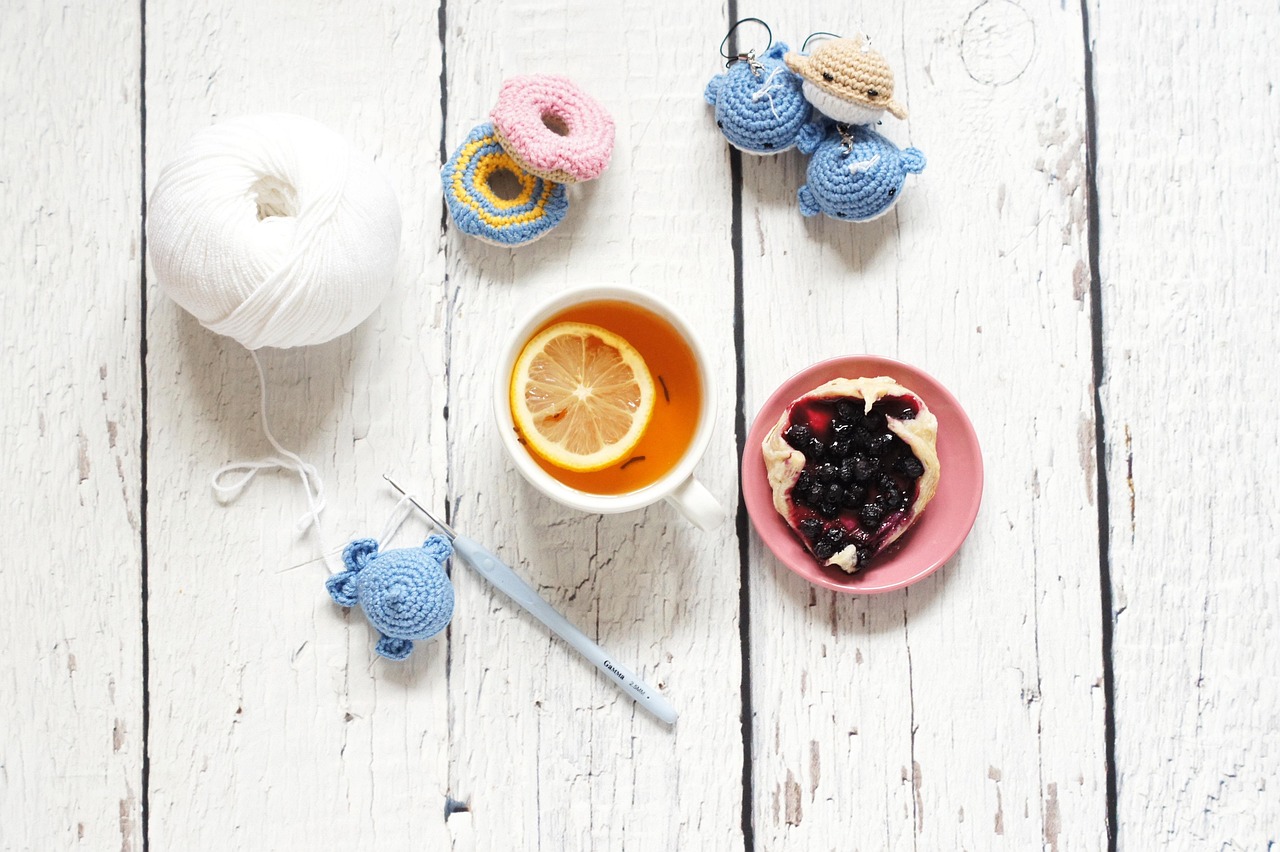
    Cozy crochet workspace with tea, yarn and handmade amigurumi - mindful crafting setup
    Look at this scene. Tea. A half-finished amigurumi whale. The quiet chaos of creation.
    Here’s a secret no one tells beginners: your first crochet vest will be ugly. The tension will be uneven. The armholes will be suspicious. You will wear it anyway, and it will become your favorite piece of clothing. Why?
    Because unlike store-bought fashion — designed by strangers, manufactured by machines, marketed to your insecurities — a handmade vest is a memory palace stitched in wool. That uneven row? That was the night your cat sat on the pattern. That slightly tight shoulder? That was the episode of the podcast where you laughed so hard you dropped a stitch.
    The vest becomes a diary you wear. Every flaw is a timestamp. Every color choice is a mood ring. The garment does not hide your humanity — it exhibits it.
    And here’s the megalogic that breaks consumerism: when you wear a crochet vest, you are wearing proof that you can create. Not consume. Not purchase. Create. In an economy built on making you feel insufficient, the handmade vest is a radical act of self-sufficiency. You looked at a $120 boutique vest and said, “I can birth that from my own hands for $8 of acrylic yarn.” And you did.

    Part IV: The Free PDF Paradox

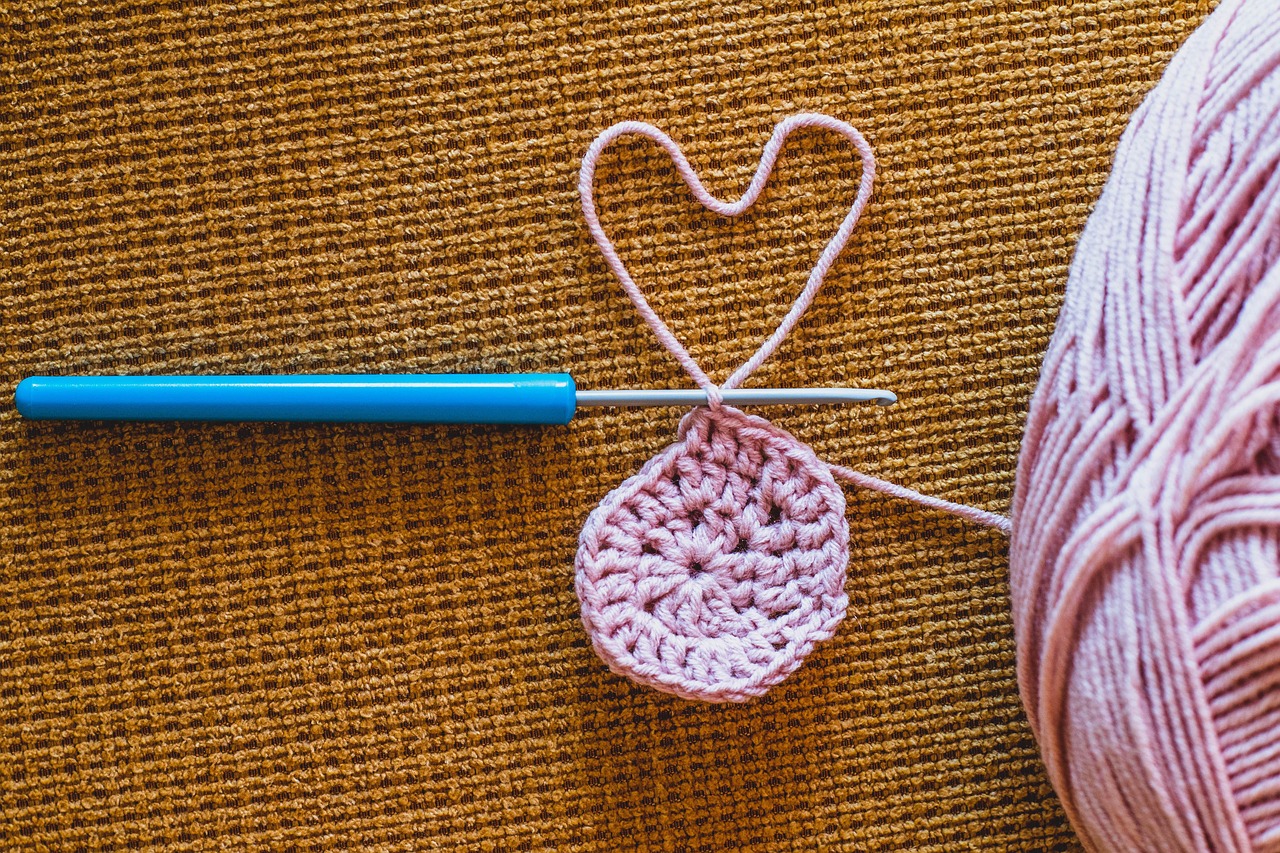
    Pink crochet heart with hook and yarn - love for handmade crochet vest patterns
    See this? A heart made of yarn. A hook. A beginning.
    There is a profound generosity in the crochet community. Millions of hours of pattern-designing, released into the world as free PDFs. Why? Because crocheters understand something that Silicon Valley never will: the best things in life gain value when shared, not when sold.
    When you download a free crochet vest pattern, you are entering an ancient contract. The designer encoded their knowledge — their hours of trial, error, frogging, and revelation — into a document that asks for nothing but your curiosity. You take that code, execute it with your own hands, and produce something that keeps you warm. This is open-source philosophy, but for your wardrobe.
    The vest, then, is not the end product. The vest is the medium. The real product is the transformation: the person who started with tangled yarn and ended with wearable art. The pattern is just the map. The journey is the destination. The hook is the key.

    Epilogue: Wear Your Time

    So here is my challenge to you, dear reader. Not “go crochet a vest.” That’s too small.
    Instead: go steal back your time. Reclaim the hours that algorithms are eating. Pick up a hook. Make something imperfect. Make something that took too long. Make something that no factory could replicate because no factory has your specific fingerprints, your specific tension, your specific stubbornness.
    The crochet vest is not a trend. It is not a hobby. It is a philosophy of slowness in a world obsessed with speed. It is wearable proof that you are patient, capable, and weirdly good at math you never knew you understood.
    And when someone asks, “Where did you get that vest?” — which they will — you get to smile and say the four most satisfying words in the English language:
    “I made it myself.”
    Ready to start? Grab a free pattern, a skein of yarn, and the radical belief that you have enough time to create something extraordinary. Your future self — wrapped in geometric, hand-stitched coziness — will thank you.
    Happy crocheting.
  • The Outfit That Grew on a Hook: Why Crochet Sets Are Taking Over Summer

    The Outfit That Grew on a Hook: Why Crochet Sets Are Taking Over Summer


    White crochet crop top and skirt set with pastel lavender and pink accents, handmade summer

    Clothing used to come from plants and animals. Then it came from factories. Now, somehow, it comes from patience.

    Here is the first lie we tell about fashion: that it must be fast.
    We accept the conveyor belt. The seasonal drop. The shirt that travels 12,000 miles to reach our closet and falls apart after four washes. We call this “modern.” But somewhere between the warehouse and the wardrobe, we lost a crucial ingredient: time.
    Enter the crochet set. Not knitted — knitted is industrial. Crocheted. One hook. One thread. One loop pulled through another by a human hand moving at the speed of thought, not machinery. The result is an outfit that didn’t roll off a belt. It grew. Like a vine. Like a decision. Like something that took Tuesday afternoon and turned it into sleeves.
    And that is precisely why it is winning.

    The Holes Are the Point

    Boho crochet beach outfit on model at sunset, white handmade festival wear
    We spend our lives trying to eliminate gaps. We patch jeans. We buy opaque leggings. We layer tank tops under sheer blouses because somewhere, someone decided that skin must be either fully revealed or fully concealed — no in-between.
    Crochet laughs at this binary.
    The holes in a crochet top are not a manufacturing error. They are architecture. Each negative space is a window the breeze requested. The pattern doesn’t hide the body; it negotiates with it. From three feet away, you see a silhouette. From one foot away, you see the geometry of the stitch. From six inches away, you see skin framed by cotton like a photograph in a handmade frame.
    The mega-logic? A crochet outfit breathes better than linen, moves better than silk, and weighs less than a secret. It is the only clothing that gets cooler when the sun hits it — not because of some lab-engineered fabric, but because the air simply walks through it.
    Wear it to a festival. Wear it to the market. Wear it on the day you decide that your body deserves to be housed in something that took time to exist.

    The Flower That Moved to Your Chest

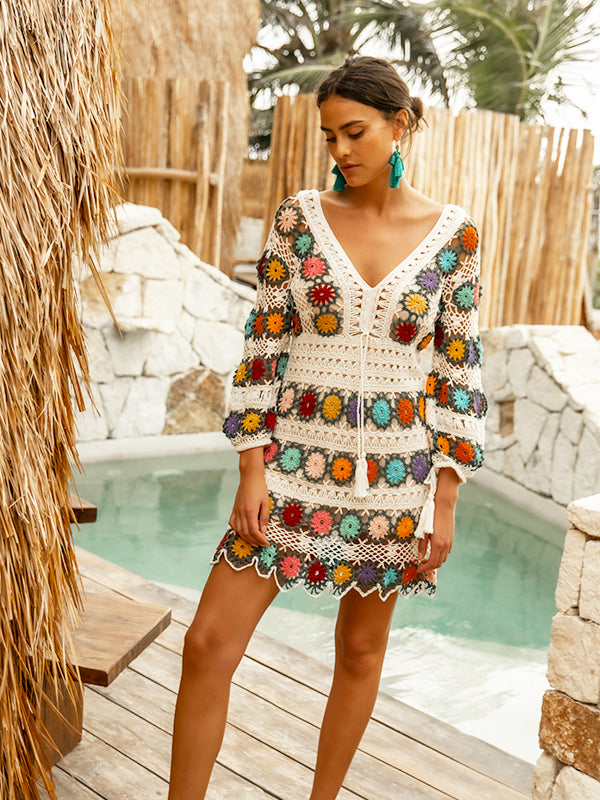
    Colorful crochet dress with floral granny squares, boho resort wear by pool
    There was a time when flowers on clothing meant one of two things: grandmother’s couch, or a Hawaiian shirt worn ironically at a barbecue. The crochet set changed the terms.
    A flower appliquéd onto a crop top is not decoration. It is relocation. The maker looked at a garden, decided the bloom was in the wrong place, and moved it to the exact center of the chest. Now it doesn’t need soil. It needs a heartbeat.
    The psychology is almost aggressive in its gentleness. A machine-printed floral dress says: I bought a pattern. A crocheted flower says: I built a bloom, petal by petal, and then I attached it to myself. It is wearable botany. It is the declaration that nature is not something you visit on weekends — it is something you wear on Tuesday.
    And when the flower sits in a gradient of lavender, violet, and blush — colors that don’t exist in any single real blossom — it becomes something better than nature. It becomes intention. A flower that knows exactly where it belongs.

    The Skirt That Refuses to Be a Circle

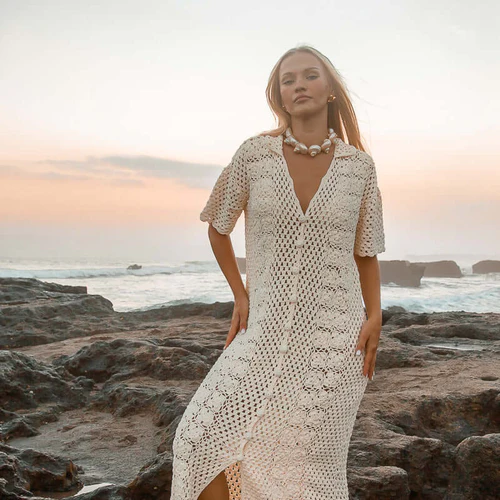
    White crochet maxi dress on rocky beach at golden hour, bohemian summer style
    Most skirts obey geometry. A-line. Pencil. Circle. They start at the waist and follow a predictable path to the hem, like a good student drawing within the lines.
    A crochet skirt with ruffles? It dropped out of geometry school.
    The ruffles don’t cascade evenly. They flare, they hesitate, they change their mind. The hemline argues with itself. One side wants to be shorter. The other side wants more volume. The result is a skirt that moves like a conversation — unpredictable, alive, slightly chaotic in the best way.
    This is the secret power of handmade clothing: it doesn’t fit a pattern. It fits a person. The ruffles land where the body needs them. The waistband stretches exactly where hips exist. The skirt doesn’t hang on you; it agrees with you.
    And when you walk, the ruffles do something no factory hem can replicate: they catch air, hold it for a split second, and release it like a sigh. You don’t walk in a crochet skirt. You sway. You become weather.

    The Color Gradient Nobody Asked For

    Here is the final surprise, the logic that ties the holes, the flower, and the ruffles together:
    The colors of this set — lavender melting into violet, violet blushing into pink, pink cooling into sky — are not found in nature’s wardrobe department. Nature separates its colors. Lavender grows in fields. Pink grows in cherry trees. Blue grows in the sky above them both.
    But crochet negotiates between kingdoms. It says: why should lavender and pink be neighbors only in a sunset? Why can’t they be neighbors on a waistband?
    The gradient is not a dye job. It is a diplomatic mission. Each row of color argues with the next until they reach a compromise. The result is an outfit that looks like it was dipped in a twilight and pulled out before the dark could win.
    Wear it at golden hour and you will disappear into the light. Wear it at noon and you become the only soft thing in a hard world. Wear it at midnight and you glow like a lantern made of yarn.

    The Invisible Thread

    A crochet set is not clothing. It is a timeline. Someone — maybe you, maybe a stranger on the other side of the world — sat with a hook and a ball of cotton and made a thousand tiny decisions. Tighter here. Looser there. A flower here. A ruffle there. Each stitch is a moment that cannot be rushed, duplicated, or automated.
    In a world obsessed with speed, the crochet set is the ultimate rebellion: an outfit that says I took time. I took care. I took this Tuesday and turned it into something that makes summer apologize for ending.
    Pick up a hook. Choose a color that doesn’t exist in fast fashion. And remember: the best outfit you will ever wear is the one that grew, stitch by stitch, from patience.